A Time to Keep Silence

Silence of DaybreakPassage for Reflection:  Ecclesiastes 3: 1-7

For everything there is a season, and a time for every matter under heaven: 2a time to be born, and a time to die; a time to plant, and a time to pluck up what is planted; 3a time to kill, and a time to heal; a time to break down, and a time to build up; 4a time to weep, and a time to laugh; a time to mourn, and a time to dance; 5a time to throw away stones, and a time to gather stones together; a time to embrace, and a time to refrain from embracing; 6a time to seek, and a time to lose; a time to keep, and a time to throw away; 7a time to tear, and a time to sew; a time to keep silence, and a time to speak;

A time to keep silence…So, this is it.  This is the time to which we are called during this Season of Advent.  Maybe the silence is what makes waiting so hard. And so we try to fill the silence with something we know, speaking words into the darkness until we are more comfortable with this time of waiting.  Have you ever thought that Silence itself is a powerful Presence?  Meister Eckhart said that “nothing is so like God as silence.” But silence, for us, is often uncomfortably deafening, and we respond with sometimes meaningless words and thoughts, desperately
attempting to fill a space that does not need filled at all.   In her book, When God is Silent, Barbara Brown Taylor makes the point that “sometimes we may do all the talking because we are afraid God won’t.”  Perhaps we are just trying to cover up the uncomfortable feeling that God is not with us.

Maybe Advent is trying to teach us to hear the silence, to breathe in God’s Presence, and to hear something that is totally foreign to our worldly ears yet vaguely familiar to our God-centered heart. Taylor speaks of it as the most eloquent word of all.  As she says, “In the moments before a word is spoken, anything is possible.  The empty air is formless void waiting to be addressed…anything is possible until God exhales…[making] something out of nothing by saying that it is so.  She goes on to say that “in silence, we travel back in time to the day before the first day of creation, when all being was still part of God’s body.  It had not yet been said, and silence was the womb in which it slept.”

This notion of silence as the womb in which something that is about to be sleeps might help us with this waiting game.  After all, one cannot rush a womb.  There has to be time.  Advent is that time, that time right before daybreak, before the world starts speaking, that moment when everything is as it should be.  And to live this mystery of Advent, we wait, just wait, until God says the world (and us) into being once again.  Shhhh!  The baby is coming.

Reflection:  Sit in silence and let it speak to you.

Grace and Peace,

Shelli

Advent 2A: Shoots and Stumps

Garden of Gethsemane 07 (New Shoots)Advent 2A Old Testament Passage: Isaiah 11: 1-10

A shoot shall come out from the stump of Jesse, and a branch shall grow out of his roots. 2The spirit of the Lord shall rest on him, the spirit of wisdom and understanding, the spirit of counsel and might, the spirit of knowledge and the fear of the Lord. 3His delight shall be in the fear of the Lord. He shall not judge by what his eyes see, or decide by what his ears hear; 4but with righteousness he shall judge the poor, and decide with equity for the meek of the earth; he shall strike the earth with the rod of his mouth, and with the breath of his lips he shall kill the wicked. 5Righteousness shall be the belt around his waist, and faithfulness the belt around his loins. 6The wolf shall live with the lamb, the leopard shall lie down with the kid, the calf and the lion and the fatling together, and a little child shall lead them. 7The cow and the bear shall graze, their young shall lie down together; and the lion shall eat straw like the ox. 8The nursing child shall play over the hole of the asp, and the weaned child shall put its hand on the adder’s den. 9They will not hurt or destroy on all my holy mountain; for the earth will be full of the knowledge of the Lord as the waters cover the sea.  10On that day the root of Jesse shall stand as a signal to the peoples; the nations shall inquire of him, and his dwelling shall be glorious.

We Christians tend to read this with our own Christ-centered lens.  The shoot–newness, replacing the old sad stump–and the branch–us, growing from the foundations that have been laid.  And yet, this Scripture is purely Old Testament, purely Hebrew Scripture.  It speaks of a vision, a vision when life will be what God calls it to be, when the earth and all that it holds will finally once and for all live together just as the Lord intended.  Jesse was the father of David, the pinnacle of the great dynasty of Israel.  But dynasties and kingdoms have life spans just as people do.  And what was once a thriving political powerhouse becomes a stump, seemingly useless for the world, a shadow of the past.  And yet, from what we thought was dead suddenly springs forth life, providing a foundation for a new shoot.  It creates a new order, a new way of seeing the world, a time of peace and unity for all the world.  The people of Israel expected this from their king.  This was what God intended–an order of justice and righteousness and peace.  They long for a dynasty such as this, one with all the solid foundations of the past but one that grows in righteousness.

So, back to the Christ-centered lens…new order, justice, righteousness, peace…isn’t that the thing for which we hope?  In this season of Advent, we once again remember and live that hope of the people of Israel for the Messiah, the Savior of the World.  And we prepare for this year’s coming that will once again push us just a little bit closer to who we are meant to me.  And at the same time we wait for our own Advent, our own coming of God in its fullness.  Advent is all these things.  We long for that new creation.  We long for the day when  warriors will sit down with those that they now attack, when predators will live in peace with their victims, and when those that consume more than they need just because they can finally come to the realization that the resources of this world belong to all.  We hope against hope for a world without poverty and homelessness, without the threat of annihilation from weapons of all kinds, a world where each and every child has enough nutrition and education and healthcare to grow and flourish into who God calls him or her to be.

So, are we the shoot or the stump?  Are we the newness bursting forth or are we the foundation from whence it comes?  The answer is yes.  The two are so inter-connected that they cannot be separated.  The shoot does not just drop out of the sky but is born into generations upon generations of waiting and hoping for the Light to come.

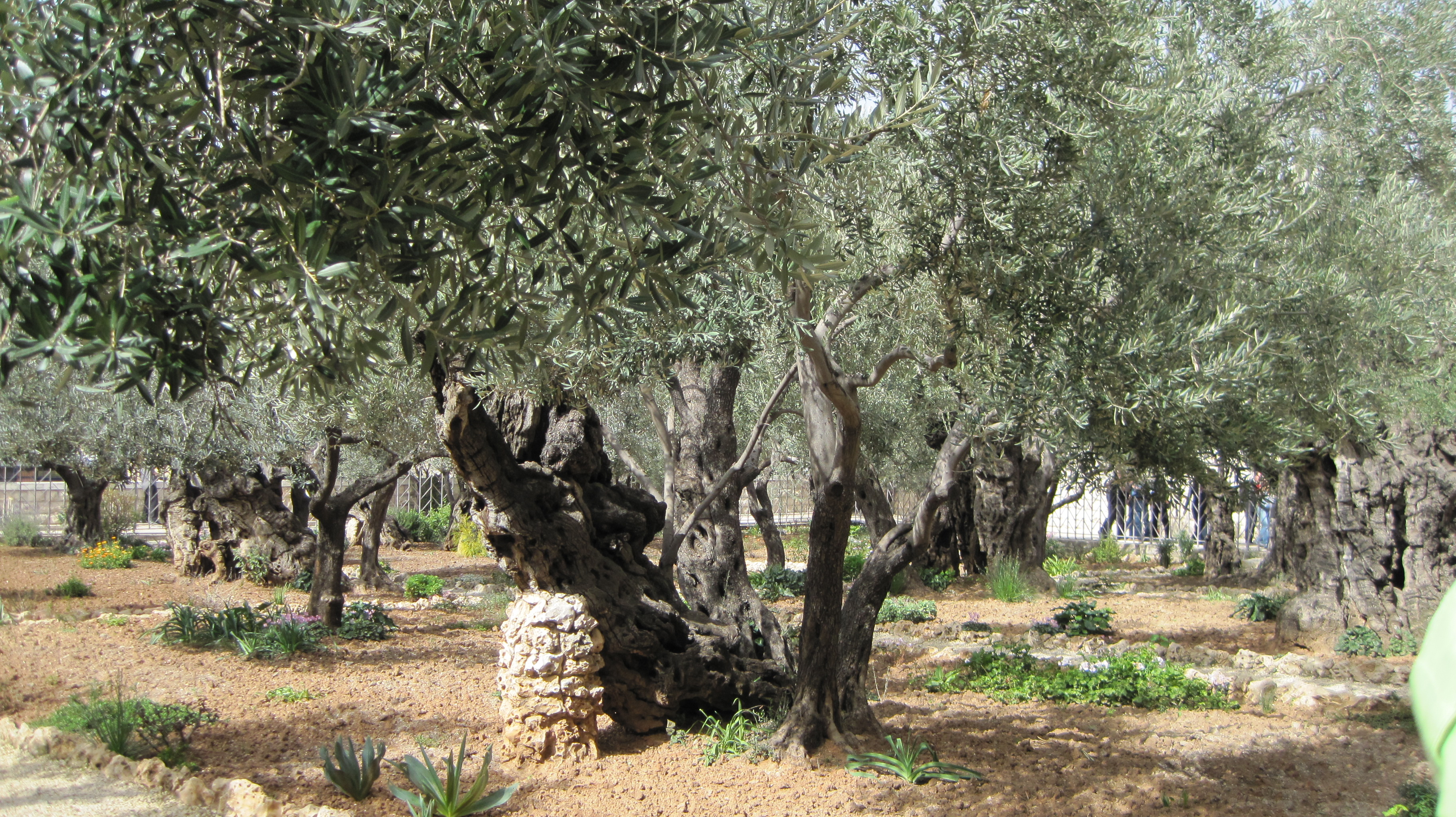
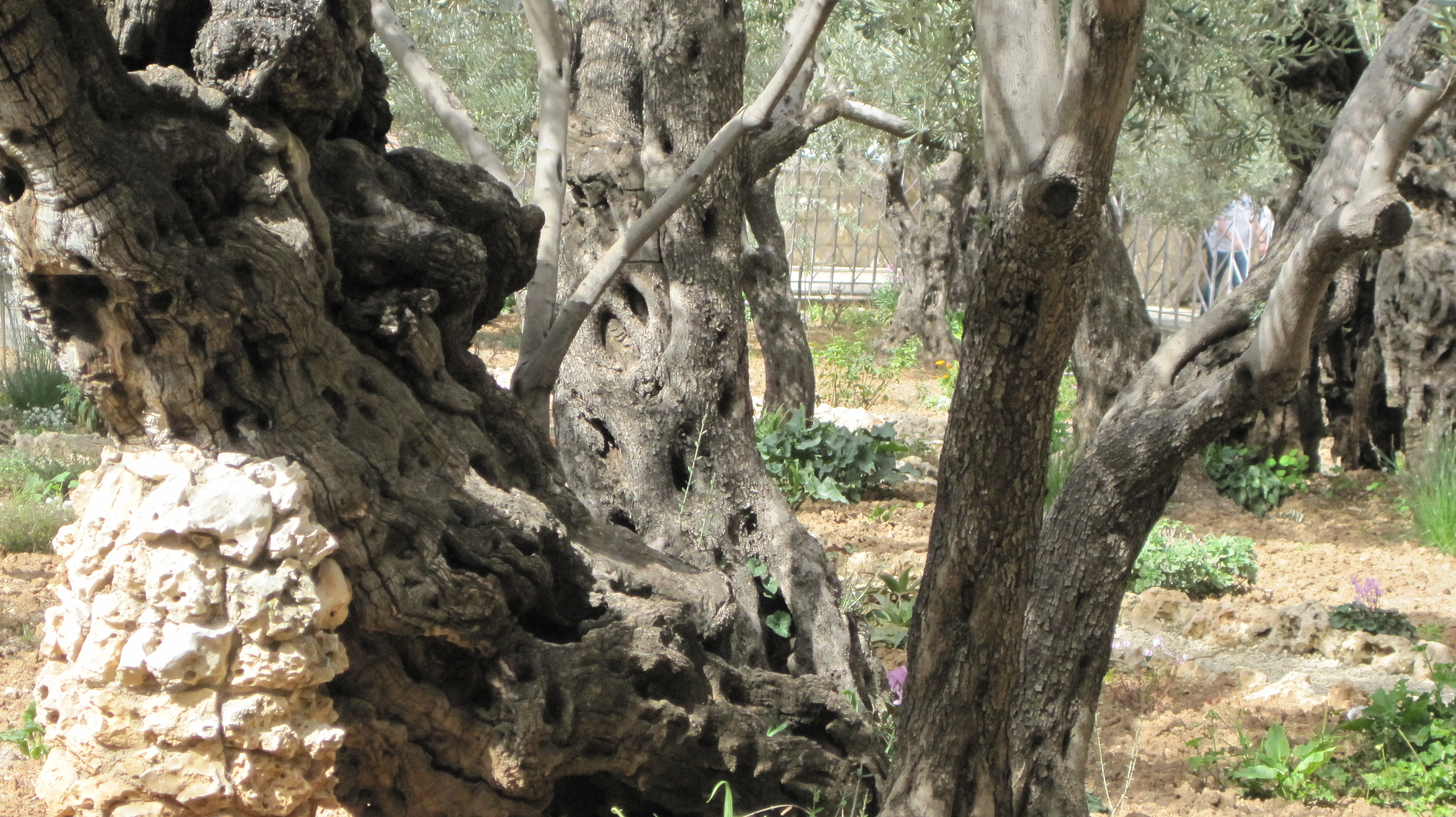
Garden of Gethsemane 08 (New Shoots)When I was in Israel a few years ago, I was fascinated with the olive trees.  You see, they live hundreds or perhaps even a thousand years.  And then they die, they leave what seems to be a mere stump.  But the root system gives way to something new.  So one of the oldest trees has a stump that is thousands of years old, almost petrified from the eons of weathering.  But shooting from its foundation is another tree that is hundreds of years old.  And shooting from it is another younger tree.  And shooting from it is yet another brand new shoot.  The tree is both a stump and a shoot, embracing the foundations of the past but leaving room for newness and recreation, leaving room for God’s work.  And they exist together there in the garden, the Garden of Gethsemane.

God did not create a disposable world, regardless of what we do with it.  God created an earth that would sustain itself not as individual lives making their way on others but as solid foundations giving way to new life.  Both shoots and stumps are part of God’s vision for what will be.  God is not replacing but recreating, redeeming, and resurrecting over and over again.

The fullness of joy is to behold God in everything. (Julian of Norwich)

Reflection:  Where are the stumps in your life?  Now look closer.  What shoots do you see emerging from them?  Are there parts of your life that you have discarded before God was finished working on them?

Grace and Peace,

Shelli

To see my full notes for this week’s Lectionary passages, go to http://journeytopenuel.com/.  If you’d like to get them each week, just follow the blog!

Turning the Page

Cross and LightLECTIONARY GOSPEL PASSAGE: Luke 23: 33-43 (Click to read)

All of the Scriptures for this week lead us to this Sunday, known as “Christ the King” Sunday.  It is the final Sunday of our Lectionary year, the end of the season of Pentecost, when as the community of faith, we move through the season of building the church and its journey toward sanctification in the fullness of God’s Kingdom.  The Sunday after next begins the season of Advent, when we will begin the whole cycle again.

But if you think that this is merely an annual repeating motion of the same thing over and over, think again.  Our liturgical calendar invites us into an ongoing cycle of preparing, birthing, seeing, emptying, rebirth, and becoming, as we journey toward the fullness of the Kingdom of God, lived, as Rainer Maria Rilke said, in “ever widening circles”, reaching farther and farther beyond ourselves, encompassing all of Creation. Over the past few months, we have recounted the rich stories of the Old Testament through the eyes of many  of the Prophets as they sought to illuminate what it was those early people of God were meant to become.  And we once again read many of Jesus’ parables, this time from the Gospel According to Luke, those incredible stories of wisdom found in everyday life.  The reason that we read these stories over and over again from Creation through the cycle of life is because, as we’ve said before, they are our story, they are the recounting of our own becoming who we are, they are our journey toward being the people of God.  Perhaps it gives us more and more of a sense that we are not, as we might think, the center of the universe; rather, we are part of the story.  Henry Van Dyke said that “if the meaning could be put into a sentence, there would be no need of telling the story,” so each liturgical cycle we tell our story. 

This week is not the end.  It is the beginning, a new beginning.  The Gospel passage that the Lectionary assigns us this week probably feels a little odd.  I mean, really, look around.  The Christmas season is bombarding us from all sides (even though my Thanksgiving turkey has yet to be purchased!…yeah, I know…get on that, Shelli!) and we are reading a Good Friday passage.  This is just messed up. But we read of a thief or a criminal (depending on your translation) hanging there with Jesus that asked for mercy from this one who in this moment he truly knew was the Christ.  Jesus’ response did not include asking him what he had done with his life.  He did not demand either a confession or a profession.  There was no “if” attached to his answer—no condition of “if you clean up your life” or “if you promise to stop doing what you do or being who you are” or “if you become someone different so that you will fit in with what we think we are all supposed to look like”.  None of that mattered.  Because in this moment, the man that history has never named anything but “Thief” entered the story that we call the Gospel and was promised eternal life.  THIS was Jesus’ crowning glory.  THIS was the true coronation of Christ as King!

You see, it’s not about what we do or who we are.  It’s about becoming the story, becoming the Gospel, the Good News of Jesus Christ.  It’s not about placing a crown on the head of our King but about becoming part of the Coronation, part of that image of Christ the King.  It’s not about proclaiming Christ as King but about being the presence of Christ in this world.  O Come, O Come, Emmanuel, God with Us.  And now we know that’s exactly where God is.  It’s about entering the story.

Mortals, join the mighty chorus which the morning stars began;

Love divine is reigning o’er us, binding all within its span.

Ever singing, march we onward, victors in the midst of strife;

Joyful music leads us sunward, in the triumph song of life.

(Henry Van Dyke, “Joyful, Joyful, We Adore Thee”, alt. st. 4, 1989)

Look, the light is just over the horizon.  The world is with child.  For this we were created.  All we have to do is turn the page and follow the story.

What does it mean to you to proclaim Christ the King?

What does it mean to you to become part of the story?

Grace and Peace,

Shelli

And now for some program notes…yes, I know it’s been too long since I’ve posted on “Dancing to God”, but I’ve promised that I would come back for Advent (and it’s been publicized in the church paper, so I have to stick with it!), so here’s a way for us to “turn the page” (aaarrrggghh….aaarrrggghhh…aaarrrggghhh).  I’ll post some entries next week that will cover the Lectionary passages for the first Sunday in Advent and then beginning December 1, the first Sunday of Advent, we’ll do something every day.  Thanks for joining me!  Also, if you’re interested, my weekly Lectionary notes are posted on another blog that can be found at http://journeytopenuel.com/.  I usually post those on Sunday evening or Monday morning for the following week.  There is some overlap with this blog because I only have one brain, but I’d love for you to follow that one too!  Shelli

Repurposed

Coal BucketThis Week’s Lectionary Passage:  Isaiah 43: 16-21
16Thus says the Lord, who makes a way in the sea, a path in the mighty waters,17who brings out chariot and horse, army and warrior; they lie down, they cannot rise, they are extinguished, quenched like a wick:18Do not remember the former things, or consider the things of old.19I am about to do a new thing; now it springs forth, do you not perceive it? I will make a way in the wilderness and rivers in the desert.20The wild animals will honor me, the jackals and the ostriches; for I give water in the wilderness, rivers in the desert, to give drink to my chosen people,21the people whom I formed for myself so that they might declare my praise.

I am about to do a new thing…Wake up! Pay attention!  This is going to be incredible!  Remember the context of this passage.  It is probably toward the end of the exile, the end of a time of great loss and despair.  They have lost everything–homes, land, their way of making a living, even their very sense of who they were.  And now this…a new thing.  Let it go…leave it behind…let us go forward toward something new.  Let us begin again.

God is a God of beginning again.  It happens over and over throughout our story.  God takes us from a garden that we threw away and places us in a world.  God takes us from a world that we let get away and placed us on an ark to sail to a new way of being.  God takes us from exile and sends us to freedom.  God takes us from death and heads us toward life.  God is a God of beginning again.  The thing is God is always and forever about to do a new thing.  It is the story of our faith.  Our problem is that we don’t pay attention.  We don’t trust enough to let go.  Our faith tells us that the new creation will be better, will be something that we can’t even fathom right now.  But we stay, attached to our old way of being, to being comfortable and predictable and seemingly in control.

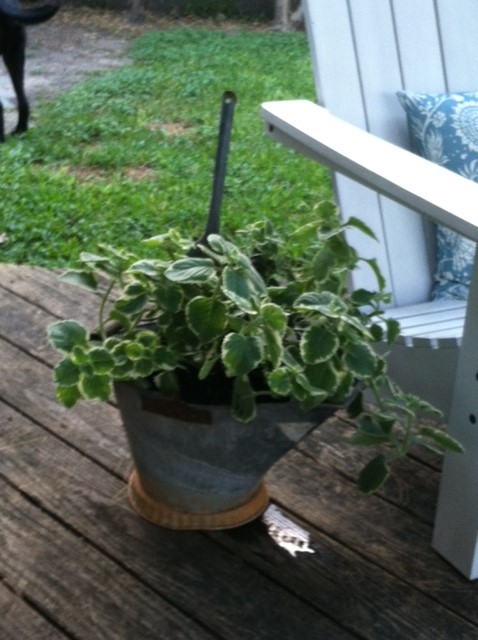
I love old things.  My house and my yard are filled with them.  In fact, I suppose that my house IS one of them.  But living and decorating with old things requires a few tricks.  You want them to look old.  (In fact, I have new things that I want to look old.)  You want them to look old but have a new purpose.  The trick is not to have old things but rather to repurpose them, to bring them in to a new way of being, to perhaps use them in a new way.  So I have an old rusty coal bucket with Cuban Oregano planted in it.  I have an old rusty metal lawn chair that sits out by the bird feeders.  I have old wire baskets that have become shelves.  And I have an old wooden ice chest that is a coffee table.  And my 1920 bungalow has central air, a modern kitchen, and a new bathroom.  Perhaps doing a new thing is not starting over but beginning again with what you have.  Perhaps doing a new thing is repurposing rather than replacing.   Maybe that’s hard for us to embrace.  We live in a disposable society in a temporary world.  The thing that we have is always in need of being replaced by the thing that we want.  So what would it mean to live a life of repurposing?

God created us and calls us into being.  But there is not some new me out there that God is waiting to slip into place.  God is a God of repurposing, of making new what is already here, of giving it new meaning and a new purpose, of giving it new life.  You just have to believe that God is about to do something new with who you are.  That is what faith is all about–believing in repurposing.

Grace and Peace,

Shelli

Falling in Love With God

Lectionary Passage: Song of Solomon 2: 8-13

To read this passage online, go to http://bible.oremus.org/?passage=Song+of+Songs+2:8-13&vnum=yes&version=nrsv

Do you love God?  Sure you do!  That’s the whole point, right?  But here’s perhaps a harder (or at least a weirder) question:  Are you in IN love with God?  After all, being “in love” seems to be something so profoundly human, so earthy, so “fleshy”, so intimate, so private.  It’s more than just loving.  It’s more than just being together.  It’s almost a completion of who you are called to be, an entirely different way of being.  It really is more about being one than being two that love.  We proper Western Protestants understand loving God (and, certainly, pleasing God).  But do we let ourselves fall, with utter abandon, into love with God?    The Old Testament passage from this week’s Lectionary selections is from the wisdom writing known in Hebrew as the Song of Songs.  It’s not the usual fare for our lectionary.  I mean, it borders on what is sometimes characterized as almost erotic imagery and it doesn’t even mention God.  So, as you can imagine, there were lots of debates about whether or not it belonged in the canon at all.  The matter was settled by Rabbi Akiba, the great teacher and mystic, who said this: “The whole world is not worth the day on which the Song of Songs was given to Israel, for all the Scriptures are holy, but the Song of Songs is the Holy of Holies.   The Holy of Holies?  Wow!  We’ll have to think about that one.  I mean, really?  We struggle with that, as if our relationship with God should be proper and acceptable, as if it should be reverent of the One in whom we live and breathe and have our being.  So what is reverence?  Is it standing away, removed from the One whom we revere?  Or it is realizing that every molecule of our being desires to connect with God, longs to return to the One who created us.  Or maybe, just maybe, it’s falling in love with God.   Implicit in this poem is a sort of pining absence, a longing so deep that the poet cannot be complete without the One that is loved. I think that’s the way we’re called to be. I mean, think about it, we were created in the image of God, made with a shape and a sense into which only God fits. And we struggle. We struggle to find what fits into that shape. And in the absence, in the longing, we finally find that Presence of God, we finally find that One in whom we are destined to fall in love. Seventeenth century mathematician, Blaise Pascal spoke of it as a “God-shaped vacuum” in every human, a hole that only God could fill. It’s like being in love.

Like I said, this poem is not your usual reading from the Bible. There are no parables, no words of judgment, no promises of future and unrequited redemption. Rather, there is presence; there is reverence; there is a depiction of the most joyous and incredible love imaginable. It is flirtatious, and playful, and filled with utter joy. It is the very love of God. And the poet depicts it as transforming, a veritable spring at the end of winter, when life bursts forth from lifelessness and literally consumes death.  (Sounds like resurrection to me!)

Perhaps it is the language that makes us bristle, that makes us squirm a bit in our pews.  Perhaps we are even a bit uncomfortable with a God who is so intimate, so a part of us, that falling in love is all we can do.  Perhaps we really haven’t thought through what it means to be created in the image of someone else.  It means that we have to let ourselves go, that we have to become who God called us to be, that we have to realize that there is something more, that WE are something more, that we are created in the image of our Beloved, that we are created to fall in love with God.  It is about completion; it is about wholeness; it is about being who we were created to be.  It is about falling in love with God and falling into God.

Our lectionary probably doesn’t do us any favors because it doesn’t even allow us to finish the poem.  The next four verses go like this:

O my dove, in the clefts of the rock, in the covert of the cliff, let me see your face, let me hear your voice; for your voice is sweet, and your face is lovely. Catch us the foxes, the little foxes, that ruin the vineyards— for our vineyards are in blossom.”   My beloved is mine and I am his; he pastures his flock among the lilies.  Until the day breathes and the shadows flee, turn, my beloved, be like a gazelle or a young stag on the cleft mountains.

My beloved is mine and I am my beloved’s.  That’s a whole lot different than an image of a seemingly-removed deity sitting up somewhere waiting for us to get our act together and catch up.  And it flies in the face of us spending our earthly lives wallowing in chaos and muck, hoping against hope that we will finally rack up enough points to make it to heaven someday.  Once again, it’s present tense.  We are God’s and God, in a show of grace more amazing than we could ever sing, becomes ours.  We are not just called to love and support and please God and try to figure out who or what God is; we are called to let ourselves go, to fall into love with God and fall into God with utter abandon and profound joy.

Until the day breathes and the shadows flee, turn, my beloved…My beloved is mine and I am [my beloved’s].  Thanks be to God!
There is only one love.  (Teresa of Avila)
Grace and Peace,
Shelli


Mirror, Mirror

Lectionary Passage: 2 Samuel 11: 26-12: 13a
To read this passage online, go to http://bible.oremus.org/?passage=2+Samuel+11:26+-+12:15&vnum=yes&version=nrsv

Do you remember the story of Snow White?  The fantasy begins with a magic mirror.  And every morning, the hopelessly vain evil queen rises, dresses, coifs her hair, applies her make-up, and then admires herself in the mirror.  But as we know, it’s not an ordinary mirror.  This mirror can carry on a conversation.  Better than that, this mirror tells her exactly what she wants to hear.  Every morning the evil queen looks into the mirror and says, “Mirror, mirror, on the wall, who’s the fairest of them all?”  And the dutiful mirror, perfectly rehearsed, answers, “You, my queen, you are the fairest of them all.”
But even brainwashed mirrors can go rogue now and then and one morning when the queen looked into the mirror with the familiar question, “Mirror , mirror, on the wall, who’s the fairest of them all?”, the mirror replied, “Snow White, my queen, Snow White is the fairest of them all.”  You know, the truth hurts, doesn’t it?  Sometimes we would rather just live our lives with a magic mirror affirming that everything we do is the right thing, one that would somehow allow us to hide in a fairy tale.  But life is not a fairy tale.
Our Old Testament passage is the continuing story from last week.  Remember that David, home alone while his armies were out fighting battles, had spied the fair Bathsheeba and, in what can only be described as a colossal failure of leadership and an implausible abuse of  power and authority, had sent for her, slept with her, impregnated her, and then in an attempt to cover up the deed, lied, schemed, and finally murdered her husband Uriah the Hittite.  So, Uriah is now dead and Bathsheeba mourns.  With Uriah dead, David then is free to take Bathsheeba as his wife, bringing legitimacy to their son.   Well, as you know, there are a variety of ways that this story is told.  Some will shift the blame to Bathsheeba, depicting her as some sort of harlot or something that wooed David into the affair.  But that, of course, ignores the fact that it was David that had all the power here.  Others will somehow characterize it as God’s work, as if God would call David to cheat, lie, scheme, and murder to further the building of the Kingdom of God.  Sorry, I don’t really think that’s quite what God had in mind.
So today we have the story of Nathan.  I love Nathan.  He confronts the problem head-on.  And he does it in quite a remarkable way.  He tells a parable.  (Where have we heard that style of teaching before?)  He tells the story of a rich man who possessed many flocks and herds—so many, in fact, that he didn’t even really know them all–and a poor man who possessed one lowly little lamb who the poor man actually had grown to love.   Yet when a traveler appeared, the rich man, replete with livestock, actually took the one lamb from the poor man to feed his guest.  Well, David was incensed.  After all, what a horrible man!  Someone should do something!  That is not justice!  That man should be punished!  That man doesn’t deserve to live!
You know, John Westerhoff once said that “if a parable doesn’t make you a bit uncomfortable, [doesn’t make you squirm a little in your seat], you probably have not gotten it.”  So, obviously, David didn’t get it.  Obviously, it was much easier to hand out judgment for someone else’s acts than to recognize his own failures and shortcomings.  So Nathan, courageously speaking the truth in love, essentially, holds up the mirror.  “David,” he said, “You are the man!”
He then explains in detail what David has done, all the time holding a mirror, forcing David to look at himself, to look at his own actions, to realize that his actions have consequences, that they cannot be hidden from God.  And, maybe even more painful, they cannot be hidden from himself.  David has to face what he has done, look at the consequences, look at the pain and the suffering that he has caused.  And David finally admits his wrong.  He confesses.  It’s a hard thing.  It’s a hard thing to admit when you’ve done something wrong.  It’s a hard thing to be forced to take a good hard look in that mirror and see the reflection not of that image of God in which you were created but rather someone that you’d rather not be around.
Yeah, sin is a hard thing to talk about.  It’s a hard thing to look at, particularly, when that mirror is showing us someone that we don’t really want to be.  Where did we go wrong?  And what will everyone else think?   And, after all, we’re good Methodists.  We don’t need to talk about sin.  We have grace.  Really?  I think Rev. Barbara Brown Taylor has possibly written the most incredible book on sin that I have ever read.  I highly recommend it.  In her book entitled “Speaking of Sin:  The Lost Language of Salvation,” she depicts sin as our only hope.  Well that’s a new spin on it!  After all, aren’t we trying to avoid it?  She says that “sin is our only hope, because the recognition that something is wrong is the first step toward setting it right again.” (pg. 59)  In other words, no longer can we just sweep something under the rug hoping that it will go away, hoping that our good Methodist upbringing will shower us with grace and keep our sins closeted away where they need to be.  It’s a phenomenal way to think about it, to realize that in some way, holding the mirror up for ourselves or, if we can’t do that, hoping that someone in our life will be grace-filled enough to do it for us, can actually bring us closer to God, actually put us on the road to beginning again.
We often talk about sin as that which separates us from God.  Traditional Christianity loves to take it all the way back to Adam and Eve, as if the first couple’s transgression somehow changed the path for us all.  Do you think that’s a way of trying to cover it up?  (OK, I must admit, I’m not really an “Original Sin” type of person!)  Do you think that’s our way of trying to shift the blame from us a bit, a way to somehow transfer over to someone else’s mirror?  Well, I think we may need some sort of holy spurt of Windex or something.  Because tucking it away or covering it up or shifting blame does us no good at all.  It’s still there, still separating us, still standing in the way of the grace-filled relationship that God offers each of us. 
Truth is, the opposite of sin is not innocence.  I don’t even think it’s righteousness.  The opposite of sin is choosing God, choosing to look ourselves in the mirror and finally see that image of God in each of us. We don’t live in a fairy tale.  God did not create a bunch of robotic, perfect creatures and claim them as children.  God created us—sometimes cheating, sometimes lying, sometimes sinful, always wanting to do better, always wanting to find our way, always searching and wondering what it is God desires for us.  I don’t think God wants or expects us to remain innocent.  If God had wanted that, we wouldn’t be here at all.  We would have no reason to be.  Faith would be non-existent.  Innocence has no reason to choose God.  Innocence does not need faith.  Maybe we need a Nathan in our life unless we can somehow learn to look into the mirrors that God provides for us along the way, to truly see ourselves, where we fall short, where we choose darkness over light, where we choose or just acquiesce to those systemic sins that we see (hunger and homelessness over shared resources,  prejudice over acceptance, classism over equality, nationalism over patriotism ) and, most of all, to see that image of God that is always part of us somehow slip through and reveals itself in the most miraculous ways.
We are not innocent; we are forgiven.  But that’s not an eraser on the giant chalkboard of life.  God’s forgiveness comes when we don’t deserve it, when we haven’t earned it.  It comes in the darkness; it comes at our lowest point; it comes when sin is our only hope.  It is grace.  “Mirror, mirror on the wall, who’s the fairest one of all?”  It is that you that is staring back—doubtful and assured, sinful and forgiven, speaking the truth in love with a tiny piece of God in you—only an image, a faint glimmer that holds your whole life in its hands.  That’s all that God needs to create beauty, to create wonder, to create life.  You see, God has done this before—many, many times.  It is the very mirror that shows us the image of God, that shows us who we are really called to be.
Grace and Peace,
 
Shelli


Protecting Our Identity

Who are you?  No, I mean really.  Who are you?  Most of us live lives that demand that we take on numerous roles.  For me, I am a pastor, a preacher, a friend, a confidante, a counselor, a teacher, a daughter, a sister, a cousin, a homeowner, a sometimes-writer, a reader, a cook, a lover of antiques, a lover of history, and, right now, a human companion and purveyor of food and treats to one dog that I adopted on purpose and another one that twelve days ago accidentally adopted me (does anyone want a really cute dog?).  And those roles are just the tip of the iceberg.  It gives new meaning to “meeting yourself coming and going”.

The articles and advertisements for protecting one’s identity seem endless nowadays.  It’s the new danger in our world, the chance that someone might steal who we are, that we might somehow lose ourselves.  And so we shred and we cut and we lock and we watch.  We do everything to keep who we are intact. And yet, we find ourselves searching for who we are.  Isn’t that interesting?

God created each one of us.  We are unique, full of gifts and graces, most of which we haven’t even tapped into yet.  Each of us is a child of God, with the ability to become fully human and the desire to connect with the Divine.  I think that God actually envisions something for each of us, that God somehow created us with an idea of what the best of each of us is.  But we’re not children of the Stepford clan.  We are not pre-programmed robots that God wound up at the start and then pushed us down the road with enough battery juice to get us to the end of the road.  No, God’s vision of Creation was much more nuanced and much more beautiful than that.  Somewhere along the way, God decided to instill the notion of free will in us, the wherewithal (if, sometimes, not the ability!) to choose–to choose right from wrong, to choose one road or another, to choose to be one role or to be something completely different.  God gave us life and  envisioned what that life could be, envisioned our identity.  But how we get there is completely up to us.

Maybe this life of faith is about protecting our identity, then–from the world, from all those voices that beg for our time or our money or our attention, and, most of all, from ourselves.  Maybe learning to walk this life of faith is about figuring out how to protect our identity, walking that journey of becoming, losing, recapturing, and becoming again that Being that God envisioned us to be from the very beginning. It’s hard.  So, in this Season of Lent, as we strip away all of those encumbrances that pull us away from ourselves, as we try to find the way back to who we are, maybe it’s not just about becoming someone else, but protecting who we are in the first place.  So who are you?  No, I mean, really.  Who are you?
 
On this eighteenth day of Lenten observance, make a list of all your roles in life.  Which ones drain your existence?  Which ones give you life?  It’s a good thing to think about once in awhile.

Grace and Peace on this Lenten Journey,

Shelli  

And I’m serious…anyone want to adopt a dog?