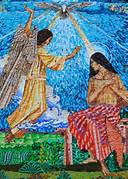
When Things Began to Change


Church of the Annunciation, Nazareth, Israel

Scripture Text:  Luke 1: 30a-38

“Do not be afraid, Mary, for you have found favor with God. And now, you will conceive in your womb and bear a son, and you will name him Jesus. He will be great, and will be called the Son of the Most High, and the Lord God will give to him the throne of his ancestor David. He will reign over the house of Jacob forever, and of his kingdom there will be no end.” Mary said to the angel, “How can this be, since I am a virgin?” The angel said to her, “The Holy Spirit will come upon you, and the power of the Most High will overshadow you; therefore the child to be born will be holy; he will be called Son of God. And now, your relative Elizabeth in her old age has also conceived a son; and this is the sixth month for her who was said to be barren. For nothing will be impossible with God.” Then Mary said, “Here am I, the servant of the Lord; let it be with me according to your word.” Then the angel departed from her.

Think back.  Think back to that time when things began to change.  Think back to the announcement.  Think back to the point where our world as we know it was rocked to its foundations as God revealed the very Godself to us, bursting into our world, the world that we thought was the one.  For us, it began the mystery that is Jesus Christ, the mystery that brought us here, the mystery that will take us to Jerusalem.  But in this moment we remember, the fog lifted and there before us was the bridge between the human and the Divine.  This IS the beginning of Jesus Christ.  We often sort of skip over that sometimes, choosing not to get much beyond that night of mangers and stars and visiting field hands.  Think about it.  Jesus was fully human and this human Jesus, like all of us, had to be grown and nurtured in the womb before the miracles started.  March 25th (that would be nine months before Christmas) is celebrated as The Feast of the Annunciation, the veritable turning point of all human history.  It is was in this moment that God stepped through the fog into humanity and, just like every human before and every human since, must wait to be fully birthed into this world.

In the beginning when God created the heavens and the earth, the earth was a formless void and darkness covered the face of the deep, while a wind from God swept over the face of the waters.  Then God said, “Let there be light”; and there was light. (Genesis 1: 1-3)

And in some traditions, March 25th is regarded as the first day of Creation.  (Now, really, I don’t even begin to see THAT as a real date!  But it’s a good thing to remember and that date is as good as any, right?)  So, let’s go with it.  March 25th marks the beginning, when God’s Spirit moved across the face of the waters bringing Light into the Darkness.  So the Annunciation…the announcement of the coming of Christ, the coming of God, into our little world…is that day when once again the darkness begins to fill with Light.  So, begin at the beginning and count forward…to the birth of God into the world. Like Creation, the coming of Christ was the Light pushing the darkness away.  It was when things began to change.  The world was with child.

So on this 29th day of Lent, we realize how close we really are, realize that, once again, things are about to change.  It is scary as the ground beneath us begins to shift and the shadows around us begin to move about.  But think about that moment when things began to change.  Can you imagine what Mary must have thought?  She was young, she had plans, she had her whole life ahead of her.  “How can this be?” we read.  In today’s vernacular, it would read, “Are you kidding me?  I had my whole life planned.  It was safe.  It was known.  It was figured out.”  And, if only for a moment, God and the world waited expectantly in the silence.  And so as everything she knew and everything she planned toppled around her, she said “yes” and entered the mystery of God.  And we, those who would follow, those who come into this sometimes maddening, always-changing world, those who are tempted to play it safe and planned, will also say yes.  And in that moment, once again, God’s Spirit will sweep over the face of the waters and bring Light into the darkness.

Hope holds with it the promise that God always answers our questions by showing up, not necessarily with what we ask for but with remarkable gifts that change our lives and the world.   (Mary Lou Redding)

So as things begin to change, envision Light, envision the Light as it moves into the darkness.  What does it mean to follow?  What does it mean to say “yes” when the world is rocking on its foundations?

Grace and Peace,

Shelli


Unsaid

The Sound of SilenceScripture Passage: Psalm 62: 1a

For God alone my soul waits in silence.

We are not generally a silent people.  Even in the quietness of our homes, there is noise–lots and lots and lots of noise.  (Because there is a somewhat demanding Black Lab barking at me right now!) Silence seems to elude us.  On some level, it takes a lot of time and that is a hard thing to come by. And, to be honest, in my world, I’m not even sure it exists.  There is always something making noise.  So how does my soul wait in silence?  How does my soul find that rhythm that it so desperately needs, the natural rhythm of noise and silence.  Maybe we could employ some of that white noise that is supposed to drown out other noises.  Would that work?  But isn’t that just more noise?  We work hard at honing our communication skills.  And yet, communication is not just about talking; it’s about that rhythm of expression and listening, of noise and silence.  We need silence sometimes.  It is part of the rhythm of life.  Mother Teresa of Calcutta once said that “we need to find God, and [God] cannot be found in noise and restlessness.  God is the friend of silence.  See how nature–trees, flowers, grass–grows in silence; see the stars, the moon, and the sun, how they move in silence…we need silence to be able to touch souls.”

So, why is silence so hard to find?  Are we unsure of ourselves, a little reticent about what we might hear, perhaps a little fearful of what we might be asked to do? So, we try to fill the emptiness with noise.  Now, to be honest, I’m not sure that “pure” silence really exists.  There’s always something making noise.  Perhaps “keeping silence” is more about returning to a natural level of noise than it is stopping all noise itself.  In her book, When God is Silent, Barbara Brown Taylor talks about an experience by composer John Cage’s time in an anechoic chamber (a room without echoes).  With his perfect hearing, he picked up two distinct sounds–one high and one low.  When he described them to the engineer in charge, he was told that the high sound was his nervous sytem in operation, and the low one was his blood in circulation.  Noise is part of life.  Keeping silence is not about existing in pure silence; it is about living in pure life, in Creation.  And yet, most of us live most of our lives in noise–artificial noise, the noise of the world, rather than the noise of Creation.

If you go back and read the story of Creation, it began in silence.  I think it probably began in “pure” silence, in a void (implying that perhaps “pure” silence is not meant to exist at all).  And then God spoke us (along with everything else) into being.  In her book, Taylor says, “in his poetic eulogy “The World of Silence”, the French philosopher Max Picard says that silence is the central place of faith, where we give the Word back to the God from whom we first received it.  Surrendering the Word, we surrender the medium of our creation.  We unsay ourselves, voluntarily returning to the source of our being, where we must trust God to say us once again.”

In this Lenten journey, we talk about journeying, about surrendering. We talk about re-aligning our lives with what God envisions for us, and we talk about change.  But maybe the part we’re missing is where we don’t talk–I mean, INTENTIONALLY, enter into silence.  Shhhhh!  Let God say you into being again. (And now I’m going to quit talking!)

There is nothing so much like God in all the universe as silence. (Meister Eckhart)

At this point in your Lenten journey, just be silent.  Just listen.  Just wait to be unsaid.

Grace and Peace,

Shelli

Becoming Real

The_Velveteen_Rabbit_pg_25Scripture Passage:  Romans 5: 12-19 (Lent 1A)

Therefore, just as sin came into the world through one man, and death came through sin, and so death spread to all because all have sinned— sin was indeed in the world before the law, but sin is not reckoned when there is no law. Yet death exercised dominion from Adam to Moses, even over those whose sins were not like the transgression of Adam, who is a type of the one who was to come. But the free gift is not like the trespass. For if the many died through the one man’s trespass, much more surely have the grace of God and the free gift in the grace of the one man, Jesus Christ, abounded for the many. And the free gift is not like the effect of the one man’s sin. For the judgment following one trespass brought condemnation, but the free gift following many trespasses brings justification. If, because of the one man’s trespass, death exercised dominion through that one, much more surely will those who receive the abundance of grace and the free gift of righteousness exercise dominion in life through the one man, Jesus Christ. Therefore just as one man’s trespass led to condemnation for all, so one man’s act of righteousness leads to justification and life for all. For just as by the one man’s disobedience the many were made sinners, so by the one man’s obedience the many will be made righteous.

God is God and we are not.  We cannot do this by ourselves.  We cannot save ourselves.  Do you have it?  Is it clear?  (Or perhaps our brother Paul should have written yet another run-on sentence!)  And yet, we humans, we “adams”, by our very nature bear at least some of God’s characteristics, some of God’s image.  So we can’t be all bad, right?  Essentially, there is no such thing as being “only human”.  After all Christ was human, “fully human” if I’m remembering correctly.  So humanity is not bad.  I don’t think our humanness makes us bad, despite what others have maintained.  After all, God created us human. 

So, perhaps the problem is not that we’re “human” but that we are not yet completely “fully human”.  You see, we keep lapsing into doing things or allowing things that are, for want of a better word, inhumane–injustice, poverty, homelessness, prejudice, greed, inequality, ____ism, _____ism, _____ism….need I go on?  The notion of “adam” that we glean from the Scriptures is, basically, a human creature, created by God, loved by God, but a creature that is destined for more.  Think of it like some sort of mock up or prototype of what humanity is, a beautiful, naked, picturesque creature surrounded by a beautiful garden.  And, yet, on some level, this creature is not yet real.  It has to become, become real.  It has to become. 

Christ, God With Us, is, as we know “fully human” and “fully divine”.  Christ was the epitome of real, the perfect image of what humanity is–fully human.  Christ did not walk this earth to show us how to become divine.  (I don’t think that’s our mission!  The job of Savior of the World has been filled.)  Christ came to show us how to be fully human, truly human, real.  That is who we are called to be.  We are human, beautifully, wonderfully-made.  But God’s vision of us is so much more.  The journey is for us to traverse from Adam to Christ, from the human creature to fully human, to that very image of the Godself that we were created to be.    

Do you remember the Margery Williams tale of “The Velveteen Rabbit”?  “Real…doesn’t happen all at once…You become.  It takes a long time.  That’s why it doesn’t often happen to people who break easily, or have sharp edges, or who have to be carefully kept.  Generally, by the time you are Real, most of your hair has been loved off, and your eyes drop out and you get loose in the joints and very shabby.  But these things don’t matter at all, because once you are Real you can’t be ugly, except to people who don’t understand.”  You see, as we journey closer to being Real, closer to being fully human, more and more of “us” falls away and is filled by that very image of Christ.  We become fully human.  We become who God intended us to be.

 We are not human being having a spiritual experience.  We are spiritual beings having a human experience.  (Pierre Teilhard de Chardin)

On this Lenten journey, think what it means to be fully human, what it means to be the very image of Christ in the world.

Grace and Peace,

Shelli

What Is Left

Flower in AshesScripture Passage: Joel 2: 1-3

Blow the trumpet in Zion; sound the alarm on my holy mountain! Let all the inhabitants of the land tremble, for the day of the Lord is coming, it is near— a day of darkness and gloom, a day of clouds and thick darkness! Like blackness spread upon the mountains a great and powerful army comes; their like has never been from of old, nor will be again after them in ages to come. Fire devours in front of them, and behind them a flame burns. Before them the land is like the garden of Eden, but after them a desolate wilderness, and nothing escapes them.

I know.  What a way to begin the season–darkness and gloom, devouring fire and flame, and desolate wilderness!  I know what you’re thinking.  Can we go back to that manger scene now?  Can we go back to being bathed in light with the hope of the world nestled in our arms?  Well, the problem, is that somewhere on this journey between seasons, we forgot.  We forgot who and whose we were.  Somewhere along the way we became self-sufficient and sure of ourselves.  Somewhere along the way, we thought we had figured it out, thought we were so right.  Somewhere along the way the trumpet announcing the birth of our Savior became our own horn.  Somewhere along the way we forgot that we were blessed not by what God has given us but by what God has called us to do.  You know–scattering the proud and bringing down the powerful, filling the hungry and sending the rich away.  (Hmmm, that sounds distantly and vaguely familiar.) And now we sit in ashes wondering what to do next.

Lent is our chance to begin again.  Because, think about it, those ashes that you are going to spread on your forehead today are what is left.  They are what has survived.  After all of the devouring fires scorching the gardens, they are left.  They are the remnant.  They are the hope for what will come next.  So we begin our Lenten journey in ashes because we repent for what we have done.  But that is not the end.  God does not leave us on the ash heap alone.  God picks us up and recreates us, walking us through the wilderness, through the valley of the shadow of death, through the Cross, to Life.  The ashes are the beginning.

I’ve used this before on Ash Wednesday (and for those who will hear me later in the day, you have two more chances to hear it in a sermon!), but it’s such a great reminder, I couldn’t resist.  A rabbi once told his disciples, “Everyone must have two pockets, with a note in each pocket, so that he or she can reach into the one or the other, depending on their needs.  When feeling high and mighty one should reach into the left pocket, and find the words: “Ani eifer v’afar; I am dust and ashes.  But when feeling lowly and depressed, discouraged or without hope, one should reach into the right pocket, and, there, find the words: “Bishvili nivra ha’olam…For my sake was the world created.”

So what will you do with what is left?  What will you do with your share of ashes?  Repent and turning–that is what this day is about.  No longer do we wallow in morbid shame and guilt; no longer do we pound ourselves down for our past mistakes; no longer do we sit on the ash heap sullen and morose.  This is the day when we begin to begin again.  Pick yourself up!  Dust yourself off!  And start.  This is the day when we begin the journey to life.  But we are called to travel light.  God has given what we need.

My soul magnifies the Lord, and my Spirit rejoices in God my Savior, for he has looked with favor on the lowliness of his servant.  Surely, from now on all generations will call me blessed; for the Mighty One has done great things for me, and holy is his name.  (Luke 1: 46b-49)

As you begin this Lenten journey, what things do you need to leave behind? What things do you need to take with you?  Remember, we are traveling light.  The wilderness journey is long and difficult.  But we are traveling with the one who created us and calls us to live life freely and blessed.

Grace and Peace,

Shelli


Word

Star over BethlehemScripture Passage for Reflection:  John 1: 1-5

In the beginning was the Word, and the Word was with God, and the Word was God. He was in the beginning with God. All things came into being through him, and without him not one thing came into being. What has come into being in him was life, and the life was the light of all people. The light shines in the darkness, and the darkness did not overcome it.

The day has dawned.  The Light has flooded in illuminating everything in its path.  It happened before long ago.  Remember…remember back to the beginning when with a Word, God spoke everything into being.  With just a Word, what was dark and without form became waters that parted revealing a new earth.  And then God called Light and Light came, not to push out the darkness but to illuminate its meaning and the two would become forever entwined like twins that know each other’s thoughts.  And then God separated the waters and made sky and then gathered them all together to raise a new land.  God filled the earth with plants and streams and crawling creatures and swimming serpents and flying fantastical feather beings and animals that would walk on four legs, animals that would push us to our wildest limits of fear and trepidations and others that we would tame and love and be loved by in return.  God made the sun and the moon and the stars and gave us time and space and ways to measure both.  And then with yet another Word God spoke us into being and gave us life.  And God then seemed to fall silent if only for awhile, with a faint vision of what the future would hold.  And God proclaimed it good.

And now from the silence, God speaks again as the Word made Flesh.  Once again time and space part and God beckons Light forward.  But this time rather than creating a separate world, God pours the Divine into Creation.  This time rather than speaking water and sky and creatures into being, God speaks the very Godself into earth.  This day all of earth is new again, recreated from the inside out this time.  God is here, God in our midst, Emmanuel.  And God proclaimed it good.

On this day, all power and prestige and prepared plans are laid at the feet of a baby.  God has spoken yet again with a Word that was there even in the beginning, but a Word that God was saving for this moment in time.  God speaks and shepherds hear, drawn to the child.  God speaks and Gentiles from the east begin their journey to lay their gifts at the feet of the Christ.  God speaks this day and each of us must listen and follow.  Creation was not missing anything before.  It was good.  It was the way it was supposed to be.  But through the years, we forgot how to see, forgot how to listen, and started worshipping a silent God.  But God is never silent.  If we see, if we hear, God is always speaking.  God came, Emmanuel, God With Us, that we might finally hear the Word, the Word, this time, made flesh.

Have a wonderful Christmas!

Grace and Peace,

Shelli

A little programming news…Thank you for joining me on this daily Advent journey.  Now I’m going to rest for a little while.  I’ll write more often starting in Epiphany.  I’ll try for once or twice a week.  Then join me in Lent and we’ll do our daily journey together again!  In the meantime, keep “dancing to God”!  Shelli 

Advent 4A: All of the Above

Winding PathLectionary Old Testament Passage for Reflection:  Isaiah 7: 10-16

Again the Lord spoke to Ahaz, saying, Ask a sign of the Lord your God; let it be deep as Sheol or high as heaven. But Ahaz said, I will not ask, and I will not put the Lord to the test. Then Isaiah said: “Hear then, O house of David! Is it too little for you to weary mortals, that you weary my God also? Therefore the Lord himself will give you a sign. Look, the young woman is with child and shall bear a son, and shall name him Immanuel. He shall eat curds and honey by the time he knows how to refuse the evil and choose the good. For before the child knows how to refuse the evil and choose the good, the land before whose two kings you are in dread will be deserted.

During this season of Advent this year, we have read texts that get louder and louder with prophetic messages of what is to come.  This is the thing of which Christmas’s are made.  And now we read of the signs and wonders that were shown to the House of David.  “Here, listen people, there is a young woman with child.  She shall bear a son and the world will change.”  That’s essentially what it says.  But wait a minute!  We always read this as a prophetic sign of what will come, a prophet’s vision of the coming of Christ, Immanuel.  But, read it again.  This is in the present tense.  The young woman IS with child.  (as in already)  So, which is it?  Is it a child born immediately after this writing or are we talking about the birth of Jesus?  After all, the writer known as Matthew depicted it differently.  Is it then or is it later?  Yes.  All of the above.

The sign is a child.  The child’s name, Immanuel (or “God with us”) reinforces the divine promise to deliver the people from sure demise.  The child is born of a young woman, the Hebrew “almah”, which means a young woman of marriageable age.  Many scholars think that the young woman may have been Ahaz’s wife and her son the future king Hezekiah.If the author had wanted to depict the woman as a virgin, the word “betulah” would have been used.  But in the Greek translation of the Old Testament, the word was translated as “parthenos” or “virgin”.  So the writer of The Gospel According to Matthew understood the verse as a prediction of the birth of Jesus.  And then all those translators that came after that capitalized on that notion, perhaps in an effort to explain the unexplainable, to rid the text of the ambiguities that were probably meant to be there in the first place.

So, which is it?  Is it a virgin or a young woman?  Is it talking about Hezekiah or Jesus?  Is it what the writer known as Isaiah probably wrote or what the writer known as Matthew assumed or what the later redactors translated?  Yes.  All of the above.  The text and, indeed, the whole Bible is ambiguous at best.  Who are we kidding?  Faith is ambiguous.  It encompasses surety and doubt, light and darkness, life and death.  I don’t really get wrapped up in what “really” happened.  It doesn’t bother me if this is actually talking about Hezekiah.  But it was part of the Matthean writer’s tradition.  It meant something to him.  Somewhere in the words, in the text of his faith, he saw God.  He felt God.  To him, it mean Immanuel.  And so what better way to depict the first century nativity story that we love?  The coming of God WAS foretold–over and over and over again–through sacred stories told and shared by a waiting people.  It continues to be told, the story of God who breathed Creation into being, who entered the very Creation that held the God-breath, and who comes into each of our lives toward the glorious fulfillment of all that was meant to be.

I don’t think that God ever intended to lay it all out for us like some sort of lesson for us to memorize.  God doesn’t call us to have it all figured out but rather to live it, to open our eyes to all the sign and wonders of the world, to all the ways that God walks with us, to all the ways that God calls us to follow, to become.  All of the above, the obvious and the ambiguous, are part of the Truth that God reveals (whether or not our human minds can fathom it as “true”).  We are about to begin our journey to Bethlehem.  It is a road that is filled with ambiguities–loss and finding, sorrow and joy, fear and assurance, doubts and fears, a manger and a cross.  But along the way are signs of the God who is always with us, Immanuel, who carries us from moment to moment and from eon to eon with the promise of new life.  Let us go and see this thing that the Lord has made known–you know, all of the above.  It is this for which we were made.

If God’s incomprehensibility does not grip us in a word, if it does not draw us into [God’s] superluminous darkness, if it does not call us out of the little house of our homely close-hugged truths…we have misunderstood the words of Christianity. (Karl Rahner)

On prisoners of darkness the sun begins to rise, the dawning of forgiveness upon the sinner’s eyes, to guide the feet of pilgrims along the paths of peace, O bless our God and Savior with songs that never cease. (Michael Perry)

Reflection:  What are the things that are ambiguous for you in the story?  How do they really change the story for you?

Grace and Peace,

Shelli

A Pondering Faith


Church of the Annunciation, Nazareth, Israel

Scripture Passage for Reflection:  Luke 1: 26-35

In the sixth month the angel Gabriel was sent by God to a town in Galilee called Nazareth, to a virgin engaged to a man whose name was Joseph, of the house of David. The virgin’s name was Mary. And he came to her and said, ‘Greetings, favoured one! The Lord is with you.’* But she was much perplexed by his words and pondered what sort of greeting this might be. The angel said to her, ‘Do not be afraid, Mary, for you have found favour with God. And now, you will conceive in your womb and bear a son, and you will name him Jesus. He will be great, and will be called the Son of the Most High, and the Lord God will give to him the throne of his ancestor David. He will reign over the house of Jacob for ever, and of his kingdom there will be no end.’ Mary said to the angel, ‘How can this be, since I am a virgin?’* The angel said to her, ‘The Holy Spirit will come upon you, and the power of the Most High will overshadow you; therefore the child to be born* will be holy; he will be called Son of God.

So, what does it mean to ponder?  If you read this Scripture, it does not mean thinking something through until you understand it or until you “get it”.   Nowhere does it say that Mary was ever completely sure about what was going to happen.  Nowhere does it say that she ever stopped asking questions, that she ever stopped pondering what this would mean for her life.  Nowhere does it say that she expected this turn of events.  When you think about it, Mary was probably just like the rest of us.  She probably pretty well had her life figured out.  She was just trying to live it.  And then this angel shows up.  “Excuse me Mary, I know that this might be a little out of the box for you but I need you to stop everything that you’re doing and listen.  God has something special just for you.  See, if it’s not too much trouble, we’d like you to birth the Savior, the Son of God and the Son of Humanity, Emmanual, the Messiah, the very Godself into being.  And, we’d really like to get this show on the road now.”

What if Mary had said no?  What if her fear or her plans had gotten the best of her?  What if she was just too busy planning for whatever was going to happen next in her life?  What if she really didn’t have time to do any pondering today? Now, as much as we’d like to think that we have the whole story of God neatly constructed between the covers of our Bible or on that nifty little Bible app that you have on your iPhone, you and I both know that there is lots of God’s work that is missing.  We really just sort of get the highlights.  Who knows?  Maybe Mary wasn’t the  first that God asked to do this.  Maybe she was the second, or the tenth, or the 386th.  After all, this is a pretty big deal.  I mean, this pretty much shoots that long-term life plan out of the water.  But, you see, this story is not about Mary; it’s about God.  And through her willingness to ponder, her willingness to let go of the life that she had planned, her willingness to open herself to God’s entrance into her life and, indeed, into her womb, this young, dark-haired, dark-skinned girl from the wrong side of the tracks in a sleepy little suburb of Jerusalem called Bethlehem, was suddenly thrust into God’s redemption of the world.  It is in this moment that all those years of envisioning what would be, all those visions that we’ve talked about, it is here, in this moment, that they begin to be.

Annunciation literally means “the announcement”.  The word by itself probably holds no real mystery.  But it is the beginning of the central tenet of our entire Christian faith—The Annunciation, Incarnation, Transfiguration, Resurrection.  For us, it begins the mystery of Christ Jesus.  For us, the fog lifts and there before us is the bridge between the human and the Divine.  Now we Protestants really don’t tend to give it much credence.  We sort of speed through this passage we read as some sort of precursor to “In those days a decree went out from Emperor Augustus…” so we can light our Christmas candle.  This, for us, is the typical beginning of the birth story. But think back.  Something happened nine months before.  This human Jesus, like all of us, had to be grown and nurtured in the womb before the miracles and the ministry started.  The Feast of the Annunciation is the turning point of human history.  It is in this moment, this very moment, that God steps through the fog into humanity and, just like every human that came before, must wait to be fully birthed into this world.

What about us?  When do you let yourself ponder?  When do you expect to encounter the unexpected?  What is your answer when the angel or some other God-sent character comes bursting into your life:  “Excuse me [You], I know that this might be a little out of the box for you but I need you to stop everything that you’re doing and listen.  God has something special just for you.  See, if it’s not too much trouble, we’d like you to birth the Savior, the Son of God and the Son of Humanity, Emmanual, the Messiah, the very Godself into being.  And, we’d really like to get this show on the road now.”  Again, what if Mary had said no?  So, why are we so different from that scared little girl.  So, maybe it’s time for us to get busy pondering!

Annunciation 2Mary pondered these things in her heart, and countless generations have pondered them with her.  Mary’s head is bowed, and she looks up at the angel through her lashes.  There is possibly the faintest trace of a frown on her brow.  “How shall this be, seeing that I know not a man?” she asks, and the angel, the whole of Creation, even God himself, all hold their  breath as they wait for what she will say next.

“Be it unto me according to thy word,” she says, and jewels blossom like morning glories on the arch above them.  Everything has turned to gold.  A golden angel.  A golden girl.  They are caught up together in a stately golden dance.  Their faces are grave.  From a golden cloud between them and above, the Leader of the dance looks on.

The announcement has been made and heard.  The world is with child.

Frederick Buechner, The Faces of Jesus:   A Life Story, p. 8-9

Reflection:  What is God asking you to do with your life?  What part of the story is yours to play, or yours to write, or yours to live?  When have you taken time to ponder?

Grace and Peace,

Shelli