Turning the Page

Cross and LightLECTIONARY GOSPEL PASSAGE: Luke 23: 33-43 (Click to read)

All of the Scriptures for this week lead us to this Sunday, known as “Christ the King” Sunday.  It is the final Sunday of our Lectionary year, the end of the season of Pentecost, when as the community of faith, we move through the season of building the church and its journey toward sanctification in the fullness of God’s Kingdom.  The Sunday after next begins the season of Advent, when we will begin the whole cycle again.

But if you think that this is merely an annual repeating motion of the same thing over and over, think again.  Our liturgical calendar invites us into an ongoing cycle of preparing, birthing, seeing, emptying, rebirth, and becoming, as we journey toward the fullness of the Kingdom of God, lived, as Rainer Maria Rilke said, in “ever widening circles”, reaching farther and farther beyond ourselves, encompassing all of Creation. Over the past few months, we have recounted the rich stories of the Old Testament through the eyes of many  of the Prophets as they sought to illuminate what it was those early people of God were meant to become.  And we once again read many of Jesus’ parables, this time from the Gospel According to Luke, those incredible stories of wisdom found in everyday life.  The reason that we read these stories over and over again from Creation through the cycle of life is because, as we’ve said before, they are our story, they are the recounting of our own becoming who we are, they are our journey toward being the people of God.  Perhaps it gives us more and more of a sense that we are not, as we might think, the center of the universe; rather, we are part of the story.  Henry Van Dyke said that “if the meaning could be put into a sentence, there would be no need of telling the story,” so each liturgical cycle we tell our story. 

This week is not the end.  It is the beginning, a new beginning.  The Gospel passage that the Lectionary assigns us this week probably feels a little odd.  I mean, really, look around.  The Christmas season is bombarding us from all sides (even though my Thanksgiving turkey has yet to be purchased!…yeah, I know…get on that, Shelli!) and we are reading a Good Friday passage.  This is just messed up. But we read of a thief or a criminal (depending on your translation) hanging there with Jesus that asked for mercy from this one who in this moment he truly knew was the Christ.  Jesus’ response did not include asking him what he had done with his life.  He did not demand either a confession or a profession.  There was no “if” attached to his answer—no condition of “if you clean up your life” or “if you promise to stop doing what you do or being who you are” or “if you become someone different so that you will fit in with what we think we are all supposed to look like”.  None of that mattered.  Because in this moment, the man that history has never named anything but “Thief” entered the story that we call the Gospel and was promised eternal life.  THIS was Jesus’ crowning glory.  THIS was the true coronation of Christ as King!

You see, it’s not about what we do or who we are.  It’s about becoming the story, becoming the Gospel, the Good News of Jesus Christ.  It’s not about placing a crown on the head of our King but about becoming part of the Coronation, part of that image of Christ the King.  It’s not about proclaiming Christ as King but about being the presence of Christ in this world.  O Come, O Come, Emmanuel, God with Us.  And now we know that’s exactly where God is.  It’s about entering the story.

Mortals, join the mighty chorus which the morning stars began;

Love divine is reigning o’er us, binding all within its span.

Ever singing, march we onward, victors in the midst of strife;

Joyful music leads us sunward, in the triumph song of life.

(Henry Van Dyke, “Joyful, Joyful, We Adore Thee”, alt. st. 4, 1989)

Look, the light is just over the horizon.  The world is with child.  For this we were created.  All we have to do is turn the page and follow the story.

What does it mean to you to proclaim Christ the King?

What does it mean to you to become part of the story?

Grace and Peace,

Shelli

And now for some program notes…yes, I know it’s been too long since I’ve posted on “Dancing to God”, but I’ve promised that I would come back for Advent (and it’s been publicized in the church paper, so I have to stick with it!), so here’s a way for us to “turn the page” (aaarrrggghh….aaarrrggghhh…aaarrrggghhh).  I’ll post some entries next week that will cover the Lectionary passages for the first Sunday in Advent and then beginning December 1, the first Sunday of Advent, we’ll do something every day.  Thanks for joining me!  Also, if you’re interested, my weekly Lectionary notes are posted on another blog that can be found at http://journeytopenuel.com/.  I usually post those on Sunday evening or Monday morning for the following week.  There is some overlap with this blog because I only have one brain, but I’d love for you to follow that one too!  Shelli

Bending Rules

Bending tree2This Week’s Lectionary Text: Luke 7:36-8:3

I am for the most part a rule-follower (so I’m trying to get back to posting some blogs!).  Part of it is due to what could probably be considered my meticulous, “Type A” personality, but my guess is that most of it is due to my small-town, Protestant upbringing.  Rules are good.  They create boundaries; they can provide protection; they serve as a foundation on which to stand and from which to grow as we are guided by the remnants of the past.  Our society and our lives are built on rules.  So what happens when the rules are not followed?  Does it always result in chaotic anarchy?  Or are there some rules that it’s alright to stretch just a bit? Do you think that there are possibly some rules that need to be bent?

We all know enough about religion to know that it was based on rules from the very beginning.  My own denomination’s generally-accepted beliefs and consensual polity are encapsulated in The Book of Discipline of the United Methodist Church.  This is not a new publication.  It’s been around for about as long as Methodism has been in the United States.  I have a small collection of antique Disciplines and the oldest one that I have is dated 1828.  I also have one that I found in my great-grandfather’s attic.  It’s from 1900.  When you look through it, there are some similarities to our current one.  It has the Articles of Religion and the General Rules.  But it’s also got some rules that we would probably consider just downright odd.  They seemed to be very concerned with how people dressed and intent on insuring that people did not come to church wearing too much jewelry.  There are very few of us that would fit into that mold of what we’re supposed to look like when we come to church.  The point is that sometime rules change.  Sometimes they need to be edited or added to and I think sometimes they need to be thrown out altogether.       

In the Gospel passage that we read, we are given lots of rules.  It starts at the beginning when it tells us that Jesus “took his place at the table.”  He took his place as if there was a designated place where he was supposed to sit.  It was probably, you could surmise, toward the head of the table to the right of the host.  Isn’t that what the rules of etiquette usually tell us?  And then this woman enters—a woman already defined by the community and now by Scripture as a “sinner”.  Somewhere along the way she had apparently broken some rule of conduct and violated what would be considered an acceptable way of living and being. (People have often designated her a prostitute.  Go there if you want, but it never really tells us, so…maybe that’s not a great “rule of thumb”!)  And now she is apparently interrupting what is probably a perfectly-choreographed evening in the home of one of the most respected religious leaders.  She desires to anoint Jesus’ head with oil.  (Boy, I hope she doesn’t get that all over the imported tablecloth!) But standing nearer Jesus’ feet, she is suddenly overcome with emotion and begins to weep.  She begins to wash his feet with her tears, takes down her hair to dry them and then kisses them and pours the anointing oil on them.  What a spectacle that must have been!  And right here in the home of this respected Pharisee!

And so the Pharisee not only pronounces judgment on the woman, but also on Jesus.  After all, they had both broken the rules!  Woman of questionable reputation did not act like this, with weeping and flying hair and all, and if Jesus was really who he claimed to be, he would have known better.  But Jesus’ response is not the apology that the Pharisee and his “respectable” guests probably expected.  Instead Jesus challenges Simon’s pronouncement of both of them by launching into a parable about forgiveness.  And woven through the parable are reminders of what the woman did.  She openly and generously gave of herself, more than anyone else at the table had done.

Jesus is trying to make them realize that there is something more than rules, there is something more than religion, and there is something more than doing the “right thing”.  Ralph Waldo Emerson said that “the faith that stands on authority is not faith”.  I think that is what Jesus is trying to get across.  Faith is not about rules.  The woman’s intense act of love beyond all reasonable expectations and all acceptable actions becomes a means of grace.  It leads us to God.  It shakes us out of our comfort zones of what is normal and expected and even acceptable because, when you think about it, Jesus was very seldom normal and expected and even acceptable.  Instead he showed us how to step out of our boxes and live a life of faith—real faith that is untamed and uncontrolled and virtually undefined, a faith that rips open our carefully-sewn-together lives just enough to let God’s presence spill into them.     

 In a 2006 article in the “National Catholic Reporter”, editor Tom Roberts said that “we live in an age of expanding religion and a diminishing God.”  Those words probably make several of us squirm.  After all, have we become so sure of who we think God is and what we think God wants from us that we are willing to sacrifice the new and expanding ways that God interacts with our lives?  Religion and faith are not the same thing. Religion is about what we believe and why we believe.  It is about tradition, the institution, the system, and, yes, the rules.  When you think about it, our religion has been constructed over centuries.  It has given us creeds and liturgy and definitions of God.  It gathers us and grounds us and reminds us of a world to come.  It gives us commandments and rules that guide the way we live so that we can become what we seek, so that we can journey toward a oneness with God.  It is meant to lead us to God, not pave the way (as in make it easier) or drive us there. 

Somewhere in the midst of those rules we, like Jesus, have to do a little bending.  We have to at some point move beyond and transcend the rules and rituals.  We have to look beyond where we are to that place to which God calls us.  That is where faith comes in.  That is where God, greater than any religion, meets us.

In her book, Called to Question, Joan Chittister says that “in order to find the God of life in all of life, maybe we have to be willing to open ourselves to the part of it that lies outside the circles of our tiny little worlds.”  She goes on to tell a Sufi tale of disciples who, when the death of their master was clearly imminent, became totally bereft.  “If you leave us, Master,” they pleaded, “how will we know what to do?”  And the Master replied, “I am nothing but a finger pointing at the moon.  Perhaps when I am gone you will see the moon.”  The meaning is clear:  It is God that religion must be about, not itself.  When religion [or rules] makes itself God, it ceases to be religion.  But when religion becomes the bridge that leads to God, it stretches us to live to the limits of human possibility.”[i]  Chittister maintains that “religion ends where spirituality begins.”  From that standpoint, these rules, these dogmas, all of these things that make up our religion are not our faith journey, but they lead us through it.  They are, from that standpoint, a means of grace.

And as we change, as our journey changes, as our context changes, perhaps we are sometimes called to the act of bending rules.  It doesn’t mean that we’re dismissing them or ignoring them.  It means that we are allowing the conversation about God to continue.  But more important than that, it means that we are becoming part of the conversation.  We are becoming part of the journey.  And so, perhaps we really are called to a spiritual discipline of bending the rules sometimes.  It is part of the ongoing conversation, the ongoing faith journey of which we are a part.  Sometimes that bending means we just understand it better after we’ve questioned and explored.  Sometimes it means that we need to add something to make it clearer for us and for those who walk this journey with us.  And sometimes it means that we need to get rid of things that no longer augment or serve to depict our understanding of who God is and how God enters and is revealed in our lives.   Hugh E. Brown said that “Christianity is not being destroyed by the confusions and concussions of the time; it is being discovered.”  That is the point.  We don’t discover how God is revealed to us without continuing to think about it, continuing to look and re-address how we have understood God. 

That’s what Jesus was doing that day at the Pharisee’s house.  He wasn’t shunning the rules that had been a part of the faith tradition for as long as anyone could remember.  He was just bending them a bit, making them a bit more pliable, a bit more nimble, a little bit more transcendent, a little bit closer to what God had in mind.  The rules are meant to be foundations on which we can stand and through which God is revealed.  But when they become boundaries that control who is welcome and who is accepted, or who is invited to live out their own calling or who is not, that is not what God is about.  So, Jesus didn’t really follow the rules.  In fact, Jesus often got himself in trouble with those rule-followers.  Jesus just loved God and wanted to reveal that love for us and everyone else.  And here was this woman—a sinful woman, the Scriptures say—shunned by the rule-followers and welcomed by God.  Because you see this woman did what we are called to do—love generously and extravagantly, love the way that God loves.  G.K. Chesterton said that we should “let our religion be less of a theory and more of a love affair.”  There are really very few rules—except to love the way God loves and be open to doing perhaps a little bending.

So, go do a little rule-bending of your own!
 
Grace and Peace,
 
Shelli
 
(To see notes on all of the Lectionary texts for this week, go to http://journeytopenuel.wordpress.com/)


[i] Joan Chittister, Called to Question:  A Spiritual Memoir, (Lanham, MD:  Sheed & Ward, 2004), 19-20.

Station VIII: Lament

"The Women:  Veronical Wipes Jesus' Face and Jesus Meets the Women of Jerusalem, St. Mary's Church, Barton-on-Humber, April 4, 2007
“The Women: Veronical Wipes Jesus’ Face and Jesus Meets the Women of Jerusalem, St. Mary’s Church, Barton-on-Humber, April 4, 2007

Scripture Passage: Luke 23: 27-31

27A great number of the people followed him, and among them were women who were beating their breasts and wailing for him.28But Jesus turned to them and said, “Daughters of Jerusalem, do not weep for me, but weep for yourselves and for your children.29For the days are surely coming when they will say, ‘Blessed are the barren, and the wombs that never bore, and the breasts that never nursed.’30Then they will begin to say to the mountains, ‘Fall on us’; and to the hills, ‘Cover us.’31For if they do this when the wood is green, what will happen when it is dry?”

The eighth station on this holy walk is marked by a stone with a Latin cross on the wall of a Greek Orthodox church.  Near the cross, an inscription reads, “Christ the Victor.”  Tradition has designated this as the place where Jesus encounters the women of Jerusalem.  The women were convinced of his holiness.  I don’t think they understood it completely.  After all, who did?  (After all, who does?)  But they knew that he was something special.  After all, he had paid attention to them, these women, these ones who were given no place in society other than to birth babies.  He saw them as something more.  And they were grateful.  And today they grieved.

As Jesus and the crowd moved closer to the end, the wailing got louder and louder.  Jesus, covered in dirt and sweat and near death, lifted his head and looked into their eyes.  “Do not weep for me,” he said, “but weep for the world.”  Weep for the world; cry for the world; grieve for the world. In other words, those that suffer in the world, those parts of the world that are not life-giving, those part of people’s lives that are not the vision that God holds–those things should bother you.  Those are the things for which you should weep.

Weeping is hard for us.  Our culture is pretty well emotionally controlled, for the most part.  In fact, there are those that grow up thinking that tears and grief and crying are a sign of weakness.  We do not know how to lament.  And, yet, think of all those psalms of lament.  They are prayers.  Laments are prayers.  Weeping is prayer.  These are prayers for what could be and is not, prayers for what should have been that fell short, and prayers for the hurting in our world.  Jesus is telling these women to pray, to wake up, and to work to change the world.  He is acknowledging that they understand this vision and that, now, they have work to do.  It is a way of putting others before self.  It is a way of engaging yourself and your faith in bringing the Kingdom of God in its fullest into being.  It is a way of continuing the life of Jesus Christ.

I saw a feature news story by NBC’s Brian Williams last night on Camden, New Jersey.  A bustling boomtown in the first half of the 20th century, Camden is now America’s poorest city and the one with the highest crime rate.  Surrounded by relatively affluent suburbs, it is the place that we drive by, wondering why no one does anything.  Its residents that fill the inner city row houses seldom venture outside for fear of the safety of themselves and their children.  It is the way we hide poverty and despair in plain sight.

http://www.nbcnews.com/video/rock-center/51110367

So on this Lenten journey, learn what it means to weep for the world.  Pray for the world and for others who hurt and grieve and bleed, those who fear and cry and need.  Learn to lament, an active lament that will make you part of bringing the world into that vision that God holds.  Open your eyes to see the pain that exists in plain sight.  Our Lenten journey calls us to do something to change the world.

Grace and Peace,

Shelli

Emergence

Lectionary Passage:  Jeremiah 1: 4-10
4Now the word of the Lord came to me saying,5“Before I formed you in the womb I knew you, and before you were born I consecrated you; I appointed you a prophet to the nations.”6Then I said, “Ah, Lord God! Truly I do not know how to speak, for I am only a boy.”7But the Lord said to me, “Do not say, ‘I am only a boy’; for you shall go to all to whom I send you, and you shall speak whatever I command you,8Do not be afraid of them, for I am with you to deliver you, says the Lord.”9Then the Lord put out his hand and touched my mouth; and the Lord said to me, “Now I have put my words in your mouth.10See, today I appoint you over nations and over kingdoms, to pluck up and to pull down, to destroy and to overthrow, to build and to plant.”

This account of the calling of Jeremiah includes the things that so many call stories do (including, probably, most of ours).  They include a calling from God, a promise that God will help and support and walk with the one that God has seen fit to call.  Then it includes an argument.  “No, no, no, not me.  I have my life all planned out.  This cannot be happening.  In fact, this is really going to mess up my plans.”  But, finally, it includes a response.  In Jeremiah’s case, God puts the words in his mouth, promising him that he would know what to say and when to say it.  And from that time on, Jeremiah is single-minded in what he is called to do.  But the problem is that the words that Jeremiah was called to say were not what people planned on hearing.  In fact, Jeremiah’s message didn’t resonate at all with the society to which he was appointed to serve.  He wasn’t called to tell them how great they were doing; instead, he was called to pluck up, pull down, destroy, and overthrow.  And then, and only then, is he called to build and plant.  What is that about?  This plucking and pulling and destroying and overthrowing doesn’t sound like God’s work.  In fact, it just sounds like out and out chaos.

So did you forget?  Did you forget what God does with chaos?  Read Genesis 1.  God took chaos and created order.  And, as I recall, it turned out pretty well. And yet, we often forget that.  We would much rather God take the plans that we’ve conjured up for our lives and have God just continue them. But sometimes we have to pluck and pull and even destroy and overthrow.  Sometimes, we just need to start again with a new plan.  But change is hard. Change is scary.  Walking that tightrope can tip us into opportunity or crisis at any turn.  So how do we prepare for that?

Maybe we don’t.  Maybe preparation comes not in the form of plans but rather a sort of clearing of our minds and our souls so that God can fill us.  Maybe preparing for change, preparing for what God is going to do in our lives, has to involve plucking and pulling and destroying.  Maybe deep in that chaos is a certain holiness, a newness that has just begun to emerge from its womb.  And God, rather than stamping some sort of holy approval on our comfortable and complacent existence, calls us into a new way of being.  God is always recasting the vision for our lives, always pushing us out of our comfort zones, and always birthing us into newness. 

But God reminded Jeremiah that even in that womb, he was not alone.  God is there in our transformation.  But we can’t stay there.  God has too much in store for us.  So, all through our lifetime, as we emerge from womb to womb, God is birthing us closer and closer to the life that God has created just for us.  Maybe we’re not called so much to plan our lives but rather to emerge.

Grace and Peace,

Shelli 

ADVENT 2B: Something Incredible is About to Happen

ADVENT 2B: Lectionary: Isaiah 40: 1-5 (6-11)
Comfort, O comfort my people, says your God. Speak tenderly to Jerusalem, and cry to her that she has served her term, that her penalty is paid, that she has received from the Lord’s hand double for all her sins.  A voice cries out: “In the wilderness prepare the way of the Lord, make straight in the desert a highway for our God. Every valley shall be lifted up, and every mountain and hill be made low; the uneven ground shall become level, and the rough places a plain. Then the glory of the Lord shall be revealed, and all people shall see it together, for the mouth of the Lord has spoken.”

First of all, with all due respect to Mr. Handel’s presentation, this passage was probably not originally written with us or our tradition in mind!  This really is talking about the people of Israel.  It really is talking about bringing comfort to a people who have wandered in the Judean wilderness.  Probably written toward the end of the Babylonian exile, this writing offers a vision where a highway (a REAL highway) through the wilderness will be made level and straight.  If, as most assume, this part of the book that we know as Isaiah was written after the exile, it would have been soon after 539 BCE when Cyrus of Persia conquered the Babylonians and, not really caring whether or not the Israelites stayed, allowed them to return to Jerusalem.  So imagine a highway that, typical of the ancient world, would have originally been built to accommodate royal processions.  And so God is depicting a highway made for a grand procession led by the Almighty.

The just-released exiles are returning.  But to what?  Their city and their way of life lay in ruins.  They can’t just go back and pick up where they left off.  They have to feel that God has deserted them.  They are looking for comfort.  They are looking for solace.  They are looking for God to put things back the way they were before.  But God has something different in mind.  Rather than repair, God promises recreation; rather than vindication, God promises redemption; and rather than solace, God promises transformation.  God is making something new–lifting valleys, lowering mountains, and ultimately, when all is said and done, revealing a glory that we’ve never seen before.

In this Advent season, we are given the same vision.  We are not promised solace.  We are not promised that Emmanuel, God With Us, is coming to put our lives back together.  In fact, can you feel it?  The world has begun to shake.  The valleys are rising; the mountains are leveling.  Something incredible is about to happen.  The light is just beginning to dawn.  Life as we know it will never be the same again.   Soon the fog will lift and we will see that the road does not lead back.  It instead leads us home.  But we’re going to have to be willing to leave what we know.

In this season of Advent, give yourself the gift of not going back so that God can show you the Glory that is about to be revealed.

Grace and Peace,

Shelli

Following Mystery

16th century English poet and priest, John Donne said that “to love God is to follow the mystery, to be led by its showing and withdrawing.”  So, what does that mean…to follow the mystery?  We live in a world where truth is defined as a collection of knowledge, as the accumulation of things known, of things proven.  We do not do well with mystery.  We attempt to conquer it, rather than follow it.  We pray that God will somehow swoop in and finally clear all of this chaos up for us once and for all.  We pray that God will give us understanding and easy roads.  We pray for enlightenment.  We pursue certainty.  We try to figure it all out.  And then Advent comes…

Behold!  Hear this!  Keep awake!  Be not afraid!  You see, things are about to change.  The world as you know it is about to be shaken to its core or, at least, to its senses.  All of those things that you have placed around you in at attempt to control your life will mean nothing.  All of those expectations that you have wrapped around yourself in an effort to prepare for the future are probably keeping your hands from doing what they are meant to do.  And as hard as it is for this “Type A” personality to admit, it is not our job to conquer the chaos of the world by organizing it into something that makes sense to us; rather, we are called to follow the Divine Mystery as it illuminates everything around us.  We are called to open our eyes to see what God is showing us.

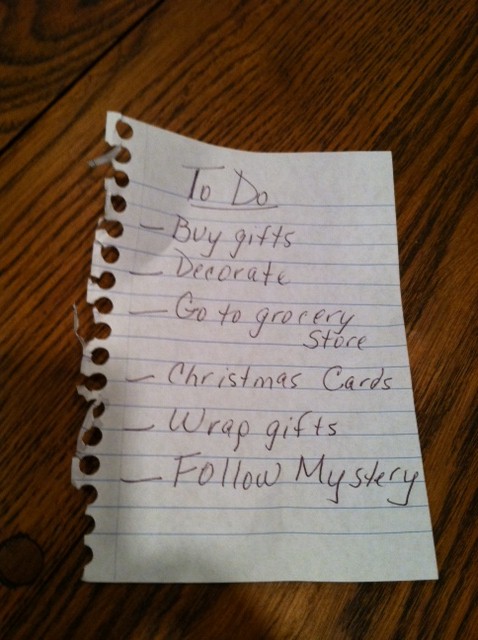
Don’t get me wrong.  I love preparing for Christmas.  I love buying and wrapping gifts.  I love Christmas trees and lights.  I love baking and giving what I’ve baked away.  And all of those things are on my “to do” list.  But Advent is about mystery.  It is about being open to the revealing of the One whom we cannot define or control.  It is about being open to the possibility that God will enter this seemingly God-forsaken world not with loud, thrashing pronouncements so that we are certain that’s who it is, but more like a whisper in the quiet of the night in a small town and an unkempt grotto in the midst of the chaotic reality of this world.  Advent is about letting go of certainty and following the mystery.

In this season of Advent, give yourself the gift of not needing to be certain, of not needing to have everything planned.  Give yourself the gift of being open to the mystery that enters your life.

Grace and Peace,

Shelli

FIRST SUNDAY IN ADVENT: Awakening

ADVENT 1B:  Isaiah 13: (24-31) 32-37
32“But about that day or hour no one knows, neither the angels in heaven, nor the Son, but only the Father.33Beware, keep alert; for you do not know when the time will come.34It is like a man going on a journey, when he leaves home and puts his slaves in charge, each with his work, and commands the doorkeeper to be on the watch.35Therefore, keep awake—for you do not know when the master of the house will come, in the evening, or at midnight, or at cockcrow, or at dawn,36or else he may find you asleep when he comes suddenly.37And what I say to you I say to all: Keep awake.”

The first day of Advent…the first day of the Christian year…and (I know), the first day that I’ve written a blog posting in a really long time.  We begin this Year B of our Lectionary year with a reading from The Gospel According to Mark, whose writer really just sort of skips over the whole Advent / Christmas thing and cuts right to the chase.  Most over-personalized readings of this Scripture leave us with a fear of what comes next.  (Oh my, am I ready?  What’s going to happen to me?) We quickly go to visions of those who are unprepared being uncomfortably ripped from what they know or, as a series of cult fiction writings would depict it, being flat out left behind!  But keep reading…this is not meant to scare us; it is meant to wake us up.  Sure, it is meant to remind us that there is something coming!  We do not want to miss it.  But, more than that, we do not want to miss the present spiritual awakening that we are all having in this very moment.

We have skewed our understanding of Advent a bit.  I think all of us know that.  But, really, can you blame us?  The world is so bent on being prepared for what comes next that it tends to live one season ahead at all times–the Halloween decorations go up the end of August, the Thankgiving decorations go up the end of September, and the Christmas decorations go up the end of October.  The twelve days of Christmas tide, will of course, be filled with merchandise sales, a couple of unreplaced burned out Christmas lights, and and a flowering of little red hearts filled with candy to make sure we’re ready for the next thing.  Somewhere in there, Advent is lost.  Oh, we Christians, do alright with it.  We faithfully light one candle at a time while we begrudingingly ward off the singing of any Christmas carols.  But Advent is not merely a season of preparation for Christmas.  It is much, much more.  It is from the Latin “Adventus“, which means arrival or coming.  It is not really meant to be only a time of shopping and checking off our “to do” list for the December 25th festival. Rather, Advent is our awakening to the realization that the Divine is even now spilling into our lives, even now a new humanity is being birthed, and even now all of Creation is being reformed and recreated.

We cannot live one season ahead.  God will come when God will come.  The full revealing of what God has in store is yet to be.  But this season of Advent, this season of waiting, awakens us that we might see that it has already started to be.  The feast has yet to be set but the dancing has begun.  All we have to do is learn to stay awake.

In this season of Advent, give yourself the gift of your own awakening to God’s Sacred Presence that is all around you.

Grace and Peace,

Shelli