LENT 5A: The New Dead

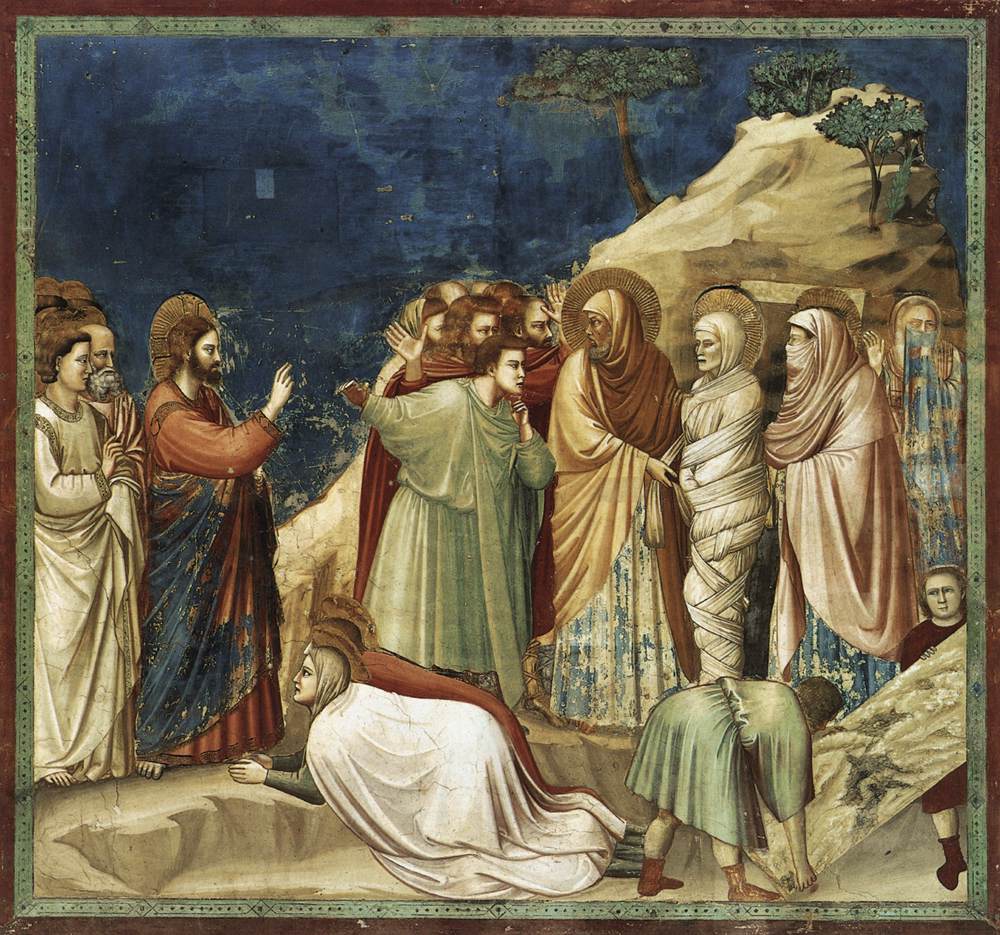
“The Raising of Lazarus”
Fresco by Giotto di Bondone, Italian, 1304-06

Lectionary Text:  John 11: 1-4, 17-26, 41-44
Now a certain man was ill, Lazarus of Bethany, the village of Mary and her sister Martha. Mary was the one who anointed the Lord with perfume and wiped his feet with her hair; her brother Lazarus was ill. 3So the sisters sent a message to Jesus, “Lord, he whom you love is ill.” But when Jesus heard it, he said, “This illness does not lead to death; rather it is for God’s glory, so that the Son of God may be glorified through it.”… When Jesus arrived, he found that Lazarus had already been in the tomb four days. Now Bethany was near Jerusalem, some two miles away, and many of the Jews had come to Martha and Mary to console them about their brother. When Martha heard that Jesus was coming, she went and met him, while Mary stayed at home. Martha said to Jesus, “Lord, if you had been here, my brother would not have died. But even now I know that God will give you whatever you ask of him.” Jesus said to her, “Your brother will rise again.”… Martha said to him, “I know that he will rise again in the resurrection on the last day.” Jesus said to her, “I am the resurrection and the life. Those who believe in me, even though they die, will live, and everyone who lives and believes in me will never die. Do you believe this?”…So they took away the stone. And Jesus looked upward and said, “Father, I thank you for having heard me. I knew that you always hear me, but I have said this for the sake of the crowd standing here, so that they may believe that you sent me.”When he had said this, he cried with a loud voice, “Lazarus, come out!” The dead man came out, his hands and feet bound with strips of cloth, and his face wrapped in a cloth. Jesus said to them, “Unbind him, and let him go.”

So, gray and brown are the new black; forty is the new thirty, fifty is the new forty, and hybrids are the new luxury car.  Things change.  The ways that we live and talk about things change.  There are always new perspectives bursting into our consciousness.  And Lazarus is the “new dead”…Let me explain…have you ever noticed the last part of this story?  “The dead man came out…”.  It is not that “Lazarus came out miraculously alive again”. He did not appear and then go back to work that day.  It says, “the dead man…”.  Lazarus was still dead the way this world thinks of dead.  Jesus did not undo his death.  The point was that Jesus turned it into something new–a new life, a new way of looking at things, a new creation.  “The dead man came out….let him go…”  We can’t even imagine how great it’s going to be. 

Today would have been my grandmother’s 102nd birthday.  She died a year ago in November.  I still miss her.  I can’t even really describe how.  We were more than grandmother and granddaughter.  We were some sort of soul mates.  I still want to call her, to talk to her.  Now don’t get me wrong.  Sometimes she made me so angry, downright infuriated me.  She had that fundamentalist bend that I just didn’t understand.  I suppose I had that progressive bend that she just couldn’t tolerate.  But we were more alike than we were unalike.  We had a kinship beyond our obvious blood connection. I enjoyed doing things for her toward the end.  I remember one time I was helping her go to the bathroom when we were away from her house.  (OK…that may be too graphic!)  But she looked up at me with those deep brown eyes and said, “You know…I used to do this with you.”  “Well then,” I responded, “it’s time I do it for you.”  Things change; people change; life changes.  I still grieve, still want to call her.  I’ve been thinking about her lately, grieving all over again.  I know she’s gone.  And yet, not…

You see, the thing we had in common was our faith.  And that faith, that shared faith, tells me that there is something new.  I don’t think this story of Lazarus was a miracle story, per se.  Jesus did not do some sort of magic trick so that Lazarus could walk out in his burial clothes.  The end of the story (although I’ve never noticed it and never even read any commentary to support this) says that Lazarus was still dead.  Death was not undone.  Lazarus did not get up and go back to his life.  Rather, death was recreated into life.  Recreation is not undoing; recreation is making something new.  There is still grief and wanting for what was, for the familiar, for the usual, for the phone conversations that we crave.  But this is better.  We justF have to live into it.  That’s what faith is about.

This story is also seen as a foreshadowing of Jesus’ own crucifixion and raising.  It’s like he’s saying, “Folks…stay with me here.  There are things that are about to happen that are hard.  In fact, we’re fixing to go through crap.  (Sorry…couldn’t think of a better way to say it!)  Your loss will be unbearable.  And it will not be undone.  I will not pull some magic trick out of a hat at the last minute.  I will not undo my death.  But, as I said…stay with me…look what I’ve done here.  The best is yet to come!  If you stay with me, I can’t even describe the incredible things that will happen.  You just have to experience them for yourself.  Just stay with me. “

Death is not to be undone; rather, it is made new.  It is recreated into life.  It’s the “new dead.”  Isn’t that better?  Do you believe this?

So, in the Lenten season, know that the best is yet to come!

Happy Birthday Grandmother!

Grace and Peace,

Shelli

Preserving Life

I had the opportunity yesterday to attend a global “Leadership Summit” within the United Methodist Church.  No, I did not travel around the world, but through the wonders of modern technology, we were joined live with United Methodist clergy and laypersons from literally all corners of the globe–Phillipines, Zimbabwe, and most of our United States conferences, to name a few.  We talked about what it means to “make disciples of Jesus Christ for the transformation of the world.”  We discussed what exactly it meant to strive toward the goal of having vital congregations and vital disciples.  As I was sitting there listening to part of the presentation, I asked myself what thing probably most stands in the way of a church being a “vital congregation” or a person being a “disciple of Jesus Christ for the transformation of the world.”  What do you think it is?  The thing that popped into my head is self-preservation.

I typed preservation (not even limiting it to the “self” variety!) into an online concordance.  Do you know how many times that is mentioned in the Scriptures?  Guess.  The answer would be zero.  Yes, zero.  There is no place that I know in the Scriptures where God calls us to a practice of self-preservation.  There is no place where God calls congregations to be self-preserving of who they are, of what they think, of what they’ve accomplished, no place where God wants us to make sure that we have beautiful buildings or comfortable facilities, no place where God calls us to be safe and secure and risk-free. 


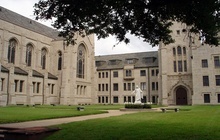
St. Paul’s United Methodist Church
Houston, TX
(Voted one of the fifty most iconic buildings in the city)

 (Now, I need to offer a point in the spirit of full disclosure here:  I am privileged to worship and lead worship in a space that is truly amazing!  It was built in 1929 and is one of the most magnificent cathedrals in Houston, if not the United States.  I am truly thankful for it.  It provides both emotional and spiritual food for me.  That said, there is indeed a fine line between allowing it to be transformational (as it is!) and making sure that we preserve it for our own edification.  It is difficult to be a part of a congregation whose building is its greatest asset and at the same time its largest possible detriment.  It is a walk of faith between the two.  Thanks be to God! )

You know, I don’t think there’s any where in the Scriptures where Jesus tells us not to rock the boat or make waves or push people beyond where they are comfortable going.    If I’m remembering correctly, Jesus turns all those nicely set tables and beautifully-constructed worship spaces completely on end! In fact, we’re actually supposed to be more in the surrender mode, letting go of all those things that “make” us, that wall us off from each other and from God, that stand in the way of our becoming who we’re called to become, and throwing ourselves into this journey of faith, risky as that may be.

Lent is the season when we are acutely reminded of this.  It is the season for letting go, the season for fasting from the usual, the season for surrendering our lives to the cross.  I have read a lot of Lenten resources and studied the Lenten Scripture passages.  I do not recall being asked to hold on to what I’ve been given for dear life.  Because, you see, that is not life.  Life is not about preservation; life is about laying everything aside and following the One who gives you life.  Life is about loss at the very depth of our soul to the point where we have nothing to lose.  It is at that lowest point of letting go and losing all so that we will truly preserve life.  Resurrection happens in the shadows of crosses, not in the bright lights of success.

So, what makes vital congregations and faithful disciples of Jesus Christ for the transformation of the world?  I would contend that it would be letting go.  In fact, start running…God is way out ahead of us!

So, in this Lenten season, let go.  It is there that you will find the Cross and it is in the shadows and darkness of the Cross that you will finally see the Light of Life.

Grace and Peace,

Shelli

LENT 5A: Reintegration

Lectionary Text:  Romans 8: 6-11
To set the mind on the flesh is death, but to set the mind on the Spirit is life and peace. For this reason the mind that is set on the flesh is hostile to God; it does not submit to God’s law—indeed it cannot, and those who are in the flesh cannot please God. But you are not in the flesh; you are in the Spirit, since the Spirit of God dwells in you. Anyone who does not have the Spirit of Christ does not belong to him.  But if Christ is in you, though the body is dead because of sin, the Spirit is life because of righteousness. If the Spirit of him who raised Jesus from the dead dwells in you, he who raised Christ from the dead will give life to your mortal bodies also through his Spirit that dwells in you.

Romans 8 is said to have been Paul’s greatest work, a masterpiece within a masterpiece.  We’re all familiar with it.  We’ve prayed it, sung it, and heard it read at funerals.  It’s a shame that many of us might be reading it completely wrong.  I mean, where in the world did we get the idea that the “flesh” was completely bad?  For Paul, the “body” or the “flesh” was probably closer to neutral than bad, more lifeless than life-taking.  The point is, though, that it cannot exist alone.  Paul actually had a “big picture” view of what life holds.  His contention is not that there is some sort of ongoing war between the flesh and the Spirit but rather that the flesh, the body, needs the Spirit to breathe life into it, to breathe the very essence of God into its being, making it holy and wholly what it should be. Paul is not preaching segregation but, rather re-integration, unity, a return to the way it should have been all along.

On the other side, Paul never claims that the Spirit can exist alone.  I mean, really, what good would the notion of some sort of disembodied Spirit really do us?  Do you think that the essence of God really wants to just float around us, disengaged from who we are and what we do?  If that were the case, I’m thinking that the whole idea of Jesus Christ, God Incarnate, Emmanuel, God WITH us would have been completely unnecessary.  The whole point is that life is breathed into the ordinary, even the mundane, so that it becomes holy and sacred, so that it becomes life?

But unity is a hard thing to accomplish and an even harder thing to hold together (no, that one is not meant to be a pun).  I remember when our church got its new website.  There was a committee, there were numerous meetings, there were months of working on this big change.  When we finally went “live” on the internet, it was beautiful.  Everyone commented on it.  We actually won an award.  But it took several weeks for someone to finally mention to us that the homepage of our website actually said “St. Paul’s Untied Methodist Church”.  As I said, it is hard to stay united!

So why is it easier or more comfortable for us to categorize things, to draw a dividing line between darkness and light, between body and Spirit, between bad and good, between “religious” and “spiritual”, between “them” and “us”, between death and life?  Do we think that’s more validating for us and the way we think and the way we live?  Oh come now!  Paul is claiming that God’s Spirit has the capability of crossing that line, of bringing the two together, infused by the breath of God.  It is a spirituality that lives incarnate in this world, even this world.  Incarnation, God with Us, is about reintegration.  It is flesh infused with spirit and spirit embodied in flesh.  That, my friends, is life.

So, for this Lenten season, let’s get it together!

Grace and Peace,

Shelli     

Once Upon a Time

Once upon a time…it’s always the beginning to a great story.  We all love a good story, one that grabs us and holds our attention all the way to the end, one that comes to some resolution that stays with us, whether it is a fairy-tale ending for a character portrayed as an “underdog” or one that leaves us with a sense of deep and profound loss or disappointment with which we must wrestle and live into ourselves.  We all love a good story.  I actually watched the last game of the Final Four last night.  I have no emotional attachment to either team.  (My “emotional attachment” dropped from the bracket several wrungs ago.)  But I really wanted Butler to win.  It’s just a better story.  Like I said, we like it when the underdog makes good.

The truth is, we all have a story.  Yes, our lives are veritable short stories within themselves.  But there’s something bigger.  There’s THE story.  You know, the one that begins, “Once upon a time there was heaven and earth, covered in darkness, until God brought light into being.  And then God filled this light-filled Creation with life–seeds that would yield growth, seasons that would bring rhythm into being, and living creatures to bring beauty and companionship and even sustenance to this light-filled place.  It was beautiful and life-filled and good.  And then God created the ultimate of creations–one who carried the very image of God within itself, one who could care for Creation and love Creation and be light.  God blessed it all and then God ceased creating.  And God looked at all of Creation and crowned it with the Holy and the Sacred, giving it just a glimpse of what it could become.  And God called that glimpse, the pinnacle of all time, “Sabbath”.”  (OK, so I took a little poetic license with the Scripture!)  The point is, it’s our story.  We were not created as individuals separate and apart from the story.  We were created as parts of the story.

Lent is a time to remember that, to remember that it’s not all about me, to remember that the story itself and all of its characters are bigger than the sum of all of us.  Lent is a time to realize that we are part of story that began long before we got here and that will continue long after we are gone and yet, we have always been a part of the story and always will be.  Lent is a time to let go of those individual wants and needs to which we hold so tightly, to let go of our need for our “story” to come out in a certain way, and to let THE story–OUR story grab us and take hold of our lives.  It is a mutual story but we all have a chapter to write, to write and then hand off to another, all without disrupting the story.  It is true that we don’t really know the ending, but my guess is that we all live happily ever after!

So, in this Lenten season, enter the story and find what chapter is yours to write!

Grace and Peace,

Shelli

Had to add this…even though they dropped early!


LENT 5A: Ru’ah

The Valley of The Dry Bones (Gustave Dore’, 1866)

Lectionary Text: Ezekiel 37: 1-14 The hand of the Lord came upon me, and he brought me out by the spirit of the Lord and set me down in the middle of a valley; it was full of bones. He led me all around them; there were very many lying in the valley, and they were very dry. He said to me, “Mortal, can these bones live?” I answered, “O Lord God, you know.” Then he said to me, “Prophesy to these bones, and say to them: O dry bones, hear the word of the Lord. Thus says the Lord God to these bones: I will cause breath to enter you, and you shall live. I will lay sinews on you, and will cause flesh to come upon you, and cover you with skin, and put breath in you, and you shall live; and you shall know that I am the Lord.” So I prophesied as I had been commanded; and as I prophesied, suddenly there was a noise, a rattling, and the bones came together, bone to its bone. I looked, and there were sinews on them, and flesh had come upon them, and skin had covered them; but there was no breath in them. Then he said to me, “Prophesy to the breath, prophesy, mortal, and say to the breath: Thus says the Lord God: Come from the four winds, O breath, and breathe upon these slain, that they may live.” I prophesied as he commanded me, and the breath came into them, and they lived, and stood on their feet, a vast multitude. Then he said to me, “Mortal, these bones are the whole house of Israel. They say, ‘Our bones are dried up, and our hope is lost; we are cut off completely.’ Therefore prophesy, and say to them, Thus says the Lord God: I am going to open your graves, and bring you up from your graves, O my people; and I will bring you back to the land of Israel. And you shall know that I am the Lord, when I open your graves, and bring you up from your graves, O my people. I will put my spirit within you, and you shall live, and I will place you on your own soil; then you shall know that I, the Lord, have spoken and will act,” says the Lord.

“Ru’ah.”  It is the Hebrew word that is here translated as “breath,” God breathing life.  It is also translated as “wind” or “spirit”.  Actually, we English-speakers don’t really have a translation that will do it justice.  It is not JUST breath; it is the very essence of God giving us life, God’s Spirit, God’s Word breathed into all of Creation, into all that is life.

Ezekiel was both a priest and a prophet in the 6th century BCE, before and during the time of the conquest of Judah and the Babylonian exile.  Ezekiel himself was taken into exile, into a land far away from the land of his birth and of his identity.  The temple was destroyed and the city lay in ruins.  All seemed hopeless and gone.  The bones here, whether taken literally or as metaphor, are dry, lifeless, and broken.  They symbolize all of the hopes and dreams that now lay in despair.  The kingdom of Israel is gone and their lives have gone away with it.  There is nothing left but corpse-like bones.

And then, according to Ezekiel, “the hand of the Lord came upon me.”  In The Message, Eugene Peterson says that “God grabs me”.  Think of that image.  Here was Ezekiel, probably feeling the weight of despair of those around him and virtual helplessness at what he could do as their leader.  But then “God GRABBED him…I have something to show you.”  And there in the middle of death and destruction and despair, God showed him what only God could see.  And then God breathes life into the bones and the bones come to life.  It is a story of resurrection.

The idea of God creating and recreating over and over again is not new to us.  But most of us do not this day live in exile.  We are at home; we are residing in the place where our identity is claimed.  So how can we, then, understand fully this breathing of life into death, this breathing of hope into despair?  The image is a beautiful one and yet we sit here breathing just fine.  We seldom think of these breaths as the very essence of God.  In the hymn, “I’ll Praise My Make While I’ve Breath”, Isaac Watts writes the words, “I’ll praise my God who lends me breath…”  Have you ever thought of the notion of God “lending you breath”?  Think about it.  In the beginning of our being, God lent us breath, ru’ah, the very essence of God.  And when our beings become lifeless and hopeless, that breath is there again.  And then in death, when all that we know has ended, God breathes life into dry, brittle, lifeless bones yet again.  Yes, it is a story of resurrection.

God gave us the ability to breathe and then filled us with the Breath of God.  We just have to be willing to breathe.  It involves inhaling.  It also involves exhaling.  So exhale, breathe out all of that stuff that does not give you life, all of that stuff that dashes hopes and makes you brittle, all of that stuff that you hold onto so tightly that you cannot reach for God.  Most of us sort of live our lives underwater, weighed down by and environment in which we do not belong.  We have to have help to breathe, so we add machines and tanks of air.  But they eventually run out and we have to leave where we are and swim to the top.  And there we can inhale the very essence of God, the life to which we belong.  God lends us breath until our lives become one with God and we can breathe forever on our own.

I’ll praise my God who lends me breath;
 and when my voice is lost in death,
praise shall employ my nobler powers. 
My days of praise shall ne’er be past,
while life, and thought, and being last,
or immortality endures.
                         (Isaac Watts)
So, in this Lenten season, ask yourself, “What is it that gives me life?”, and then, exhale…and then inhale the very Breath of God.  That will give you life.
Grace and Peace,
Shelli

Lenten Discipline: Bowing and Becoming

“Then Jesus went to a place called Gethsemane…” (Matt. 26: 36)

During the Sundays of this season of Lent, I am posting some thoughts on different spiritual disciplines.  Today I have chosen prayer.  Who am I to talk about prayer?  After all, it is probably “THE” spiritual discipline, the one that we all do (or think we should do more often!), that we all know (or think we should know better!), that we all feel like we should be doing better.  So, what is prayer to you?  At its simplest it is a conversation with God, a connection with the holy and the sacred.  So why is it that most of us claim that we need a deeper prayer life.  Are we not satisfied with the conversation?  Are we not getting the answers we want?  Or do we think that God wants more from us?  My guess is that it would be a little of all of the above.

In my “previous life” before ordained ministry, I sang in the choir as a layperson.  We almost always did a choral response following The Lord’s Prayer.  So, to this day, I cannot say that prayer in worship without looking up when I get to the last line, as if I’m still watching for the cue from the director.  (Of course, if you who go to St. Paul’s and you already know that, I guess it means you don’t have your eyes closed either!)  But, the point is that I cannot NOT do it and when I catch myself looking up while everyone’s heads are still bowed in prayer, I’m always a little embarrassed.  But, when you think about it, maybe that’s not such a bad thing.  Prayer is a way of  “attuning ourselves to a conversation that is already going on deep in our hearts”, as Marjorie Thompson says (in Soul Feast, p. 31.). It does not end with “Amen.”  It, like most good spiritual disciplines and all good faith stories, ends with a beginning.  It ends with our becoming engaged with God and joining what began long before we came along to the story.

There is a story from the Sufi mystical tradition of a disciple that comes to an elder for direction.  “Where shall I find God?” the disciple asked the elder.  “God is with you,” the Holy One replied.  “But if that is true,” the disciple asked, “why can I not see this Presence?” “Because you are like the fish who, when in the ocean, never notices the water.”  It is not that God is not with us; it is that we are unaware of that incredible Presence. (From There is a Season, by Joan Chittister, p. 14.)

And yet, most of us tend to pray prayers as if we’re throwing something out to a God that is “out there” somewhere, hoping against hope that God will pick them up and answer them (hopefully with the answer that we desire!).  We are told to “turn everything over to God.” I don’t think, though, that God meant to be in this alone.  Our prayers should not resemble our Christmas list of desires or even our grocery list of needs.  Rather, our prayers are our way of connecting to and entering the heart of that incredible Presence that is everywhere that we can imagine and everywhere that we will never know, the Presence of God.  Think of prayer as reaching and grasping, connecting and attuning, enfolding and becoming a part of the holy and the sacred God that is everywhere in our lives.  Prayers are indeed answered.  We just have to attune ourselves to the answer that is already present in our lives.  God’s desire is to fulfill our heartfelt prayers by filling our open heart with God.

Prayer is indeed “THE” spiritual discipline.  In fact, prayer is everything we are and everything we do, our whole life, every breath, every person we meet, every word we say, every thought we think that brings us closer to knowing this God who is already there.  Think of your “amen” as the beginning of that journey of holiness and wholeness that fills your life.  Maria Boudling says of prayer:  “All your love, your stretching out, your hope, your thirst, God is creating in you so that God may fill you…God is on the inside of the longing.”  And needing to pray, or wanting to pray, or just knowing that you “should” be praying means that you have already entered the conversation.  Amen.

Prayer is the soul’s sincere desire, unuttered or expressed,
the motion of a hidden fire that trembles in the breast.
Prayer is the burden of a sigh, the falling of a tear, 
the upward glancing of an eye, when none but God is near.
Prayer is the simplest form of speek that infant lips can try;
prayer the sublimest strains that reach the Majesty on high.
Prayer is the contrite sinners’ voice, returning from their way,
while angels in their songs rejoice and cry, “Behold, they pray!”
Prayer is the Christians’ vital breath, the Christian’s native air;
their watchword at the gates of death; they enter heaven with prayer.
O Thou, by whom we come to God, the Life, the Truth, the Way:
the path of prayer thyself hast trod; Lord, teach us how to pray!
                                           (James Montgomery, 1818, in The United Methodist Hymnal, # 492) 

So, in this Lenten season, become your prayer and let your prayer become part of all that is God.


Sometimes You Just Have to Wait…(See “A Season for Pruning”, 03/31/2011)

 Grace and Peace,

Shelli

There’s Always a Plan B

It is comfortable for us to think about the ideal life as one that moves in a straight line–no bumps, no turns, no dead-ends.  It is comfortable for us to think that God has some sort of grand plan for our lives and that God then leads us down this straight, narrow road to get to the glorious end.  Really?  Do you really think that’s it?  I mean, think about it, would you have traded some of the “bumps” and twists in your life’s pathway?  Would you give up who you are today for walking through those?  And what if your life HAD continued down one of the roads on which you started?  Where would you be today?

I’m not really convinced anymore that God lays out some road on which I am to walk.  (I suppose some of you would say that’s the reason I wander off of it as much as I do!)  After all, there’s that free will thing.  If there was one road for each of us and we then chose to wander from that road or just detour around part of it or if we ended up on someone else’s road altogether, would we then be a failure in God’s eyes?  Would we have messed up God’s perfect pre-ordained plan?  Nah…I don’t think that’s the way God works.

I think that God does have a plan, a plan that brings us to a place where we encounter God, to a place where all of who we are–our gifts, our talents, our minds, our hearts, those things we’ve learned and those things we made up on our own, those mistakes and those choices that we’ve made in our lives–comes together into who God calls us to be.  But I don’t think there is one pre-determined road down which we are required to travel to make that happen.  God is much more grace-filled than that!  When we wander from the road on which we’re traveling, when we cut our own path through life, and even when we follow others on a well-worn route, God, with infinite mercy and wisdom does not pull us back to the center of our road;  rather, God moves the path itself and continues journeying with us.  There’s always a Plan B.

God has done this before.  I have a hard time buying in to the idea of God sending Jesus to this earth specifically to die a painful and horrific death just so we slackers could have eternal life.  I hate the thought of Jesus’ sole mission on this earth being born to die.  Oh, don’t get me wrong–the eternal life thing was God’s purpose.  God had that in mind all along; in fact, God had that in mind from the very beginning of Creation.  We just didn’t get it.  So God came and walked this earth, Emmanuel, God with us, to show us the Way, to show us that at the end was the beginning.  I don’t think it went completely as planned.  (Oh, really now, does life EVER go completely as planned?)  Instead of embracing the Way, humanity put an end to it, hanging it on a cross and walking away.  But God, with infinite mercy and wisdom, did something different.  God took the end that we handed God and recreated it into a beginning.  There’s always a Plan B.

In this Lenten season, we’ve talked a lot about roads and pathways.  Maybe Lent is the time to realize that the end of the road is always the beginning, so the purpose of the journey is the journey.  Maybe that’s a good Plan B.

It may be that when we no longer known what to do, we have come to our real work.  And when we no longer know which way to go, we have begun our real journey.  (Wendell Berry)

Grace and Peace,

Shelli