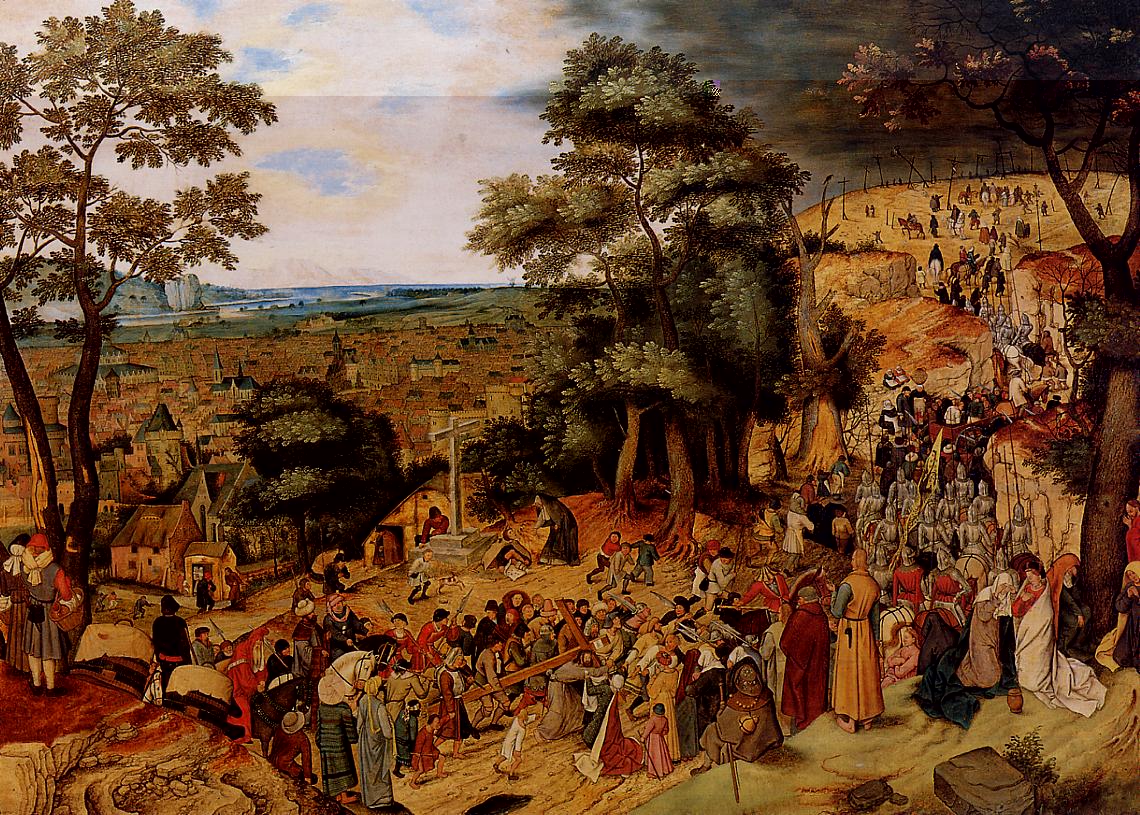
Intersection

The Way of the Cross
Pieter Brueghel the Younger (1603)
Koninklijk Museum Voor Schone Kunsten (Belgium)

Scripture Passage:  Matthew 11: 28-30
28“Come to me, all you that are weary and are carrying heavy burdens, and I will give you rest.29Take my yoke upon you, and learn from me; for I am gentle and humble in heart, and you will find rest for your souls.30For my yoke is easy, and my burden is light.”

In this Season of Lent, we are called to deepen our own walk with Christ.  This means moving beyond what Christ does for us.  Oh, don’t get me wrong.  Christ does everything for us.  But our relationship with Christ does not stop at that.  God is more than some sort of divine vending machine.  We are called to do more than worship the God who gives us everything; we are called to enter the Way of Christ itself, the Way of the Cross.  It means experiencing all of Christ–the birth, the ministry, the life, the Passion, the crucifixion, the death, the Resurrection–on the deepest and most profound level.  It means moving from being an observer to being a participant with Christ.  It also means entering our own humanity at the deepest level. It means becoming real.  Sadhu Sundar Singh says  that “if we do not bear the cross of the Master, we will have to bear the cross of the world, with all of its earthly goods.  Which cross have you taken up?  Pause and consider.

Over the last few years, I have become more and more drawn into the Stations of the Cross, that 4th century devotional tool that helped pilgrims flocking to the Holy Land from all parts of the world to walk in the Way of Christ.  It has become more than a way of prayer.  It is real, full of the depth and breadth of human experience and emotion, full of the power to move one beyond oneself, full of Christ.  These Stations, also called the “Way of the Cross”, the “Way of Sorrows”, the “Sorrowful Way”, and the “Via Dolorosa”, are a pilgrimage not just to the historical places of Jesus (because, truth be known, the places marked as stations in the streets of Jerusalem are really just good guesses) but to the Way to which we are called.

In this walk of faith, we are clear that we are called to worship and revere God, our Creator, the very Spirit that runs beneath us and at the same time courses through our veins.  This is the God who is there just ahead of us, calling us forward, calling us home.  This is our very source of gravity, that straight and perfect plumb-line that connects us to the Holy and the Sacred.  And yet, in science, relative strength is measured not just with the vertical pull of gravitational force, but with the horizontal relationship to that force itself. And true horizontality, the strongest point, occurs at the intersection with the vertical.  This Way that we walk with Christ, this horizontal side-by-side with Jesus gives meaning to our worship and reverence and draws it strength at that point.

So in the midst of our Lenten journey, remember that it is more than becoming a better person, more than developing a deeper relationship with God.  It is about worshipping and walking, walking and worshipping.  It is about entering the way of Christ.  So in the midst of these writings, let us walk this Way of the Cross.

Grace and Peace,

Shelli  
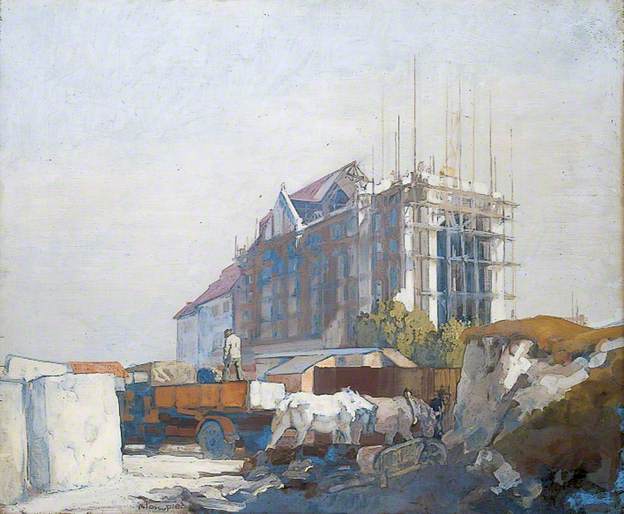
Brick by Brick

Building a Cathedral at Annecy, France
Edmund Blampied
Early 20th century

Lectionary Passage for This Week:  Genesis 15: 1-12, 17-18
After these things the word of the Lord came to Abram in a vision, “Do not be afraid, Abram, I am your shield; your reward shall be very great.”  2But Abram said, “O Lord God, what will you give me, for I continue childless, and the heir of my house is Eliezer of Damascus?”3And Abram said, “You have given me no offspring, and so a slave born in my house is to be my heir.”4But the word of the Lord came to him, “This man shall not be your heir; no one but your very own issue shall be your heir.”5He brought him outside and said, “Look toward heaven and count the stars, if you are able to count them.” Then he said to him, “So shall your descendants be.”6And he believed the Lord; and the Lord reckoned it to him as righteousness.  7Then he said to him, “I am the Lord who brought you from Ur of the Chaldeans, to give you this land to possess.”8But he said, “O Lord God, how am I to know that I shall possess it?”9He said to him, “Bring me a heifer three years old, a female goat three years old, a ram three years old, a turtledove, and a young pigeon.”10He brought him all these and cut them in two, laying each half over against the other; but he did not cut the birds in two.11And when birds of prey came down on the carcasses, Abram drove them away.  12As the sun was going down, a deep sleep fell upon Abram, and a deep and terrifying darkness descended upon him.

17When the sun had gone down and it was dark, a smoking fire pot and a flaming torch passed between these pieces.18On that day the Lord made a covenant with Abram, saying, “To your descendants I give this land, from the river of Egypt to the great river, the river Euphrates,

We often read this story with Abram as the hero, trusting and faithful to God, who follows God’s call and believes God’s promises.  After all, Abram would become the patriarch of three worldwide religions.  But even Abram was not perfect.  Yes, the truth is, Abram was more like us than we care to admit.  He told himself that he trusted God, that God had made a great promise of descendants to him.  And he had waited and waited and nothing had happened.  So, he took care of it.  After all, he was old, Sarai was old.  Time was slipping away.  Something had to be done.  But, in Abram’s defense, remember what “barrenness” meant in that time. An absence of children was not just a discontinuation of one’s line or one’s name. It was death. There would be no one to care for you, no one to work with you to provide. Barrenness or infertility was looked upon as failure. It meant that God had not blessed you or provided for you.

But, God clarifies the promise a little bit more. This is not the heir that God had been talking about. The heir shall be a biological child of Abraham and Sarah rather than a surrogate birth. Well, I’m sure you can see Abraham rolling his eyes a bit. Are you kidding me? Because, you see, I’m really, really old. My wife is really, really old.  This is just not normal. This is not even rational. This is nuts!

Well, we know how the story turns out.  God, once again, in spite of Abram, comes through.  The truth is, that’s pretty much what God does.  We can plan and prepare and even force things to happen but when it’s all said and done, things will happen in God’s time.  The truth is, hard as it may be for us to admit, the fruits of trust and faith do not come to harvest when we think they should.  Did you read the last line of the passage?  Abram did not get the promise of land.  The land was to go to his descendants.  He was not called to deliver the world; rather, he was called to be a small part of a long line of the faithful that God would call.  The realization of God’s promise was not immediate gratification. (I mean, did you think that you were the only one to which God was making promises?)

Maybe that’s our whole problem. Maybe we want to see the fruits of our faith now, in our lifetime. Maybe faith is about realizing that we are part of a deep and abiding relationship between God and humanity as the holy and the sacred sort of dribbles into our world little by little. Our part is important but it is, oh, so much bigger than us. In fact, it’s really not even rational the way we think it should be. Maybe that’s what makes it faith. Faith does not teach us to believe; it teaches us to wait with expectant hope that when the time comes, the clouds will part and the light will break through.  In the meantime, we are called to keep building cathedrals, brick by brick, knowing that it doesn’t matter whether or not we see them completed but only that we had faith enough to imagine it to be.

So, on this Lenten journey, let go of needing to see the result and instead do your part to make it be.

Grace and Peace,

Shelli 

Subtraction

Scripture Passage:  Luke 9: 23-24
23Then he said to them all, “If any want to become my followers, let them deny themselves and take up their cross daily and follow me.24For those who want to save their life will lose it, and those who lose their life for my sake will save it.

So, out in that wilderness, Jesus was doing more than just being tempted.  The wilderness is not something that is done TO us.  It is a place you enter, a place you experience, a place in which you change.  But change is hard.  It is not something that happens by just piling on more stuff.  A couple of years ago, I had my bathroom remodeled.  Well, intellectually I knew that in order to build something new, you had to first tear out the old.  But it was still disconcerting.  At the end of the contractor’s first day of work, I walked into the house and saw all of my things covered in plastic.  That in and of itself was strange.  But then there was the bathroom.  There were no lights (because the electricity has been disconnected and partially ripped out) but all I saw was an empty room walled no longer by tile and paint but by raw wood.  And there, there where the toilet had been, was a big gaping hole.  All of the fixtures (yes I mean ALL of the fixtures) were piled in my yard.  I had this sinking feeling.  “What have I done?”

Our faith journey is no different.  We do not go through our lives collecting more and more knowledge about God or more and more spiritual disciplines.  Try as we might, we cannot continue to take on increased faith and hope to cram it into our already-busy lives and our already-over-taxed bodies and our already-full minds.  Our faith journey, just like everything else in life, does not work like that.  Early 14th century German theologian and mystic Meister Eckhart said that “God is not attained by a process of addition to anything in the soul, but by a process of subtraction.”  Our faith journey must involve letting go of those things to which we hold so tight, of creating room for God to fill us.

The Season of Lent has traditionally been one in which many people are compelled to give up something.  Most think that by creating that want, one will be reminded to think of God.  I suppose that works.  If you think of God every time you want chocolate, go for it.  Other people spend Lent adding something to their life, perhaps something that they know that they need to be including in their faith journey anyway.  So while both of these ways of journeying through Lent are good, I’m not sure that either is enough.  (Shoot!  You mean I gave up chocolate and it’s not even enough???)  No, seriously, subtraction and addition are good things but they are both necessary.  As Meister Eckhart reminds us, our faith journey is first an act of subtraction, shedding those things that pull us away, that distract us, that get in the way of who we are.  They are the temptations that we so want to hold onto for comfort, for security, for power, for control.  Let go.  That’s what the Scripture says.  Let go of what you think your life is.  Create room.  And then God will have room to add the things that give you life–trust, strength, faith. 

This Lenten journey is not just one of giving up.  It is a season of ordering, or remodeling one’s life, tearing away the things that you thought you needed so that God can create something new.  But it’s more than a season.  Each Lenten journey is a part of our whole journey.  So rather than it being a temporary way station, this experience of subtraction is part of the Way itself.  Lent is just a time to teach us that.

Grace and Peace,

Shelli

On the Other Side of the Wilderness

“Christ in the Desert”
Ivan Kramskoi, 1872
Tretyakov Gallery, Moscow

This Week’s Lectionary Passage:  Luke 4: 1-13
Jesus, full of the Holy Spirit, returned from the Jordan and was led by the Spirit in the wilderness, 2where for forty days he was tempted by the devil. He ate nothing at all during those days, and when they were over, he was famished. 3The devil said to him, “If you are the Son of God, command this stone to become a loaf of bread.” 4Jesus answered him, “It is written, ‘One does not live by bread alone.’” 5Then the devil led him up and showed him in an instant all the kingdoms of the world. 6And the devil said to him, “To you I will give their glory and all this authority; for it has been given over to me, and I give it to anyone I please. 7If you, then, will worship me, it will all be yours.” 8Jesus answered him, “It is written, ‘Worship the Lord your God, and serve only him.’” 9Then the devil took him to Jerusalem, and placed him on the pinnacle of the temple, saying to him, “If you are the Son of God, throw yourself down from here, 10for it is written, ‘He will command his angels concerning you, to protect you,’ 11and ‘On their hands they will bear you up, so that you will not dash your foot against a stone.’” 12Jesus answered him, “It is said, ‘Do not put the Lord your God to the test.’” 13When the devil had finished every test, he departed from him until an opportune time.

Every year in this first week of Lent we read of Jesus, led or driven by the Spirit, intentionally going out into the wilderness.  On purpose?  Who does that?  Who chooses to relinquish control and put oneself at the mercy of the elements or whatever else might come along? Well, obviously Jesus.  So what is our take-away of that?  Are we really supposed to follow?  After all, our lives have been a veritable exercise in learning to maintain control–of our homes, our families, our finances, our health, our time, and even our spiritual life.  And then, this.  Jesus leaves all the comforts and control of home and goes out into the wilderness by himself.  I mean, really, anything could happen out there, right?  He is hungry.  He is vulnerable.  And he surely knows that he is in danger.  And sure enough, temptation looms.  Jesus, Son of God and Son of Man, the gift of the God’s unfailing grace, the ground of our hope, and the promise of our deliverance from sin and death, is driven not just into the wilderness but into the depths of his humanity.  And it is there that he is tempted to raise himself up, to fill his emptiness, to place himself above others, to guarantee his own being and his own protection. 

The truth is, though, no one, not even Jesus, can save oneself.  That’s just not the way it works.  Maybe that’s what the wilderness teaches us–that we cannot save ourselves, that we cannot guarantee what will or won’t happen to us, that we are not, much as we hate to admit it, in control.  Now there are those that will say that this whole account was some sort of divine plan by God.  I have a hard time with that.  I mean, really, what point wout that prove?  All that says is that God is some sort of divine game player and we are nothing but pawns on an earthly gameboard.  And after all, is Jesus human or isn’t he?  I’ve been told that he was.  You know–fully human.  He was not above it all.  He was not a super hero.  And he was certainly not a game piece.  He encountered the same human weaknesses that we do every day.  Real weaknesses, real happenings in one’s life, are part of being real, part of being human. 

The truth is that there are some things for which we just cannot prepare.  I mean, think about it, we go along living our lives the best we can and then, without warning, a meteor comes screaming across the sky.  Do you know why astronomers and cosmologists weren’t expecting it?  They didn’t know that it was coming because it was too small to see.  That, too, is what the wilderness teaches us.  Sometimes the small things that we dismiss in our lives are the things that can hurt us, can slowly, bit by bit, pull us away from who we are, from who God calls us to be.

God does not inflict the wilderness on us.  Jesus was not led into this dark and foreboding place to pass some sort of Divine test.  Because, remember, a test does not always possess a right or wrong answer.  Think about a chemical test.  You put two or more elements together not to see if they will pass but to compel them to change.  Jesus went into the wilderness to change, to be fully human, and to find deep within himself the piece of the Godself that calls him home.

So, in this Lenten season, let us intentionally enter the wilderness, not to prove something or because God is waiting to see whether or not we fail, but because the wilderness is the way home.

The Promised Land lies on the other side of a wilderness.  (Havelock Ellis)

Grace and Peace,

Shelli

Amazing, Isn’t it?

This Week’s Lectionary Passage:  Romans 8b-13
“The word is near you, on your lips and in your heart” (that is, the word of faith that we proclaim);9because if you confess with your lips that Jesus is Lord and believe in your heart that God raised him from the dead, you will be saved.10For one believes with the heart and so is justified, and one confesses with the mouth and so is saved.11The scripture says, “No one who believes in him will be put to shame.”  12For there is no distinction between Jew and Greek; the same Lord is Lord of all and is generous to all who call on him.13For, “Everyone who calls on the name of the Lord shall be saved.”

The Word is near you.  It is already there.  You know the answer.  Just listen.  It’s there; hidden deep within your being.  Just believe.  Just confess.  Or is it confess and then believe?  If you notice, the order gets reversed either in the writing or in the translation.  Either way…does it matter?  Do we confess and then believe or do we believe and then confess?  Do we believe what we confess or do we confess what we believe?  Oh, I’m so confused…

I know.  They are just words.  But really, does it matter?  I’m thinking there are a whole lot of rules to this belief thing.  Do we confess?  Do we believe?  Do we confess our beliefs or believe our confessions?  Oh, good grief!  I don’t care.  I’m pretty convinced God doesn’t care.  God just desires that we be with God, that we walk through that threshold where the invitation to “come and see this thing that has happened” is hanging, waiting for each of us.  And the truth is that the invitation is open to all.  As the passsage says, there is no distinction.

So, what came first–the chicken or the egg?  The confession or the belief?  I don’t know.  I don’t think it matters.  God so desires to be with each of us–so much so that God came to this earth as Emmanuel, God With Us.  Call it belief.  God so desires that we realize how much we need God–so much so that God came to show us the way.  Call it confession.  But Paul left it open:  “Everyone who calls on the name of the Lord shall be saved.”  Everyone?  No rules?  No prescribed order of how things happen?  Nope.  Just call.  That’s all it takes.  Call.  That’s all God wants.  And the door will open and you will be welcomed in.  (So what happened to all those rules?)

So as we journey to the Cross, let us stop, step back, let go of the rules and come and see this thing that has happened.  And then, even in the shadows, let us open our eyes and our heart to doing the same thing that God has done.  Invite your neighbor to come and see this thing that has happened.  (Rules?  Nope.  A Profile of who is accepted?  Nope.  An invitation to all?  Yep, that’s the way it works!  Amazing, isn’t it?)

Grace and Peace,

Shelli  

Possession

This Week’s Lectionary Passage:  Deuteronomy 26: 1-11
When you have come into the land that the Lord your God is giving you as an inheritance to possess, and you possess it, and settle in it,2you shall take some of the first of all the fruit of the ground, which you harvest from the land that the Lord your God is giving you, and you shall put it in a basket and go to the place that the Lord your God will choose as a dwelling for his name.3You shall go to the priest who is in office at that time, and say to him, “Today I declare to the Lord your God that I have come into the land that the Lord swore to our ancestors to give us.”4When the priest takes the basket from your hand and sets it down before the altar of the Lord your God,5you shall make this response before the Lord your God: “A wandering Aramean was my ancestor; he went down into Egypt and lived there as an alien, few in number, and there he became a great nation, mighty and populous.6When the Egyptians treated us harshly and afflicted us, by imposing hard labor on us,7we cried to the Lord, the God of our ancestors; the Lord heard our voice and saw our affliction, our toil, and our oppression.8The Lord brought us out of Egypt with a mighty hand and an outstretched arm, with a terrifying display of power, and with signs and wonders;9and he brought us into this place and gave us this land, a land flowing with milk and honey.10So now I bring the first of the fruit of the ground that you, O Lord, have given me.” You shall set it down before the Lord your God and bow down before the Lord your God.11Then you, together with the Levites and the aliens who reside among you, shall celebrate with all the bounty that the Lord your God has given to you and to your house.

They say that possession is 9/10ths of the law.  When you have worked hard and earned your due, it is yours.  But did you see the news story the last couple of weeks where the guy in Dallas claimed possession of a mansion for just $16? Did he own it?  Did he possess it?  Well, for awhile the little-known Texas law of adverse possession said that he did.  After all, possession is 9/10ths of the law.  So, the promise here is that God is giving you an inheritance, an inheritance to possess.  You possess it, you settle into it, and its yours.  Doesn’t that sound great–sort of an American dream on steroids or something?

But read on…”possession” comes with responsibility.  We’re supposed to give back.  The meaning of possession here is not holding, not putting away for safe-keeping, and certainly not hoarding what we have for a rainy day.  Possession comes with responsibility.  Possession is not holding, but being entrusted with with something.  God gives and then we are called to give in return.  The gifts that we are given are not “ours” the way we think of “ours”; they are what has been entrusted to us to use in putting to into play the vision of God.

Oh, this is not good.  I mean, I work hard.  I own this little house in The Heights.  (Well, OK, I don’t really “own” it.  By my calculation, I own about half of it and share the pride of ownership with CitiMortgage.  But, really, that’s just semantics, right?)  The point is, I own it.  Really?  So, my family resources had nothing to do with it?  So, the fact that I had the gift of an education, which provided me a good job, which provided me a good living had nothing to do with it?  So, the point that I have been so incredibly fortunate in my life is lost on me?  I own it.  It is mine.

No, see, we may own it in the way that the world defines ownership.  But the real truth is that God has entrusted us with what we have, that God has given us the gift of what fills our lives, that God has already done the 9/10ths.  We can call it law or we can call it a gift.  God is waiting on our response.  (Yeah, I know that tenth thing is the same as the prescribed tithe.  The truth is , I’m really talking about something more.  Just let it go for now. )  The response to which we are called is not limited to what we give back; it is not some sort of prescribed off-the-top tenth.  It is more.  It is realizing from where we come and to whom we journey.  It is seeing that our ancestor was a wandering Aramean, a sojourner, an immigrant of sorts (yeah, I know, that’s a live one), and one in whose steps we tread.  It is realizing that, really, nothing that we hold is ours.  What we possess is only what we are willing to share.  That is the way God works.  God gives us the wherewithal to share, to live in community, to love.  God gives us this incredible bounty.  But it is not mine.  I do not own it.  It is ours.  And only when we realize that we hold it together will we truly possess it.

So on this Journey to the Cross, look at what you hold and look at what you truly possess.

Grace and Peace,

Shelli

The Season of Shadows

Scripture Passage: Joel 2: 1-2, 12-17
Blow the trumpet in Zion; sound the alarm on my holy mountain! Let all the inhabitants of the land tremble, for the day of the Lord is coming, it is near—2a day of darkness and gloom, a day of clouds and thick darkness! Like blackness spread upon the mountains a great and powerful army comes; their like has never been from of old, nor will be again after them in ages to come…12Yet even now, says the Lord, return to me with all your heart, with fasting, with weeping, and with mourning;13rend your hearts and not your clothing. Return to the Lord, your God, for he is gracious and merciful, slow to anger, and abounding in steadfast love, and relents from punishing.14Who knows whether he will not turn and relent, and leave a blessing behind him, a grain offering and a drink offering for the Lord, your God?15Blow the trumpet in Zion; sanctify a fast; call a solemn assembly;16gather the people. Sanctify the congregation; assemble the aged; gather the children, even infants at the breast. Let the bridegroom leave his room, and the bride her canopy.17Between the vestibule and the altar let the priests, the ministers of the Lord, weep. Let them say, “Spare your people, O Lord, and do not make your heritage a mockery, a byword among the nations. Why should it be said among the peoples, ‘Where is their God?’”
 
In the shadow of the morning, we can see just a hint of light peeking through the clouds.  There is no brightness, no need to shield our eyes from the glare.  The season of shadows has begun.  We have been through this before.  We know what is to come.  And, yet, we cannot help but continue down the path.  It is where we are called to go.  The Light is at the end.  But to get to it, we must walk through the shadows.  We must walk through the ashes of last year’s palms and the smoky residue of plans we had.  It is the way that we return.  It is the way home.
 
We don’t do well with shadows.  There is something untrustworthy about these shadows, as if they’re hiding something that we cannot see.   But think about it.  A somewhat overcast day is a photographer’s dream.  After all, we need light; we crave light; we are children of the Light!  The darkness is not for us.  It is foreboding.  We do not know which way to go.  But light…full, glaring, heat-ridden light.  It is too much.  So we don our sunglasses and we pull down the shades.  Our eyes are not accustomed to the glare.  It is just too hard to see.  But filtered light, those overcast days, those gray, cloud-filled shadow days that seem to hide something behind it all–those are the ones that let us see.  The glare is gone.  And there is just enough light to illumine our way.  Shadows are disconcerting and, yet, they provide the place for the most clarity.  The filtered colors are brilliant as if all of them are refracted through one prism in brilliant technicolor.  The shadows are where we can truly see.

This is the Season of Shadows.  As hard as it is for us to admit to ourselves, we are not yet ready for the Light.  So God gives us just enough to show us the way without blinding our path.  We will walk for 40 days, stopping to rest every now and then as the Light become brighter, stopping to adjust our eyes.  This is the Season of Shadows, the season of clarity, the season that lights our way when we’re not really ready for the brightness of Home.  Let us now walk, slowly, basking in the shadows.  Even the Shadow is a part of God’s grace.

On this Day of Ashes, remember that even the Shadows were created by God.  And be thankful.

Grace and Peace,

Shelli