Station IX: On the Other Side

"Under the Baobab Tree:  African Stations of the Cross"
“Under the Baobab Tree: African Stations of the Cross”

Scripture Passage: Luke 10: 30-33

30Jesus replied, “A man was going down from Jerusalem to Jericho, and fell into the hands of robbers, who stripped him, beat him, and went away, leaving him half dead. 31Now by chance a priest was going down that road; and when he saw him, he passed by on the other side. 32So likewise a Levite, when he came to the place and saw him, passed by on the other side. 33But a Samaritan while traveling came near him; and when he saw him, he was moved with pity.

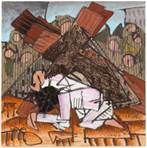
For us, we have the sense that this procession to the Cross was some sort of grand parade but, truthfully, this was something that happened regularly.  It really was just another crucifixion in the big scheme of society.  And most would have assumed that this poor criminal, already tried, convicted, and sentenced, already rejected by society, was just being dragged to a death that he must deserve.  And, besides, this was the eve of the Passover.  There was so much to be done–errands, food to be prepared, houses to clean.  So think of all the passersby, scurrying through their lives, many complaining about the traffic and the clogged roads that the procession was causing.  So, many would have just passed by on the other side, not wanting to touch or be touched by hopelessness and despair and death or maybe just not wanting or having the time to get involved.  And, then, again, Jesus falls.

Tradition tells us that Jesus collapsed for a third time not far from where he would be crucified.  A Roman column indicates the location of his third and final fall.  It has become part of a wall of a Coptic church.  During the Crusader period, there was a large monastery here, the remains of which are still visible today.  Standing there, you can see the roof of St. Helena’s Chapel, a part of the Church of the Holy Sepulchre, where a community of Abyssinian monks live today.  This is the place where Jesus would fall for the last time.  This is the end of the road, so to speak.  The next station will be on the other side, preparing him for crucifixion.  This is the last place where those along the way could show mercy, the last place where they could help, where they could stoop down and gently help him to his feet.  But most would pass by on the other side.

This is uncomfortable for us.  After all, where would we have been in the procession?  I hate to admit it, but I’m not the most patient person in the world. I’m afraid that I would have been avoiding the traffic,trying to get everything done, trying to get everything in place by sunset.  We are so accustomed to living a life of faith needing Jesus.  We know we need Jesus.  We know that we are not complete without God.  We do not always live that way, often trying to fix things and change things and make it look like we don’t need anyone.  But we know we do.  We need Jesus.  But, here, here is the place where Jesus needs us.  How can that be?  How can the Savior of the World need me?  These three falls that are depicted in the Via Dolorosa, the Way of the Cross, uncomfortably show Jesus as vulnerable, as betrayed, and as needing us.  So where are you standing?

Jesus still needs us.  We are called to be there to feed the starving, to house the homeless, to clothe the poor.  We are called to be there to comfort the afflicted, to hold the grieving, to love the unloved.  We are called to be there to welcome the sinner and forgive the unforgiven.  We are called to open our church doors to all the children of God.  We are called to be Christ, to be Compassion, to be Love each and every time one of us falls.  So in this Lenten season, let us not relegate our faith to the other side of the road.  Let us walk the way that Jesus walked.

Grace and Peace,

Shelli

Repurposed

Coal BucketThis Week’s Lectionary Passage:  Isaiah 43: 16-21
16Thus says the Lord, who makes a way in the sea, a path in the mighty waters,17who brings out chariot and horse, army and warrior; they lie down, they cannot rise, they are extinguished, quenched like a wick:18Do not remember the former things, or consider the things of old.19I am about to do a new thing; now it springs forth, do you not perceive it? I will make a way in the wilderness and rivers in the desert.20The wild animals will honor me, the jackals and the ostriches; for I give water in the wilderness, rivers in the desert, to give drink to my chosen people,21the people whom I formed for myself so that they might declare my praise.

I am about to do a new thing…Wake up! Pay attention!  This is going to be incredible!  Remember the context of this passage.  It is probably toward the end of the exile, the end of a time of great loss and despair.  They have lost everything–homes, land, their way of making a living, even their very sense of who they were.  And now this…a new thing.  Let it go…leave it behind…let us go forward toward something new.  Let us begin again.

God is a God of beginning again.  It happens over and over throughout our story.  God takes us from a garden that we threw away and places us in a world.  God takes us from a world that we let get away and placed us on an ark to sail to a new way of being.  God takes us from exile and sends us to freedom.  God takes us from death and heads us toward life.  God is a God of beginning again.  The thing is God is always and forever about to do a new thing.  It is the story of our faith.  Our problem is that we don’t pay attention.  We don’t trust enough to let go.  Our faith tells us that the new creation will be better, will be something that we can’t even fathom right now.  But we stay, attached to our old way of being, to being comfortable and predictable and seemingly in control.

I love old things.  My house and my yard are filled with them.  In fact, I suppose that my house IS one of them.  But living and decorating with old things requires a few tricks.  You want them to look old.  (In fact, I have new things that I want to look old.)  You want them to look old but have a new purpose.  The trick is not to have old things but rather to repurpose them, to bring them in to a new way of being, to perhaps use them in a new way.  So I have an old rusty coal bucket with Cuban Oregano planted in it.  I have an old rusty metal lawn chair that sits out by the bird feeders.  I have old wire baskets that have become shelves.  And I have an old wooden ice chest that is a coffee table.  And my 1920 bungalow has central air, a modern kitchen, and a new bathroom.  Perhaps doing a new thing is not starting over but beginning again with what you have.  Perhaps doing a new thing is repurposing rather than replacing.   Maybe that’s hard for us to embrace.  We live in a disposable society in a temporary world.  The thing that we have is always in need of being replaced by the thing that we want.  So what would it mean to live a life of repurposing?

God created us and calls us into being.  But there is not some new me out there that God is waiting to slip into place.  God is a God of repurposing, of making new what is already here, of giving it new meaning and a new purpose, of giving it new life.  You just have to believe that God is about to do something new with who you are.  That is what faith is all about–believing in repurposing.

Grace and Peace,

Shelli

Laetare

Easter Lily (DT 8087007)Scripture Passage:  Isaiah 66: 10-14
10Rejoice with Jerusalem, and be glad for her, all you who love her; rejoice with her in joy, all you who mourn over her—11that you may nurse and be satisfied from her consoling breast; that you may drink deeply with delight from her glorious bosom.12For thus says the Lord: I will extend prosperity to her like a river, and the wealth of the nations like an overflowing stream; and you shall nurse and be carried on her arm, and dandled on her knees.13As a mother comforts her child, so I will comfort you; you shall be comforted in Jerusalem.14You shall see, and your heart shall rejoice; your bodies shall flourish like the grass; and it shall be known that the hand of the Lord is with his servants, and his indignation is against his enemies.

This is a hard journey to walk.  It is a journey of despair and lament, of darkness and death.  It is also a journey of joy.  On this fourth Sunday of Lent, known as Laetare Sunday, we are encouraged to be joyful.  It is a recognition that in the midst of all that is life, there are natural rhythms.  We have just passed the mid-point of this Lenten journey.  This is a day of refreshment, of basking in the comfort and joy and life that God offers us.  Think of it as a glimpse of Easter Sunday, of that glorious day of Resurrection.  This is a day of joy!

But, sadly, joy often eludes us.  Why is that?  Are we waiting for everything to be in place?  Do we not think we deserve it?  Do we not think we have time for it?  Why is it so hard?  Can we just not find it?  Look around you.  Joy is everywhere.  Life is not a sequential movement from darkness to light, from sadness to joy, or from death to life.  Faith in God is not about pursuing a degree in joy. Life is about rhythms.  All of those experiences and feelings are part of it.  They all exist in the midst of one another.  And God is woven through all of them.  Being joyful is not some sort of pinnacle point that we are trying to reach.  It is not about seeking happiness.  Happiness is fleeting.  But joy…joy is deep and abiding.  Joy is everlasting.  Joy is present with all experiences of life.  It is thanksgiving; it is gratitude; it is an embracing of the part of the journey through which we travel now.  Joy is a realization that God is in all things.  Joy is God in our being and in everything that is.  Allowing ourselves to feel joy, to be joyful, is to respond to God.  Joy is faith.

So on this day, rejoice with Jerusalem and be glad for her.  Rejoice with her in joy.  Show her what is to come.  Show her that in the midst of this journey to the cross when death looms and darkness seems to overtake us, when it is hard to see anything other than grief and despair, that there is always joy.  There is always a glimpse of the beauty over the horizon.  So, rejoice and be glad!

Joy has no name.  Its very being is lost in the great tide of selfless delight–creation’s response to the infinite loving of God! (Evelyn Underhill)

Grace and Peace,

Shelli

Station VIII: Lament

"The Women:  Veronical Wipes Jesus' Face and Jesus Meets the Women of Jerusalem, St. Mary's Church, Barton-on-Humber, April 4, 2007
“The Women: Veronical Wipes Jesus’ Face and Jesus Meets the Women of Jerusalem, St. Mary’s Church, Barton-on-Humber, April 4, 2007

Scripture Passage: Luke 23: 27-31

27A great number of the people followed him, and among them were women who were beating their breasts and wailing for him.28But Jesus turned to them and said, “Daughters of Jerusalem, do not weep for me, but weep for yourselves and for your children.29For the days are surely coming when they will say, ‘Blessed are the barren, and the wombs that never bore, and the breasts that never nursed.’30Then they will begin to say to the mountains, ‘Fall on us’; and to the hills, ‘Cover us.’31For if they do this when the wood is green, what will happen when it is dry?”

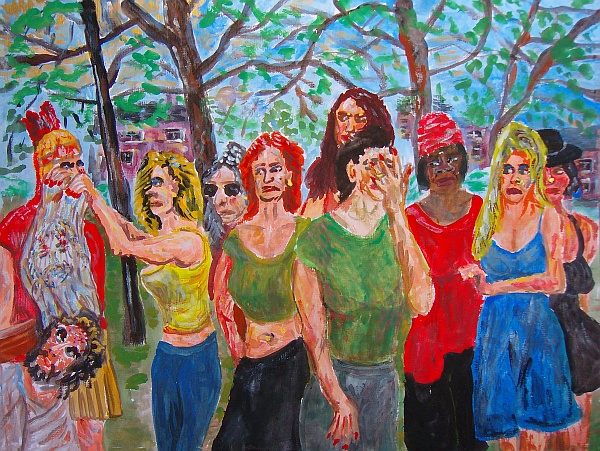
The eighth station on this holy walk is marked by a stone with a Latin cross on the wall of a Greek Orthodox church.  Near the cross, an inscription reads, “Christ the Victor.”  Tradition has designated this as the place where Jesus encounters the women of Jerusalem.  The women were convinced of his holiness.  I don’t think they understood it completely.  After all, who did?  (After all, who does?)  But they knew that he was something special.  After all, he had paid attention to them, these women, these ones who were given no place in society other than to birth babies.  He saw them as something more.  And they were grateful.  And today they grieved.

As Jesus and the crowd moved closer to the end, the wailing got louder and louder.  Jesus, covered in dirt and sweat and near death, lifted his head and looked into their eyes.  “Do not weep for me,” he said, “but weep for the world.”  Weep for the world; cry for the world; grieve for the world. In other words, those that suffer in the world, those parts of the world that are not life-giving, those part of people’s lives that are not the vision that God holds–those things should bother you.  Those are the things for which you should weep.

Weeping is hard for us.  Our culture is pretty well emotionally controlled, for the most part.  In fact, there are those that grow up thinking that tears and grief and crying are a sign of weakness.  We do not know how to lament.  And, yet, think of all those psalms of lament.  They are prayers.  Laments are prayers.  Weeping is prayer.  These are prayers for what could be and is not, prayers for what should have been that fell short, and prayers for the hurting in our world.  Jesus is telling these women to pray, to wake up, and to work to change the world.  He is acknowledging that they understand this vision and that, now, they have work to do.  It is a way of putting others before self.  It is a way of engaging yourself and your faith in bringing the Kingdom of God in its fullest into being.  It is a way of continuing the life of Jesus Christ.

I saw a feature news story by NBC’s Brian Williams last night on Camden, New Jersey.  A bustling boomtown in the first half of the 20th century, Camden is now America’s poorest city and the one with the highest crime rate.  Surrounded by relatively affluent suburbs, it is the place that we drive by, wondering why no one does anything.  Its residents that fill the inner city row houses seldom venture outside for fear of the safety of themselves and their children.  It is the way we hide poverty and despair in plain sight.

http://www.nbcnews.com/video/rock-center/51110367

So on this Lenten journey, learn what it means to weep for the world.  Pray for the world and for others who hurt and grieve and bleed, those who fear and cry and need.  Learn to lament, an active lament that will make you part of bringing the world into that vision that God holds.  Open your eyes to see the pain that exists in plain sight.  Our Lenten journey calls us to do something to change the world.

Grace and Peace,

Shelli

Becoming Prodigal

"The Return of the Prodigal Son", Rembrandt, c.
“The Return of the Prodigal Son”, Rembrandt, c. 1667

This Week’s Lectionary Passage: Luke 15: 1-3, 11b-32

Now all the tax collectors and sinners were coming near to listen to him. 2And the Pharisees and the scribes were grumbling and saying, “This fellow welcomes sinners and eats with them.” 3So he told them this parable:…“There was a man who had two sons. 12The younger of them said to his father, ‘Father, give me the share of the property that will belong to me.’ So he divided his property between them. 13A few days later the younger son gathered all he had and traveled to a distant country, and there he squandered his property in dissolute living. 14When he had spent everything, a severe famine took place throughout that country, and he began to be in need. 15So he went and hired himself out to one of the citizens of that country, who sent him to his fields to feed the pigs. 16He would gladly have filled himself with the pods that the pigs were eating; and no one gave him anything. 17But when he came to himself he said, ‘How many of my father’s hired hands have bread enough and to spare, but here I am dying of hunger! 18I will get up and go to my father, and I will say to him, “Father, I have sinned against heaven and before you; 19I am no longer worthy to be called your son; treat me like one of your hired hands.”’ 20So he set off and went to his father. But while he was still far off, his father saw him and was filled with compassion; he ran and put his arms around him and kissed him. 21Then the son said to him, ‘Father, I have sinned against heaven and before you; I am no longer worthy to be called your son.’ 22But the father said to his slaves, ‘Quickly, bring out a robe—the best one—and put it on him; put a ring on his finger and sandals on his feet. 23And get the fatted calf and kill it, and let us eat and celebrate; 24for this son of mine was dead and is alive again; he was lost and is found!’ And they began to celebrate. 25“Now his elder son was in the field; and when he came and approached the house, he heard music and dancing. 26He called one of the slaves and asked what was going on. 27He replied, ‘Your brother has come, and your father has killed the fatted calf, because he has got him back safe and sound.’ 28Then he became angry and refused to go in. His father came out and began to plead with him. 29But he answered his father, ‘Listen! For all these years I have been working like a slave for you, and I have never disobeyed your command; yet you have never given me even a young goat so that I might celebrate with my friends. 30But when this son of yours came back, who has devoured your property with prostitutes, you killed the fatted calf for him!’ 31Then the father said to him, ‘Son, you are always with me, and all that is mine is yours. 32But we had to celebrate and rejoice, because this brother of yours was dead and has come to life; he was lost and has been found.’”

This is truly one of the world’s best-known and best-loved parables.  In fact, it shows up even in the Mahayana Buddhist tradition as well as others, so I would surmise that everyone has a hard time figuring this out.  The truth is, we humans like the image of one being welcomed home.  And even though those of us who try to do everything right, try to be who we’re supposed to be, are a little bothered by our identification with the older son, we like that image of the safety net that no matter how badly we mess our lives up, we can always begin again.

But when you delve a little deeper, there’s always more to the story.  (Oh, come now, you didn’t think that there would just be one level to a parable told by Jesus, did you?)  So, think about the fact that in this time and in this culture, there were expectations.  Land and resources were viewed as a gift to be handled responsibly.  They were ancestral lands and were meant to stay together, to stay within the family, rather than being split apart and divided.  So, this was a shocking parable, far from anything that its hearers could have imagined.  This father who gave away resources to a younger son that then leaves the family was going against all that the culture prescribed.  And a father that welcomed him back was just being duped.  And then to essentially take him back into the family and heap more abundance upon him was just unthinkable.  Good grief, when will this father ever learn?

We have come to equate the word “prodigal” with one who returns.  But if you look up the word, it means one who is recklessly spendthrift.  It also means yielding abundantly.  So how can those two definitions refer to the same word?  Because the notion of abundance, the notion of offering all that you have and all that you are, the notion of being this prodigal father is deemed irresponsible in our world’s view.  And yet, this image of one who offers all as abundance is the image of God that we get over and over again.  God does not dole out riches or rewards based on who we are and what we do; rather God offers everything, pouring as much of the Godself into our lives as we can possibly hold (and then more that we might spill it out into the world around us).  This is a God of abundance.  We don’t understand it.  We can’t control it.  We can’t even really accept it half the time.  We look for a catch.  After all, the world tells us that we cannot get something for nothing.

But “something for nothing” is exactly what God is offered.  God’s only desire is that we open ourselves to this prodigal abundance that God offers.  You’ve probably often heard a description of this parable ending with something like “head home to the open arms of God, the feast is waiting.”  What if the ending was something more like “just open yourselves to the abundance that is right there.  You don’t have to go anywhere.  You don’t have to do anything.  You just have to desire in the deepest part of your being the incredible blessings and abundance that God is already heaping into your life.”

Here is the God I want to believe in:  a Father who, from the beginning of Creation, has stretched out his arms in merciful blessing, never forcing himself on anyone, but always waiting; never letting his arms drop down in despair, but always hoping that his children will return so that he can speak words of love to them and let his tired arms rest on their shoulders.  His only desire is to bless. (Henri J.M. Nouwen, The Return of the Prodigal Son, 95-96)

So in this Lenten season, open yourself to this Prodigal God, this God of Abundance.  Think what it would mean to become a prodigal, spending lavishly the abundance that God offers and, then, becoming that very abundance yourself.

Grace and Peace,

Shelli

Station VII: Betrayed

Station 07-EScripture Passage:  Matthew 26: 20-23

20When it was evening, he took his place with the twelve; 21and while they were eating, he said, “Truly I tell you, one of you will betray me.” 22And they became greatly distressed and began to say to him one after another, “Surely not I, Lord?” 23He answered, “The one who has dipped his hand into the bowl with me will betray me.

The seventh station on the Via Dolorosa is Jesus’ second fall.  Marked by a Roman column housed in a Catholic Chapel, it is the traditional place where the Gate of Judgment stood.  This is the place where judgments were passed on those that had committed crimes.  And here, passing out of the city, Jesus falls again.  Though surrounded by a host of onlookers and curious tourists, he is alone, deserted and betrayed by those whom he had loved.  You can surmise that they were fearful for themselves, perhaps even fearful that there would be no one to carry the message into the future.  But let’s be honest.  They just weren’t there.  The night before, Jesus had dipped his hand into a bowl that others at the table would also touch and dip.  Jesus knew that the one who had dipped his hand into the bowl with him would betray him.

I know.  The story picks up with Judas right after the verses of Scripture that I used.  We like thinking of Judas as the poster boy of betrayal.  That’s an easy way out, to blame it on the most obvious perpetrator, the one who makes us all look like saints.  And yet, Jesus’ words as the writer of this Gospel portrayed them, says “the one who has dipped his hand…”  Think about it.  It was a community bowl.  ALL of those at the table dipped their hands in the bowl.  The truth is, Jesus probably knew that he would be alone on this day, that all would in their own way betray him–one by a kiss, one by a denial, and others by stepping back into their fears that they, too, might be found out.

Polish-born writer Isaac Singe said that “when you betray someone else you also betray yourself.”  The reason, I think, is because betrayal cuts so deep that you lose a part of yourself.  If someone asked you what the opposite of faith is, you’d probably immediately say doubt.  But, think about it, doubt compels one to search, compels one to question, compels one to grow.  Doubt and faith are inextricably intertwined.  The opposite of faith, the antithesis of faith, of journeying toward who you are called to be is more than likely betrayal.  It is completely contrary to “love your neighbor” as well as to “love God with [all you are]”.  Betrayal is a loss of who one is called to be.

And so Jesus falls, alone, defeated, betrayed.  He was feeling the ultimate of rejection.  All he had left was hope.  And so he breathed deeply and continued on.  And his betrayers cowered behind closed doors feeling a loss that they could not describe.  Surely not I…surely not I…surely not I.

In this Season of Lent, think of ways that you betray who you are called to be, ways that you cut yourself off from life, from others, from God.  Then, rise up, for you faith has made you whole.

Grace and Peace,

Shelli 

The Sacred “And”

The Creation of Adam [Humanity], Michelangelo, segment of The Sistine Chapel, c. 1512
This Week’s Lectionary Passage:  2 Corinthians 5: 16-21

16From now on, therefore, we regard no one from a human point of view; even though we once knew Christ from a human point of view, we know him no longer in that way. 17So if anyone is in Christ, there is a new creation: everything old has passed away; see, everything has become new! 18All this is from God, who reconciled us to himself through Christ, and has given us the ministry of reconciliation; 19that is, in Christ God was reconciling the world to himself, not counting their trespasses against them, and entrusting the message of reconciliation to us. 20So we are ambassadors for Christ, since God is making his appeal through us; we entreat you on behalf of Christ, be reconciled to God. 21For our sake he made him to be sin who knew no sin, so that in him we might become the righteousness of God.

Paul starts right off acknowledging Jesus as both divine and human.  That in and of itself is hard for us.  I mean, we like the idea of Jesus coming and walking around in our midst, giving us a much clearer way of understanding what it is we’re supposed to be about.  We like the idea of what sometimes seems to us to be a sort of “semi-human” leading us around and in some satisfactory way “proving” to us that God really does exist.  We like the idea of having someone to emulate.  But, see, Jesus is not a textbook or proof of God’s existence or even a super-hero that we can aspire to be like.  Jesus is fully human, that fully-developed image of the Godself in which we were all created.  Jesus came not to start a religion or even a belief system; Jesus came into our midst, Emmanuel, God With Us, that we might, finally, become human.

But in order to be fully human, in order to become this New Creation about which Paul writes, we have to let go, have to open ourselves to the Divine pouring into us, filling us.  The New Creation is not a denial of humanity.  The coming of God’s Kingdom into our being does not mean that we will become Divine; it means, rather that God’s Spirit, the essence of the Divine will pour into our lives and make us fully human.  St. Athanasius of Alexandria (4th century) supposedly claimed that “Christ became human that we might become divine.”  Now that used to bug me a bit.  It even bugs me when someone refers to another person (or themself!) as “godly”.  I don’t think of myself or anyone else as “like God”.  I actually believe that God pretty much has a monopoly on that way of being.  And yet, if Jesus had NOT come as human, as one of us, then God’s Spirit, the essence of the Divine, would have remained pretty removed and unapproachable for our limited capabilities.  Perhaps Jesus came as human to show us how to open ourselves to the Divine, how to leave room for this pouring in of the sacred and the holy into our lives, how to relate to a God that was never really removed and unapproachable at all. 

The statement says that Jesus came as fully human and fully divine.  The two cannot be separated; otherwise, humanity is removed from God and the Divine remains aloof and inaccessible.  But together, intertwined, eternally connected with a sacred “and”, we become fully human.  We become the one that God created us to be.  We become a new creation, reconciled to God.  We become righteousness, become sacredness, become the essence of God’s Spirit.

So in this Lenten season, be fully human.  Open yourselves to the Spirit of the Divine pouring into your life.  Embrace the sacred “and” of you and God together, Emmanuel, God With Us. 

Grace and Peace,

Shelli