A Place to Flee

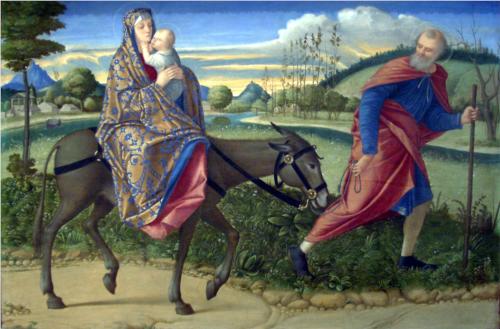
"The Flight Into Egypt", Vittore Carpaccio, c. 1500
“The Flight Into Egypt”, Vittore Carpaccio, c. 1500

Scripture Passage:  Matthew 2:13-2313Now after they had left, an angel of the Lord appeared to Joseph in a dream and said, “Get up, take the child and his mother, and flee to Egypt, and remain there until I tell you; for Herod is about to search for the child, to destroy him.”14Then Joseph got up, took the child and his mother by night, and went to Egypt,15and remained there until the death of Herod. This was to fulfill what had been spoken by the Lord through the prophet, “Out of Egypt I have called my son.”  16When Herod saw that he had been tricked by the wise men, he was infuriated, and he sent and killed all the children in and around Bethlehem who were two years old or under, according to the time that he had learned from the wise men.17Then was fulfilled what had been spoken through the prophet Jeremiah:18“A voice was heard in Ramah, wailing and loud lamentation, Rachel weeping for her children; she refused to be consoled, because they are no more.” 19When Herod died, an angel of the Lord suddenly appeared in a dream to Joseph in Egypt and said,20“Get up, take the child and his mother, and go to the land of Israel, for those who were seeking the child’s life are dead.”21Then Joseph got up, took the child and his mother, and went to the land of Israel.22But when he heard that Archelaus was ruling over Judea in place of his father Herod, he was afraid to go there. And after being warned in a dream, he went away to the district of Galilee.23There he made his home in a town called Nazareth, so that what had been spoken through the prophets might be fulfilled, “He will be called a Nazorean.”

(OK, see, I had something else in mind to write today, but my journey took me another way…Thanks, Mary! :))

We keep talking about our “journey” like it’s some neatly-mapped pathway from one point to another, like there is only one way to get to where we need to go.  But, really, our “journey” is a series of journeys, all connected, all with a beginning and an ending that pushes us into the next leg of our Way.  Rainer Maria Rilke speaks of living one’s life in “ever-widening circles”, all complete and yet inter-connected, each in its completion giving way to the beginning of another and all together creating an infinity of time and space and being.

We don’t deal with this particular Scripture a whole lot.  It appears in the Revised Common Lectionary once in Year A on the first Sunday following Christmas, so it is in competition with New Year’s, national Associate’s Sunday, and, depending on how the calendar falls, Epiphany Sunday.  So what does this mean?  Well, on one level, it is indicative of the unstable and almost chaotic way the world was put together then, with people vying for power and doing anything to make sure that their position stayed as it was (OK, maybe it’s not just about then!).  It is also a depiction of the great love that Mary and Joseph showed for the child Jesus, wanting to protect him, to rush him away, giving up themselves, giving up their own lives, leaving their families, probably Joseph’s carpentry business, leaving all that was familiar and all that was comfortable to make sure that the one that they loved was safe.

But Egypt?  If I remember, Egypt did not go well for Joseph and Mary’s ancestors.  In fact, Egypt represented oppression and slavery and forced labor and loss of home and way of living and way of being and overwhelming despair.  Well, apparently, God can redeem anything!  After all, Joseph is told to flee into the very place from which those before him fled.  This time around, Egypt means safety and freedom and redemption.  Oh, how our journeys turn, giving way to one another!  Perhaps this is a taste of what is to come.  Jesus will never be “safe”; Jesus will never be “comfortable”; Jesus will never be in a place of stability.  Jesus will always be journeying, fleeing from one circle to another–from a home that has no room for his birth to a place of exile that offers freedom and life.  Jesus will spend his life fleeing toward temptation and walking away from self-centeredness.  Jesus will spend his life with no place to lay his head and fleeing toward Jerusalem.  Jesus’ life of ever-widening circles will take him from rejection by his own to welcome to a place of exile over and over again.

Maybe each of our journeys prepares us for what’s to come, for not only the next, but to resolution down the road of a journey that we once thought had ended.  Perhaps this image of Egypt not as a captor but as redemption is a foretaste of what’s to come, that an instrument of death, an ending that logic tells us has no redemption, begins again.  And there, we will be called to the home where we have always belonged, where there was always room.

So on this Lenten journey, think of your journeys, think how they connect, how they redeem each, and how each is part of calling you home.  And imagine that the one that ends in despair could possibly be the one that begins your life.

Grace and Peace,

Shelli

In Those Days…

In those days a decree went out from Emperor Augustus that all the world should be registered.2This was the first registration and was taken while Quirinius was governor of Syria.3All went to their own towns to be registered.4Joseph also went from the town of Nazareth in Galilee to Judea, to the city of David called Bethlehem, because he was descended from the house and family of David.5He went to be registered with Mary, to whom he was engaged and who was expecting a child.6While they were there, the time came for her to deliver her child.7And she gave birth to her firstborn son and wrapped him in bands of cloth, and laid him in a manger, because there was no place for them in the inn.

They say that hindsight is 20-20.  I don’t know whether that’s the case or not but I think we’re making a mistake if we don’t somehow pay attention to it, somehow incorporate it into our life.  Life is not sequential.  It is not some neat orderly arrangement of one life event after another.  Rather, life is filled with a vast array of memories and occurrences and dreams that are in some way connected and intermingled and  always somehow give way to each other.  As my grandmother, who lived to the ripe young age of 101 1/2, came into her final years, I had the gift and the privilege of being a part of what I would call her “taking stock”.  I spent time driving her around the town in which we both grew up and noting the things that had once been, the things that were, and the things that would someday be.  We drove past the Stockdick farm.  The house in which she grew up in her early years was no longer there but through her shared memories, there was even for me a faint recollection, memories and images that came flooding in even though it was long before I was born.  There was the house and the barn and the tree swing.   The tree had remained, a lasting memory of what once was.  And then down the road was the Stockdick school.  My grandmother remembered every student that had attended there with the exception of one.  That bothered her.  There were about sixty or so but it still bothered her, as if she had not only forgotten a person but also had forgotten a part of her past.   There is a Greek word, “anamnesis”, that we loosely translate as “remembering”.  But it is more.  It is the taking unto oneself the memories that make up our story, whether or not we were there, whether or not we truly have hindsight.  It is what we do when we take Communion.  It is also what we do when we read the Scriptures and take them to heart.  It is what we do when we remember our story:

It had been a hard trip. Bethlehem seemed an eternity away from the Galilee that she knew.  And then there had been that mad scramble to find lodging.  She wished that her family had gotten word.  But everyone had come to this small city at the samie time.  She had known the baby was coming, coming quick.  And poor Joseph was in such panic.  They had finally bedded down in the back room, the grotto, of someone’s house.  It was the part of the house that sheltered the animals.  Maybe that wasn’t so bad.  They were out of the cold, out of the elements, and away from all of the politics that was going on during that time.  But when she looked into his eyes, it all went away–all the chaos, all the rejection, all the stuff of life.  She knew that this child was different.  She knew that he was destined for greatness.  No, that’s not right…he was destined for something more.  It didn’t matter where they were.  It didn’t matter that they were young and scared.  It didn’t matter that that place was not safe or comfortable or the right place to have a baby.

In those days, a child was born.  In those days, God came into the world, not bursting into it with fanfare and acclaim, but tiptoeing into a back room, the place that we would least expect God to appear.  Indeed, the child was destined for something more.  And just a few miles away from this small city of Bethlehem was Jerusalem, the holy city, the future of the world.  But it’s good to take stock, especially in this moment of uncertainty and unknowing.

In this holy season, let us remember.  Let us remember from where we came.  For it is only then that we will know where we are going.

Grace and Peace,

Shelli

Lenten Threshold

Celtic Cross-2Scripture Passage: John 1: 1-14

In the beginning was the Word, and the Word was with God, and the Word was God.2He was in the beginning with God.3All things came into being through him, and without him not one thing came into being. What has come into being4in him was life, and the life was the light of all people.  5The light shines in the darkness, and the darkness did not overcome it.6There was a man sent from God, whose name was John.7He came as a witness to testify to the light, so that all might believe through him.8He himself was not the light, but he came to testify to the light.9The true light, which enlightens everyone, was coming into the world.10He was in the world, and the world came into being through him; yet the world did not know him.11He came to what was his own, and his own people did not accept him.12But to all who received him, who believed in his name, he gave power to become children of God,13who were born, not of blood or of the will of the flesh or of the will of man, but of God.14And the Word became flesh and lived among us, and we have seen his glory, the glory as of a father’s only son, full of grace and truth.

Happy St. Patrick’s Day!  Yes, even those of us who are in traditions where we honor few feast days of saints get in to this one and don our green.  Now, admittedly, most of us don’t even know much about Patrick or his tradition, save a few legends about snakes and stuff.  Patrick was said to have been born Maewyn Succat (Lat., Magonus Succetus) in Roman Britain in the late 4th century.  When he was sixteen, he was captured by Irish raiders and taken as a slave to Ireland, where he lived for six years before escaping and returning to his family.  He wrote that his faith grew in captivity and he prayed daily.  The story is told that one day Patrick heard a voice saying “your ship is ready” and took it to mean that it was time to return home.  Fleeing his master, he traveled to a port two hundred miles away, found a ship, and sailed home.  He entered the church and later returned to Ireland as a missionary.  By the eighth century, he had become one of the patron saints of Ireland.

Patrick’s life, like his Celtic tradition, is based on pilgrimage.  Life in this tradition is about growing and moving and not “pitching our tent” in one place too long.  It is about connecting to all of Creation, about honoring and revering all as sacred.  It is about treating all of life sacramentally, embracing it as a gift from God and a way to God.  Embracing the Celtic spirit means going on a journey, open to moving from one place to another, one thought to another, one way of seeing to another.  In the midst of this journey, Celtic spirituality recognizes the importance of crossing places, seeing them as thresholds of growth.  These places are truly looked upon as sacred spaces.  Bridges and gateways express a determined refusal to be stopped by what blocks our way; causeways open up pathways to places that have been inaccessible; and burial grounds mark the crossing place from life to death, from “this world” to an “other world”, from time and space to eternity and infinity.      These thresholds prevent us from becoming islands, closed off to change and moving forward.  The thresholds open up new worlds and new possibilities.  Thresholds are bridges between the now and the to be.

For us, this Celtic tradition holds a lot of things that can help us on our Lenten journey.  In fact, they are notions that we spend a good part of our Lenten season trying to grasp.  Lent itself is a threshold, a sacred doorway to growth and connection, to learning to embrace our own lives as gifts, as sacramental journeys toward a new oneness with God.  It is a journey to the ultimate threshold of all, the gateway between life and death, between the world that we know and the Way that we are called to go.  Lent keeps us from staying behind when God is moving just ahead.  There is an Old English word, “liminality”, that literally means “betwixt and between”.  It is a place of intersection, a threshold, between what is and what will be.  And we are called to that place, to the intersection of this world and the world to which God calls us.  We are called to be “betwixt and between”, with our feet firmly planted in this world and our heart, our soul, and our mind stretching beyond ourselves, stretching to God.

And the snakes?  Well the legend credits St. Patrick with banishing all the snakes from Ireland.  Evidence suggests, however, that post-glacial Ireland never had any snakes.  But some suggest that Patrick was instrumental in ridding the Celtic Christians of all the “serpents” that were so common in their pre-Christian Druid belief, of helping them get rid of those things that got in the way of their movement, of their threshold, of their journey toward God.  Hmm!  Sounds like Lent to me!

So, as we journey during this Lenten season, let us embrace our threshold, let us embrace all of time and all of space that has brought us to this place, and then let us journey toward the Way that God is calling us.

Rath De ‘ort (Gaelic, pronounced Rah Day urt, “The Grace of God on you.”)

Shelli

Station XI: Regrets

crucifixion-22Scripture Passage: Mark 15: 22-32

22Then they brought Jesus to the place called Golgotha (which means the place of a skull).23And they offered him wine mixed with myrrh; but he did not take it.24And they crucified him, and divided his clothes among them, casting lots to decide what each should take.  25It was nine o’clock in the morning when they crucified him.26The inscription of the charge against him read, “The King of the Jews.”27And with him they crucified two bandits, one on his right and one on his left.29Those who passed by derided him, shaking their heads and saying, “Aha! You who would destroy the temple and build it in three days,30save yourself, and come down from the cross!”31In the same way the chief priests, along with the scribes, were also mocking him among themselves and saying, “He saved others; he cannot save himself.32Let the Messiah, the King of Israel, come down from the cross now, so that we may see and believe.” Those who were crucified with him also taunted him.

The eleventh station of the Via Dolorosa is marked by a beautiful Latin shrine.  This is the place where tradition tells us that soldiers nailed Jesus’ hands and feet to the cross.  It is only 9:00 in the morning.  For us, the thought of arriving at this eleventh station seems much longer, days really.  But it is still only mid-morning.  The sounds are deafening.  The clanging rings out over the land and settles into our hearts–a nail of greed, a nail of selfishness, nails of betrayal and hatred and war, nails of hunger and poverty, nails of not accepting and loving each other, nails of being so sure of one’s beliefs, so sure of one’s understanding of who God is and what God desires, that we miss seeing what God is trying to show us.  It is finished.  In the Name of Jesus Christ, you are forgiven.

It is here that our regrets sink in. It is here that we want to go back, we want a redo.  We would do it differently next time. We would not ask so many questions as to why he was doing what he was doing and to whom.  We would just watch and listen and learn from him how to love.  We would not fight and grapple with each other over who was in charge, over who was the most important, over who was his favorite.  Instead, we would bask in his spirit and his radiance and his love of equality for all.  And when asked if we knew who he was, we would not betray him.  Rather, we would step forward no matter the cost.  Because grace is not cheap.  But now we know how incredibly rich it really is.  Yes, we would stand up and be counted as one who follows him, who brings healing and love to the world, who doesn’t need credit or acclaim, and who is willing to lose one’s life to find it.  But there are no redos just now.

Regrets can be debilitating.  They can pull us into the past and keep us there.  It is not healthy.  Regrets can also be life-giving if we allow them to compel us to change, to perhaps turn a corner that we did not see before, to become something new, a New Creation, to become the one that God calls us to be.  And, yet, we still want the easy way out.  After all, we are empty cross people, Resurrection people!  And so maybe we walk away from this moment entirely too quickly.  After all, it makes us uncomfortable and God offers us life.  So too quickly we let it go, too quickly we move past our regrets without letting them change us.

The most difficult thing for us to face is that so little has changed.  We still try to be the one on top.  We still shut the door to those who are not like us.  We still close our doors so we don’t have to think about poverty or homelessness.  We still justify war.  We still will do anything it takes to defend the life that we have created.  We still betray.  We forget to love; we forget to bring healing; we forget to lose our life.  So, would we crucify Jesus today?  Would things go differently?  Only we can tell…

So on this Lenten journey, stop for a moment.  Look at the cross.  And let your regrets of what should have been done differently change your pathway.

Grace and Peace,

Shelli

Anointing Presence

mary-anoints-jesusThis Week’s Lectionary Passage: John 12: 1-8
Six days before the Passover Jesus came to Bethany, the home of Lazarus, whom he had raised from the dead. 2There they gave a dinner for him. Martha served, and Lazarus was one of those at the table with him. 3Mary took a pound of costly perfume made of pure nard, anointed Jesus’ feet, and wiped them with her hair. The house was filled with the fragrance of the perfume. 4But Judas Iscariot, one of his disciples (the one who was about to betray him), said, 5“Why was this perfume not sold for three hundred denarii and the money given to the poor?” 6(He said this not because he cared about the poor, but because he was a thief; he kept the common purse and used to steal what was put into it.) 7Jesus said, “Leave her alone. She bought it so that she might keep it for the day of my burial. 8You always have the poor with you, but you do not always have me.”

Several years ago a friend of mine forwarded me one of those prepared video streams with the background music that everyone emails around.  I have to admit that many of them have very little substance and some are bordering on being downright hokey, but this one struck me.  It told of a teacher who asked her students to list the Seven Wonders of the World and write about them.  They began work and most of them came up with the same ones that most of us would:  Egypt’s Grand Pyramids, The Taj Mahal, The Grand Canyon, the Panama Canal, the Empire State Building, St. Peter’s Basilica, and the Great Wall of China (yeah, I know, it depends on what list you’re using, doesn’t it?).  But, to the point, one girl seemed to be having difficulty.  The teacher asked her to read hers aloud so that maybe the others could help.  Her answers to the question “What are the Seven Wonders of the World?” were these:  to see, to hear, to smell, to touch, to feel, to laugh, and to love. 

The story said that you could have heard a pin drop.  What a really incredible answer!  It’s more than just those biological senses that we have to make life enjoyable.  Rather, those are the things that connect us to each other.  Those are the gifts that give us a common humanity and draw us together.  The ability to see, to hear, to smell, to touch, to feel, to laugh, and to love—any of them enable us to reach out and connect to the world around us.  

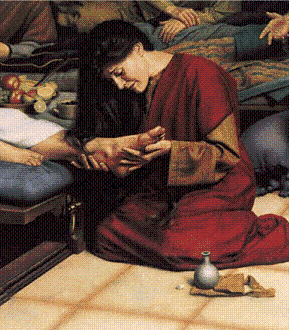
This story is told in all four canonical Gospel accounts.  But it’s never told the same way twice, illustrating yet again that the Bible is not an historical narrative but rather a way to connect us to God and to each other.  The fact, though, that costly and seemingly extravagant perfumed oil is poured onto Jesus is always the same.  So what does that mean?  What could this costly nard mean in our relationship to God?  I think on some level, it represents presence.  It represents the way that we connect, the way that we relate.  It represents the way that we love.  After all, this story is all about presence and connecting with each other.  They have a dinner together; they are served; Mary touches Jesus’ feet; Mary wipes his feet with her hair.  (You will notice that in none of the accounts is Mary checking her email or texting her friend while she is doing this!)  She is present–fully and completely present.

Sometimes I think that our society (myself included!) sometimes forgets what that’s about.  What does it mean to be present, to fully and completely engage with another, to enter their world, to open yourself up to them, to who they are, to the God that you see in them?  If each of us indeed has a piece of the Godself in us, an image of God in our being, then engaging with each other in this very moment is the very crux of our spiritual journey.  It is the way that we journey to God, becoming aware of the moment and the experience that God has placed before us right now.  Alfred North Whitehead supposedly once said that “the present is holy ground.”  Maybe that’s what Jesus was trying to get across.  “Look, look at me now, be with me now.  Take this moment that God gives you now and feel it, for it is offering you each other–see, hear, smell, touch, feel, laugh, love.  In other words, live loving God and neighbor with all your heart and your soul and your might, with everything that you have.”

On this Lenten journey, we are coming closer and closer to the Cross.  Do not be afraid.  Take each step as it comes and extravagantly anoint it.  See, hear, smell, touch, feel, laugh, love.  The point is the journey itself and what you do while your on it.  Eternity is not “out there” somewhere.  It is here, it is now, beckoning you on this path.

Grace and Peace,

Shelli

Station X: Stripped Naked


"Station 10", Peter Adams, 2012
“Station 10”, Peter Adams, 2012

Scripture Passage:  John 19: 23-25a

23When the soldiers had crucified Jesus, they took his clothes and divided them into four parts, one for each soldier. They also took his tunic; now the tunic was seamless, woven in one piece from the top. 24So they said to one another, ‘Let us not tear it, but cast lots for it to see who will get it.’ This was to fulfil what the scripture says, ‘They divided my clothes among themselves, and for my clothing they cast lots.’ 25And that is what the soldiers did.

This tenth station of the Via Dolorosa recalls that the Roman soldiers stripped Jesus of his clothing and gambled for his robe near where Jesus was to be crucified.  Visitors can peer into a Latin chapel through a special window.  This station is disconcerting, to say the least.  Keep in mind that Jesus was Jewish and, as a Jew, had been taught that it was a disgrace to be seen naked.  This would have been the ultimate disgrace.  Jesus, stripped of his humanness and his very dignity, is being prepared for crucifixion.

Dignity is a strange thing.  We think of it as something that we humans can bestow or take away from each other at will.  And, yet, dignity by its very definition is described as innate.  It is a gift from God, a gift of our humanity, so removing it from another is essentially depriving them of something that has not only been given to them but is part of them.  So stripping Jesus of his garments was the way that his tormenters removed his dignity, the way that they made him something less than human, the way that they, in their minds, put him in some way beneath humanity, in some way less than themselves.

Sadly, there are ways that we continue to strip others of their dignity, ways that we over and over again strip humanity of the gifts that God has bestowed.  And it’s not limited to physical stripping, although we as a people are guilty of that over and over again as we allow that to happen to others.  Putting someone in a place of humiliation, a place where they can no longer be who they are called to be does the same thing.  Anytime that we become so convinced of our “rightness”, of our position of being above others, anytime that we misuse and abuse conceived power over others, anytime that we refuse to accept others because they are different than what we think they should be, we have again stripped the garments of Christ from our world.

And yet, Jesus was seemingly passive as the soldiers stripped away at his garments and bared his nakedness for all to see.  Maybe it was because he knew, he knew that he was being stripped of his humanness.  This is the turning point.  This is the way that one prepares oneself, by stripping away at the things that get in the way.  This is the final hour.  The cross is being prepared and Jesus along with it.

So on this Lenten journey, let us allow ourselves to be stripped of those things that get in the way, let us allow ourselves to be humbled that we might be open to receive the Divine into our lives.

Grace and Peace,

Shelli

Resume’

Resume'This Week’s Lectionary Text: Philippians 3: 4b-14

4even though I, too, have reason for confidence in the flesh. If anyone else has reason to be confident in the flesh, I have more: 5circumcised on the eighth day, a member of the people of Israel, of the tribe of Benjamin, a Hebrew born of Hebrews; as to the law, a Pharisee; 6as to zeal, a persecutor of the church; as to righteousness under the law, blameless. 7Yet whatever gains I had, these I have come to regard as loss because of Christ. 8More than that, I regard everything as loss because of the surpassing value of knowing Christ Jesus my Lord. For his sake I have suffered the loss of all things, and I regard them as rubbish, in order that I may gain Christ  9and be found in him, not having a righteousness of my own that comes from the law, but one that comes through faith in Christ, the righteousness from God based on faith. 10I want to know Christ and the power of his resurrection and the sharing of his sufferings by becoming like him in his death, 11if somehow I may attain the resurrection from the dead. 12Not that I have already obtained this or have already reached the goal; but I press on to make it my own, because Christ Jesus has made me his own. 13Beloved, I do not consider that I have made it my own; but this one thing I do: forgetting what lies behind and straining forward to what lies ahead, 14I press on toward the goal for the prize of the heavenly call of God in Christ Jesus.

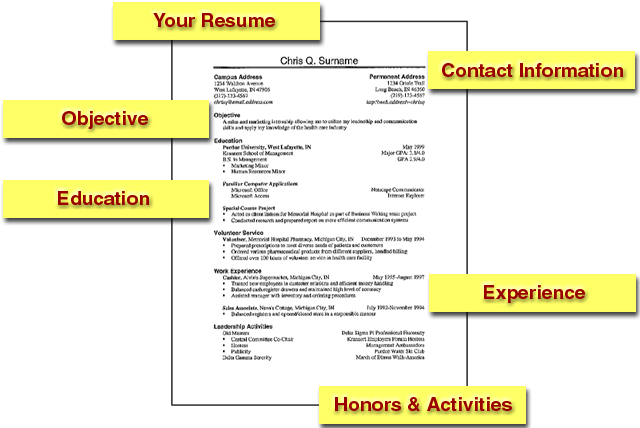
This passage begins with Paul almost sounding a little arrogant, as if he is presenting his resume’ for being a church leader and quashing anyone else that might think themself better for the job than he.  But then his tone changes quickly.  It’s as if the resume’ is just not enough.  The resume’ is not going to get someone to the point in this faith journey where they need to be.  So Paul’s words become a treatise on faith itself, rather than on Paul.  In fact, Paul is almost disputing that claim that being better-versed or better-practiced in the faith brings one closer to God.  I think he might even say quite the opposite.  Paul would discount any blind following of the rules and order of religion and opt instead for a bare openness to what the faith journey itself holds.  In fact, my guess is that Paul would claim that any reliance on our resume’ will get us nowhere.

I saw a feature on one of the news shows this week that talked about the “new” look of resumes.  With the changing economy coupled with the changing needs of the job market, the traditional one or two page, neatly blocked listing of one’s accomplishments just doesn’t cut it anymore.  Oh, it’s not bad, per se, but it will probably not get one farther than the myriads of other one or two page, neatly blocked presentations that get tossed into the same pile.  It just doesn’t work anymore.  Instead, prospective employers want to get a sense of who the person is.  People are now posting on Facebook and tweeting their presentations.  They are providing PowerPoint and You Tube media releases that either augment or replace their resume’s.  One guy called the company that he was hoping would hire him and asked for his resume’ to be pulled because he had another offer.  They called and talked him into interviewing and then hired him.  The point is, a resume’ is now more than a list of accomplishments; it depicts who the person is.  (Gee, I thought I was being stupendously cutting edge by printing mine out on cream or ecru colored paper!)

But, face it, we are a list-driven people.  We want to neatly and systematically check off what headway we’ve made and our faith journey is no different.  It’s really sort of a “catch-22” when you think about it.  Our religion and our belief system provide the necessary grounding that we need for our journey.  They point us in the right direction.  They start us on our journey and they keep us with at least some modicum of framework of what that journey entails.  And yet, if we rely on them, if we turn them into some sort of spiritual resume’, we are lost.  In fact, they just downright get in the way.   Religion does not provide the answers; it provides the questions.  The “prize”, if you will, is not the attainment of the goal.  It is not being “in”; it is not finally and forever getting the position that we so desperately want.  The prize is the journey, the opening of our lives so that God can weave through and truly become for us the One in which we live and move and have our being.  And in order to do that, as Paul says, we have to leave ourselves (and our resume’s) behind and journey into who we are rather than what we’ve done.

So, on this Lenten journey, forget who you are and journey toward who you are called to be. (And don’t worry about your resume’…we’re all behind the times anyway!)

Grace and Peace,

Shelli