Advent 2A: One Voice


HarmonyLectionary Epistle Passage for This Week:  Romans 15: 4-13

4For whatever was written in former days was written for our instruction, so that by steadfastness and by the encouragement of the scriptures we might have hope.  5May the God of steadfastness and encouragement grant you to live in harmony with one another, in accordance with Christ Jesus, 6so that together you may with one voice glorify the God and Father of our Lord Jesus Christ.  7Welcome one another, therefore, just as Christ has welcomed you, for the glory of God. 8For I tell you that Christ has become a servant of the circumcised on behalf of the truth of God in order that he might confirm the promises given to the patriarchs, 9and in order that the Gentiles might glorify God for his mercy. As it is written, “Therefore I will confess you among the Gentiles, and sing praises to your name”; 10and again he says, “Rejoice, O Gentiles, with his people”; 11and again, “Praise the Lord, all you Gentiles, and let all the peoples praise him”; 12and again Isaiah says, “The root of Jesse shall come, the one who rises to rule the Gentiles; in him the Gentiles shall hope.”  13May the God of hope fill you with all joy and peace in believing, so that you may abound in hope by the power of the Holy Spirit.

So you thought you had it figured out?  No where here does Paul depict Scripture as some sort of moral code, some sort of holy instruction book that tells us what is right, tells us what we need to know, tells us what choices to make.  The point is not that Scripture teaches us the “right” way to live but that it opens the door–opens the door to a different way of being, a different way of living, opens the door to hope.  The passage talks of welcoming one another–not correcting one another or shaping one another into some sort of pre-ordained human caricature–but just welcoming. It means opening our arms and welcoming the other, welcoming the one who is different, the one who sings in a different voice.

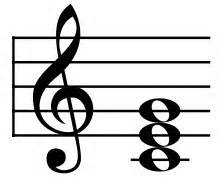
Think of a choir or a symphony or even a band.  The point is not to sing the same note but to learn to sing your own note in tune with those around you.  You know how you do that?  You listen to those around you.  You learn to live not in “sameness”, but in harmony.  If you’ve ever participated in any sort of musical ensemble or even if you simply sat and listened to one, you know that there is something that happens before a note of the music is played.  Nothing happens until the ensemble tunes itself to one voice.  This does not mean that they become each other.  A clarinet will always be a clarinet with a unique timbre and sound. A violin will remain what it is.  And in a choral ensemble, a rich bass voice will never become a first soprano (Thanks be to God!…kidding!).  Each instrument, each voice, remains what they are, remains what God calls them to be.  But before they start playing, they listen. They listen to themselves in a way that other people might hear them.  They listen to those around them to make sure that they blend together.  And, most importantly, they listen to the tuning pitch, to that one voice that will enable them to make glorious music.

That is the lesson that we must learn.  Do not get me wrong.  We are rich in diversity—in the way we look, the way we think, the way we live, the way we move through life.  Thanks be to God!  But there is a common rhythm running through all of our lives, one voice to which we must tune our lives.   That is our hope.  It is not becoming something different than we are but all of us becoming who we are already created to be.  Thomas Merton once said that “everything has already been given.  What we need is to live into it.”

In this Advent season, that is the invitation that we are given–not to re-craft or re-structure our lives into something that fits but to listen to the tune deep within us, the common harmony that runs through us all.  As the Scripture say, we listen to ourselves in a way that others hear us; we listen to our hearts in a way that others feel.  Advent is not some final-inning stretch before God comes.  Rather, it is the final tuning before the symphony begins.

Has it ever occurred to you that one hundred pianos all tuned to the same fork are automatically tuned to each other? They are of one accord by being tuned, not to each other, but to another standard to which each one must individually bow. So one hundred worshipers [meeting] together, each one looking away to Christ, are in heart nearer to each other than they could possibly be, were they to become ‘unity’ conscious and turn their eyes away from God to strive for closer fellowship. (A.W. Tozer)

Reflection:  Where are those place in your life where you need to just listen?  Write them down.  Carry them around.  And, then, shhhh…what are they telling you?

Grace and Peace,

Shelli

To see my full notes for this week’s Lectionary passages, go to http://journeytopenuel.com/.  If you’d like to get them each week, just follow the blog!

Waiting For Each Other

waitingPassage for Reflection:  Isaiah 30: 18-20

18Therefore the Lord waits to be gracious to you; therefore he will rise up to show mercy to you. For the Lord is a God of justice; blessed are all those who wait for him. 19Truly, O people in Zion, inhabitants of Jerusalem, you shall weep no more. He will surely be gracious to you at the sound of your cry; when he hears it, he will answer you. 20Though the Lord may give you the bread of adversity and the water of affliction, yet your Teacher will not hide himself any more, but your eyes shall see your Teacher.

So, what are we supposed to be doing while we’re doing all this waiting?  I think that Advent may be the Master Teacher in waiting, dangling unlit candles each week and angels coming to a young girl and a world that is not ready.  And, of course, the rest of the world decorates the Christmas trees and covers the houses with lights and pressures us to get everything done (Hurry, hurry, hurry…Cyber Monday-Tuesday-Wednesday-Thursday is almost over!!!).  But Advent quietly calls us to wait.  OK, which is it?  Do we wait or do we follow that vision of God and change the world, the vision that has been in front of us all this time?

There’s our problem.  The act of waiting to which we are called, the waiting that Advent teaches us over and over again, year after year, is not your run-of-the-mill-twiddle-your-thumbs kind of waiting.  The waiting to which we are called is active.   It is indeed a waiting that changes the world.  So what, then, are we waiting for?  Well, see, we wait for the time to be right; we wait for our galaxy of stars to perfectly align; we wait for the world to accept the change that we offer, to need the gifts that we have to give.  And all this time, the One for which you were waiting has been waiting for you.

So in this season of Advent, we are told to wait.  We are not told to stop, just to wait.  Perhaps it is our time to let go of the plans that we had made, to let go of what or who we envisioned would save us.  Perhaps it is the time to return to the One that envisioned us in the first place, the One that is waiting for us to return, the One that calls us to act, to work, to build the Kingdom of God.  Advent is not about stopping what you are doing but just rethinking it.  We are called to be a part of bringing God’s vision into being but we have to wait long enough to know what the vision is.  God is waiting for us to realize that…And we are called to realize that all this time God has been there…waiting, waiting for us to wait for God.  All this time we were waiting for each other…

Click to listen…

http://www.youtube.com/watch?v=lIY_2t0ZKPU

Reflection:  For what are you waiting?  Are you waiting on the God who is waiting on you?  What part of God’s vision are you being called to change?  Perhaps you’ll have to wait on the other parts, but is there something that you are called to do now?  Is there something that God is waiting for you to do?

Grace and Peace,

Shelli

Advent 2A: Shoots and Stumps

Garden of Gethsemane 07 (New Shoots)Advent 2A Old Testament Passage: Isaiah 11: 1-10

A shoot shall come out from the stump of Jesse, and a branch shall grow out of his roots. 2The spirit of the Lord shall rest on him, the spirit of wisdom and understanding, the spirit of counsel and might, the spirit of knowledge and the fear of the Lord. 3His delight shall be in the fear of the Lord. He shall not judge by what his eyes see, or decide by what his ears hear; 4but with righteousness he shall judge the poor, and decide with equity for the meek of the earth; he shall strike the earth with the rod of his mouth, and with the breath of his lips he shall kill the wicked. 5Righteousness shall be the belt around his waist, and faithfulness the belt around his loins. 6The wolf shall live with the lamb, the leopard shall lie down with the kid, the calf and the lion and the fatling together, and a little child shall lead them. 7The cow and the bear shall graze, their young shall lie down together; and the lion shall eat straw like the ox. 8The nursing child shall play over the hole of the asp, and the weaned child shall put its hand on the adder’s den. 9They will not hurt or destroy on all my holy mountain; for the earth will be full of the knowledge of the Lord as the waters cover the sea.  10On that day the root of Jesse shall stand as a signal to the peoples; the nations shall inquire of him, and his dwelling shall be glorious.

We Christians tend to read this with our own Christ-centered lens.  The shoot–newness, replacing the old sad stump–and the branch–us, growing from the foundations that have been laid.  And yet, this Scripture is purely Old Testament, purely Hebrew Scripture.  It speaks of a vision, a vision when life will be what God calls it to be, when the earth and all that it holds will finally once and for all live together just as the Lord intended.  Jesse was the father of David, the pinnacle of the great dynasty of Israel.  But dynasties and kingdoms have life spans just as people do.  And what was once a thriving political powerhouse becomes a stump, seemingly useless for the world, a shadow of the past.  And yet, from what we thought was dead suddenly springs forth life, providing a foundation for a new shoot.  It creates a new order, a new way of seeing the world, a time of peace and unity for all the world.  The people of Israel expected this from their king.  This was what God intended–an order of justice and righteousness and peace.  They long for a dynasty such as this, one with all the solid foundations of the past but one that grows in righteousness.

So, back to the Christ-centered lens…new order, justice, righteousness, peace…isn’t that the thing for which we hope?  In this season of Advent, we once again remember and live that hope of the people of Israel for the Messiah, the Savior of the World.  And we prepare for this year’s coming that will once again push us just a little bit closer to who we are meant to me.  And at the same time we wait for our own Advent, our own coming of God in its fullness.  Advent is all these things.  We long for that new creation.  We long for the day when  warriors will sit down with those that they now attack, when predators will live in peace with their victims, and when those that consume more than they need just because they can finally come to the realization that the resources of this world belong to all.  We hope against hope for a world without poverty and homelessness, without the threat of annihilation from weapons of all kinds, a world where each and every child has enough nutrition and education and healthcare to grow and flourish into who God calls him or her to be.

So, are we the shoot or the stump?  Are we the newness bursting forth or are we the foundation from whence it comes?  The answer is yes.  The two are so inter-connected that they cannot be separated.  The shoot does not just drop out of the sky but is born into generations upon generations of waiting and hoping for the Light to come.

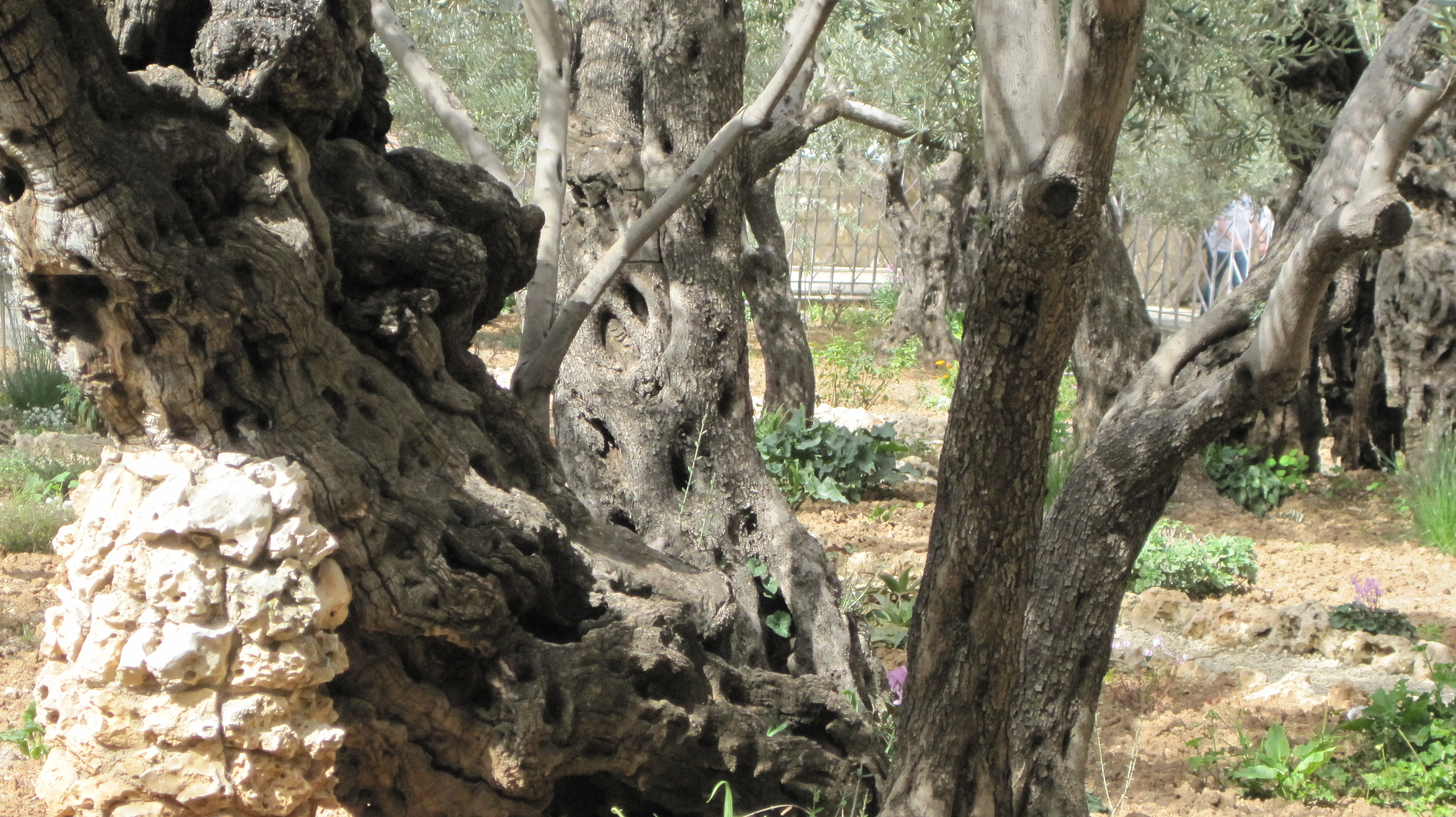
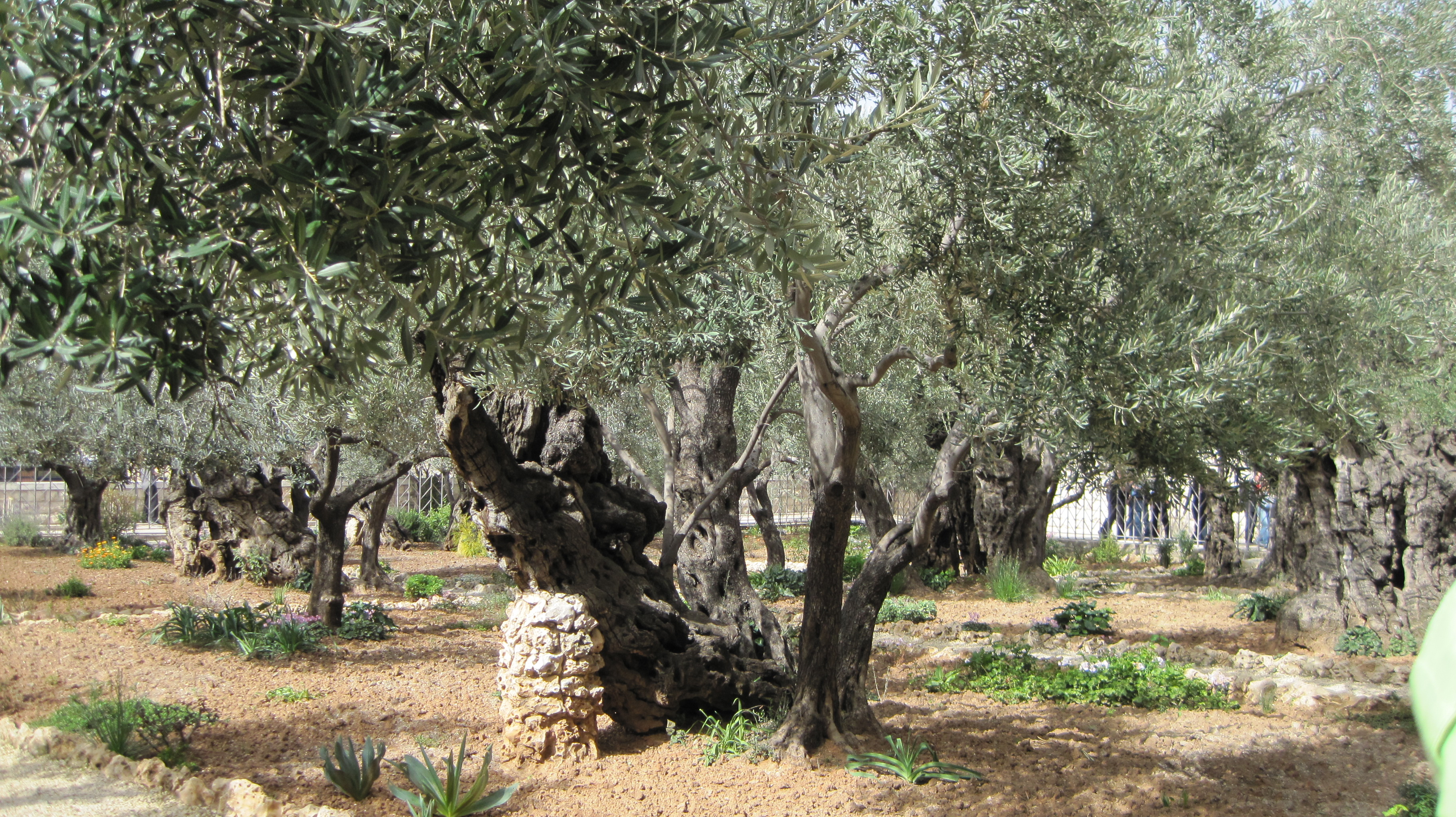
Garden of Gethsemane 08 (New Shoots)When I was in Israel a few years ago, I was fascinated with the olive trees.  You see, they live hundreds or perhaps even a thousand years.  And then they die, they leave what seems to be a mere stump.  But the root system gives way to something new.  So one of the oldest trees has a stump that is thousands of years old, almost petrified from the eons of weathering.  But shooting from its foundation is another tree that is hundreds of years old.  And shooting from it is another younger tree.  And shooting from it is yet another brand new shoot.  The tree is both a stump and a shoot, embracing the foundations of the past but leaving room for newness and recreation, leaving room for God’s work.  And they exist together there in the garden, the Garden of Gethsemane.

God did not create a disposable world, regardless of what we do with it.  God created an earth that would sustain itself not as individual lives making their way on others but as solid foundations giving way to new life.  Both shoots and stumps are part of God’s vision for what will be.  God is not replacing but recreating, redeeming, and resurrecting over and over again.

The fullness of joy is to behold God in everything. (Julian of Norwich)

Reflection:  Where are the stumps in your life?  Now look closer.  What shoots do you see emerging from them?  Are there parts of your life that you have discarded before God was finished working on them?

Grace and Peace,

Shelli

To see my full notes for this week’s Lectionary passages, go to http://journeytopenuel.com/.  If you’d like to get them each week, just follow the blog!

In the Spirit of Waiting

waiting-on-god1Passage for Reflection: Habakkuk 2:3

For there is still a vision for the appointed time; it speaks of the end, and does not lie.  If it seems to tarry, wait for it; it will surely come, it will not delay.

Most of us do not wait well.  It is not in our nature.  Our society tells us to “hurry up”, to “not waste time”, to “make the most of our time”.  And so we run and we hurry and we go through the season with our lists and our parties and our hope against hope that we can get it all done.  And then we get there.  We will sit in the sanctuary on Christmas Eve like we have done every year and we will wonder, wonder where it all went, wonder what happened to the holiness of Advent waiting, wonder what happened to the joy of it all.  Well, today is the beginning of the waiting, the beginning of living with hopeful expectation.  Yes, this year will be different!  We will light the first candle, the candle of hope and promise, the candle that calls us to wait.

Simone Weil once wrote that “waiting patiently in expectation is the foundation of the spiritual life.” Now, read that again.  The point of her statement is not calling us to patience but to expectation.  We are called to wait, yes, but to wait with the belief, no, more than belief, to wait with the conviction that someday, in some way, God will come.  Think about it.  Would you stand in line at the grocery store, impatiently looking at your watch, somewhat miffed at the women who is checking out 38 canned goods that were carefully concealed in the bottom of her basket, using 42 paper coupons (did you know that you can load those on your card, lady?), and then handing every known type of squash to the high school-age checker that has never seen these vegetables before if you didn’t know that, eventually, you would get there?  Eventually, you will get to the front of the line.  Would you sit there as the seconds roll into minutes and the minutes approach a partial hour as you wait to talk to a real person at the cable company? Eventually, as you know, SOMEONE will answer. And would you spend time sitting in the doctor’s waiting room (good grief, they don’t even make any bones about it–they just go ahead and call is what it is!  What if they called it the expectation room?  But no, someone way back there said, you know what, we’re going to make people wait and we’re going to build a room just for that purpose!) if you didn’t know that you really were going to be able to see the doctor?  No, see, none of us would do all this waiting that we do without some level of expectation, some belief that the thing for which we are waiting really IS going to occur.

So why is Advent different?  What does it mean to wait expectantly for God, not feeling compelled to make something happen or fill in the spaces that feel temporarily empty in our faith, but to just wait?  Henri Nouwen said that “the whole meaning of the Christian community lies in offering a space in which we wait for that which we have already seen.”  That’s right.  Remember that we KNOW that this is going to happen, we KNOW that God will come because God has come before over and over through centuries of waiting and even in our own lives.  Waiting is not some sort of grand proof that we are patient enough to be followers of Christ; waiting is a part of the story itself.

I remember when I was little.  Christmas Eve was magical.  We would drive home, usually near midnight, from Grandmother and Granddaddy Reue’s, and as we made our way down the dark roads between Fulshear and Katy, I used to look at the lit radio tower.  I knew it was a tower but, just for that moment, it was Rudolph leading Santa to our house.  Just for that moment, it was a glimmer of light in an otherwise darkened world.  And when we got home, I would try and try to go to sleep but it was just all too exciting.  Christmas was coming.  It always came.  And in some way, it changed the world.  You see, to me, that time of waiting, that time of expectancy was part of Christmas itself. So, let a little magic into your life.  Get into the spirit of waiting, waiting with expectation that God will come (because God always comes).

We are waiting for what we know.  But the waiting is part of the journey itself.  We wait with the expectation that the world will change.  We live with the expectation that God will come when God will come and the world will finally know that hope has been born.  We wait not because there is nothing else to do or because patience is some sort of virtuous way of being but because we know that each waiting moment is part of God’s bringing freedom and peace and life to us all.  And, in every moment of every day of every lifetime, God waits with us, waits for the world to awaken to the light.

Blessed be the God of Israel, who comes to set us free, who visits and redeems us, and grants us liberty.  The prophets spoke of mercy, of freedom and release; God shall fulfill the promise to bring our people peace.

On prisoners of darkness the sun begins to rise, the dawning of forgiveness upon the sinner’s eyes, to guide the feet of pilgrims along the paths of peace; O bless our God and Savior with songs that never cease!

“Blessed Be the God of Israel” (vs. 1,3), Michael Perry, 1973

Reflection:  What does it mean to wait expectantly?  What does God’s promise of life look like to you?

Grace and Peace,

Shelli

Beginning at the End

Closed CurtainAdvent 1A: Matthew 24: 36-44

36“But about that day and hour no one knows, neither the angels of heaven, nor the Son, but only the Father. 37For as the days of Noah were, so will be the coming of the Son of Man. 38For as in those days before the flood they were eating and drinking, marrying and giving in marriage, until the day Noah entered the ark, 39and they knew nothing until the flood came and swept them all away, so too will be the coming of the Son of Man. 40Then two will be in the field; one will be taken and one will be left. 41Two women will be grinding meal together; one will be taken and one will be left. 42Keep awake therefore, for you do not know on what day your Lord is coming. 43But understand this: if the owner of the house had known in what part of the night the thief was coming, he would have stayed awake and would not have let his house be broken into. 44Therefore you also must be ready, for the Son of Man is coming at an unexpected hour.

Oh, this can’t be right.  Our Gospel passage for the first reading in Advent is starting toward the end of the Gospel According to Matthew.  What happened to Mary?  Where are those angels announcing the coming birth?  After all, we need something joyful to think about it as we drag the boxes of Christmas decorations out of storage and begin to prepare for the season that most retailers have already proclaimed on the heels of the Jack-o-Lanterns!  I mean, really, first they tell us that we have to wait to sing Christmas carols and then they give us this perceived warning of a thief coming in the middle of the night.  Why in the world are we beginning at what feels like the end of the story?

There are those in our modern world who will pounce on this Scripture as a warning of what might happen if we do not act right or think right or live right.  There are those who will abuse it by holding over the heads of persons to scare them into religion.  I don’t think that’s what it’s about.  Faith is not about doing the right thing or living the right way or being scared into a place that does not feel welcoming and grace-filled.  Faith is about relationship.  And, as the Scripture says, it is about waking up so that God can gather us in.  God doesn’t want a bunch of zombies that have to be pulled kicking and screaming into faith.  God desires a relationship with those who desire a relationship with God.  And God has faith that in the deepest part of ourselves, there is faith enough for all.

Jesus is not standing at the edge of some far off place waiting for us to step over the line.  Jesus is here, ahead of time itself, calling and gathering and sanctifying each of us as we awake to the morning.  Remember last week’s Scripture that we read for Christ the King? We were again given the image of Jesus hanging on the Cross, minutes away from death.  It was the end.  And there, there beside him was the thief.  “But understand this: if the owner of the house had known in what part of the night the thief was coming, he would have stayed awake and would not have let his house be broken into. 44Therefore you also must be ready, for the Son of Man is coming at an unexpected hour.” The thief was not left behind but instead was gathered into the Reign of God.  Advent is not waiting to see whether or not you make the cut but rather waking up to the glorious Gathering that is happening all around us.

The curtain on the Advent season is about to rise.  Jesus is not waiting in the wings somewhere until the play is done; rather, Jesus is standing on the stage itself, inviting us in.  “Come, wait with me.  You do know when the Glory will come but this waiting is a holy place.  Come, all, wait with me.  Stay awake so that you won’t miss the inbreaking of Glory itself, the dawn of the fullness of the Kingdom of God.”  The reason that we begin at the end is because it is the same as the beginning.  God is the Alpha and the Omega.  Birth and death are all wrapped up together, needing each other to give life.  Awaken now that you do not miss one thing.  Open your eyes.  There is a baby coming!  The extraordinary miracle of what is about to happen is matched only by the moment before it does–this moment, this time.  The world awaits!  Awaken that you do not miss the story!

Awake! awake! and sing the blessed story; Awake! awake! and let your song of praise arise;                                                                       Awake! awake! the earth is full of glory, And light is beaming from the radiant skies;                                                                                  The rocks and rills, the vales and hills resound with gladness, All nature joins to sing the triumph song.

(Refrain)  The Lord Jehovah reigns and sin is backward hurled! Rejoice! rejoice! lift heart and voice, Jehovah reigns! Proclaim His sov’reign pow’r to all the world, And let His glorious banner be unfurled! Jehovah reigns! Rejoice! rejoice! rejoice! Jehovah reigns!

Ring out! ring out! O bells of joy and gladness; Repeat, repeat anew the story o’er again,                                                                             Till all the earth shall lose its weight of sadness, And shout anew the glorious refrain;                                                                                   Ye angels in the heights, sing of the great Redeemer, Who saves us from the pow’r of sin and death.

(Refrain)

“Awakening Chorus”, Charles H. Gabriel, 1905

Reflection:  Advent is our awakening season.  What do you need to do to no longer hit the “snooze button” of your faith?

Grace and Peace,

Shelli

Turning the Page

Cross and LightLECTIONARY GOSPEL PASSAGE: Luke 23: 33-43 (Click to read)

All of the Scriptures for this week lead us to this Sunday, known as “Christ the King” Sunday.  It is the final Sunday of our Lectionary year, the end of the season of Pentecost, when as the community of faith, we move through the season of building the church and its journey toward sanctification in the fullness of God’s Kingdom.  The Sunday after next begins the season of Advent, when we will begin the whole cycle again.

But if you think that this is merely an annual repeating motion of the same thing over and over, think again.  Our liturgical calendar invites us into an ongoing cycle of preparing, birthing, seeing, emptying, rebirth, and becoming, as we journey toward the fullness of the Kingdom of God, lived, as Rainer Maria Rilke said, in “ever widening circles”, reaching farther and farther beyond ourselves, encompassing all of Creation. Over the past few months, we have recounted the rich stories of the Old Testament through the eyes of many  of the Prophets as they sought to illuminate what it was those early people of God were meant to become.  And we once again read many of Jesus’ parables, this time from the Gospel According to Luke, those incredible stories of wisdom found in everyday life.  The reason that we read these stories over and over again from Creation through the cycle of life is because, as we’ve said before, they are our story, they are the recounting of our own becoming who we are, they are our journey toward being the people of God.  Perhaps it gives us more and more of a sense that we are not, as we might think, the center of the universe; rather, we are part of the story.  Henry Van Dyke said that “if the meaning could be put into a sentence, there would be no need of telling the story,” so each liturgical cycle we tell our story. 

This week is not the end.  It is the beginning, a new beginning.  The Gospel passage that the Lectionary assigns us this week probably feels a little odd.  I mean, really, look around.  The Christmas season is bombarding us from all sides (even though my Thanksgiving turkey has yet to be purchased!…yeah, I know…get on that, Shelli!) and we are reading a Good Friday passage.  This is just messed up. But we read of a thief or a criminal (depending on your translation) hanging there with Jesus that asked for mercy from this one who in this moment he truly knew was the Christ.  Jesus’ response did not include asking him what he had done with his life.  He did not demand either a confession or a profession.  There was no “if” attached to his answer—no condition of “if you clean up your life” or “if you promise to stop doing what you do or being who you are” or “if you become someone different so that you will fit in with what we think we are all supposed to look like”.  None of that mattered.  Because in this moment, the man that history has never named anything but “Thief” entered the story that we call the Gospel and was promised eternal life.  THIS was Jesus’ crowning glory.  THIS was the true coronation of Christ as King!

You see, it’s not about what we do or who we are.  It’s about becoming the story, becoming the Gospel, the Good News of Jesus Christ.  It’s not about placing a crown on the head of our King but about becoming part of the Coronation, part of that image of Christ the King.  It’s not about proclaiming Christ as King but about being the presence of Christ in this world.  O Come, O Come, Emmanuel, God with Us.  And now we know that’s exactly where God is.  It’s about entering the story.

Mortals, join the mighty chorus which the morning stars began;

Love divine is reigning o’er us, binding all within its span.

Ever singing, march we onward, victors in the midst of strife;

Joyful music leads us sunward, in the triumph song of life.

(Henry Van Dyke, “Joyful, Joyful, We Adore Thee”, alt. st. 4, 1989)

Look, the light is just over the horizon.  The world is with child.  For this we were created.  All we have to do is turn the page and follow the story.

What does it mean to you to proclaim Christ the King?

What does it mean to you to become part of the story?

Grace and Peace,

Shelli

And now for some program notes…yes, I know it’s been too long since I’ve posted on “Dancing to God”, but I’ve promised that I would come back for Advent (and it’s been publicized in the church paper, so I have to stick with it!), so here’s a way for us to “turn the page” (aaarrrggghh….aaarrrggghhh…aaarrrggghhh).  I’ll post some entries next week that will cover the Lectionary passages for the first Sunday in Advent and then beginning December 1, the first Sunday of Advent, we’ll do something every day.  Thanks for joining me!  Also, if you’re interested, my weekly Lectionary notes are posted on another blog that can be found at http://journeytopenuel.com/.  I usually post those on Sunday evening or Monday morning for the following week.  There is some overlap with this blog because I only have one brain, but I’d love for you to follow that one too!  Shelli

Bending Rules

Bending tree2This Week’s Lectionary Text: Luke 7:36-8:3

I am for the most part a rule-follower (so I’m trying to get back to posting some blogs!).  Part of it is due to what could probably be considered my meticulous, “Type A” personality, but my guess is that most of it is due to my small-town, Protestant upbringing.  Rules are good.  They create boundaries; they can provide protection; they serve as a foundation on which to stand and from which to grow as we are guided by the remnants of the past.  Our society and our lives are built on rules.  So what happens when the rules are not followed?  Does it always result in chaotic anarchy?  Or are there some rules that it’s alright to stretch just a bit? Do you think that there are possibly some rules that need to be bent?

We all know enough about religion to know that it was based on rules from the very beginning.  My own denomination’s generally-accepted beliefs and consensual polity are encapsulated in The Book of Discipline of the United Methodist Church.  This is not a new publication.  It’s been around for about as long as Methodism has been in the United States.  I have a small collection of antique Disciplines and the oldest one that I have is dated 1828.  I also have one that I found in my great-grandfather’s attic.  It’s from 1900.  When you look through it, there are some similarities to our current one.  It has the Articles of Religion and the General Rules.  But it’s also got some rules that we would probably consider just downright odd.  They seemed to be very concerned with how people dressed and intent on insuring that people did not come to church wearing too much jewelry.  There are very few of us that would fit into that mold of what we’re supposed to look like when we come to church.  The point is that sometime rules change.  Sometimes they need to be edited or added to and I think sometimes they need to be thrown out altogether.       

In the Gospel passage that we read, we are given lots of rules.  It starts at the beginning when it tells us that Jesus “took his place at the table.”  He took his place as if there was a designated place where he was supposed to sit.  It was probably, you could surmise, toward the head of the table to the right of the host.  Isn’t that what the rules of etiquette usually tell us?  And then this woman enters—a woman already defined by the community and now by Scripture as a “sinner”.  Somewhere along the way she had apparently broken some rule of conduct and violated what would be considered an acceptable way of living and being. (People have often designated her a prostitute.  Go there if you want, but it never really tells us, so…maybe that’s not a great “rule of thumb”!)  And now she is apparently interrupting what is probably a perfectly-choreographed evening in the home of one of the most respected religious leaders.  She desires to anoint Jesus’ head with oil.  (Boy, I hope she doesn’t get that all over the imported tablecloth!) But standing nearer Jesus’ feet, she is suddenly overcome with emotion and begins to weep.  She begins to wash his feet with her tears, takes down her hair to dry them and then kisses them and pours the anointing oil on them.  What a spectacle that must have been!  And right here in the home of this respected Pharisee!

And so the Pharisee not only pronounces judgment on the woman, but also on Jesus.  After all, they had both broken the rules!  Woman of questionable reputation did not act like this, with weeping and flying hair and all, and if Jesus was really who he claimed to be, he would have known better.  But Jesus’ response is not the apology that the Pharisee and his “respectable” guests probably expected.  Instead Jesus challenges Simon’s pronouncement of both of them by launching into a parable about forgiveness.  And woven through the parable are reminders of what the woman did.  She openly and generously gave of herself, more than anyone else at the table had done.

Jesus is trying to make them realize that there is something more than rules, there is something more than religion, and there is something more than doing the “right thing”.  Ralph Waldo Emerson said that “the faith that stands on authority is not faith”.  I think that is what Jesus is trying to get across.  Faith is not about rules.  The woman’s intense act of love beyond all reasonable expectations and all acceptable actions becomes a means of grace.  It leads us to God.  It shakes us out of our comfort zones of what is normal and expected and even acceptable because, when you think about it, Jesus was very seldom normal and expected and even acceptable.  Instead he showed us how to step out of our boxes and live a life of faith—real faith that is untamed and uncontrolled and virtually undefined, a faith that rips open our carefully-sewn-together lives just enough to let God’s presence spill into them.     

 In a 2006 article in the “National Catholic Reporter”, editor Tom Roberts said that “we live in an age of expanding religion and a diminishing God.”  Those words probably make several of us squirm.  After all, have we become so sure of who we think God is and what we think God wants from us that we are willing to sacrifice the new and expanding ways that God interacts with our lives?  Religion and faith are not the same thing. Religion is about what we believe and why we believe.  It is about tradition, the institution, the system, and, yes, the rules.  When you think about it, our religion has been constructed over centuries.  It has given us creeds and liturgy and definitions of God.  It gathers us and grounds us and reminds us of a world to come.  It gives us commandments and rules that guide the way we live so that we can become what we seek, so that we can journey toward a oneness with God.  It is meant to lead us to God, not pave the way (as in make it easier) or drive us there. 

Somewhere in the midst of those rules we, like Jesus, have to do a little bending.  We have to at some point move beyond and transcend the rules and rituals.  We have to look beyond where we are to that place to which God calls us.  That is where faith comes in.  That is where God, greater than any religion, meets us.

In her book, Called to Question, Joan Chittister says that “in order to find the God of life in all of life, maybe we have to be willing to open ourselves to the part of it that lies outside the circles of our tiny little worlds.”  She goes on to tell a Sufi tale of disciples who, when the death of their master was clearly imminent, became totally bereft.  “If you leave us, Master,” they pleaded, “how will we know what to do?”  And the Master replied, “I am nothing but a finger pointing at the moon.  Perhaps when I am gone you will see the moon.”  The meaning is clear:  It is God that religion must be about, not itself.  When religion [or rules] makes itself God, it ceases to be religion.  But when religion becomes the bridge that leads to God, it stretches us to live to the limits of human possibility.”[i]  Chittister maintains that “religion ends where spirituality begins.”  From that standpoint, these rules, these dogmas, all of these things that make up our religion are not our faith journey, but they lead us through it.  They are, from that standpoint, a means of grace.

And as we change, as our journey changes, as our context changes, perhaps we are sometimes called to the act of bending rules.  It doesn’t mean that we’re dismissing them or ignoring them.  It means that we are allowing the conversation about God to continue.  But more important than that, it means that we are becoming part of the conversation.  We are becoming part of the journey.  And so, perhaps we really are called to a spiritual discipline of bending the rules sometimes.  It is part of the ongoing conversation, the ongoing faith journey of which we are a part.  Sometimes that bending means we just understand it better after we’ve questioned and explored.  Sometimes it means that we need to add something to make it clearer for us and for those who walk this journey with us.  And sometimes it means that we need to get rid of things that no longer augment or serve to depict our understanding of who God is and how God enters and is revealed in our lives.   Hugh E. Brown said that “Christianity is not being destroyed by the confusions and concussions of the time; it is being discovered.”  That is the point.  We don’t discover how God is revealed to us without continuing to think about it, continuing to look and re-address how we have understood God. 

That’s what Jesus was doing that day at the Pharisee’s house.  He wasn’t shunning the rules that had been a part of the faith tradition for as long as anyone could remember.  He was just bending them a bit, making them a bit more pliable, a bit more nimble, a little bit more transcendent, a little bit closer to what God had in mind.  The rules are meant to be foundations on which we can stand and through which God is revealed.  But when they become boundaries that control who is welcome and who is accepted, or who is invited to live out their own calling or who is not, that is not what God is about.  So, Jesus didn’t really follow the rules.  In fact, Jesus often got himself in trouble with those rule-followers.  Jesus just loved God and wanted to reveal that love for us and everyone else.  And here was this woman—a sinful woman, the Scriptures say—shunned by the rule-followers and welcomed by God.  Because you see this woman did what we are called to do—love generously and extravagantly, love the way that God loves.  G.K. Chesterton said that we should “let our religion be less of a theory and more of a love affair.”  There are really very few rules—except to love the way God loves and be open to doing perhaps a little bending.

So, go do a little rule-bending of your own!
 
Grace and Peace,
 
Shelli
 
(To see notes on all of the Lectionary texts for this week, go to http://journeytopenuel.wordpress.com/)


[i] Joan Chittister, Called to Question:  A Spiritual Memoir, (Lanham, MD:  Sheed & Ward, 2004), 19-20.