Advent 3A: Hurry Up and Wait!

Seeded FieldLectionary Passage for Reflection:  James 5: 7-10

Be patient, therefore, beloved, until the coming of the Lord. The farmer waits for the precious crop from the earth, being patient with it until it receives the early and the late rains. You also must be patient. Strengthen your hearts, for the coming of the Lord is near. Beloved, do not grumble against one another, so that you may not be judged. See, the Judge is standing at the doors! As an example of suffering and patience, beloved, take the prophets who spoke in the name of the Lord.

OK, I have to admit that I am not the most patient person in the world.  (Like THAT’S a big surprise!)  So, this whole Advent notion of waiting and waiting some more is almost too much to bear.  And don’t you hate it when someone tells you to “be patient”.  Grrrr!  Look, you just don’t know what all I have going on in my life.  You just don’t know how hard that is!  (Yeah, I know, that sounds way too familiar for comfort!)  And something about this season makes it even harder.  We have to hurry up and get the tree up!  And then we have to hurry up and get all the shopping done!  And then we have to hurry up and get the gifts wrapped!  And then we have to hurry to the party and hurry with the cooking and hurry with the hurrying.  And, please, please tell us what will happen next so that we can get ready!  So, how in the world with all this hurrying are we expected to be patient, to wait for God’s time to be our own. 

There is a story that you’ve probably heard of an American traveler on safari in Kenya.  He was loaded down with maps, and timetables, and travel agendas.  Porters from a local tribe were carrying his cumbersome supplies, luggage, and “essential stuff.”  On the first morning, everyone awoke early and traveled fast and went far into the bush.  On the second morning, they all woke very early and traveled very fast and went very far into the bush.  On the third morning, they all woke very early and traveled very fast and went even farther into the bush.  The American seemed pleased.  But on the fourth morning, the porters refused to move.  They simply sat by a tree.  Their behavior incensed the American.  “This is a waste of valuable time.  Can someone tell me what is going on here?”  The translator answered, “They are waiting for their souls to catch up with their bodies.”

Maybe that’s what this Advent season is–a season of waiting for our souls to catch up.  (So why did they put it in the busiest season of the year!  That doesn’t make sense!)  Whoever wrote this short epistle buried toward the back of the New Testament knew exactly what our problem was.  He or she knew that when we get something in our head, when we set our sights on something, we want it immediately if not last night sometime.  And so, many of us are running around with bodies and souls that are dangling, disconnected, not quite able to reach other, not able to connect.  Stop.  Stop what you’re doing.  Like the farmer, all that you are is planted and fertilized.  Now you have to wait.  You have to wait for God’s Spirit in God’s Time to rain in, drenching the thirsty soil.  Your soul knows how to wait.  There is a Divine Wisdom planted deep within.  The soul moves slowly soaking up everything in life.  Oh, what our minds and bodies could learn from that!  But we have be patient.  Sometimes we have to wait.  And sometimes we might even have to step back and be led to the next place. 

Perhaps rather than living life with the words “hurry up” always on our lips, we should live a life of “Amens”, “so be it”.  Life will be what life will be.  God knows that this is not easy.  There are things that we must finish and there are patches that we want to quickly run through so that we don’t experience the pain or the heartache.  God knows that it is hard to wait.  It is not God’s will that we suffer or that we have difficulties in life.  It is God’s will that we become who God envisioned us to be, that Creation becomes what God meant it to be.  It is all there, planted and fertilized.  But it takes time.  You have to wait.  The time is near but it is not yet right.  There is still more to come.

And ye, beneath life’s crushing load, whose forms are bending low, who toil along the climbing way with painful steps and slow, look now! for glad and golden hours come swiftly on the wing, O rest beside the weary road, and hear the angels sing!

For lo! the days are hastening on, by prophet seen of old, when with the ever-circling years shall come the time foretold, when peace shall over all the earth its ancient splendors fling, and the whole world send back the song which now the angels sing.

Edmund H. Sears, 1849

Reflection:  Why are you such a hurry?  What are you missing by hurrying through life?  What is your soul trying to teach you?

Grace and Peace,

Shelli
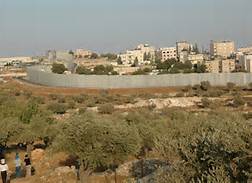
Searching for Home


Modern-Day Bethlehem and the West Bank wall

Passage for Reflection:  Ruth 1:16b

“Do not press me to leave you or to turn back from following you! Where you go, I will go; Where you lodge, I will lodge; your people shall be my people, and your God my God.

What does “home” mean to you? Is it the place that keeps you safe?  Is it the place that encourages you to grow, to pursue your dreams, to become better than you are?  Is it the place to which you return or the place that you’re trying to find?  Is it the place you know or the place where you are known?  Robert Frost said that “home is the place where when you have to go there, they have to take you in.” (Personally, that sounds a lot like grace to me!)  Emily Dickinson said “where thou art, that is home.”  Ann Danielson said that “home is where your story begins.”  So when did home turn into something that we protect, something that we “own”, something that we use to close the doors and shut out the world?  When did home become something that keeps us where we are?  When did home become our stopping point?

These words of Ruth’s are not, as popular culture’s wedding traditions often assume, about a married or a marrying couple.  They are a daughter-in-law’s words to her mother.  And perhaps buried deep within their meaning is something even more.  They are also the words of a displaced, homeless wanderer desperately searching for home.  They are the words of one who lives in poverty and exile who is looking for a new story, a new life.  They are the words that begin a journey to Bethlehem.  So, Ruth, the Moabite, the foreigner, the one who really does not belong in the story travels with Naomi in search of a home.  And she becomes a part of the story, a story that also happens in Bethlehem.  Generations later, the Gospel writer known as Matthew will name Ruth as the ancestor of Jesus.

We will read the story of Jesus’ birth in a few weeks and we will bemoan the fact that there was no room for him, no home for him to begin his life on this earth.  Maybe that was the point.  Maybe it was because the world as it was, a world full of homelessness and poverty, a world full of empires vying for control, a world full of those who would shut the doors of their homes to others, was never really going to be home.  There was never really room for Jesus in this world the way it was.  And he lived a little more than three decades, we are told, wandering, never really settled, in search of a home.

Maybe that is what this season of Advent with of its stories of exiles and wild men in the wilderness, stories of misfits and rebels that are searching for a place to belong, a place that makes sense, a place that fits with the vision that they have been shown, teaches us.  (Good grief, ANOTHER Advent lesson?!?)  13th and 14th century theologian Meister Eckhart once said that “God is at home; it is we who have gone out for a walk.” Maybe, then, home is not the place where we hide under the covers all warm and toasty; maybe it is not the place to which we return but rather the place to which we are drawn.  Our faith journey is an incredible act of searching for home.  It is not the place that makes us comfortable but the place that gives us meaning, the place that makes us real, the place that makes us become who God calls us to be.  That vision that God holds for us is not one that draws us into the unknown but rather one that brings us home.  “Home is where your story begins.”  It begins now.  Have you ever thought that Advent is not about making room for Christ in the midst of what you know but rather following Christ in search of God’s vision of Home, not a home in some far off place in your next life, but home with God even now?  Advent is not about making room for God in your life but rather following God into the life in which God has made room for you.  But sometimes, like Ruth, you have to leave what you know behind.

Reflection:  What does “home” mean to you?  What places do you need to leave behind to search for home?

Grace and Peace,

Shelli

Advent 3A: Altars in the Desert

Crocus Desert IrisThis Week’s Lectionary Passage:  Isaiah 35: 1-10

The wilderness and the dry land shall be glad, the desert shall rejoice and blossom; like the crocus it shall blossom abundantly, and rejoice with joy and singing. The glory of Lebanon shall be given to it, the majesty of Carmel and Sharon. They shall see the glory of the Lord, the majesty of our God. Strengthen the weak hands, and make firm the feeble knees. Say to those who are of a fearful heart, “Be strong, do not fear! Here is your God. He will come with vengeance, with terrible recompense. He will come and save you.”  Then the eyes of the blind shall be opened, and the ears of the deaf unstopped; then the lame shall leap like a deer, and the tongue of the speechless sing for joy. For waters shall break forth in the wilderness, and streams in the desert; the burning sand shall become a pool, and the thirsty ground springs of water; the haunt of jackals shall become a swamp, the grass shall become reeds and rushes. A highway shall be there, and it shall be called the Holy Way; the unclean shall not travel on it, but it shall be for God’s people; no traveler, not even fools, shall go astray. No lion shall be there, nor shall any ravenous beast come up on it; they shall not be found there, but the redeemed shall walk there. And the ransomed of the Lord shall return, and come to Zion with singing; everlasting joy shall be upon their heads; they shall obtain joy and gladness, and sorrow and sighing shall flee away.

Look!  Look really, really hard!  This is not some proclamation of some future utopian world.  This is not our reward that God is dangling before us for living righteous lives.  This is not some other place in some other realm or some other life.  This is God’s vision for the world that is here, that is now.  It is there, blooming in the desert even as we speak.  The question, then, is whether or not we really dare to imagine it into being, dare to open our eyes to see the Kingdom of God come pouring into our lives.  Albert Einstein once said that “your imagination is your preview of life’s coming attractions.”  So what do you imagine is next?  The writer of this passage was probably writing to an exiled people, a people who had been so beat up and put down that they were having a hard time imagining anything else.  But this writer looked at a world that was in chaos and saw order, looked at a road so overgrown that it was thought to be impassable and saw a highway, and looked at the thirsty, lifeless desert and saw blooms.  And then he or she writes of a scene that was beyond what anyone ever thought would happen.  He envisions these exiles, these people whose hopes and dreams had long been quashed and whose lives had become nothing more than an exercise in survival dancing and singing with joy as they returned home.

Why can’t we do that?  Have we come so far from this that there is no way back?  Do we have our lives so sowed up that we cannot open ourselves to imagining something else?  Are our plans so finalized that we are not able to listen to another way?  What if this year were different?  What if instead of preparing for a Christmas like you’ve always had, you prepared for the coming of God into this world, for a world beyond anything that you can plan or even fathom to suddenly come flooding in to the tune of “Hark, the Herald Angels Sing” as you light your Christmas candle on the 24th?  Now THAT is what the writer is talking about!

In this season of Advent, we are not just called to look toward that day about which the writer of this passage writes.  We are reminded to look FOR that day, to imagine and believe it into being and to see what of it is already there.  We live within a holy tension of the way the world is and the way God calls the world to be.  But we are reminded that the blooms in the desert are already planted.  We just have to open our eyes to the possibility and then sing and dance for joy.  It will be the fulfillment of the promise that has always been there and, finally, there will indeed be “joy to the world.” Barbara Brown Taylor says that “Human beings may separate things into as many piles as we wish—separating spirit from flesh, sacred from secular, church from world.  But we should not be surprised when God does not recognize the distinctions we make between the two.  Earth is so thick with divine possibility that it is a wonder we can walk anywhere without cracking our shins on altars. (An Altar in the World:  A Geography of Faith, p. 15.)  So, what if everything that you saw, everything that you touched, was indeed holy–maybe not holy in the “holier-than-thou, overly-righteous, inaccessible-to-the-ordinary-human” sense, but rather “thick with divine possibility,” filled with the promise of redemption, the promise that buried deep within its being were deserts waiting to bloom?  Look!  Look really, really hard!

Click on this link for pure joy!    http://www.youtube.com/watch?v=-C0fO3GFK6s

Lift up your heads, ye mighty gates; behold the King of glory waits; the King of kings is drawing near, the Savior of the world is here!      (Georg Weissel, 1642)

Reflection:  How would you prepare for the coming of God into this world?  How do you imagine a world that is filled with holiness, thick with divine possibility, and the very vision that God imagines?  What do you have to do to look really, really hard?

Grace and Peace,

Shelli

Prepare Ye the Way

Lighted PathwayScripture for Reflection:  Mark 1: 2-3

2As it is written in the prophet Isaiah, “See, I am sending my messenger ahead of you, who will prepare your way; 3the voice of one crying out in the wilderness: ‘Prepare the way of the Lord, make his paths straight,’”

We read this as a call to preparation, a call to hastily clean up our act before the Holy Child appears, a call to straighten up and follow the path to God.  But we forget about the ones who came before.  There has been waiting and preparing going on for centuries upon centuries of generations.  The word “Hebrew” is from the root “avar”, which means “to wander”.  What we have is a story of a people journeying home.  What we know is not the whole story, but merely a chapter of an incredible epic that God has written on our hearts.

Lately, I have gotten back to working some more with my family history, trying to figure out who came before, who was on the path before me.  I realized that I had quite a few pictures of the generations of women in my family–my grandmothers, my great-grandmothers, my great-great grandmothers, and even some great-great-great grandmothers.  So I set to work scanning and printing and framing and arranging and created a “Wall of Women”, those women in my family that are part of me.  I have eleven pictures on the wall and I and the rest of my family are now looking for others.  Of those women, I only knew four–my mother, both my grandmothers, and my Great Grandmother Stockdick.  And yet, I know them all.  They are part of me.  They are the ones that have prepared the way.

Jesus was not just plunked down from the sky into a manger.  Jesus came, God with Us, after eons of the earth straining to see the Light.  He came into centuries upon centuries of waiting journeyers, those who had prepared the way for his coming, not know what that would be but knowing that it would be.  Those that came before are not just a prelude to the story but are part of the story itself.

We, too, do not just appear on the scene.  We are part of the story–all that came before us and all that will come after us.  And a little more than two weeks from you when you sit in the sanctuary surrounded by candlelight knowing that, yet again, the Light has come, you will know that it does not just appear.  It comes after centuries of waiting; it comes after years of your life preparing for it and journeying toward it; and it comes at the end of this darkened season of Advent.  We journey not knowing what will be but that it will be.  We enter a Way that has already been prepared and prepare the Way ourselves.

2 Abraham was the father of Isaac, and Isaac the father of Jacob, and Jacob the father of Judah and his brothers, 3and Judah the father of Perez and Zerah by Tamar, and Perez the father of Hezron, and Hezron the father of Aram, 4and Aram the father of Aminadab, and Aminadab the father of Nahshon, and Nahshon the father of Salmon, 5and Solomon the father of Boaz by Rahab, and Boaz the father of Obed by Ruth, and Obed the father of Jesse, 6and Jesse the father of King David.  And David was the father of Solomon by the wife of Uriah, 7and Solomon the father of Rehoboam, and Rehoboam the father of Abijah, and Abijah the father of Asaph,* 8and Asaph* the father of Jehoshaphat, and Jehoshaphat the father of Joram, and Joram the father of Uzziah, 9and Uzziah the father of Jotham, and Jotham the father of Ahaz, and Ahaz the father of Hezekiah, 10and Hezekiah the father of Manasseh, and Manasseh the father of Amos,* and Amos* the father of Josiah, 11and Josiah the father of Jechoniah and his brothers, at the time of the deportation to Babylon.  12 And after the deportation to Babylon: Jechoniah was the father of Salathiel, and Salathiel the father of Zerubbabel, 13and Zerubbabel the father of Abiud, and Abiud the father of Eliakim, and Eliakim the father of Azor, 14and Azor the father of Zadok, and Zadok the father of Achim, and Achim the father of Eliud, 15and Eliud the father of Eleazar, and Eleazar the father of Matthan, and Matthan the father of Jacob, 16and Jacob the father of Joseph the husband of Mary, of whom Jesus was born, who is called the Messiah.* (Matthew 1: 2-16)

photo(1)Catherine Coffman Morrison, the mother of William Patrick Morrison, who with Hattie Aurelia Brockway Morrison, was the father and mother of Zeta Helen Morrison Stockdick;   (2) Mary Angeline Egbert Stockdick, the mother of Adam Henry Stockdick and Sarah A. Klaiss Young, the mother of Elmira Young Stockdick, who, with Adam Henry Stockdick were the parents of William Chester Stockdick.  (3) William Chester Stockdick and Zeta Helen Morrison Stockdick were the parents of Ruth Mary Stockdick Williams, (4) Mary Elizabeth Little Williams, the mother of Lester Leon Williams, who with Ruth Mary Stockdick Williams, were the parents of William Don Williams, (5) Helene Sitz Krause, mother of Agnes Helene Angeline Krause Reue, mother of Helen Louise Reue Williams, (6) William Don Williams and Helen Louise Reue Williams, the parents of Helen Michelle (Shelli) Williams.

Reflection:  Who has prepared the way for you? How are you being called to prepare the way?

Grace and Peace,

Shelli

The Plans I Have for You

BlueprintsScripture for Reflection:  Jeremiah 29: 11-14

11For surely I know the plans I have for you, says the Lord, plans for your welfare and not for harm, to give you a future with hope. 12Then when you call upon me and come and pray to me, I will hear you. 13When you search for me, you will find me; if you seek me with all your heart, 14I will let you find me, says the Lord, and I will restore your fortunes and gather you from all the nations and all the places where I have driven you, says the Lord, and I will bring you back to the place from which I sent you into exile.

Plans–we’re good at making plans.  We make plans and we put them on a list and we structure our time and our finances and we walk toward those plans.  But what happened to that vision that we keep talking about?  You know the one, when the predators really do lie down with those that they now persecute, when all of us listen to each other, respect each other, when we are all open to change and open to being the instruments of change.  It is the vision for which we hope, the vision on which our whole being, our whole faith is placed.  But, remember that means change-change for the world and change for us.  How open to change are we?  No, I mean really.  How open are we to letting go of what we hold, letting go of the lives that we’ve built around us, the lives that we’ve earned, the lives that we deserve?  How open are we, truly, to letting go of the plans that we’ve made for ourselves?  Oh, we say we are but, then, most of us are the ones with a whole lot more to let go, a whole lot more to lose.  I mean, after all, if your life is going exactly like you’ve planned for it to go, why would you want to change?

We want to change because we are called to change.  It is part of who we are in the deepest part of our being, that part of ourselves that is truly created in God’s image.  So do not hold too tightly to what you have made for yourself.  There is something much, much more waiting for you.  That is what this season of Advent calls us to do–let go, be open to change, open to the plan that God has for us.  Think about it.  What shapes you?  What shapes your life?  What are your goals?  What gives your life me aning?  In what kingdom do you reside?

In what kingdom do I reside?  What does THAT mean?  I mean, who do you follow, what drives you, to whom do you listen?  Life is hard work, this following of our dreams, this pursuing of our riches, this trying desperately to hold on to what we perceive as ours.  Maybe it’s because this is not that for which we were made.  This is not the image that is buried deep within us, the one that compels us to change, the one will lead us out of exile.  The lights have just begun to dawn, pointing the way to the promise, to that vision that God holds for us, to the blueprint that God has had all along.  This season points to a baby each year but the main reason is that it is calling us to rebirth, to follow another Way.  Search for the Lord and you will find that Way.

In each heart lies a Bethlehem, an inn where we must ultimately answer whether there is room or not, When we are Bethlehem-bound we experience our own advent in his.  When we are Bethlehem-bound we can no longer look the other way conveniently not seeing stars, not hearing angel voices.  We can no longer excuse ourselves by busily tending our sheep or our kingdoms.

This Advent let’s go to Bethlehem and see this thing that the Lord has made known to us.  In the midst of shopping sprees, let’s ponder in our hearts the Gift of Gifts.  Through the tinsel, let’s look for the gold of the Christmas Star.  In the excitement and confusion, in the merry chaos, let’s listen for the brush of angels’ wings.  This Advent, let’s go to Bethlehem and find our kneeling places.

(“In Search of Our Kneeling Places”, from Kneeling in Bethlehem, by Ann Weems, p. 19)

Reflection:  What plans are you following?  Where does that image of God within you call you to go?

Grace and Peace,

Shelli

Advent 2A: Troublemaker

Mandela
Nelson Mandela
(1918-2013)

In those days John the Baptist appeared in the wilderness of Judea, proclaiming, 2“Repent, for the kingdom of heaven has come near.” 3This is the one of whom the prophet Isaiah spoke when he said, “The voice of one crying out in the wilderness: ‘Prepare the way of the Lord, make his paths straight.’” 4Now John wore clothing of camel’s hair with a leather belt around his waist, and his food was locusts and wild honey. 5Then the people of Jerusalem and all Judea were going out to him, and all the region along the Jordan, 6and they were baptized by him in the river Jordan, confessing their sins.  7But when he saw many Pharisees and Sadducees coming for baptism, he said to them, “You brood of vipers! Who warned you to flee from the wrath to come? 8Bear fruit worthy of repentance. 9Do not presume to say to yourselves, ‘We have Abraham as our ancestor’; for I tell you, God is able from these stones to raise up children to Abraham. 10Even now the ax is lying at the root of the trees; every tree therefore that does not bear good fruit is cut down and thrown into the fire. 11“I baptize you with water for repentance, but one who is more powerful than I is coming after me; I am not worthy to carry his sandals. He will baptize you with the Holy Spirit and fire. 12His winnowing fork is in his hand, and he will clear his threshing floor and will gather his wheat into the granary; but the chaff he will burn with unquenchable fire.”

Oh, John!  Shhh!  Really, you’re causing problems.  Why are we reading this during Advent?  What happened to Mary?  What happened to Joseph?  What happened to that wonderful story of the journey to Bethlehem leading up to the Holy Birth?  Well, the truth is, John was just a troublemaker.  He came onto the scene with his outlandish dress and his unconventional diet and his loud, brash behavior and his ideas that went totally against the establishment.  This really does not fit with the season, don’t you think?  Yeah, John was a troublemaker.  John was preaching something that the world had not ever heard, preaching something that most did not want to hear, preaching something that could shatter and take down what we knew.  Shhh!  Really, you’re causing problems.  Really, you’re truly a troublemaker.

Fast forward…On July 18, 1918 in the village of Mvezo on the banks of the Mbashe River in Transkei, South Africa, was born a child.  He was named Rolihlahla.  In the Xhosa language, the name means “pulling the branch of a tree,” but more commonly is translated as “troublemaker”.  Attending a Methodist school as a child, he was given the English name of “Nelson”.  And today…today is the end of an era as Nelson Mandela passed away.  He was not always who he was.  Early on, he was brash and impatient and even prone to violence.  Born into an almost aristocratic clan, he was brought up to despise the white people that shunned him.  But as he grew, he realized that his calling was not to hate the whites but to hate the system, the establishment, that separated him from them.  And so he began a lifetime journey of change, speaking something that the world had not ever heard, speaking something that most did not want to hear, speaking something that could shatter and take down what we knew.  Shhhh!  Really, you’re causing problems.  Really, you’re truly a troublemaker.

The world is gathering as I write this, standing in moments of quiet silence, honoring Mandela, remembering, standing on the edge of a new era, hoping that the change will continue and on some level afraid that it will.  Mandela’s beginning would carry him through years of imprisonment from which would emerge one of strength and calm with a playful bend and a resolve toward non-violent revolution.  The world is better because he walked among us.  His legacy is one of peaceful resistance, one of change.

Although his life was cut short earlier on, I’m not convinced that John was that unlike Mandela.  (OK, probably Mandela didn’t eat locusts.  I don’t know.)  In very different ways and in very different contexts, both stepped forward and banged the door of the establishment, daring to disturb the sleeping giants of acceptable society and insert themselves as instruments of change.  Both were troublemakers, shaking the walls that had been so carefully built around their lives, refusing to be silent in the face of injustice, in the face of the acceptance of that which flies in the face of change.

Perhaps Advent is the time that calls troublemakers.  Perhaps it is a time that makes us uncomfortable enough to think about another way of being, another way of doing things, another way of life.  Perhaps it is that for which we are getting ready in this long season of waiting.  At the end of the day, most tributes would pray that Nelson Mandela rest in peace.  Do you think that’s really what he would want?  I think that he would much rather that we keep shaking the walls and banging the doors and knocking down those systems that are unjust and unfair.  I think he and John would both be much more pleased with us becoming troublemakers, with our awakening.  Thanks be to God!

There is nothing like returning to a place that remains unchanged to find the  ways in which you yourself have altered. (Nelson Mandela)

Reflection:  Where do you need to be a troublemaker?  Where are you called to be an instrument of change?

Grace and Peace,

Shelli


A Time to Keep Silence

Silence of DaybreakPassage for Reflection:  Ecclesiastes 3: 1-7

For everything there is a season, and a time for every matter under heaven: 2a time to be born, and a time to die; a time to plant, and a time to pluck up what is planted; 3a time to kill, and a time to heal; a time to break down, and a time to build up; 4a time to weep, and a time to laugh; a time to mourn, and a time to dance; 5a time to throw away stones, and a time to gather stones together; a time to embrace, and a time to refrain from embracing; 6a time to seek, and a time to lose; a time to keep, and a time to throw away; 7a time to tear, and a time to sew; a time to keep silence, and a time to speak;

A time to keep silence…So, this is it.  This is the time to which we are called during this Season of Advent.  Maybe the silence is what makes waiting so hard. And so we try to fill the silence with something we know, speaking words into the darkness until we are more comfortable with this time of waiting.  Have you ever thought that Silence itself is a powerful Presence?  Meister Eckhart said that “nothing is so like God as silence.” But silence, for us, is often uncomfortably deafening, and we respond with sometimes meaningless words and thoughts, desperately
attempting to fill a space that does not need filled at all.   In her book, When God is Silent, Barbara Brown Taylor makes the point that “sometimes we may do all the talking because we are afraid God won’t.”  Perhaps we are just trying to cover up the uncomfortable feeling that God is not with us.

Maybe Advent is trying to teach us to hear the silence, to breathe in God’s Presence, and to hear something that is totally foreign to our worldly ears yet vaguely familiar to our God-centered heart. Taylor speaks of it as the most eloquent word of all.  As she says, “In the moments before a word is spoken, anything is possible.  The empty air is formless void waiting to be addressed…anything is possible until God exhales…[making] something out of nothing by saying that it is so.  She goes on to say that “in silence, we travel back in time to the day before the first day of creation, when all being was still part of God’s body.  It had not yet been said, and silence was the womb in which it slept.”

This notion of silence as the womb in which something that is about to be sleeps might help us with this waiting game.  After all, one cannot rush a womb.  There has to be time.  Advent is that time, that time right before daybreak, before the world starts speaking, that moment when everything is as it should be.  And to live this mystery of Advent, we wait, just wait, until God says the world (and us) into being once again.  Shhhh!  The baby is coming.

Reflection:  Sit in silence and let it speak to you.

Grace and Peace,

Shelli