The Jordan River: Renewing Waters

Journey to Bethlehem-Jordan

3The voice of the Lord is over the waters; the God of glory thunders, the Lord, over mighty waters… 11May the Lord give strength to his people! May the Lord bless his people with peace!  (Psalm 29: 3,11)


When Mary and Joseph got to the Jordan, it was such a relief.  The waters were calm and beckoning, as if they contained something life-giving, as if they contained life.  The river was a welcomed site.  It meant that the path that they had taken was the right one and for at least a while, the waters would be their guide.  They walked along the waters and listened to their voice.  It was as if they were giving them something more, washing away fear and hesitation, perhaps again telling them, “Do not be afraid.”  Somehow, this River Jordan, this simple body of water, called them in and sent them forth at the same time.  They stopped every now and then and drank the cool water and as it trickled down their throats, they felt renewed.  Things were going to be OK.  And somehow they knew that the River Jordan would be important for them, would somehow be the source of life.

____________________________


Three decades later, these waters would hold and give life yet again.  These same waters would be the ones that would claim Jesus, the baby yet to be, as God’s Beloved.  They would be the same waters that would send Jesus back into the wilderness to become who he was.  And then, the waters would give us life as well.  Water is the source of life in every way.  Creation began in the waters, swirling and forming until it was ready to emerge as the lands of the earth.  We began in the waters, protected in a watery womb until we could live.  And then we were given life again through the waters of baptism.


In a way, it is the waters that connect us all—Waters to land, oceans to continents, Creation to Life, Jesus’ baptism to our own, Bethlehem to Jerusalem.  We do not live hearing this story over and over again.  We are instead invited to become it, to enter the water and feel its power, to live the story and become someone new.  Perhaps it really is the waters that hold God’s voice.  We just have to listen as they swirl around us.

____________________________


As Jesus stood, dripping with the waters of the Jordan that poured back into themselves, everything indeed changed.  In that moment, Bethlehem and Jerusalem, Creation and Eternity, manger and Cross, all who came before and all who would follow, were one.  In that moment, all that was and all that would be were almost indistinguishable from each other.  In that moment, all of those who were there that day and all of those who were part of the past and all of those who would come later in this walk of humanity, were swept into those waters, swept into the memories of what would be.  Remembering means that we realize that we are part of the story, that we, too, emerge dripping with those waters.


This time of waiting, this time of journeying to Bethlehem, is not to hear the story again but to become someone new, to change, to receive new life so that we can begin again.


The future enters into us in order to transform itself in us, long before it happens. (Rainer Maria Rilke)


Grace and Peace,

Shelli


Jezreel Valley: Traveling in Darkness

Journey to Bethlehem-Darkness2The people who walked in darkness have seen a great light; those who lived in a land of deep darkness— on them light has shined. (Isaiah 9:2)
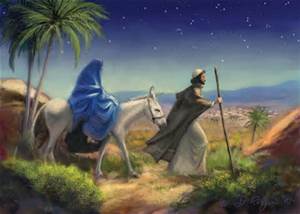
Only one day into the journey, Mary and Joseph were feeling the weight of their trip.  As they left the familiar area surrounding the Lake of Galilee, they entered the Jezreel Valley.  Mary was tired, oh so tired.  The weather had changed and the world was dark.  It was hard to see the pathway they were on.  It was difficult to be assured that nothing was coming toward them from the side.  She so wanted to stop and rest.  But they had to keep moving.  And they of course could not go back alone.  It would not be safe.  So, they had to keep moving through the darkness.  The air was cold and damp, as if the darkness had wrapped around her.  She said a silent prayer for light, for light that would somehow push the darkness away.  Once again, she remembered the angel’s words.  “Do not be afraid.”  But the fears were consuming her.  Where was God?  God be with us.

____________________________


Tonight is the longest night of the year, the day of darkness.  We don’t do well with darkness.  We don’t do well with the unknown, with not being able to see our pathway.  And yet so much of our faith journey is made in darkness.  In fact, so much of our faith journey actually begins in darkness.  Creation begins in darkness.  Seeds sprout in darkness.  Birth begins in darkness.  Even light begins in darkness. And on this day of the longest night, we begin to turn a corner.  As the season of winter begins, we are reminded that the cold and the darkness does indeed wrap around the new life that will come to be, protecting it until it is ready to spring forth.

But we try our best to dispel the darkness, to light our lives with whatever artificial light we can find.  And we fill our lives with enough light so that we will never experience the darkness.  And because our lives are so full, there is no place to begin.  There is no room for light.  In my old neighborhood, there is a house that is an old French colonial with wonderful verandas lining both floors of the house.  For years, the house would outline the verandas with twinkling Christmas lights.  It was beautiful.  Then, for some reason I’ve never completely understood, they began to add more and more lights.  They started by stringing lights across the verandas three, five, seven, fifteen times.  Then the next year, they did the same to the house.  They must have had 50,000 lights!  I would describe it as a veritable blob of holiday lights—so many lights, in fact, that you could no longer see the lines of the house itself.  The house had been overtaken by light.  And, let me tell you, it was no longer beautiful.  Light is not pretty or comforting or even helpful alone.  Light is at its best when it illuminates the darkness and creates shadows and contrasts so that we can truly look at the light.

Part of our Advent journey is traveled in darkness.  It is a darkness where we wait for what is to come, not really knowing how or when God will come, but knowing that the light is just up ahead as we journey down this Holy pathway, never alone.  Traveling in darkness means that we must look to the One that guides us.  And, here, in the darkness, we will be able to see the light as it dawns on our world.

In every beginning, there is darkness.  The darkness of chaos seems eternal, Yet form emerges: light dawns, and life is born..  (New Union Prayerbook.)

Grace and Peace,

Shelli


Galilee: Faith Migration

Journey to Bethlehem-Galilee2In those days a decree went out from Emperor Augustus that all the world should be registered. 2This was the first registration and was taken while Quirinius was governor of Syria. 3All went to their own towns to be registered. 4Joseph also went from the town of Nazareth in Galilee to Judea, to the city of David called Bethlehem, because he was descended from the house and family of David. 5He went to be registered with Mary, to whom he was engaged and who was expecting a child. (Luke 2: 1-5)


Mary awoke early that morning. She laid in bed, heavy in both body and spirit. She was close to giving birth. She could feel it. But they had received word that they had to go to Bethlehem to register with the Roman government there. It didn’t make sense. This was their home. But Bethlehem was where their names were known. The world was changing so fast. It didn’t used to be this way. But the land was no longer their own. They were considered trespassers, immigrants, really, even though they had lived here their whole lives. So she got up and began to pack. The desert trek would be treacherous and unforgiving. She thought back to what the angel had said: “Do not be afraid.” There was no choice but to go, so she packed both her fears and her faith and began to ready herself for whatever might come. They would leave Galilee and head toward Judea, to a foreign land, an unwelcoming land. Go with us, God.

____________________________


For most of us, our faith journey is fairly easy. We live comfortably. We live in a place that feels like home. But once in a while, we are forced to go, to go into the unknown. And that is where our faith comes to be. Maybe these treks are God’s gentle way of nudging us along on our faith journey, lest we get too comfortable, lest we begin to call a place home that is really not ours.


You know, if you read the Bible, it is a story of immigration, of moving from one place to another and sometimes back again, journeying from one way of being to another. The Bible stories are full of those who found themselves in places that they did not really belong—strange utopian gardens, searching for Promised Lands (“So, here’s the deal Abe…if you’ll leave your country and journey to a place that you’ve never seen and that you don’t know, this is all going to turn out.”), and 40 years of lost wilderness wanderings, just to name a few. And in those places, alone, without the comforts of home, they found God and, perhaps just as importantly, they found who they were supposed to be. And now this Bethlehem tale. We know they’ll get there and there won’t be a place (AGAIN!) They won’t build a mansion and settle into a dream home. They will keep journeying to the place that God calls them to go.


Our journey is no different.  There’s never a place.  You see, God does not call us down roads that are paved with our plans and our preconceptions.  God calls us instead to travel through the wilds of our lives, to journey with our eyes open that we might see this new thing that God is doing.  T.S. Eliot once said that “the end of all our exploring…will be to arrive where we started…and know the place for the first time.”  There’s never a place.  We never really “arrive”.  The journey does not end. It’s always new, re-created.  That’s the point.   After all, even Mary and Joseph turned and made their way home.  But they were never the same again.  And the baby that is coming?  Well, he was never meant to settle down and stay put.  And there was never really room for him at all.  God didn’t intend to show us how to build a house; God revealed the journey home and threw in traveling mercies on the way. So, let us go and see this thing that the Lord has made known to us!


God travels wonderful paths with human beings; God does not arrange matters to suit our opinions and views, does not follow the path that humans would like to prescribe for God.  God’s path is free and original beyond all our ability to understand or to prove.  (Dietrich Bonhoeffer, in Christmas With Dietrich Bonhoeffer, Manfred Weber, ed.)


Grace and Peace,

Shelli

Re-Ordering

upsidedownworld“My soul magnifies the Lord, 47and my spirit rejoices in God my Savior, for he has looked with favor on the lowliness of his servant. Surely, from now on all generations will call me blessed; for the Mighty One has done great things for me, and holy is his name. His mercy is for those who fear him from generation to generation. He has shown strength with his arm; he has scattered the proud in the thoughts of their hearts. He has brought down the powerful from their thrones, and lifted up the lowly; he has filled the hungry with good things, and sent the rich away empty. He has helped his servant Israel, in remembrance of his mercy, according to the promise he made to our ancestors, to Abraham and to his descendants forever.” (Luke 1: 47-55)


We love this passage.  It is Mary’s Song, the poetic rendering of her realization that she has truly been blessed, that she has been called to do what no one else has done, what no one else will do.  She has been called to give birth to God in this world, to deliver the promise that her people have always known.  But don’t get too lost in the poetry and the familiarity. E. Stanley Jones called The Magnificat “the most revolutionary document in the world”.  It is said that The Magnificat terrified the Russian Czars so much that they tried to dispel its reading.  It is an out and out call to revolution.  Less subversive language has started wars.  Edward F. Marquart depicts it as God’s “magna carta”.  It is the beginning of a new society, the preamble to a Constitution that most of us are not ready to embrace.  We’d rather chalk it up to the poetry of an innocent young woman and keep shopping.


See, this is God’s vision for the world. It is not a world where the best and the brightest and the richest come out on top. It is not a world that we can control. It is not a world where we can earn what we have and deserve who we are. It is rather a world where God’s presence and God’s blessings are poured onto all. But it comes with a price. Those who have, those who are, those whose lives are filled with plenty are called to change, to open their lives to God and to others. Because God will scatter the proud, those who think they have it figured out, those who are so sure of their rightness and their righteousness.  In other words, those of us who think that we have it all nailed down will be shaken to our core.  The powerful–those with money, those with status, those with some false sense of who they are above others–will be brought down from their high places.  The poor and the disenfranchised, those who we think are not good enough or righteous enough, will be raised up. They will become the leaders, the powerful, the ones that we follow.  The hungry will feel pangs no more and those who have everything–the hoarders, the affluent, those are the ones whose coffers will be emptied to feed and house the world.  God is about to turn the world upside-down.  Look around you.  This is not it; this is not what God had in mind.  And God started it all not by choosing a religious leader or a political dynamo or even a charismatic young preacher but a girl, a poor underage girl from a third-world country with dark skin and dark eyes whose family was apparently so questionable that they are not mentioned and whose marital status seemed to teeter on the edge of acceptable society.  God picked the lowliest of the lowly to turn the world upside down.


And when you’re turned upside down, things tend to spill. No longer can we hold onto what we know. No longer can we rest on the laurels of our past. If we’re going to be part of God’s vision of the world, we have to give up those things that are not part of it. We have to change, learn to live a new way, look upon the world and others not as competition, not as threats, but as the very vision of God pouring into the world. So, THIS Advent, what are you willing to let go of so that you will have room to offer a place for God? What are you willing to change in your life to come just a little bit closer to what God envisions? How willing are you to turn your world upside down? What do you plan to do with this precious life you’ve been given?


There are those who will read this and dismiss it as some utopian socialist notion, something that flies in the face of our capitalistic society. I don’t think it’s either. God’s vision does not align with any form of government on this earth but is instead ordered with love and grace and abundant mercy. It is not a vision where everyone is treated the same; it is a vision where everyone is loved. So, again, what are you willing to change in your own life? What are you willing to trade for love? Christmas is six days away. Six days…that’s all that’s needed to create a new order.


Into this world, this demented inn, in which there is absolutely no room for him at all, Christ has come uninvited. But because he cannot be at home in it, because he is out of place in it, and yet he must be in it, his place is with those others who do not belong, who are rejected by power, because they are regarded as weak, those who are discredited, who are denied the status of persons, tortured, exterminated. With those for whom there is no room, Christ is present in this world. (Thomas Merton)


Grace and Peace,

Shelli

Pointing to the Light

zechariah-elizabeth-and-john-the-baptist-the-other-nativity-story57Now the time came for Elizabeth to give birth, and she bore a son. 58Her neighbors and relatives heard that the Lord had shown his great mercy to her, and they rejoiced with her. 59On the eighth day they came to circumcise the child, and they were going to name him Zechariah after his father. 60But his mother said, “No; he is to be called John.” 61They said to her, “None of your relatives has this name.” 62Then they began motioning to his father to find out what name he wanted to give him. 63He asked for a writing tablet and wrote, “His name is John.” And all of them were amazed. 64Immediately his mouth was opened and his tongue freed, and he began to speak, praising God. 65Fear came over all their neighbors, and all these things were talked about throughout the entire hill country of Judea. 66All who heard them pondered them and said, “What then will this child become?” For, indeed, the hand of the Lord was with him. (Luke 1: 68-80)
 

We don’t always pay attention to this story. It is not the story of a manger. It is not the story of an angel appearing to a young maiden. It is not the story of a star that leads its followers to the place they are called to go. It is the story of another baby, a baby named John. Born to older parents, parents who had never thought they would have a child, parents who were related to the young Mary, who held her in their arms after her encounter with the angel and told her that everything would be alright, that she was blessed, that she was not alone.


And so he became John. And, it says, they pondered what he would become. Of course, every parent does that, wonders what this child they hold will become. I’ve done it when I’ve held a baby that is only an hour old. You hold the baby and there is a sense that you are holding all the hopes of the world, the chance for things to change, to move just a bit closer to what God envisioned they could be. What then will this child become?  They may have dreamed that he would become a learned rabbi or a great leader or a successful businessman. They probably did not dream that he would make his way into the wilderness, cover himself with animal skins, and live off of the earth. They probably did not dream that he would place himself in the position he did that would eventually get him executed. They probably did not dream that this child they were holding would be the one that got it, would be the one that would point people to the Messiah, would be the one that would be the forerunner of the Messiah.


So, why do we read this during Advent when we are supposed to be preparing ourselves for the coming of Christ, for that manger birth of our Messiah? Because Jesus was not born out of or into a vacuum. Jesus, fully human just as he was fully Divine, had a mother and a father and, later, even siblings. And he had this cousin. Maybe they grew up together, played together, schemed and dreamed and played with their first-century toys. Maybe they came in muddied and torn and their mothers wondered where they’d been. See, God seldom sets us up to work alone. Even Jesus had the one that pointed people his way. His name was John. He was not the One, but he pointed to the One. So, “what then will this child become?” What the child became is exactly what God called him to be—the messenger, the forerunner, the One who would pave the path that God had outlined, who would give all that he was for Jesus and for what Jesus would bring the world.


So, then, why do we read this during Advent? Maybe because Jesus is not an historic figure for us to emulate; Jesus is not some future image that we aspire to one day meet; Jesus is God-With-Us, Emmanuel, here, now. And what, then, will we become? THIS Advent, let us become the one who points to the One, the one who helps pave the way for the world to know the Christ that comes. So are you almost ready?


I cannot create the light. The best I can do is put myself in the path of its beam. (Annie Dillard)


Grace and Peace,


Shelli

Blessed

Visitation of Mary and Elizabeth
Painting in the Church of El Sitio, Suchitoto, El Salvador

(Advent 4C)


39In those days Mary set out and went with haste to a Judean town in the hill country, 40where she entered the house of Zechariah and greeted Elizabeth. 41When Elizabeth heard Mary’s greeting, the child leaped in her womb. And Elizabeth was filled with the Holy Spirit 42and exclaimed with a loud cry, “Blessed are you among women, and blessed is the fruit of your womb. 43And why has this happened to me, that the mother of my Lord comes to me? 44For as soon as I heard the sound of your greeting, the child in my womb leaped for joy. 45And blessed is she who believed that there would be a fulfillment of what was spoken to her by the Lord.” (Luke 1: 39-45)

Remember the story. Mary, the young maiden, betrothed to Joseph, probably planning her wedding and dreaming of her life to come, was approached by an angel. Now the Scriptures seem to lead us to believe that an angel coming was not that extraordinary but I’m thinking that angel-coming stories are grossly over-represented in the Bible because, frankly, it’s at best a little surprising and, to be honest, downright disconcerting. So, the angel, after calming her down (our clue that this was NOT an ordinary incident), asked her to do one thing—just one thing—to birth the salvation of the world. (Sure, no problem!) Just one thing. But here’s the catch, Mary: your life will never again be what it is now; your life will be one of extremes—incredible joy and the most profound grief that you can possibly imagine; your life will be nothing like what you’ve planned for it to be. Your life will be one full of moving from place to place and really never again feeling at home. There will be times when you are running from things and times when you are searching. And it may be lonely, oh so lonely. And, no hurry, except that we really need to have an answer now because, frankly, all this time that we’ve waited, all this time that we’ve hoped, all this time that we’ve prepared has now ended. Now is the time. But, other than that, no hurry. Take your time. And the world stopped, if only for a moment…

So, Mary, not really sure of what she was getting into, agreed. This young maiden who the world doesn’t even know will birth the Savior, will become part of the redemption of the world. So, the angel left and Mary stood there. What in the world have I done? I mean, I love God and all, I want to serve God, but what in the world have I done? So, she runs. She runs to a place where she knew they would take her in, where they would hold her, where they would love her. Elizabeth would have been surprised. After all, it’s not like Mary could text her and tell her she was coming! And when Mary entered, she knew. The child inside her knew. The world knew. The angels’ gossip line was going crazy! After all, the world was with child.

And then Elizabeth took Mary in her arms. After all, this was not going to be easy. The world expects so much and is sometimes incredibly unforgiving, expecting too much, No one knew the road that lay ahead for the young girl but it didn’t matter. Elizabeth would be with her, to hold her, to love her, to listen to her as she worked things through.

You know, that’s really what it means to be blessed—not to be showered with riches or surrounded by happiness or, God forbid, to have our lives turn out the way we plan, but rather to be held and loved as you walk this journey that God has laid before each of us. Mary’s journey mirrors ours. God calls us to change our lives, to sometimes let go of our plans and our dreams and trade them in for what God envisions that we can be. And it is there that we will be blessed. So, THIS Advent, may you be truly blessed!

Here is the God I want to believe in: a Father who, from the beginning of Creation, has stretched out his arms in merciful blessing, never forcing himself on anyone, but always waiting; never letting his arms drop down in despair, but always hoping that his children will return so that he can speak words of love to them and let his tired arms rest on their shoulders. His only desire is to bless. (Henri J.M. Nouwen)


Grace and Peace,


Shelli

The Next Chapter

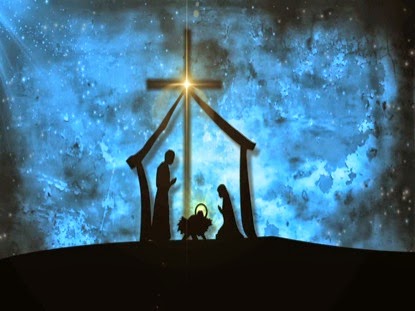
Manger and cross

(Advent 4C)

5Consequently, when Christ came into the world, he said, “Sacrifices and offerings you have not desired, but a body you have prepared for me; 6in burnt offerings and sin offerings you have taken no pleasure. 7Then I said, ‘See, God, I have come to do your will, O God’ (in the scroll of the book it is written of me).” 8When he said above, “You have neither desired nor taken pleasure in sacrifices and offerings and burnt offerings and sin offerings” (these are offered according to the law), 9then he added, “See, I have come to do your will.” He abolishes the first in order to establish the second. 10And it is by God’s will that we have been sanctified through the offering of the body of Jesus Christ once for all. (Hebrew 10: 5-10)

So why did God come? Why did the Divine make a way into the ordinary? Why did the Creator of the world, the Maker of all that is, come and dwell within Creation and hang around with the muck and mire of the world? So many times this passage is read as if God somehow traded one world for another, as if God somehow felt the need to start over on the grand plan that God had previously proclaimed as “Good”. Does that really make sense? Did Christ come into the world as a “do-over”, as if what God had so lovingly begun had somehow failed?

I don’t think God is throwing away the old order; I think God is continuing to create it. God is always continuing to create, not to exchange one way of being for another but to change one way of being into another. God was always coming into the world. There were incarnations all along the pathway, if we had only dared to open our eyes and notice. But then it was time for the next chapter for those of us who were called to that part of the story. And what had begun with God’s goodness and God’s mercy and the holiness of the Divine continued, bringing a new order to the whole story.

Christmas did not begin nor end with the manger. The shepherds and the visiting kings did not drop their baby presents off and go back to their lives. As Christians, Christmas is our entrance into the story, into something relevant, into faith, into a story that will take us to Golgotha and then home. It does not replace the part of the story that Abraham brought to us; rather, for us, it brings us into it. And from there, we continue on. So, in a way, Christmas is our birth as much as it is Jesus’. So, in eight days, on that holiest of nights, when you light your candle and sing “Silent Night”, do not look at it as the beginning of the story, but rather the chapter in which you come to be, the very dawn of redeeming grace spilling into a waiting story-filled earth.

Christmas did not come after a great mass of people had completed something good, or because of the successful result of any human effort. No, it came as a miracle, as the child that comes when his time is fulfilled, as a gift of God which is laid into those arms that are stretched out in longing. In this way did Christmas come; in this way it always comes anew, both to individuals and to the whole world. (Eberhard Arnold)


Grace and Peace,


Shelli