Psalm 130: A Season of Waiting for Morning

First LightToday’s Psalter:  Psalm 130 (Lent 5A)

Out of the depths I cry to you, O Lord.  Lord, hear my voice! Let your ears be attentive to the voice of my supplications!  If you, O Lord, should mark iniquities, Lord, who could stand?  But there is forgiveness with you, so that you may be revered.  I wait for the Lord, my soul waits, and in his word I hope;  my soul waits for the Lord more than those who watch for the morning, more than those who watch for the morning.  O Israel, hope in the Lord! For with the Lord there is steadfast love, and with him is great power to redeem.  It is he who will redeem Israel from all its iniquities.

The Psalmist writes from the deepest bowels of life.  It is his or her lowest point, feeling so overwhelmed with despair, almost hopeless.  And yet, there, is the sound of the still small voice.  It’s only a whisper but it is there.  The Psalmist strains to hear, laying there in the darkness, unable to sleep, unable to see the light of the morning.  It is a Psalm of faith.  It is the expression of one who though wallowing in the depths of sadness and despair, cannot feel God’s Presence and, yet, knows in the deepest part of his or her being that God is there.  It is the writing of one who knows that there is always morning, if we will only wait.

The words of the Psalm promise us that no matter how dark the night will be, there is always morning.  There is always redemption.  The King James Version depicts it as “plenteous redemption”.  We often hear of redemption as if it is some sort of payment that God required for our sins, as if Jesus’ death was somehow foreordained because we were such sinful creatures that God could take it no more.  But redemption also means restoration, to bring something to a better state.  It is what the Psalmist knows.  God is there, though unseen, restoring, recreating, even in this moment of darkness.  Redemption is not about payment; it is about the promise of morning, the promise of life.  Redemption is not about what Jesus gave us or what Jesus did for us but what God in Christ does even now.  God brings morning.

The Psalm does not give us empty promises that “everything will be alright”.  Rather, it is honest.  Sometimes life hurts.  Sometimes life hurts more than we think we can bear.  Sometimes we have our own dark night of the soul.  But in the darkness, we learn to wait.  We learn to hope.  That is what Lent is–a waiting in the depths.  We are journeying now deeper and deeper into the darkness.  We know that it will be painful, at times even unbearable.  But our faith tells us that God is present whether or not we can feel the presence.  And so we learn to wait.  We wait through pain and betrayal and last nights together.  We wait through darkness and death.  We wait in the stillness and foreboding silence.  We wait because we know that morning always comes.

Bidden or unbidden, God is present.  (Desiderius Erasmus, 1466-1536, Also attributed to Carl Jung, because the quote was posted above his door in his house in Switzerland.)

“Out of the Depths”, John Rutter, “Requiem”

On this 5th Sunday of Lent, claim your own depths.  Imagine what your own recreation looks like.

Grace and Peace,

Shelli

I have posted a reflection on the Stations of the Cross as a “page” on the blog.  If you go to dancingtogod.com and click on it at the top, you can view it.


A Feast of Fools

April FoolLectionary Text:  1 Corinthians 1: 18-20 (21-24) 25

For the message about the cross is foolishness to those who are perishing, but to us who are being saved it is the power of God. For it is written, “I will destroy the wisdom of the wise, and the discernment of the discerning I will thwart.” Where is the one who is wise? Where is the scribe? Where is the debater of this age? Has not God made foolish the wisdom of the world?..For God’s foolishness is wiser than human wisdom, and God’s weakness is stronger than human strength.

What an odd day this is!  We have set aside and declared an entire day dedicated to nothing but pranks and fools and all out silliness.  I supposed with everything going on right now, a little silliness is not such a bad thing!  If someone were looking at this world from afar, they would surely think us more than odd. Precursors of our April Fools’ Day include the Roman festival of Hilaria, held on March 25th (which, interestingly enough, is also the Feast of the Anunciation, exactly nine months before the Feast of the Birth of Christ) and the Medieval Feast of Fools set of December 28th, when pranks are played in Spanish-speaking countries. In Iran, jokes are played on the 13th day of the Persian new year (Nowruz), which falls on April 1 or 2.  This day, celebrated as far back as 536 B.C.E. is called Sizdah Bedar and is the oldest prank tradition in the world still alive today.  In Poland, Prima Aprilis (“April 1st”, in Lat.) is a day full of jokes.  Hoaxes are prepared by people, media, and even public institutions.  Serious activities are usually avoided.  This conviction is so strong that the anti-Turkish alliance with Leopold I, signed on April 1, 1683, was backdated to March 31st.  Did I say that we were an odd bunch?

So what is this “foolishness” of which Paul writes?  He was really the only one that really ever dared to speak of the foolishness of the Cross, the veritable foolishness of God.  And he’s right, because in terms of the world, the Cross IS utter foolishness.  The world says “mind your own business”, Jesus says “there is no such thing as your own business.”  The world says “buy low, sell high”; Jesus says “give it all away.”  The world says “take care of your health”; Jesus says “surrender your life to me.”  The world says, “Drive carefully–the life you save could be your own”; Jesus says “whoever would save his life will lose it, and whoever loses his life for my sake will find it.”  The world says “get what you are due”; Jesus says “love your neighbor as yourself.”  Essentially, if someone were looking at us from afar, they would think us all a bit odd.  After all, who gives up what they’ve gained, what they’ve accomplished, changes one’s life completely, and follows someone to an instrument of death?:  That, indeed is just foolishness in terms of this world.

In his book, The Faces of Jesus, Frederick Buechner says that “if the world is sane, then Jesus is mad as a hatter and the Last Supper is the Mad Tea Party…In terms of the world’s sanity, Jesus is crazy as a coot, and anybody who thinks he can follow him without being a little crazy too is laboring less under a cross than under delusion.” (Buechner, The Faces of Jesus, p. 61)  Think about it.  It is really pretty ludicrous.  (At first glance, it probably resembles an April Fool’s prank.)  It’s actually downright absurd.  Here in this season, we are called to enter Christ’s suffering, called to follow Christ to the Cross.  Are we nuts?  That could get someone killed!

And yet, there…there up on the altar every single Sunday is that beautiful gleaming cross.  Yeah, we all have them.  We polish them, we wear them, and we hang them on our walls.  I’ve seen them on bumper stickers, billboards, tattoos, and cupcakes. (You know, I guess you can put anything on top of a cupcake!)  But maybe sometimes we clean it (the cross, not the cupcake) up too much.  Maybe we have forgotten the stench of death emanating from it or the sight of a mangled body hanging from it.  Maybe we have forgotten the foolishness of it all.  Maybe it is just too much for us.  After all, we’re good Methodists, people of the “empty cross”.  But it’s NOT empty; it’s full of life–life born from death, life recreated from despair and hopelessness and the end of all we knew.  But this promise of life did not just pop out of a cupcake.  It did not just appear in the midst of an array of carefully-placed lilies one Easter morning surrounded by spirited renditions of Handel’s best music.  God took something so horrific, so dirty, so unacceptable and recreated it into Hope Everlasting.  Daniel Migliore calls it God’s greatest act of Creation yet.  But in terms of what we know, what we expect, even what we deserve, it is an act of utter foolishness.  Who writes this stuff?  In terms of this world, it is fool’s gold; but in terms of God’s Kingdom coming into being, it is a veritable Feast of Fools because it takes us and turns us into the wise.  But perhaps wisdom is not about worshipping a gleaming, pristine cross but rather looking at an instrument of death and seeing the life it holds.  I know…none of it makes sense.  If it all made sense, we wouldn’t need it at all.

And, truth be told, the Scriptures are full of accounts of the wise and powerful ones mocking and getting mocked, never really understanding this lowly carpenter’s son born of a scared young girl from a no-name town.  But notice that it is the ones who are considered fools–the outsiders, the shunned, the ones who do not measure up to society’s standards–that get it.  So, maybe you have to be a fool. After all, don’t you think that those who followed Jesus to the Cross thought to the very end that something else would happen.  Perhaps they thought that at the last moment, someone would jump up and yell “April Fool’s”, implying that it would have been the most tasteless prank ever.  But that’s not how it happened.  Jesus died that day and in that moment, Creation changed as the Sacred and the Holy poured into this foolish world.  And we, we have been gathered in, into a Feast of Fools.  Thanks be to God!

Faith, you see, is largely an intuitive process, not a summing up of “data.” Faith listens to life and hears something new. Faith drifts off during a sermon and lands on new terrain. Faith sings a new song and suddenly knows more. Faith feeds a stranger and responds differently to one’s own meal. Faith makes wild leaps, risks strange thoughts, dashes outside the box, asks foolish questions, hears unexpected voices. Little by little, faith’s “whole being”grows deeper and deeper, broader and broader.  (Tom Ehrich)

On this Lenten journey, think what it means to play the fool.  Think what it means to let go of the wisdom of this world and take on the Wisdom that is God.  (No joke!)

Grace and Peace,

Shelli

You, Resurrected


The Raising of Lazarus, Duccio de Buoninsegna, 1308-11

Scripture Text:  John 11: (1-16) 17-44 (45) (Lent 5A)

When Jesus arrived, he found that Lazarus had already been in the tomb four days. Now Bethany was near Jerusalem, some two miles away, and many of the Jews had come to Martha and Mary to console them about their brother. When Martha heard that Jesus was coming, she went and met him, while Mary stayed at home. Martha said to Jesus, “Lord, if you had been here, my brother would not have died. But even now I know that God will give you whatever you ask of him.” Jesus said to her, “Your brother will rise again.” Martha said to him, “I know that he will rise again in the resurrection on the last day.” Jesus said to her, “I am the resurrection and the life. Those who believe in me, even though they die, will live, and everyone who lives and believes in me will never die. Do you believe this?” She said to him, “Yes, Lord, I believe that you are the Messiah, the Son of God, the one coming into the world.” When she had said this, she went back and called her sister Mary, and told her privately, “The Teacher is here and is calling for you.” And when she heard it, she got up quickly and went to him. Now Jesus had not yet come to the village, but was still at the place where Martha had met him. The Jews who were with her in the house, consoling her, saw Mary get up quickly and go out. They followed her because they thought that she was going to the tomb to weep there. When Mary came where Jesus was and saw him, she knelt at his feet and said to him, “Lord, if you had been here, my brother would not have died.”

When Jesus saw her weeping, and the Jews who came with her also weeping, he was greatly disturbed in spirit and deeply moved. He said, “Where have you laid him?” They said to him, “Lord, come and see.” Jesus began to weep. So the Jews said, “See how he loved him!” But some of them said, “Could not he who opened the eyes of the blind man have kept this man from dying?” Then Jesus, again greatly disturbed, came to the tomb. It was a cave, and a stone was lying against it. Jesus said, “Take away the stone.” Martha, the sister of the dead man, said to him, “Lord, already there is a stench because he has been dead four days.” Jesus said to her, “Did I not tell you that if you believed, you would see the glory of God?” So they took away the stone. And Jesus looked upward and said, “Father, I thank you for having heard me. I knew that you always hear me, but I have said this for the sake of the crowd standing here, so that they may believe that you sent me.” When he had said this, he cried with a loud voice, “Lazarus, come out!” The dead man came out, his hands and feet bound with strips of cloth, and his face wrapped in a cloth. Jesus said to them, “Unbind him, and let him go.”

This has always been at the very least a strange story to me.  I think I once had some image of Lazarus walking out of the tomb, with tattered grave clothes dangling and an unbearable stench following him, and then dressing and sitting down for a nice fish dinner with Jesus and his sisters.  But the Scripture is not here to show us magic or to in some way depict a God that with the veritable snap of a finger can just put everything back like it was before. (Well, I don’t know, I supposed God CAN, but why?  That’s not really the way God works.  God has something much better in store.)  This story is taken as a precursor to Jesus’ own Resurrection.  It was Jesus’ way of promising life.  But, ironically, it is also the act that turns the tables toward Jesus’ demise.  Here, standing within two miles or so from Jerusalem, the journey as we know it begins to wind to an end.  Even now, the Sanhedrins are gathering their swords and the night is beginning to fall.

So, why would Jesus do that?  Surely he knew what might happen.  Surely he knew how many red flags his presence near Jerusalem had already raised.  And what about Lazarus?  Who was this mysterious man whose main part in the whole Biblical story is to die and be raised?  Why do this with someone as seemingly insignificant as this?  Maybe its because Lazarus is us–you and me.  Maybe the whole point of the passage is not to point to Jesus’ Resurrection but to our own.  Do you think of yourself as journeying toward resurrection?  Do you believe this?  Sure, we talk about journeying to God, about journeying to the Promised Land, whatever that might be, and about journeying to where God call us.  But do you think of it as resurrection?  Do you think of yourself dying and then raised?  Maybe each of us is Lazarus.  Maybe that’s what Jesus wanted us so badly to believe and live.

We talk a lot of this Lenten journey as our journey to the Cross, our journey with Christ.  So, does it stop there?  I think the story goes on.  Jesus is Resurrected.  Maybe that’s what Jesus was trying to show us–not that we would be somehow plucked from death in the nick of time and not that God really has need of putting our lives back together like some sort of Humpty-Dumpty character, but that we, too, are journeying toward resurrection, toward new life.  Lent is the journey that shows us that.  Lent shows us that the journey is sometimes hard, sometimes painful. Lent shows us not that death will not claim us but that death will not have the final word.  Lent shows us that our faith tells us that there is more.  Lent shows us what it means for Christ to unbind even us–even you and me–and let us go.  Through all of life’s transitions, through all of life’s sad endings, through all of life’s unbearable turns, there is always a beginning.  There is always resurrection–over and over and over again.

There was, indeed, something I had missed about Christianity, and now all of a sudden I could see what it was.  It was the Resurrection!  How could I have been a church historian and a person of prayer who loved God and still not known that the most fundamental Christian reality is not the suffering of the cross but the life it brings?…The foundation of the universe for which God made us, to which God draws us, and in which God keeps us is not death, but joy.  (Roberta Bondi)

As our Lenten Journey begins to turn toward Jerusalem, what does it mean to be a part of it?  And what does it mean to envision you, resurrected?

Grace and Peace,

Shelli


Returning Home

Returning HomeScripture Text:  Joel 2: 12-13

Yet even now, says the Lord, return to me with all your heart, with fasting, with weeping, and with mourning; rend your hearts and not your clothing. Return to the Lord, your God, for he is gracious and merciful, slow to anger, and abounding in steadfast love, and relents from punishing.

By my count, this is the 30th day (27th without the Sundays) of Lent.  We are coming closer.  Our journey’s footprint is beginning to narrow, honing in on our destination.  Things are beginning to change.  You can feel it in the air.  If you listen, really listen, you can hear the voices growing louder.  There’s a part of us that wants to go back, perhaps hide away until it is all over but we know that’s not the way it works.  The journey with all of its twists and turns are part of life.  We speak of going out into the world, of “broadening” our mission, often with a sense of leaving home behind.  But Lent teaches us something different.  Our journey’s map is one of widening circles as we gather the world in and, yet, the point of it, the center, tends to become a little clearer with each step.  We begin to sense the center of all these circles.  We begin to feel at home.

I have several times had the wonderful gift of sharing final journeys.  It is a time of remembering, yes, but it is more.  In the last few years of my grandmother’s life, she seemed to be gathering her memories around her, trying to recap them, trying to capture what was important so that she could leave it behind intact.  Maybe that’s what we should do when things begin to change.  Rather than walking blindly and fearlessly into the unknown as if we have some sort of prideful martyr complex, maybe we are called to gather what we have learned, those whom we have loved, those memories that are part of us, and claim them.  God calls us forward on this journey to leave behind things like material items and things to which we hold to our detriment, things that are not ours to hold.  God calls us forward not to leave our selves behind but to claim the real self that we are.  And those memories, those things we have learned, those we have loved are part of our real self.  They are part of God’s way of returning us to God.

Ann Danielson said that “home is where your story begins“.  I don’t think that’s limited to the place that you were born, the place in which you began.  Home is not meant to be a place.  It is meant to be a way of being.  Maybe that means that each new beginning, each time our story begins, is home.  Our journey is not one of going to a place we do not know but one of returning, returning to who we are called to be, returning to God.  That is what Lent teaches us.  It is a season of reflection and introspection.  It is a season of gathering and pruning, of knowing which things we are called to release and what we are called to hold.  Lent is the season when we reset our journey once again so that it is calibrated with our story, so that the journey is one both of returning home and being home.  It is a journey of returning and re-turning.  Lent is a season when we finally know what it means to be home, to know what claims us, to know what give us life.

Our true home is in the present moment.  The miracle is not to walk on water. The miracle is to walk on the green earth in the present moment. Peace is all around us–in the world and in nature–and within us–in our bodies and our spirits. Once we learn to touch this peace, we will be healed and transformed. (Thich Nhat Hanh)

On this 30th day of Lent, as the pathway begins to turn, remember from where you’ve come.  Gather what is important, what is part of you, those things you need to claim.

Grace and Peace,

Shelli


Package Deal


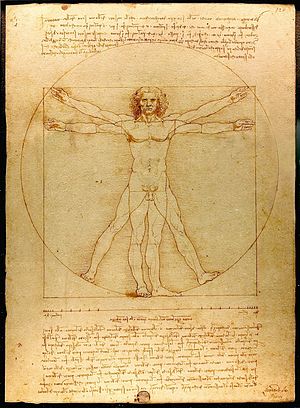
Vitruvian Man, Leonardo da Vinci, c. 1490.

Scripture Text:  Romans 8: 6-11 (Lent 5A)

To set the mind on the flesh is death, but to set the mind on the Spirit is life and peace. For this reason the mind that is set on the flesh is hostile to God; it does not submit to God’s law—indeed it cannot, and those who are in the flesh cannot please God. But you are not in the flesh; you are in the Spirit, since the Spirit of God dwells in you. Anyone who does not have the Spirit of Christ does not belong to him.  But if Christ is in you, though the body is dead because of sin, the Spirit is life because of righteousness. If the Spirit of him who raised Jesus from the dead dwells in you, he who raised Christ from the dead will give life to your mortal bodies also through his Spirit that dwells in you.

So many times, this Scripture is one of those that is read as if being “human”, being “flesh” is bad, as if somehow body and spirit are not compatible existing together in Creation.  That’s not the way it was intended.  After all, didn’t God created us as “flesh”?  For Paul, of the “flesh” is not “human”, per se, but rather a perversion of who we should be as humans. But it is the “way of the Spirit” that brings life.  Without the Spirit, the essence of Life breathed into the body ultimately dies.  The two belong together.  God’s Spirit brings breath and life.  Paul’s words are not mean to be dualistic, separating two unlike things, but, rather, transformational, depicting the salvific act of transforming sides of a whole that need each other.

Once again, it is a good Lenten passage. We tend to get wrapped up in those things of the “flesh”—our needs, our desires, our fears. Paul is not saying that we dispense with them as bad. Paul is making the claim that the Spirit can breathe new life into them. There is no sense in fighting to sustain our identity apart and away from God. It will ultimately die. Paul has more of a “big picture” understanding than we usually let him have. He’s saying that the flesh in and of itself is not bad but the Spirit brings it to life. I don’t think he is drawing a dividing line between darkness and light, between mind and Spirit, between death and life; rather, he is claiming that God’s Spirit has the capability of crossing that line, of bringing the two together, infused by the breath of God. It is a spirituality that we need, one that embraces all of life. It is one that embraces the Spirit of Life that is incarnate in this world, even this world. I mean, really, what good would the notion of a disembodied Spirit really do us? Isn’t the whole point that life is breathed into the ordinary, even the mundane, so that it becomes holy and sacred, so that it becomes life?

And here’s the important part.  Verse 1 of this chapter from Romans says that there is “no condemnation”.  In other words, through Jesus Christ, we are more than flesh.  We are more than those things that we think “make us”.  We are more than the identity that the world inflicts upon us.  Through Christ, we are “flesh embodied”.  Our flesh and our spirit, our body and our soul, our humanness and that piece of the Godself that was so lovingly and graciously supplanted in us is one, undivided.  It is that total self that God loves–not just the Spirit, not just the things that are not of this “flesh”, but everything.  We are a package deal.  Don’t you love package deals?

In his book, Everything Belongs, Richard Rohr says that “in mature religion, the secular becomes the sacred. There are no longer two worlds. We no longer have to leave the secular world to find sacred space because they’ve come together.” In essence, our body and our spirit are one. That is what Paul was saying. Life in the Spirit is an embrace of our whole being. There are no parts that are elevated above the others. It is a new way of learning to see. It is a new way of learning to be. Everything becomes one in God. There are no good parts and bad parts. Everything is waiting to be transformed in the Spirit.

Here’s another way to illustrate it. How many of you like to eat raw eggs? How about a nice tasty tablespoon of flour? Or, perhaps you would rather have a wholesome cup of sickeningly sweet Karo syrup? Well, obviously, none of those things sound that appetizing. In fact, for most of us, they all sound downright disgusting. (I say “most” because I do know someone that eats syrup.  He knows who he is!) But if you take those things and combine them, along with some other ingredients, you get my Grandmother’s pecan pie. Alone, they are worthless. But as a whole, they are wonderful.

We cannot pick and choose what parts of our lives we want to be with God. All of the mail is opened and read. For if one is to live a true life of holiness, there is nothing left out or hidden from sight. There is no secular. It is all sacred. There is no thought in our mind that is not part of the spirit. And there is not one of us that is of lesser importance than another in a true community of faith. Every part of us, no matter what it looks like, no matter what is tastes like, is necessary to make the recipe wonderful. Life in the spirit means that everything belongs in a perfectly balanced recipe for life that perfectly reflects and perfectly reveals all that there is and all that there is meant to be. That’s us–we’re a package deal.  Thanks be to God!

The rare moment is not the moment when there is something worth looking at, but the moment when we are capable of seeing. (Joseph Wood Krutch)

On this day in your Lenten journey, think what it would mean to embrace your whole life, every part of it, as the gift that God meant it to be.

Grace and Peace,

Shelli

An Ambiguous Journey

AmbiguityScripture Text:  Genesis 2: 15-17

The Lord God took the man and put him in the garden of Eden to till it and keep it.  And the Lord God commanded the man, “You may freely eat of every tree of the garden; but of the tree of the knowledge of good and evil you shall not eat, for in the day that you eat of it you shall die.”

Well, you know the rest of the story.  The first couple ate from the forbidden tree (which, most artistic renditions notwithstanding, was not depicted as an apple tree) and the ambiguous journey began.  Life is full of ambiguities; faith is full of ambiguities; and this season of Lent is fraught with ambiguity.  We begin the season in the desert wilderness where Jesus, the fully human one, the one who we so try to emulate in every way is tempted.  Jesus, tempted?  Are you kidding me?  Then the ministry begins as he gathers this sort of wild and motley crew of followers who seem to be somewhat confused and completely inexperienced.  They then spend a couple of years hanging around this lake in the region of Galilee essentially trying to get people to wake up and look at themselves and their lives and in the process, they continually antagonize the religious establishment.  This would be the religious establishment of Jesus’ own religion, the one into which he was born.  And then after years of ministry, the scene moves to Jerusalem, to the holy city, the place of the Temple.  And there, there Jesus is tried, convicted, and put to death.  Ambiguity doesn’t begin to describe it.  The journey we take is not a straight and pre-paved pathway.  It is fraught with questions and the perils of ambiguity that challenge us and call us to go deeper into the journey and, at the same time, to go deeper into ourselves.

But Ray Anderson says that “spirituality is the ability to live with ambiguity.”  In other words, perhaps it’s MEANT to be this way.  It is part of our faith journey.  It is the way that we wind our way to God.  Because, think about it, what if the story was different?  What if the first couple had not eaten of the forbidden tree and had instead spent their lives living in some sort of utopian paradise we affectionately call “The Garden”?  Sure, they would have been good children and all but they never would have grown.  They never would have grown to understand God not as a rule-maker but as one who calls us forth into life, ambiguous though it may be.  And if Jesus had not been tempted?  Well, what good would that do us?  We would never even understand the perils that humanity faces.  And what if the disciples had been a group of impeccably well-trained rabbinical seminary professors who had no need to massage their own needs and egos? (No comment.)  And what if the religious establishment had just accepted Jesus and his new way of seeing and the Passion would never have transpired and Jesus had died of old age sometime in his late 40’s.  What if the journey were straight and predictable?  Well, we wouldn’t need faith.  We wouldn’t need to grow.  We would be wonderful little rule-followers with no need for spirituality. Hey, we probably never really would have gotten out of the garden.  And think what we would have missed!  Maybe this is a good lesson to remember in this strange time in which our society and our politics seems to have landed.  Maybe the ambiguities should prompt us to journey, to question, to change.

Lent (and life) is indeed ambiguous.  There is wilderness and city, darkness and light, temptation and grace, repentance and forgiveness, anointing and betrayal, dust and wine, death and life.  Maybe Lent is an ambiguous journey to teach us how to live, to teach us how to traverse the ambiguities that are part of our faith journey.  Ambiguity is not bad.  So many of us try to rid ourselves of it, try to “nail down” what life and what God means.  Is that really what you want, a God that you can explain, can “nail down”?  Do you really want a God that holds no mystery, no wonder, no awe?  And what would you do if everything about this God was explained and understood?  What if you DID have God all figured out?  Where would you be then?  You would miss this ambiguous journey, a journey of searching and questing, of broadening and growth, of corners and turns around which you will always find life anew.  You would have no need for faith, no need for spirituality.  You would have no need for God to lead you through this ambiguous journey.

Meaning does not come to us in finished form, ready-made; it must be found, created, received, constructed. We grow our way toward it.(Ann Bedford Ulanov)

On this ambiguous journey, think of those things that you have found anew.  Think of the life that they give.

Grace and Peace,

Shelli

Lending Breath

Breathing OutScripture Text:  Ezekiel 37: 1-14 (Lent 5A)

The hand of the Lord came upon me, and he brought me out by the spirit of the Lord and set me down in the middle of a valley; it was full of bones. He led me all around them; there were very many lying in the valley, and they were very dry. He said to me, “Mortal, can these bones live?” I answered, “O Lord God, you know.” Then he said to me, “Prophesy to these bones, and say to them: O dry bones, hear the word of the Lord. Thus says the Lord God to these bones: I will cause breath to enter you, and you shall live. I will lay sinews on you, and will cause flesh to come upon you, and cover you with skin, and put breath in you, and you shall live; and you shall know that I am the Lord.” So I prophesied as I had been commanded; and as I prophesied, suddenly there was a noise, a rattling, and the bones came together, bone to its bone. I looked, and there were sinews on them, and flesh had come upon them, and skin had covered them; but there was no breath in them. Then he said to me, “Prophesy to the breath, prophesy, mortal, and say to the breath: Thus says the Lord God: Come from the four winds, O breath, and breathe upon these slain, that they may live.” I prophesied as he commanded me, and the breath came into them, and they lived, and stood on their feet, a vast multitude. Then he said to me, “Mortal, these bones are the whole house of Israel. They say, ‘Our bones are dried up, and our hope is lost; we are cut off completely.’ Therefore prophesy, and say to them, Thus says the Lord God: I am going to open your graves, and bring you up from your graves, O my people; and I will bring you back to the land of Israel. And you shall know that I am the Lord, when I open your graves, and bring you up from your graves, O my people. I will put my spirit within you, and you shall live, and I will place you on your own soil; then you shall know that I, the Lord, have spoken and will act,” says the Lord.

The idea of God creating and recreating over and over again is not new to us.  But most of us do not this day live in exile.  We are sitting comfortably at home; we are residing in the place where our identity is claimed.  So how can we, then, understand fully this breathing of life into death, this breathing of hope into despair?  The image is a beautiful one and yet we sit here breathing just fine.  We seldom think of these breaths as the very essence of God.  In the hymn, “I’ll Praise My Make While I’ve Breath”, Isaac Watts writes the words, “I’ll praise my God who lends me breath…”  Have you ever thought of the notion of God “lending you breath”?  Think about it.  In the beginning of our being, God lent us breath, ru’ah, the very essence of God.  And when our beings become lifeless and hopeless, that breath is there again.  And then in death, when all that we know has ended, God breathes life into dry, brittle, lifeless bones yet again.  Yes, it is a story of resurrection.

God gave us the ability to breathe and then filled us with the Breath of God.  We just have to be willing to breathe.  It’s a great Lenten image. It involves inhaling.  It also involves exhaling.  So exhale, breathe out all of that stuff that does not give you life, all of that stuff that dashes hopes and makes you brittle, all of that stuff that you hold onto so tightly that you cannot reach for God.  Most of us sort of live our lives underwater, weighed down by an environment in which we do not belong.  We have to have help to breathe, so we add machines and tanks of air.  But they eventually run out and we have to leave where we are and swim to the top.  And there we can inhale the very essence of God, the life to which we belong.  God lends us breath until our lives become one with God and we can breathe forever on our own.

“Lending breath”…it is ours, but only for a moment, only for a breath.  We do not keep it, we do not store it away.  Like manna, we fill our lungs to capacity as only they are designed by God to do and then we exhale.  We let go.  We release that breath of life into Creation to make room to breathe again.  Most of us take it for granted, this rhythmic breathing in and breathing out.  We don’t really think about each of these breaths that have been lent to us, these God-breathed gasps that are ours for only a short time.  Actually, more of life is like that than we like to think.  We like to think that we are in control, that we orchestrate our breathing in and our breathing out.  But, really, the breath is not ours.  It is God-breathed.  It is what give us life, over and over and over again.  In a way, each and every moment, we are resurrected.  We begin again.  But we forget that.  Lent reminds us, reminds us that there is more than what we control, more than what we know.  Lent reminds us that the air we breathe is not our own, that we need to exhale.

God gave us the ability to breathe and then filled us with the Breath of God.  We just have to be willing to breathe.  It’s a great Lenten image. It involves inhaling.  It also involves exhaling.  So exhale, breathe out all of that stuff that does not give you life, all of that stuff that dashes hopes and makes you brittle, all of that stuff that you hold onto so tightly that you cannot reach for God.  Most of us sort of live our lives underwater, weighed down by an environment in which we do not belong.  We have to have help to breathe, so we add machines and tanks of air.  But they eventually run out and we have to leave where we are and swim to the top.  And there we can inhale the very essence of God, the life to which we belong.  God lends us breath until our lives become one with God and we can breathe forever on our own.

That is often the problem for many of us. We breathe in when we should be breathing out. It is, on some level, a sort of “spiritual asthma”. When a person suffers from asthma, it is not, as many people think, that they cannot get air into their lungs; it is that they can’t get air out. And, as a result, their lungs are too full to receive life-giving air. The breathing cycle is disrupted and the person, swelling with over-inflation, begins gasping for breath.  This spiritual asthma is a similar dilemma. If we hold onto those things with which we fill our lives, to our habits and our fears and our misconceptions of what our life should be, there is no room left for the life-giving breath of God.  If we do not leave room, God cannot lend us breath.

Not only is another world possible, she is on her way. On a quiet day, I can hear her breathing. (Arundhati Roy)

On your Lenten journey, learn to breathe.  Learn to know from whom that breath comes.  And then learn to exhale.  What do you need to breathe in and, perhaps even hard, what do you need to breathe out?

Grace and Peace,

Shelli

(And check our the weekly Lectionary notes at journeytopenuel.com )