Shhh…You’re Supposed to Be Listening

Psalm 29: 3-9

3The voice of the Lord is over the waters; the God of glory thunders, the Lord, over mighty waters. 4The voice of the Lord is powerful; the voice of the Lord is full of majesty. 5The voice of the Lord breaks the cedars; the Lord breaks the cedars of Lebanon. 6He makes Lebanon skip like a calf, and Sirion like a young wild ox. 7The voice of the Lord flashes forth flames of fire. 8The voice of the Lord shakes the wilderness; the Lord shakes the wilderness of Kadesh. 9The voice of the Lord causes the oaks to whirl, and strips the forest bare; and in his temple all say, “Glory!”

The voice of the Lord…God’s voice…listen…

Most humans don’t listen that well.  We like talking, filling our lives with our own thoughts and our own opinions and, at times, our own bloviations.  And think what we miss!  Is it possible that in our call to wait during this season, we are also being reminded to listen, to listen for God’s voice?  You know, when you read the Old Testament, there are lots of places where people are convinced that they hear God’s voice, that they hear God calling to them.  And God tells them to go from where they are or follow a star or climb a mountain or cross a sea or listen to a burning bush. So, did God quit talking?  Or did we quit listening?

God’s voice comes to us in a myriad of ways—nature, animals, others, our own conscience, our own thoughts (if we listen to them rather than feeling like we need to spit them out into the world before they’re fully formed), and music of all kinds.  I often hear God in music.  I think it’s because music breaks in and seeps into us.  It quiets us.  It teaches us to LISTEN, to listen to something other than our own voice.  Joan Chittister said that “music is the only sound of heaven we’ve ever been given…music is where the soul goes to put into notes what cannot be said in words.”  That’s why music crosses languages.  I listen to lots of music for which I can’t understand the words and, yet, I do understand them. 

That’s the way we need to learn to listen—not to know what words are being used but to learn to let what we hear penetrate deep into our souls.  We will hear God’s voice but it may not be in the words or the language to which we are accustomed.  It may be a song we’ve never heard.   This is the season when we stop and learn to listen for God’s voice.  It’s there.  But we have to listen. 

So, I found this video.  It’s a little different but I think it says a lot.  It teaches us to listen…and to sing.  It teaches us to respond to the music we hear.  (I WOULD turn the sound down a bit if you’re next to your dog.)

Down in the forest 
We'll sing a chorus  
One that everybody knows 
Hands held higher  
We'll be on fire  
Singing songs that nobody wrote (Wolf Conservation Center)

But ask the animals, and they will teach you… (Job 12:7)

In this our Season of Waiting, we are learning to listen, to listen to God’s voice.  It’s there.  It’s everywhere. It surrounds us, goes before us, follows us, and seeps into us. It’s leading us to that for which we are waiting.  But we have to stop.  And we have to listen.  It happens in the silence, the holy silence, the spaces between our words.  It happens in OUR silence.  See, Creation is full of songs of all types.  It never stops.  It never sleeps.  It is always there.  We don’t have to know the words.  We just have to listen.  When we are silent, we will hear the music around us.  And it will become a part of us.  And we will recognize it when it does.  Because we’ve heard it before.  It is God’s gift.  It is God’s voice.  Shhhhh….You’re supposed to be listening.

I just couldn’t help myself. The gates were open and the hills were beckoning…I can’t seem to stop singing wherever I am. (Maria, from…”The Sound of Music”)

Grace and Peace,

Shelli

As If It Is

Advent 2B Lectionary Passage:  2 Peter 3: 8-9 (10-15)

8But do not ignore this one fact, beloved, that with the Lord one day is like a thousand years, and a thousand years are like one day.  9The Lord is not slow about his promise, as some think of slowness, but is patient with you, not wanting any to perish, but all to come to repentance.

Now as patient as the writer of this passage sounds, it is likely that he or she (yes, I think there could have been some she’s writing!) probably assumed that Jesus’ return was imminent (as in weeks or months). In fact, my guess is that most of those that walked the earth in the time of Jesus and the years after would be absolutely stunned and perhaps downright flabbergasted that you and I sit here today having the same discussion.  They assumed that Jesus was returning in their lifetime and that this return entailed Jesus just showing up and making everything right.  But if that had happened, think about what humanity would have missed!

I used to really wonder what Jesus’ return would look like.  I mean is he going to return to Bethlehem?  Maybe this time he’ll show up in Paris or New York City or Moscow, Russia.  Maybe Australia.  Or Tahiti.  Or perhaps he’ll go for a bit of drama and plop down in the middle of the Super Bowl or something. OR…(and hear me out here) what if the “return” that Jesus spoke about has already happened?  I mean, have you read the account of Pentecost?  Remember the rush of violent wind and the Holy Spirit that filled all who were there.  Remember the quote from the prophet Joel: “In the last days it will be, God declares, that I will pour out my Spirit upon all flesh…”

The truth is that we don’t know what will happen or when it will happen or, for that matter, if the Coming that Jesus talked about has already happened.  The full transformation of all of Creation will happen when it will happen.  And it will look EXACTLY like God envisioned it will look.  God’s time is God’s time.  And in God’s time, one day is like a thousand years, and a thousand years are like one day. And for us?  We wait. 

But lest you think your waiting is just sitting around dreaming of redemption and re-creation and twiddling your thumbs, you need to remember that you are Spirit-filled.  And as those who are Spirit-filled, we need to realize that WE are the ones that God is calling now.  WE are the ones that God is filling and gathering and sending.  WE are the ones that are supposed to be peacemaking and justice-building.  WE are the ones that are called to feed the hungry and shelter the homeless.  WE are the ones that are called to wipe out racism and welcome those who are excluded. WE are the ones who are called to be Christ on earth.  So while you wait for God’s time for the full redemption of Creation to come to be, as one who is Spirit-filled, you are called to live AS IF it’s already here. 

In this Season of Advent as we practice holy waiting, when we both remember those who looked for the coming of the Messiah so long ago and look ahead for Christ’s coming into our own lives, we are also reminded to live as if it’s already come to be.  Because if everyone lived AS IF it was here, as if the world was transformed into what it was meant to be, then it would already be.  The truth is, this IS God’s time.  It’s ALL God’s time.  And we are smack dab in the middle of it.  We wait for the darkness to be pushed away by the light but in the meantime, we need to do a little of our own darkness-pushing.  God is waiting for us to respond, for us to proclaim God’s love and mercy, for us to live “as if”—as if the coming of the Lord is now, as if God’s Spirit has already spilled into the earth, as if justice and righteousness was the only way, and as if we knew no other way to live.

Earth’s crammed with heaven, and every common bush afire with God;  But only [they] who see, take off [their] shoes—the rest sit around it and pluck blueberries.   (Elizabeth Barret Browning, from “Aurora Leigh”)

Grace and Peace,

Shelli

An Active Imagination

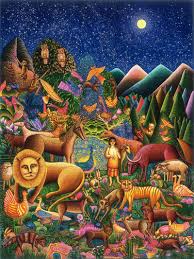
“Peaceable Kingdom”, John August Swanson, 1994

Amos 9: 13-15

13The time is surely coming, says the Lord, when the one who plows shall overtake the one who reaps, and the treader of grapes the one who sows the seed; the mountains shall drip sweet wine, and all the hills shall flow with it. 14I will restore the fortunes of my people Israel, and they shall rebuild the ruined cities and inhabit them; they shall plant vineyards and drink their wine, and they shall make gardens and eat their fruit. 15I will plant them upon their land, and they shall never again be plucked up out of the land that I have given them, says the Lord your God.

So, out here in the wilderness, what are we supposed to do while we wait for things to get better?  I mean, faith is about waiting, yes.  But faith is also about doing. Faith is supposed to be active, right?  So what are we supposed to be DOING during this wilderness time?  And how can we find out more about when this will actually resolve?

We 21st century journeyers struggle with the unknown, with just leaving things to chance, with admitting that perhaps there are those aspects of our journey that are not for us to know now. That is what Advent does for us…it points us toward mystery. Some would equate that to nothingness or, perhaps, even to darkness–unknown, foreboding, maybe even a little dangerous. But God came and comes over and over again. I think that God’s coming does not, much to some of our chagrin, bring with it the surety that we might like. In fact, knowing everything that’s ahead, being so absolutely sure of how everything is going to turn out, is surely the death of our faith.  Because if you are so sure of everything, why would you need faith at all?  God doesn’t give us surety; God instead instills faith in us to lead us through the darkness.

It is our faith that opens the door to our imagination.  And it is our imagination that strengthens our faith.   God says…walk with me awhile my child and look…look far beyond where you can see…listen far beyond where you can hear…journey far beyond where you think you belong…and there, there I will be, and there will be the Creation that I have created for you. You can’t see it right now.  But you can imagine it. 

Imagination is not some remnant of our childhood that we were supposed to lose as we matured.  It is part of us and it matures with us.  A mature imagination has no limits to what it can envision; it has no boundaries to what it can do.  A mature imagination steps beyond reason and intellect, not leaving them behind, but sweeping them into a new image, a vision of a New Creation.  A mature imagination is fueled by faith.  Our imagination takes us to the place to which God leads us.  Our imagination gives us a glimpse of the mystery that God has promised, the promise of new life.

Advent is about imagining.  Think of those that came more than 2,000 years before us.  They were imagining what the coming of the Messiah would mean.  Now they more than likely got it wrong.  But that’s not the point.  They were imagining a new Creation, a new way of being.  They were imagining that their lives would be better, that peace and justice would rule, that hunger and poverty would be no more.  They were imagining that they would find there way home.  And their faith walked them in that direction.  So, in this Advent so many years later, just imagine…

Your imagination is your preview of life’s coming attractions. (Albert Einstein)

Grace and Peace,

Shelli

Wilderness Re-Creation

ADVENT 2B: Isaiah 40: 1-11

A voice cries out: “In the wilderness prepare the way of the Lord, make straight in the desert a highway for our God. Every valley shall be lifted up, and every mountain and hill be made low; the uneven ground shall become level, and the rough places a plain. Then the glory of the Lord shall be revealed, and all people shall see it together, for the mouth of the Lord has spoken.” (Isaiah 40: 3-5)

First of all, with all due respect to Mr. Handel’s presentation, this passage was probably not originally written with us or our tradition in mind! This really is talking about the people of Israel. It really is talking about bringing comfort to a people who have wandered in the Judean wilderness. Probably written toward the end of the Babylonian exile, this writing offers a vision where a highway (a REAL man-made highway) through the wilderness will be made level and straight. If, as most assume, this part of the book that we know as Isaiah was written after the exile, it would have been soon after 539 BCE when Cyrus of Persia conquered the Babylonians and, not really caring whether or not the Israelites stayed, allowed them to return to Jerusalem. So imagine a highway that, typical of the ancient world, would have originally been built to accommodate royal processions. And so God is depicting a highway made for a grand procession led by the Almighty.

The just-released exiles are returning. But to what? Their city and their way of life lay in ruins. They can’t just go back and pick up where they left off. They have to feel that God has deserted them. They are looking for comfort. They are looking for solace. They are looking for God to put things back the way they were before. But God has something different in mind. Rather than repair, God promises recreation; rather than vindication, God promises redemption; and rather than solace, God promises transformation. God is making something new–lifting valleys, lowering mountains, and ultimately, when all is said and done, revealing a glory that we’ve never seen before.

So 2020 has handed most of us a new understanding of this passage.  (Wow! Thanks 2020!)  As a community, as a country, as a people, we sort of have our own little wilderness thing going right now. Now we haven’t been conquered by Babylonians yet (and for that we ARE thankful!), but our life has changed—probably, if we’re honest, forever. And in this season that so quickly elicits traditions and memories of past years, it is easy to start to feel like we are truly walking through an unknown wilderness, full of masked strangers, distanced friends, and communication via these little boxes of faces on Zoom.  The wilderness sometimes seems to be closing in on us.  And the pathway out seems to be murky at best.

But think about this passage.  We are given a vision.  We are not promised solace. We are not promised that Emmanuel, God With Us, is coming to put our lives back together. In fact, can you feel it? The world has begun to shake. The valleys are rising; the mountains are leveling. Something incredible is about to happen. The light is just beginning to dawn. Life as we know it will never be the same again. Soon the fog will lift and we will see that the road does not lead back to where we were. It instead leads us home. But we’re going to have to be willing to leave what we know–forever.

When we prepare ourselves in this Season, we’re not looking for the Messiah to come and put all the pegs back where they were.  We’re not preparing ourselves to go back to the lives to which we’ve become accustomed.  God is not going to “fix” it.  I mean, think about it.  God’s not usually in the “fixing” business.  God is more into making all things new.  So we have to open ourselves to the new creation that God promises and here in the wilderness, God will re-create us too.  So, open your eyes, learn to wait, prepare your hearts for something new, for the glory of the Lord to be revealed.  And, in the meantime, wear your mask!


The Wilderness holds answers to more questions than we have yet learned to ask. (Nancy Wynne Newhall)

Grace and Peace,

Shelli

The Waiting Game

SCRIPTURE: Mark 13: 32-33

But about that day or hour no one knows, neither the angels in heaven, nor the Son, but only the Father. 33Beware, keep alert; for you do not know when the time will come. 

Once again, we’re being told to wait.  Most of us don’t do that well.  We’re so accustomed to instant results and instant gratification.  We have become creatures dependent on microwaves, high-speed internets, and never-ending freeways.  We are used to getting what we need and what we want NOW.  We’ve seen that this year when we are being told to keep ourselves and our loved ones safe and patiently wait for a Covid vaccine or for the virus to begin to subside.  But millions of us still packed onto airplanes, into potentially unsafe holiday gatherings, and into probably much too crowded stores to begin our holiday shopping.  (Insert eyeroll here!) Yeah, we don’t wait well.

But this passage reminds us that faith is essentially a waiting game.  It is the season of preparation but we tend to equate preparation with knowing what will happen, when it will happen, and how many people will be involved.  But Advent preparation is not about planning; it is about a sort of active waiting.  “Adventus”, the Latin from which our season derives, means arrival or coming.  It’s only partially about looking ahead.  Think of it as a place between two ways of being, a threshold between God’s coming into this world some 2,000 years ago and the promised coming for which we wait.  Part of it is remembering.  And part of it is entering what is to come.  It’s not a checklist; it’s an act of faith.  Waiting is an act of faith.  It’s not temporary.  It’s not preparing for the “Thing”.  Waiting IS the “Thing” in this season. 

In The Life of Moses, 4th century theologian and Eastern Church Father, St. Gregory of Nyssa, talks of the incarnations of God, as in more than one.  He talks of the many comings of God—the moving of God’s Spirit over the waters, the burning bush, the cloud of knowing—that for him leads up to the Incarnation of God in the form of a human, the Birth of Jesus Christ.  But if those who were waiting for the (big “I”) Incarnation had put everything into that, ignoring all those places in their lives where God burst in and was made known, all those (small “i”) incarnations, then they never would have been fully prepared as faithful people to welcome God into the world.

Advent is not “pre-Christmas”.  It’s not really meant to only be the time that we get ready for the big day.  We cannot live one season ahead.  God will come when God will come.  The full revealing of God has in store is yet to be.  But this Season of Waiting awakens us to what has already started to be so that we’ll know the pathway that we are to take.  The feast has yet to begin but the dancing has started.  So we stay alert to the incarnations that God inserts into our lives.  And we dance with them.  And we wait.  We just have to wait.

You must give birth to your images.  They are the future waiting to be born.  Fear not the strangeness you feel.  The future must enter you long before it happens.  Just wait for the birth, for the hour of new clarity. (Rainer Maria Rilke)

Grace and Peace,

Shelli

A Light in the Darkness

Scripture Text:  Isaiah 64: 7-8

7There is no one who calls on your name, or attempts to take hold of you; for you have hidden your face from us, and have delivered us into the hand of our iniquity. 8Yet, O Lord, you are our Father; we are the clay, and you are our potter; we are all the work of your hand.

The first Sunday of Advent…the first Sunday of a new year in the Christian calendar.  It is the Season of Waiting, the season of looking toward the Light.  But this one feels…oh…so different.  Normally, the culture is pushing us toward fulfillment, toward instant gratification, trying to get us to buy into the mindset that we have to jump while the prices are hot, buy while the getting is good, check off our lists before everything is gone.  But this weekend there were pictures of empty malls and empty stores and what seems to be a somewhat slow start to the season of frenzy.

This year feels so slow to me, as if it’s an old slow motion reel that clips through each and every frame with no real connection.  Thanksgiving was scaled back and I haven’t even started thinking about Christmas gifts (unusual for me).  It feels dark somehow.  I’m tired—tired of masks and social distancing and staying home, tired of growing numbers of cases and deaths and the dangling and undangling of a vaccine that seems so close and yet way out on the horizon.  I miss my friends.  I miss sitting and having coffee and talking.  I miss having a glass of wine in a real restaurant.  I miss Brian, my funny flamboyant friend who is one of those ticking numbers of deaths from this plague.  I miss who we were.

And, yet, maybe in an odd way this Advent is closer to the time that we are supposed to remember in this season, that time of waiting, of darkness, the time when God somehow felt far away and yet, in the opacity of the clouds, there was still a faint light on the horizon.  It was a reminder that no matter what, God is there, shaping us into who God envisions we can be.  And maybe in the bright lights and frenzy of Advents past, in the somewhat panicky culture of the countdown of shopping days and crowded stores, in the packed calendars and the perfect plans, we forgot.  We forgot that God comes to us in the darkness, somewhat hidden, and leads us to the Light.

I suppose that it is right that God appears to hide from those who seek the Lord.  I suppose it is true that God has somehow hidden the face of the Divine from us.  But, really, what would you do if you knew, knew all that was God, knew what God looked like?  What would be the purpose of continuing on this faith journey, of expecting God to mold us and make us?  We are comfortable with waiting for a child to come, for a birth to happen, for the glorious gestation that our biological makeup requires that we endure.  But it happens in the darkness, hidden from our view.  Creation was the beginning, the beginning that came to be in the darkness.  And now we wait.  We wait for eternity to come to be.

Advent teaches us just that.  It doesn’t merely teach us to wait; it shows us that for which we wait.  The Advent season is three-fold.  It is a remembrance of the waiting for the birth of Emmanuel; it is the realization that we must wait in our lives, that we must experience the waiting for God to come to us; and it is the practice that we need to wait for God’s coming into the world in its fullest, the waiting of the glory that is to come.  If we don’t learn to wait, even in the darkness, we will never know what God’s Coming means.  Look….there, there in the darkness on the distance horizon…there is the faint vision of a Light.  God is at work, molding and shaping it.  Just wait….even in the darkness.  Because, think about it, you can’t see light when you are standing in light.  It is in the darkness, the holiness of the hiddenness, that the Light begins to emerge.  Sometimes the purpose of our places of darkness are to compel us to move so that we can finally see the light.

Why fear the dark?  How can we help but love it when it is the darkness that brings the stars to us? What’s more: who does not know that it is on the darkest nights that the stars acquire their greatest splendor? (Don Helder Camara)

Grace and Peace,

Shelli

For Those Who Almost Missed It

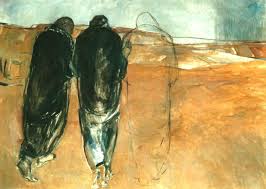
Road to EmmausLuke 24:13-49

Now on that same day two of them were going to a village called Emmaus, about seven miles from Jerusalem, and talking with each other about all these things that had happened. While they were talking and discussing, Jesus himself came near and went with them, but their eyes were kept from recognizing him. And he said to them, “What are you discussing with each other while you walk along?” They stood still, looking sad. Then one of them, whose name was Cleopas, answered him, “Are you the only stranger in Jerusalem who does not know the things that have taken place there in these days?” He asked them, “What things?” They replied, “The things about Jesus of Nazareth, who was a prophet mighty in deed and word before God and all the people, and how our chief priests and leaders handed him over to be condemned to death and crucified him. But we had hoped that he was the one to redeem Israel. Yes, and besides all this, it is now the third day since these things took place. Moreover, some women of our group astounded us. They were at the tomb early this morning, and when they did not find his body there, they came back and told us that they had indeed seen a vision of angels who said that he was alive. Some of those who were with us went to the tomb and found it just as the women had said; but they did not see him.” Then he said to them, “Oh, how foolish you are, and how slow of heart to believe all that the prophets have declared! Was it not necessary that the Messiah should suffer these things and then enter into his glory?” Then beginning with Moses and all the prophets, he interpreted to them the things about himself in all the scriptures. As they came near the village to which they were going, he walked ahead as if he were going on. But they urged him strongly, saying, “Stay with us, because it is almost evening and the day is now nearly over.” So he went in to stay with them. When he was at the table with them, he took bread, blessed and broke it, and gave it to them. Then their eyes were opened, and they recognized him; and he vanished from their sight. They said to each other, “Were not our hearts burning within us while he was talking to us on the road, while he was opening the scriptures to us?” That same hour they got up and returned to Jerusalem; and they found the eleven and their companions gathered together. They were saying, “The Lord has risen indeed, and he has appeared to Simon!” Then they told what had happened on the road, and how he had been made known to them in the breaking of the bread.

This familiar account is the story of two people—one named Cleopas and one forever unnamed leaving Jerusalem and walking along the road—an ordinary road.  Think about what they must have been feeling.

A lot had just happened.  Their heads were spinning as they tried to get their minds around it.  But it was really too overwhelming.  And there was still a sense of grief at their loss.  And, besides, they needed to pay attention to where they were walking.  These days the roads were not as safe as they used to be.  You really couldn’t trust anyone that you saw.  And all this traffic coming out of Jerusalem made it even harder.  They had to be careful.  And they were tired.

And so to pass the time, they talked about it.  Maybe by saying it out loud, it would begin to make sense.  Maybe together, the two of them, Cleopas and the other one, could put it into some sort of perspective.  And then someone approached them.  You can bet they were a little wary at first.  “What are you talking about?” the stranger asked.  “Good grief,” they must have thought.  “Where has he been?  I mean, EVERYONE is talking about it.”  So they told him the story of Jesus—at least the way they thought they understood it.  They told the story of how this wonderful man had died, how all the hopes and the plans for the future were gone, how their world would never go back to being the way it was before.

And as they got close to the village, the stranger turned like he was headed away.  But it was almost evening.  The road would not be safe.  So they asked him to stay with them.  And that evening, as they all sat around the table together, this stranger picked up a piece of bread, blessed it and broke it.  And as he handed it to them, they saw who it was.  Seven miles of dusty road and it was not until this moment that they saw what they almost missed.  Why didn’t they notice?  Why did they miss it?  They missed it because they had been so mired in loss and death that they missed life.

These times are difficult for us.  Do we open up the country?  What does that mean?  Or do we stay a little longer where we are supposedly safe?  Loss is a strange thing.  We grieve, we even stay mired in the depths of despair, and we try desperately to get things back to the way they were before.  But is it possible that we’re only remembering the rosy parts of what we lost?  And by staying so fixated on trying to regain what we lost, maybe even trying to regain control, is it possible that we’re missing some newness that is being offered to us?

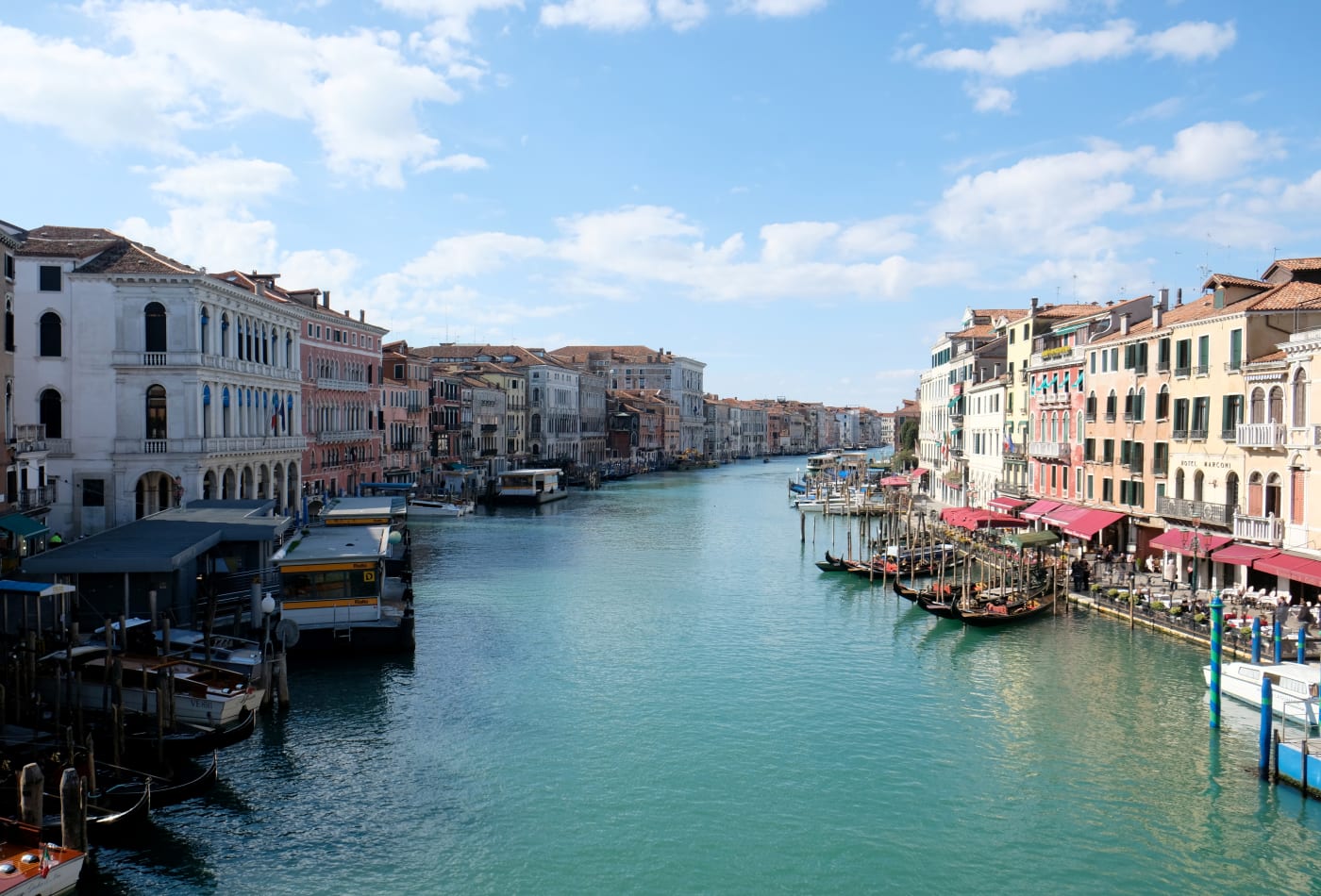
Venice Clear WatersI’m sure you’ve seen the reports of the changes that the earth has experienced while we humans have been held up in our houses.  The air is cleaner is every major city, opening views that younger generations have never even seen.  The gondolas of Venice now float on crystal waters instead of the muck to which they had become so accustomed.  Bird’s voices are returning (because they can now breathe!) and other animals are showing up in all sorts of unknown places.  See, the world is starting to heal.  The earth knows that things do not stay the same.  The earth knows how to adapt and how to look for the places of hope, how to go where the newness is being offered.
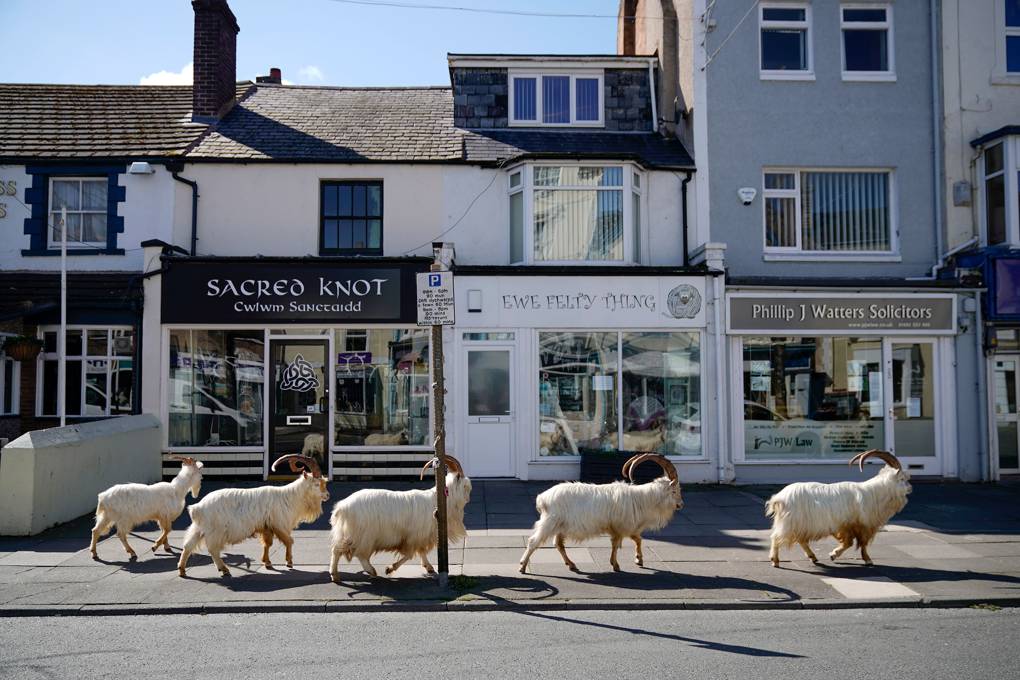
Goats in TownThe mystery of God’s transcendence is never static or predictable.  But in the midst of our ordinary and sometimes mundane lives, we are given glimpses of the holy and the sacred.  They come without warning.  They come without bidding.  Sometimes they come when we’re not quite ready.  But life is not just about those pinnacles of holy sightings.  If we spent all of our lives on the mountaintop, we would certainly get a bit of altitude sickness.  Life is an ordinary road on which we travel.  It’s got hills and valleys and a few potholes along the way.  And every once in a while, holiness enters and dances with us.  See, Jesus keeps showing up.  But if we’re looking behind us, we’ll miss it.

This is a hard time.  Keep walking–together.  There is newness just up ahead.  It’s not what we had.  It’s better.

Grace fills empty spaces, but it can only enter where there is a void to receive it, and it is grace itself which makes this void. (Simone Weil)

Grace and Peace,

Shelli