The Things That Make You Go Ahhh…

Double rainbow forming on the western outskirts of Innerleithen, Scottish Borders

Advent 3B Lectionary:  1 Thessalonians 5: 16-24

16Rejoice always, 17pray without ceasing, 18give thanks in all circumstances; for this is the will of God in Christ Jesus for you. 19Do not quench the Spirit. 20Do not despise the words of prophets, 21but test everything; hold fast to what is good; 22abstain from every form of evil. 23May the God of peace himself sanctify you entirely; and may your spirit and soul and body be kept sound and blameless at the coming of our Lord Jesus Christ. 24The one who calls you is faithful, and he will do this.

Rejoice always?  Pray without ceasing? Give thanks in all circumstances?  Are you kidding?  In this time of sickness and death and divisiveness and, well, just darkness, how in the world are we expected to rejoice, pray, and give thanks each and every moment? I mean, even if things WERE going all hunky-dory, we don’t have time to do that.  There are things to do. There are people to see, gifts to buy, gifts to wrap, places to go (well, maybe not…you know, Covid and all), and we still need to find time for ourselves to think, maybe read this blog, or whatever our life requires.  So when we read this passage, we are a little bewildered.  Because we are used to looking at how to do something.  We want to know the easiest, cheapest, most energy-efficient, or most fulfilling way to accomplish things.  And, most of all, we want to be assured that we’re doing it the right way, that we’re on the right path.

But as much as we desire a “how to” booklet for our lives, that’s not what this is. (Honestly, that’s not really what the Bible is at all!) Paul was not laying down rules.  I don’t think he ever envisioned us living body-bent and knee-bowed 24/7.  I mean, how do we respond to that call to be a Kingdom-builder if we’re praying all the time?  No, Paul was not calling us to a life spent in prayer; Paul was calling us to a prayerful life, a life that is sacred, hallowed, a life lived in the unquenchable Spirit of God.  It has nothing to do with logging prayer hours. I mean, that’s helpful, even necessary.  But this is about perspective, about seeing everything that is your life as hallowed and holy, seeing all you are and all you have and all this is as of God, as prayer. Olga Savin says that “[the Scriptures] tell us that ceaseless prayer in pursuit of God and communion with [God] is not simply life’s meaning or goal, the one thing worth living for, but it is life itself.”  And a life lived the way it is called to be lived is the very will of God.  It is prayer.

As I said, I don’t think the Scriptures are meant to be “how to’s”; maybe instead they’re meant to shape us into those who can find the “ahhhs” in life.  Let me explain.  Think about all those diverse characters in the Scriptures. Abram and Sarai were just living their best retirement life.  And suddenly God has a new plan to make them the patriarchal couple of a “multitude of nations”.  And Abraham went toward the “ahhh”.  Moses was pretty much minding his own business and then ran across this burning bush.  Now, really, wouldn’t you either avoid a bushfire or try to put it out?  But Moses saw something else and said “ahhh” and his whole life changed. And those prophets?  The prophets tried desperately for generations to get the people to pay attention, to make them understand that the Lord was indeed coming, that things were about to change.  They marched this line of people straight through history, warning of something big and dark and ominous when God would step into the world.  Truthfully, that happened.  But it was very quiet, almost a whisper, as the Light again pushed through the darkness.  If you didn’t have your life honed in on that, you would have missed it.  In fact, God had to sort of announce it to make sure people were paying attention.  And, if you noticed it, you couldn’t help but say “ahhh”. 

Praying without ceasing, living a prayerful life, is about paying attention.  It is about looking at the pathway that you walk and noticing those things that make you say “ahhh”.   And then, it’s about turning toward them.  Maybe that means that you get off the well-worn path that is comfortable beneath your feet.  Maybe that means that you veer off in a direction you do not know, a way that you did not plan to go, a way that will change your life forever.  Ahhh….

Praying without ceasing is also about not limiting yourself as to what you think prayer is.  You know those times when you have no words?  That’s a prayer.  The times when words seem to spill out of your life uncontrollably is a prayer.  The times when grief consumes you and you feel as if you cannot function is a prayer.  The times when laughter overtakes you in the middle of an otherwise-serene (and perhaps embarrassing) moment is a prayer.  Every menial task is a prayer.  Every walk is a prayer.  Every drive is a prayer.  Every time you log on to your computer is a prayer.  Every time you cook or wash dishes or empty the dishwasher (I hate emptying the dishwasher!) is a prayer.  Every time you hug someone or touch someone or connect with them on Zoom is a prayer.  Your life is a prayer.  That is what Advent shows us.  Advent wakes us up to the coming of God into the world and asks us to prepare.  But Advent also wakes us up to our own lives, prepares us to see what we’ve been missing and perhaps to notice a different way and to pray, to always pray. Look around. All you see, all you hear, all you are. It’s all prayer. Ahhh-men.

Let your religion be less of a theory and more of a love affair. (G.K. Chesterton)

Grace and Peace,

Shelli

Shoots and Branches

“Peaceable Kingdom”, John Swanson, 1994

Isaiah 11: 1-6 (7-8) 9-10

A shoot shall come out from the stump of Jesse, and a branch shall grow out of his roots. 2The spirit of the Lord shall rest on him, the spirit of wisdom and understanding, the spirit of counsel and might, the spirit of knowledge and the fear of the Lord. 3His delight shall be in the fear of the Lord. He shall not judge by what his eyes see, or decide by what his ears hear; 4but with righteousness he shall judge the poor, and decide with equity for the meek of the earth; he shall strike the earth with the rod of his mouth, and with the breath of his lips he shall kill the wicked. 5Righteousness shall be the belt around his waist, and faithfulness the belt around his loins. 6The wolf shall live with the lamb, the leopard shall lie down with the kid, the calf and the lion and the fatling together, and a little child shall lead them… 9They will not hurt or destroy on all my holy mountain; for the earth will be full of the knowledge of the Lord as the waters cover the sea.  10On that day the root of Jesse shall stand as a signal to the peoples; the nations shall inquire of him, and his dwelling shall be glorious.

So, once again we read yet another passage about that future vision that God holds for us—you know, the one that we’re walking toward, the one that we are supposed to be a part of bringing to be, the one that God promised us.  We are given a vision of a shoot, a new shoot that will come out of the dead and decaying stump of the past, a branch that will come out of the original roots of our faith and our lives. It doesn’t replace the old; it just continues growing.

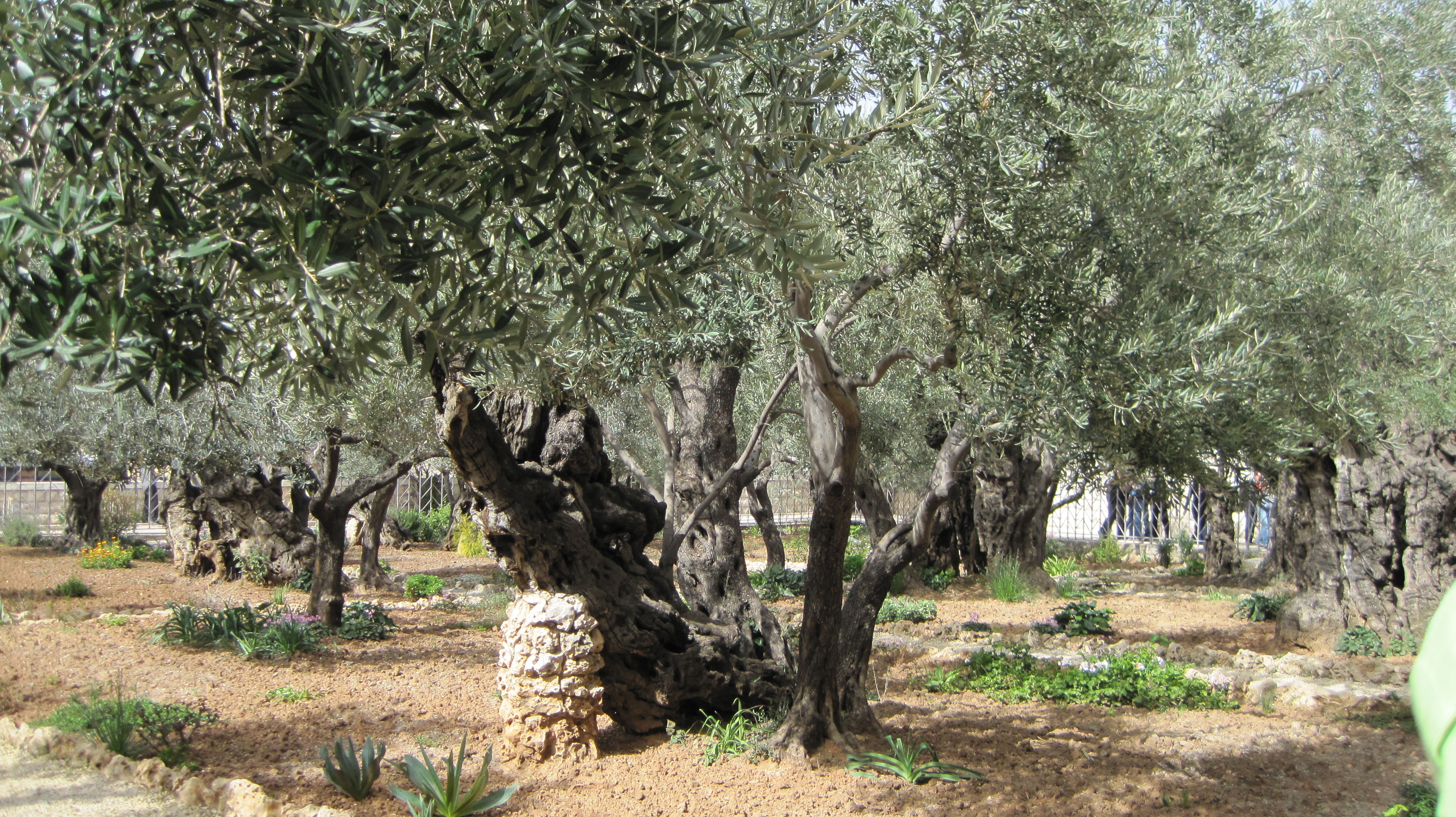
Garden of Gethsemane, Jerusalem, Israel

I have a picture of an olive tree that I took in the Garden of Gethsemane.  Olive trees will actually live for centuries, sprouting new life over and over again.  If you look at this picture, the thing on the left side that looks like a dead and decaying stump (because, well, that’s essentially what it is) is what is left of a tree that was probably in that place 2,000 years ago.  Imagine…that is what is left of a tree that might have been there that night before the Crucifixion as Jesus prayed and submitted his own life to God.  And from that stump came another shoot, that grew into a tree that is probably about 1,000 years old.  And to the right of it is yet another stump that may be 200 years old or so.  And from that is a newer shoot, a live, growing tree that is just a few years old.  It is a picture of new shoots, new creations that God is always creating and always nurturing into being.  But they exist together, sprouting from each other’s strengths into new life.

So, how do we live as new shoots?  How do we embrace that vision we’ve been given and make it part of us?  The message that Advent brings is that God loves us enough to keep showing up—in a vision laid out for us to embrace, in Emmanuel, God-With-Us, and over and over again as God walks with us through our own becoming a new creation.  Maybe the question is whether or not we are holding on to what we know or are we new shoots, giving the old new life?  This is not just a rehash of the same old thing.  William Sloane Coffin once said that “believers know that while our values are embodied in tradition, our hopes are always located in change.”  But change is often uncomfortable.  Change is unpredictable.  Change is hard.  Maybe we can just get through this busy season and then change. 

A couple of years ago, the Today Show had a feature story about some young Panda bears who had been brought up in captivity.  But the plan was to eventually return them to their natural habitat.  So, in order to prepare them for what was to come, their caretakers thought that it would be better if they had no human contact.  So to care for them, the people dressed up like panda bears.  In order to show them how to be pandas, they became them.

I think that’s been done before!  In its simplest form, the Incarnation is God’s mingling of God with humanity.  It is God becoming human and breathing a piece of the Divine into humanity.  It is the mystery of life that always was coming into all life yet to be.  God became human and lived here.  God became us that we might change the world.   God became like us to show us what it meant for us to be like God envisioned (not to be God, not even to be “Godly”, but to be just like God envisioned we could be) in the world.  God didn’t walk this earth to teach us to be divine; God came to show us what it means to be human–caring, loving humans that envision that the world could be different.  The miracle of the birth of the Christ child is that God now comes through us.  We ARE the new shoots of transformation.

So perhaps the reason that the earth is not yet filled with the knowledge of the Lord, that the Reign of God has not come into its fullness, that poverty and homelessness and injustice and war still exists is because we do not dare to imagine it any other way.  This is not some vision of an inaccessible utopian paradise; this is the vision of God.  The passage says that a shoot shall come out of the stump and a branch shall grow out of the roots.  In other words, life shall spring from that which is dead and discarded.  Because in God’s eyes, even death has the foundation, the roots of life.  Even death will not have the last word.  We just have to imagine it into being.  So, imagine beyond all your imaginings; envision a world beyond all you dare to see; and hope for a life greater than anything that is possible.  Imagine what it means to become a new shoot and prepare yourself to be just that. And then you’ll start to be.

Only those who live beyond themselves ever become fully themselves. (Joan Chittister)

Grace and Peace,

Shelli

Shadows and Remnants

Advent 3B Lectionary:  Isaiah 61: 1-4, 8-11

The spirit of the Lord God is upon me, because the Lord has anointed me; he has sent me to bring good news to the oppressed, to bind up the brokenhearted, to proclaim liberty to the captives, and release to the prisoners; 2to proclaim the year of the Lord’s favor, and the day of vengeance of our God; to comfort all who mourn; 3to provide for those who mourn in Zion— to give them a garland instead of ashes, the oil of gladness instead of mourning, the mantle of praise instead of a faint spirit. They will be called oaks of righteousness, the planting of the Lord, to display his glory. 4They shall build up the ancient ruins, they shall raise up the former devastations; they shall repair the ruined cities, the devastations of many generations… 8For I the Lord love justice, I hate robbery and wrongdoing; I will faithfully give them their recompense, and I will make an everlasting covenant with them. 9Their descendants shall be known among the nations, and their offspring among the peoples; all who see them shall acknowledge that they are a people whom the Lord has blessed. 10I will greatly rejoice in the Lord, my whole being shall exult in my God; for he has clothed me with the garments of salvation, he has covered me with the robe of righteousness, as a bridegroom decks himself with a garland, and as a bride adorns herself with her jewels. 11For as the earth brings forth its shoots, and as a garden causes what is sown in it to spring up, so the Lord God will cause righteousness and praise to spring up before all the nations.

This is a pretty familiar passage.  We often read it as part of this season.  It speaks of hope.  God has sown God’s own Spirit into the one who speaks, breathed God’s breath into one who will carry out God’s will.  And standing amid the ruins of what was once a thriving Jerusalem, the prophet depicts the perfect Reign of God, the time when all of Creation will be renewed and fulfilled.  It is the hope for the future even in the midst of the smoldering ashes of what is now.  And the prophet acknowledges and affirms an individual call from God, a call to bring good news, to bind up, to proclaim liberty, to witness, and to comfort. Well, that’s good…because we need someone to fix this mess, right?

But, then, in verse 3, notice that the pronoun changes.  No longer is the prophet affirming an individual’s call.  The calling is now to the plural “they”.  It’s not just the “me” that is the prophet; it is the “they” that is everyone. (Ugh…bet you saw that coming!) The prophet is not called to “fix” things; the prophet is called to proclaim that all are called to this work of transformation. In other words, all that work that you think needs to be done?  It’s ours to do!

All of us are part of what the Lord has planted and nourished and grown to bloom.  All of us are “they”.  We are the ones that are called to become the new shoots sprouting to life.  We are the ones that are called to bring good news, to bind up, to proclaim liberty, to bring justice, to witness, and to comfort.  This Scripture may sound vaguely familiar to us for another reason.  In the fourth chapter of the Gospel According to the writer known as Luke, Jesus stands in the synagogue in his home temple in the midst of a world smarting with Roman occupation and cites these same words.  He acknowledges his own calling, his own commissioning to this holy work.  And he sets forth an agenda using the words of this prophet.  So, here we are reminded once again.  We are reminded what we as the people of Christ are called to do–to bring good news, to bind up, to proclaim liberty, to bring justice, to witness, to comfort, and to build the Kingdom of God.

Most of you probably know the story of England’s Coventry Cathedral.  On November 14, 1940 in the midst of the Luftwaffe, the grand medieval Parish Church Cathedral of St. Michael was devastated by bombs and burned to the ground with the surrounding city.  The decision to rebuild the cathedral was made the morning after its destruction. Rebuilding was seen not as an act of defiance, but rather a sign of faith, trust and hope for the future of the world.  Shortly after the destruction, the cathedral stonemason, Jock Forbes, noticed that two of the charred medieval roof timbers had fallen in the shape of a cross. He set them up in the ruins where they were later placed on an altar of rubble with the moving words “Father, forgive” inscribed on the sanctuary wall. Another cross was fashioned from three medieval nails by local priest, Arthur Wales. The Cross of Nails has become the symbol of Coventry’s ministry of reconciliation.

Today, the new modern Coventry Cathedral stands dedicated to forgiveness, unity, and redemption.  And next to it are the remains of the medieval cathedral. In the place of the altar are the words “Father, forgive” and flanking the altar are two statues—one given by Germany and one given by Japan.  And although physically attached to the new Cathedral, the Chapel made of ruins is not consecrated as an Anglican space, but instead is on a 999-year lease to an ecumenical Joint Council.  In the Chapel of Unity, people of any faith may gather to worship and receive the sacraments.

In this Season of Advent, we are called to prepare ourselves for what is to come.  We are called to wait in hope and walk in light.  And, yet, so many of us are experiencing a world right now where we are barely able to sense that hope and see the light. We live in a world racked with sickness, and fear, and death, and quarantines, and loneliness.  Some of us have experienced financial hardships and despair.  Many of us may identify more closely with the destruction in this passage than the good news.  See, we like the image of our faith being one of light and promise and that seems like what it should be.  But maybe even of more profound importance is our faith as one of shadows and remnants.  The truth is, God doesn’t call people to “fix” the world; God calls people to transform the world.  And we are “they”.  We are the ones that are called to stand in the ruins, to step through the smoldering ashes, to take the remnants of destruction and hate and despair and to bring good news to the oppressed, to bind the brokenhearted, to proclaim liberty to the captives, and release to the prisoners; to proclaim the year of the Lord’s favor, and to comfort all who mourn.  And as the earth brings forth shoots, as a garden causes what is sown in it to spring up, so God will cause righteousness and praise to spring up before all the nations.


Faith transforms the earth into a paradise.  By it our hearts are raised with the joy of our nearness to heaven.  Every moment reveals God to us.  Faith is our light in this life.   (Jean Pierre de Caussade)

Grace and Peace,

Shelli

Preparing for What Is Next

Malachi 3: 1-3

See, I am sending my messenger to prepare the way before me, and the Lord whom you seek will suddenly come to his temple. The messenger of the covenant in whom you delight—indeed, he is coming, says the Lord of hosts. 2But who can endure the day of his coming, and who can stand when he appears? For he is like a refiner’s fire and like fullers’ soap; 3he will sit as a refiner and purifier of silver, and he will purify the descendants of Levi and refine them like gold and silver, until they present offerings to the Lord in righteousness.

We all know that Advent is the Season of Preparation.  And each of us is all too aware how much preparation that really entails and what we have to do over the next 19 days (Ahem…19 days!).  But, sadly, most of us are kind of missing the point.  Advent is not just meant to be a 4-week lead up to the big day.  It’s really it’s own thing.  And in this time, we are called to prepare ourselves by allowing God to guide us down a new pathway so we really will be ready for what is next.  But we have to be open to change.  We have to be open to BEING changed.  It’s not easy.  It was never promised that it would be easy.  This season is about more than preparing or getting ready for Jesus’ coming.  It is also about preparing ourselves, opening our hearts to the change that comes with that.

The passage from Malachi echoes that same thing.  Malachi literally means “messenger”.  We don’t know if that was someone’s name or what.  But the messenger carries a promise of God’s coming, a promise we’ve heard before.  But this time it is compared to a refiner’s fire or fuller’s soap that will reform the society in preparation for the day of the Lord’s coming. 

But we’re probably a bit uncomfortable with the whole fire thing.  Fire is destructive.  Fire burns.  But it also purifies.  It purifies by burning away the ore so that the precious metal inside is revealed.  It is intense.  But the point is that one has to get close enough to the fire to work with the metal for that to happen.  It is risky.  It might even be painful.  But it is the only way for all the impurities to be gone.  We have to endure our own impurities, our own shortcomings, being burned away until we are made new.  Part of it is up to us.

I’ve used this before but there is a wonderful illustration from an unknown author that tells the story of a woman watching a silversmith at work.  “But Sir,” she said, “do you sit while the work of refining is going on?” “Oh, yes madam, “replied the silversmith, “I must sit with my eye steadily fixed on the furnace, for if the time necessary for refining be exceeded in the slightest degree, the silver will be injured.” So as the lady was leaving the shop, the silversmith  called her back, and said he had still further to mention, that he only knows when the process of purifying was complete, by seeing his own image reflected in the silver.

That’s what God is doing for us—refining our lives, preparing them, burning away the impurities until God’s own image in which we are made is finally revealed.  John Wesley would have called the journey of sanctification, or going onto perfection in Christ.  And then this image of the fuller’s soap may be lost on us who are more accustomed to throwing Tide pods in a washing machine.  When the weaving of a fabric is complete, it is sent to a fuller, who cleans it and gets rid of the loose threads and makes it more tightly bound together.  The process means that the fabric becomes “full”, just as our lives do on this journey toward the Divine.

But we tend to concentrate on the easy and enjoyable part of God’s coming, focusing solely on a God who will make our lives better.  In that way, we are no different than those that looked for the Messiah the first time.  The truth is, as Dietrich Bonhoeffer said in a 1928 Advent sermon, “We [become] indifferent to the message, taking only the pleasant and agreeable out of it and forgetting the serious aspect, that the God of the world draws near to the people of our little earth and lays claim to us.”  Lays claim…asks us to change…asks us to become something new…asks us to let go of all those things that we hold, of all that we are so trying to control in our lives and travel down the pathway that God has laid.  Prepare the way?  Yeah…it’s not talking about your Christmas decorations; It’s talking about YOU.  It’s talking about preparing yourself for what is next.

Make many acts of love, for they set the soul on fire and make it gentle.  (Mother Teresa)

Grace and Peace,

Shelli

A Path For His Steps

Advent 2B Lectionary:  Psalm 85: 1-2, 8-13

8Let me hear what God the Lord will speak, for he will speak peace to his people, to his faithful, to those who turn to him in their hearts.9Surely his salvation is at hand for those who fear him, that his glory may dwell in our land. 10Steadfast love and faithfulness will meet; righteousness and peace will kiss each other. 11Faithfulness will spring up from the ground, and righteousness will look down from the sky. 12The Lord will give what is good, and our land will yield its increase.13Righteousness will go before him, and will make a path for his steps.

We like the image of God making a path for us to walk, giving us some sense of the direction in which we are called to go.  It just makes it easier, as if we’ve sort of been handed a holy GPS that we can turn on when we get lost. But this psalm presents it a little bit differently.  Righteousness will go before him, and will make a path for his steps.  What does that mean?  Are WE being asked to prepare that path?

This Psalm was probably originally sung in response to the return from the Babylonian exile.  Think about it.  Their land was being returned to them, their lives were beginning to get a little better, sort of fall into place, and there was a sense of a sort of national forgiveness.  There was hope that had not been present for a long time.  But hope also calls one to take a good hard look at oneself.  And the people knew what had happened and what wrongs they had done to each other.  They recognized the pall of systemic sin that was present, a certain acceptance of poverty and injustices and divisive fractions in their midst.  This Psalm is a lament that is spoken to the past and a reminder to listen to God and then look through the lens of righteousness to the beautiful path before them.

Yes, Psalms are uncomfortably timeless.  They tend to point to the perils and beauty of humanity that happens over and over again.  We, too, have wandered in a sort of exile this year.  The Covid pandemic has forced us away from each other and, for some of us, have taken away so much.  And for our society, this time has uncomfortably shined an all-too-bright light on things that we didn’t really confront in ourselves, in our community, in our nation, and in our world.  Nationally, this pandemic has had more of a dramatic effect on those in our society that were already victims of injustices.  But this time has made it worse and it forces us, like those post-exilic returnees of centuries ago, to look at ourselves and how we participate in allowing poverty and injustice and the isms that exist in our society.  It’s a hard lesson for us.  We cannot separate ourselves from each other.  We are on this pathway together.  And when one person is treated unjustly, when one person has little to eat, when one person doesn’t have fresh water or a safe place to live, when one person is hurt because of racism or sexism or any other type of exclusion, we have to open our eyes to the part we play in that.

Think about this.  God HAS laid a pathway for us.  But we’re not programmed robots.  The pathway winds and turns.  There are often multiple ways to go on it.  Parts of it are drowned in weeds and undergrowth that make it difficult to see and treacherous to travel.  Parts of it are too rocky for comfort or too wet and slippery for safe travel.  The point is that the pathway IS there; but maybe we’re called to pave the way, clearing away the debris and making the way not just for US to travel but for everyone who walks with us.

That’s the way that, as the Psalmist sings, God’s steadfast love and our faithfulness will meet and righteousness and peace will be inseparable.  It is that perfect love, hesed in Hebrew.  And it is in clearing this pathway, readying it for others to walk easily, without the hindrances that we allow to exist, that we will also find our way.  In this Season of Preparation, we are told to “Prepare the Way of the Lord.”  Have you ever really thought about what that means?  The path is there.  It’s been traveled before.  But it needs some of our work to make the Way visible, to make the Way that all of us can travel together.     

God travels wonderful paths with human beings; God does not arrange matters to suit our opinions and views, does not follow the path that humans would like to prescribe for God.  God’s path is free and original beyond all our ability to understand or to prove.  (Dietrich Bonhoeffer)

Grace and Peace,

Shelli

A Shift in the Light

Advent 2B Lectionary:  Mark 1: 1-8

The beginning of the good news of Jesus Christ, the Son of God.  2As it is written in the prophet Isaiah, “See, I am sending my messenger ahead of you, who will prepare your way;3the voice of one crying out in the wilderness: ‘Prepare the way of the Lord, make his paths straight,’”…7He proclaimed, “The one who is more powerful than I is coming after me; I am not worthy to stoop down and untie the thong of his sandals. 8I have baptized you with water; but he will baptize you with the Holy Spirit.”

My television in my living room is in the best place to be able to see it from all parts of the room.  But for about thirty minutes of each day, you have to keep changing seats if you want to see the screen.  The reason is that the sunlight coming through the window as it begins to break into dusk is just too bright reflecting off of the television screen.  You have to move to see it. 

The Lectionary year in which we find ourselves takes a lot of readings from the Gospel According to Mark.  Now our experience with the other Gospels during this season, leads us to expect either a birth story, as in Matthew and Luke, or a poetic meditation on Jesus’ pre-existence with God, as in John.  But not here.  The writer of this Gospel gets right to the point, not allowing us to risk drowning and staying in the beauty of the nativity.  Here is a messenger, coming to prepare you for what will happen next.  Here is a messenger, paving the path, preparing the way for the coming of the Lord.  No Mary and Joseph, no baby, no stable, no shepherds, no magi, no angels…just…boom…the One is coming that will baptize you with the Spirit of God…the One is coming who will change your life and change your ways and change the world from what we know it to be…the One is coming who will bring us all into the Reign of God.  It is a shift in the light.  And you have to move to see it.

We are left suspended in time between what has been and what is about to be, between the “already” and the “not yet”.  The old spiritual writers would call it a state of liminality, betwixt and between.  We are living in the Gospel, living in the Good News, and, yet, it looks odd in our current light.  So the writer of the Gospel wants to make sure that we actually get it by shifting our light a bit. 

See, Jesus did not just bolt out of the blue.  Contrary to what some people may think the Good News of Jesus Christ does not replace what came before.  It continues it and expounds on it.  I don’t know who came up with the notion of an “Old Testament” and a “New Testament” but I don’t think it’s a very good distinction. It implies that we’ve somehow quit using the first one and, at least for most of us, that’s the furthest thing from the truth.  The Good News is not the beginning of a new book; it’s the beginning of the fulfillment of what the world was supposed to be all along.  I think for us Christians the coming of Jesus is not a “new” way but rather a way of seeing God’s Truth illuminated by a shift in the Light.  God and God’s truth remain just as “In the beginning…”.  God created the Light.  The Light was always there. Maybe we just needed to adjust our sight or move to a different place to actually see it. So, enter John the Baptist…

As it is written….Essentially, the beginning of the good news of Jesus Christ, the Son of God, is everything that came before–all the prophets, all the judges, all the Wisdom, all the kings, Elijah, Moses, Ruth, Jacob, Abraham, Sarai, all the exiles returning home, all the burning bushes and parting waters, all the covenants, all those generations upon generations upon generations of people who wandered in the wilderness.  And now…now appearing in the wilderness is this wild, somewhat unkempt, bear of a man who clothes himself in camel’s hair and eats what appears to be whatever crosses his path in the brush.  There were certainly those with “proper” upbringing and “acceptable” expression of their religious beliefs that probably would have been a bit embarrassed by the whole display.  I mean, maybe it would have gone down a little easier if God had chosen someone a tad bit more “traditional”.  (But then, really, was Jesus all that in line with the traditions of the day?)  And yet, I’m fascinated with this character of John the Baptist.  He knew who he was.  He knew his place.  He was called to prepare the way.  He was called to BE the voice crying out in the wilderness.  He was called to prepare the way of the Lord.  He was called to point us toward the changing Light.

Our first inclination may be to shy away or shield our eyes because, well, it’s pretty bright.  And, truthfully, we kind of like the way our lives are going.  We like how it feels in our comfy chair.  It’s just that we can’t really see from there.  And this is serious business.  It is for this that we’ve waited for centuries.  It is for this that we as a human race have endured exile and heartache and the pains of loneliness as we wandered in the wilderness.  It is for this moment that is just about to happen.  The image is becoming clearer.  But we have to begin to adjust the way we see.  God is on the threshold of our lives and we have begun to hear the faint voices of angels as our eternity begins.  But there is work still to do.  There are still hungry to feed; there are still lost to find; and there is still peace to bring.  But it is beginning. It is coming to be.  And the Light is changing.  And now WE’RE supposed to be the voice crying out in the wilderness. It’s time for us to move.

We have become so accustomed to the idea of divine love and of God’s coming at Christmas that we no longer feel the shiver of fear that God’s coming should arouse in us.  We are indifferent to the message, taking only the pleasant and agreeable out of it [stories of babies and mangers and shepherds and angels] and forgetting the serious aspect, that the God of the world draws near to the people of our little earth and lays claim to us.  The coming of God is truly not only glad tidings, but first of all frightening news for everyone who has a conscience…We are no longer alone; God is with us.”  (Dietrich Bonhoeffer)

Grace and Peace,

Shelli

Shhh…You’re Supposed to Be Listening

There were some problems with this post, so I apologize if you’re getting this a second time!

Psalm 29: 3-9

3The voice of the Lord is over the waters; the God of glory thunders, the Lord, over mighty waters. 4The voice of the Lord is powerful; the voice of the Lord is full of majesty. 5The voice of the Lord breaks the cedars; the Lord breaks the cedars of Lebanon. 6He makes Lebanon skip like a calf, and Sirion like a young wild ox. 7The voice of the Lord flashes forth flames of fire. 8The voice of the Lord shakes the wilderness; the Lord shakes the wilderness of Kadesh. 9The voice of the Lord causes the oaks to whirl, and strips the forest bare; and in his temple all say, “Glory!”

The voice of the Lord…God’s voice…listen…

Most humans don’t listen that well.  We like talking, filling our lives with our own thoughts and our own opinions and, at times, our own bloviations.  And think what we miss!  Is it possible that in our call to wait during this season, we are also being reminded to listen, to listen for God’s voice?  You know, when you read the Old Testament, there are lots of places where people are convinced that they hear God’s voice, that they hear God calling to them.  And God tells them to go from where they are or follow a star or climb a mountain or cross a sea or listen to a burning bush. So, did God quit talking?  Or did we quit listening?

God’s voice comes to us in a myriad of ways—nature, animals, others, our own conscience, our own thoughts (if we listen to them rather than feeling like we need to spit them out into the world before they’re fully formed), and music of all kinds.  I often hear God in music.  I think it’s because music breaks in and seeps into us.  It quiets us.  It teaches us to LISTEN, to listen to something other than our own voice.  Joan Chittister said that “music is the only sound of heaven we’ve ever been given…music is where the soul goes to put into notes what cannot be said in words.”  That’s why music crosses languages.  I listen to lots of music for which I can’t understand the words and, yet, I do understand them. 

That’s the way we need to learn to listen—not to know what words are being used but to learn to let what we hear penetrate deep into our souls.  We will hear God’s voice but it may not be in the words or the language to which we are accustomed.  It may be a song we’ve never heard.   This is the season when we stop and learn to listen for God’s voice.  It’s there.  But we have to listen. 

So, I found this video.  It’s a little different but I think it says a lot.  It teaches us to listen…and to sing.  It teaches us to respond to the music we hear.  (I WOULD turn the sound down a bit if you’re next to your dog.)

Down in the forest 
We'll sing a chorus  
One that everybody knows 
Hands held higher  
We'll be on fire  
Singing songs that nobody wrote (Wolf Conservation Center)

But ask the animals, and they will teach you… (Job 12:7)

In this our Season of Waiting, we are learning to listen, to listen to God’s voice.  It’s there.  It’s everywhere. It surrounds us, goes before us, follows us, and seeps into us. It’s leading us to that for which we are waiting.  But we have to stop.  And we have to listen.  It happens in the silence, the holy silence, the spaces between our words.  It happens in OUR silence.  See, Creation is full of songs of all types.  It never stops.  It never sleeps.  It is always there.  We don’t have to know the words.  We just have to listen.  When we are silent, we will hear the music around us.  And it will become a part of us.  And we will recognize it when it does.  Because we’ve heard it before.  It is God’s gift.  It is God’s voice.  Shhhhh….You’re supposed to be listening.

I just couldn’t help myself. The gates were open and the hills were beckoning…I can’t seem to stop singing wherever I am. (Maria, from…”The Sound of Music”)

Grace and Peace,

Shelli