See, I am sending my messenger to prepare the way before me, and the Lord whom you seek will suddenly come to his temple. The messenger of the covenant in whom you delight—indeed, he is coming, says the Lord of hosts. 2But who can endure the day of his coming, and who can stand when he appears? For he is like a refiner’s fire and like fullers’ soap; 3he will sit as a refiner and purifier of silver, and he will purify the descendants of Levi and refine them like gold and silver, until they present offerings to the Lord in righteousness. 4Then the offering of Judah and Jerusalem will be pleasing to the Lord as in the days of old and as in former years.
In case you haven’t figured it out yet, I’m focusing on Light this Advent—those flashes of light that come unexpectedly, often unbidden, that fill our lives with illuminating color and spark. But light is not always welcome. It’s not always a warm twinkle that tiptoes in or peeks over the horizon as it waits until your eyes are adjusted to it. Sometimes it is hot and explosive, even blinding. Sometimes it comes as a burning bush or a chariot of fire. And sometimes it is almost destructive, a white-hot fire that burns out of our control.
This Scripture from the Book of Malachi speaks of a fire such as this. It is a refiner’s fire that will reform the society in preparation for the day of the Lord’s coming. It is a purifying Light that will change everything and everyone that it touches. Its first hearers were probably as uncomfortable with this whole fire message as we might be. After all, fire is destructive. Fire burns. It is a light that consumes, that destroys. But it also purifies. It purifies by burning away the ore so the precious metal inside is revealed. It is intense, heating beyond what most of us can normally stand. But one has to get close enough to the fire to work with the metal for it to be refined. It is risky. It might even be painful. But it is the only way for all the impurities to be removed. The impurities must be burned away until the new part is revealed.
You’ve probably already heard this illustration because I’ve used it before, but it’s wonderful as it tells the story of a woman watching a silversmith at work. “But sir,” she said, “do you sit while the work of refining is going on?” “Oh, yes madam,” replied the silversmith, “I must sit with my eye steadily fixed on the furnace, for if the time necessary for refining be exceeded in the slightest degree, the silver will be injured.” So as the lady was leaving the shop, the silversmith called her back, and said he had still further to mention, that he only knows when the process of purifying was complete by seeing his own image reflected in the silver.
Light always brings about change. Sometimes it’s warm and inviting—a sunrise, a guidelight, a lamp. And other times the Light brings about change so fast that it is painful. But we are meant to be changed. We are meant to be refined. Our very image is being burned into the change that we see in this world. This Advent light is on the horizon. We can’t push it away, no matter how uncomfortable it may be. It is our journey—into the Light. And we WILL be changed. And, finally, the image in which we were created, that very image of God, will be revealed.
But whether small or great, and no matter what the stage or grade of life, the call brings up the curtain, always, on a miracle of transfiguration-a rite, or moment, of spiritual passage, which, when complete, amounts to a dying and a birth. The familiar life horizon has been outgrown, the old concepts, ideals, and emotional patterns no longer fit; the time for the passing of a threshold is at hand. (Joseph Campbell)
9How can we thank God enough for you in return for all the joy that we feel before our God because of you? 10Night and day we pray most earnestly that we may see you face to face and restore whatever is lacking in your faith. 11Now may our God and Father himself and our Lord Jesus direct our way to you. 12And may the Lord make you increase and abound in love for one another and for all, just as we abound in love for you. 13And may he so strengthen your hearts in holiness that you may be blameless before our God and Father at the coming of our Lord Jesus with all his saints.
In a way, these few verses almost sound a little sappy to our sometimes-cynical ears. Are we ready for the big group hug? But, seriously, you have to think about this in light of the environment in which these believers lived. It was not easy. There were always other powers pulling them away, cultural norms into which it was so easy to fall once again. So, Paul’s exhortation to the church at Thessalonica was not a sappy, feel-good letter. It was a reminder that there is something more, something better up ahead. It was a reminder to hold on, to persevere, and to open one’s eyes to the signs of God’s Presence that surround us even in the midst of all these things that get in the way. It was a call to allow oneself to be strengthened in holiness as one comes nearer and nearer to God.
Perhaps these words are something we need to hear. After all, these times are tough. There is a pandemic still running rampant, a pandemic that last Advent we all thought would be long gone by now. There is greater division in our country than any of us have ever seen in our lifetimes. The world around us seems to be slipping into something that we don’t recognize sometimes. In a way, our lives are reminiscent of those early Thessalonians. And, so, we, like them, pray for strength, pray that God will strengthen our hearts in holiness that we might know the Hope that is always offered.
This season of Advent IS a season of hope. But sometimes that hope is terribly hard to see. It often calls for an adjustment of the light exposure in our picture. That may be an elusive notion nowadays with all of our automatically-adjusting cameras on every electronic device we own, but the shutter cameras that we used to all have (you know, the ones with the film) sometimes required an adjustment that would allow more or less light through the shutter, depending on the photo itself. That’s sort of what Advent does. It’s not a “beginning again” in that we start over but rather a time to adjust our picture, change the way we look at things, shift our lives just a bit so that we can see the Light. God will guide us as we prepare to do that if we will only listen, if we will only allow ourselves the gift of being changed. Just focus, make the adjustment, and bathe in the Light that illuminates your way.
Turn your face to the sun and the shadows will fall behind you. (Maori Proverb)
14The days are surely coming, says the Lord, when I will fulfill the promise I made to the house of Israel and the house of Judah. 15In those days and at that time I will cause a righteous Branch to spring up for David; and he shall execute justice and righteousness in the land. 16In those days Judah will be saved and Jerusalem will live in safety. And this is the name by which it will be called: “The Lord is our righteousness.”
“The days are surely coming…” These words attributed to the prophet Jeremiah are spoken into a world filled with uncertainty and despair. They are spoken at a time when Judah was literally being squeezed between the powerful and foreboding Assyrian nation to the north and Egypt to the south and the west. The faithful were on the verge of losing their society, their culture, and their faith. They were forgetting who they were. Hope was fading fast. The words were not a promise that things would be repaired or would go back to the way they were before. The promise was of a future hope, a New Creation beginning to rise just on the horizon.
The scripture talks of a righteous branch that will spring forth. It is a New Creation. It is that New Creation for which we look in this season of Advent. For us, the coming of Christ points us toward this New Creation. But branches do not grow alone. They are attached to the tree, sharing food and source with other branches. The branch is nothing by itself. If it somehow becomes detached from the tree, separated from its sustenance, the branch will die. It cannot exist alone. Sometimes we forget that. We begin to think that our way of being and our way of thinking and our way of understanding God is all there is. But this branch springs forth from a tree whose roots reach deep, roots that connect us all.
We are that branch, that righteous branch. But righteousness is not being “like God” or even better than most. Righteousness is holiness. It is realizing who and whose we are. It is knowing that this branch is nothing without the tree to which it is connected. It is understanding that our source and our sustenance is not made by us but comes from the God who created us all and from whom we spring forth, much like the branch that springs from the tree. Righteousness is being and growing in the way one is called to be.
This season of Advent is not situated in linear time. It is not a sequential season through which we cycle each year. It is a mystery, a season rooted in the past as we remember the promise of hope made to those so long ago, a season placed in the present as we prepare ourselves to fully grasp the meaning of Christmas, and a season that thrusts us toward the future, toward that promise of a New Creation. In this season, we realize that we are part of that branch, growing out of the sustenance and source that has existed all along and, as the righteous branch, growing forward as we reach toward the Light. Our stems and leaves may intermingle with other branches, even growing around them until they become indistinguishable. All of these branches growing together are part of a whole, part of a tree whose roots reach deep into time, sustaining everything, part of a network that always grows toward the Light. So Advent is not merely a season of waiting; it is a season of finding the Light.
Faith is not something to be grasped; it is a state to grow into. (Mahatma Gandhi)
25“There will be signs in the sun, the moon, and the stars, and on the earth distress among nations confused by the roaring of the sea and the waves. 26People will faint from fear and foreboding of what is coming upon the world, for the powers of the heavens will be shaken. 27Then they will see ‘the Son of Man coming in a cloud’ with power and great glory. 28Now when these things begin to take place, stand up and raise your heads, because your redemption is drawing near.”
29Then he told them a parable: “Look at the fig tree and all the trees; 30as soon as they sprout leaves you can see for yourselves and know that summer is already near. 31So also, when you see these things taking place, you know that the kingdom of God is near. 32Truly I tell you, this generation will not pass away until all things have taken place. 33Heaven and earth will pass away, but my words will not pass away. 34“Be on guard so that your hearts are not weighed down with dissipation and drunkenness and the worries of this life, and that day catch you unexpectedly, 35like a trap. For it will come upon all who live on the face of the whole earth. 36Be alert at all times, praying that you may have the strength to escape all these things that will take place, and to stand before the Son of Man.”
We begin again. The Christian calendar cycles around and starts again today and Advent begins. And we wait. We wait for what will come. We wait for the promise to be fulfilled. We wait for the Light. And we look for the signs. You see, there are always signs. Even here in the darkness, before the birth, before the manger, before the coming of God into our world, there are signs. Even in this unsettling time when confusion prevails, when divisions escalate, when the world topples a little as it spins, there are signs. You know the ones. They are flashes of light in the darkness that come when we don’t expect them, that appear when we’re not ready to see them, perhaps when our eyes are not adjusted enough to encounter them. And so, they hurt. And we push them away. And we wait in darkness.
This is not new. The Hebrew Scriptures are often inherently dark in timbre. They carry stories of a people waiting for God to come, sometimes hurting, sometimes wanting, always hopeful. But in the midst of the darkness, over and over and over again, there are flashes of light, flashes of a great light to be seen by those who walk in darkness. But the light can only be seen by those who are looking for it, who are prepared, who do not push it way as a nuisance for which they’re not ready. That is the lesson of Advent—not just that we must wait, not only that we must not “jump the gun” before the season of Light comes, but that we must learn how to wait. Advent waiting is anything but passive. It is instead a season of preparation. It is a time of preparing oneself to see the Light. And the signs and flashes help us know where to walk—if we will only pay attention.
This Advent is different for me. My dad passed away in September. Those “high days” are always hard at first after losing someone. But, for me, THIS is the day I was dreading. For many of the last couple of years, I have tried to post daily to this blog during Advent and Lent. I thought about not doing it this year because I knew it would be a little painful. See, my dad was probably my most engaged reader. He would read it every morning and often he would text or email me or we would talk about it. He would engage with the writing and with me. Last winter and early spring, I had to spend some time “camping out” at their house after what I have chosen to call the “great flood of 2021” after the Great Texas Freeze froze my pumps in the house in which I was living. Each morning when I was there, while I was still in that groggy state of morning sleep, I would often hear the song that I had included with the blog as I often have done. It was coming from my dad’s iPad. At that moment each morning he became part of what I had written. And as I remembered that, I took it as a sign…
Advent is a lot like that. We enter it a little a groggy. After all, it’s hard to wait. It’s hard to know what life holds. It would be easier to push it away, to wait until we are ready. But there are flashes of light and carefully-placed soundbites that draw us in, that remind us that the waiting is not for naught. They are signs that invite us to engage. That’s what Advent calls us to do—to engage, to be alert. Those signs of light that we see along the way are not for us to smile and pass by. They are drawing us in, inviting us to become a part of them, to live with them not as sign of what’s to come but as chapters of the story itself. This is the way we walk toward the Light.
So, this Advent, remember to stay alert to those signs. They are for you. Engage with them in the way that you are called to do. Do not wait passively. Do not put off encountering them for later when you think the time is right. This season is not “pre-Christmas”. It is, rather, the season of holy waiting. I hope what I write will be helpful. I hope in some small way it will hold flashes of light for you.
God did not wait till the world was ready, till nations were at peace. God came when the Heavens were unsteady and prisoners cried out for release. God did not wait for the perfect time. God came when the need was deep and great. In the mystery of the Word made flesh the maker of the Stars was born. We cannot wait till the world is sane to raise our songs with joyful voice, or to share our grief, to touch our pain. God came with Love. Rejoice! Rejoice! And go into the Light of God. (Madeleine L’Engle)
20Early on the first day of the week, while it was still dark, Mary Magdalene came to the tomb and saw that the stone had been removed from the tomb. 2So she ran and went to Simon Peter and the other disciple, the one whom Jesus loved, and said to them, “They have taken the Lord out of the tomb, and we do not know where they have laid him.” 3Then Peter and the other disciple set out and went toward the tomb. 4The two were running together, but the other disciple outran Peter and reached the tomb first. 5He bent down to look in and saw the linen wrappings lying there, but he did not go in. 6Then Simon Peter came, following him, and went into the tomb. He saw the linen wrappings lying there, 7and the cloth that had been on Jesus’ head, not lying with the linen wrappings but rolled up in a place by itself. 8Then the other disciple, who reached the tomb first, also went in, and he saw and believed; 9for as yet they did not understand the scripture, that he must rise from the dead. 10Then the disciples returned to their homes.
11But Mary stood weeping outside the tomb. As she wept, she bent over to look into the tomb; 12and she saw two angels in white, sitting where the body of Jesus had been lying, one at the head and the other at the feet. 13They said to her, “Woman, why are you weeping?” She said to them, “They have taken away my Lord, and I do not know where they have laid him.” 14When she had said this, she turned around and saw Jesus standing there, but she did not know that it was Jesus. 15Jesus said to her, “Woman, why are you weeping? Whom are you looking for?” Supposing him to be the gardener, she said to him, “Sir, if you have carried him away, tell me where you have laid him, and I will take him away.” 16Jesus said to her, “Mary!” She turned and said to him in Hebrew, “Rabbouni!” (which means Teacher). 17Jesus said to her, “Do not hold on to me, because I have not yet ascended to the Father. But go to my brothers and say to them, ‘I am ascending to my Father and your Father, to my God and your God.’” 18Mary Magdalene went and announced to the disciples, “I have seen the Lord”; and she told them that he had said these things to her.
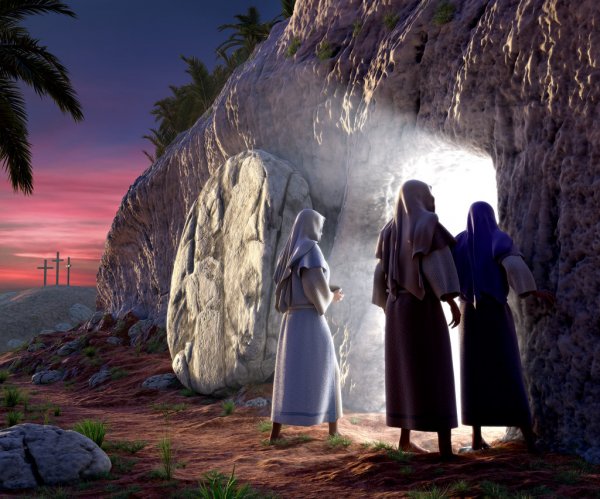
The women who walk to the tomb in the pre-dawn morning knew what they would find. After all, they were there at the Cross. They saw what had happened. Jesus had died. All hope for something more was gone. All dreams of the world somehow turning around and emerging from the darkness in which they lived had ended at that cross. They were able to quickly get his body and they had buried him, hastily laying him in a borrowed tomb so that the authorities would not find the body and take it as proof of his death. And then sundown came all too quickly before they could prepare the body. They had to stop what they were doing and observe the Passover Sabbath.
So, they come early, before the rest of the world was awake to finish what they needed to do, to properly prepare Jesus’ body for burial. They knew what they would find. But when they came around the path by the tomb, they were stunned. The heavy stone, the one that had taken all of them to roll over the hole, was no longer covering up the entrance. So, Mary takes off running. She ran to Simon Peter. He would know what to do. You can imagine his response: “What do you mean he’s not there??? That’s crazy. That doesn’t even make sense!” So, Peter and one of the other disciples went to see for themselves, running faster and faster down the pathway, surely knowing but probably dreading whatever they might find at the end. It was all there—the tomb, the linen wrappings, the cloth that had covered his head. Everything was there but Jesus. The Scripture says they believed. I don’t think they fully grasped it, though. They believed he was gone. But where did he go? And in that moment of not knowing what to think, not knowing what to do, not knowing where to turn, suspended between despair and hope, their faith journey truly began. This was the point where faith had to replace making sense of things.
But Mary Magdalene, distraught yet again with grief over what seemed to be yet another loss, just looking for ANYONE that could explain what happened or maybe just listen, mistook Jesus for the gardener. It wasn’t until he spoke that she knew who it was. It wasn’t until he spoke and she heard his voice in the darkness that she knew that she had seen the Lord.
Yeah, they had it all figured out. It was clear to them, until it wasn’t. Perhaps part of the message of Easter is that there’s always more to the story than what we know or what we have figured out or the limits around which we have constructed our very lives. So, in the darkness of Easter morning, our faith journey really begins.
But there’s something we often miss in this story. There is no sunrise service where Jesus rises with the Light. In fact, this particular Gospel account doesn’t even have any light at all. It takes great care in pointing out that it was early in the morning, while it was still dark. All of this happened in the darkness. But more than that, all of this REALLY happened before anyone showed up. Under cover of darkness, while the rest of the world was sleeping and grieving, before the women came, before the world started stirring, while Creation was still groaning under the weight of that Friday, God began doing something new. While it was still dark, God was recreating Life. God had done that before. God had come into the dark void and spoke Light and Life into being and Creation had begun. And, here, God does it yet again.
We speak of those that came to the tomb that morning as “witnesses” to the Resurrection, but, truth be told, there WERE no witnesses. No one actually SAW Jesus rise. There was no one there to document it for us. Everyone who saw Jesus alive again saw him after. Whatever happened between the hours that Jesus was laid in the tomb and that moment when the grave cloths were found discarded on the tomb’s floor, whatever happened between the beginning of the Sabbath and the morning of that third day, happened in the dark. We tend to begin our Easter morning with shouts of alleluia and beautiful Easter lilies offset by brightly streaming light. But that’s not really the way the story goes. Everyone who believes actually came into a story that was already going on, even those that were present that day at the tomb. Believing is not about seeing it happen but rather coming into the work that God has already begun and knowing that it is Truth AND that it is your story. Our journey of faith begins in the dark.
Maybe THAT’S the Resurrection story—that God does not wait until the world cleans up its act, that God does not wait until we are who we should be, that God does not wait until we believe to actually show up. Maybe the story is that God is working all the time to resurrect, to re-create, to reconcile all of us so that even in the dark, no, ESPECIALLY in the dark, we know that God is there.
So, think about it. Have you ever noticed how quietly Easter arrives? There are no angelic choirs making announcements of Jesus’ coming. There are no foreign visitors bringing gifts. There aren’t even any ordinary folks that come in from the Shepherds Fields to see what has happened. There is no voice thundering from heaven or Old Testament characters showing up on queue. There’s no drama of parting waters or chariots of fire or burning bushes or mountains shrouded in cloud. The sounds of the Resurrection are quiet, almost fearful. They seem uncertain what will happen next, a little reticent at going forward in a new way. And yet, there is a certain peace to Easter, a peace that begins in the quiet of the darkness and then allows the Light to begin to peek into the scene. It’s as if Jesus rises just for Mary and calls her by name. Maybe that’s what Jesus does for each of us. In the quiet darkness, Jesus comes and rises before we get there and then when we are listening, says our name. And we begin to follow wherever Jesus goes. We just have to pay attention.
Some of you may remember this, but twenty-seven years ago, an F4 tornado hit Goshen United Methodist Church in Piedmont, Alabama. It was Palm Sunday and the younger children’s choir had just finished presenting a pageant and were all seated on one pew. Rev. Kelly Clem was in the pulpit just beginning her sermon when the tornado struck, immediately lifting the roof off and toppling several of the church’s walls to the floor, crashing down on top of the pews and the congregation. The tornado killed nineteen people and injured eighty-six others that day. Over the next few days, all through Holy Week, the pastor performed one funeral after another, including one for her four-year old daughter, Hannah, who had been part of the choir. Toward the end of the week, she began receiving calls from members of the congregation. Given the death of the pastor’s daughter and the destruction of their sanctuary, they asked, “Reverend Clem, are we having Easter this year?” Her response? “Easter is coming.”
That Sunday morning, two hundred people gathered in the front yard of the destroyed facilities at Goshen UMC while it was still dark. And as the sun began to rise, Rev. Clem, with a bandaged head and her shoulder in a brace and a heart broken with grief, stood up in a makeshift pulpit, opened her Bible and read from Romans 8: “Nothing in all creation can separate us from the love of God in Christ Jesus our Lord.”
THAT’S the Easter message. It’s not that God put light where there was darkness; it’s not that despite all the darkness that is inflicted onto us by circumstances or by other people, God always comes out on top. The message is that while it is still dark, God is working, recreating, resurrecting, raising us up. The truth is, we call ourselves “people of the cross”. I’m not sure if that’s really it. We’re probably more “people of the empty tomb”, “people of what happened after”, “people of what God is doing now”. And more than that, if we read this story as something historic, something that happened nearly 2,000 years ago that we just make sure we read once a year surrounded by Easter lilies, we have missed the point. This day is about Jesus’ Resurrection, the one NOW. That’s why most of our words for today are in present tense. “Christ the Lord is risen today…” And it’s also about OUR resurrection, OUR re-creation, OUR reconciliation with God. It’s ongoing. Even while at times it seems dark, God is there, recreating and resurrecting and making us something new.
It’s not just looking on the bright side of life and ignoring the darkness as if it doesn’t exist; it’s not a promise that nothing will ever go wrong or that God will put everything back in place at some point if we just hold on. To be honest, that’s just bad theology. Easter is not about replacing the bad with the good; In fact, I will tell you that Easter makes a whole lot more sense when you go through Holy Week and Good Friday, when you travel through the wilderness. Because the truth is, we are not out of the wilderness (ARE YOU KIDDING?). Life is a wilderness. And God shows us not the way around, but the way through. In fact, God walks with us through the wilderness showing us The Way. That’s it. God takes our hand while it is still dark, calls our name, and shows us The Way.
So, while it was still dark, Mary Magdalene went and announced to the disciples, “I have seen the Lord.” Because, Easter does not merely change death; Easter changes life. Easter shows us the Risen Christ. And once we’ve seen the Lord, once we’ve peered into the darkness and have caught a faint vision of Light, even if we don’t really know EXACTLY where it is, once we, too, have heard our name and Risen, there is no going back. He is Risen! He is Risen indeed! And so are we—even in the wilderness.
And not that [this] story is told, what does it mean? How can I tell? What does life mean? If the meaning could be put into a sentence there would be no need of telling the story. (Henry Van Dyke)
We made it through the wilderness! (Well, not really!) The wilderness is where we are, where we travel, where we find God. So, remain in the wilderness. It will be your place of resurrection! I’ve so treasured this time in this wilderness season, even as I traveled in my own wilderness–loss, grief, packing, storing stuff, moving, arranging, unpacking….more unpacking…still unpacking. The wilderness is always with us. Thanks be to God! I will go back to posting at least weekly and maybe try to do some other things. In the meantime, thank you for traveling with me!
1In you, O Lord, I seek refuge; do not let me ever be put to shame; in your righteousness deliver me. 2Incline your ear to me; rescue me speedily. Be a rock of refuge for me, a strong fortress to save me. 3You are indeed my rock and my fortress; for your name’s sake lead me and guide me, 4take me out of the net that is hidden for me, for you are my refuge.
5Into your hand I commit my spirit; you have redeemed me, O Lord, faithful God. 15My times are in your hand; deliver me from the hand of my enemies and persecutors. 16Let your face shine upon your servant; save me in your steadfast love.
What do we do with this day, this Holy Saturday? We are still grieving. The reality of it all is beginning to sink in, beginning to be real. Jesus is gone, dying alone on some hill that we don’t even know. So, what do we do today? How do we pick up the pieces in the midst of our pain and despair and just go on with our lives? Oh, we 21st century believers know how the story ends. We’ve already jumped ahead and read the next chapter many, many times. (Don’t tell those that don’t read ahead, but it all works out in the end.)
And yet, we do ourselves no favors if we jump ahead to tomorrow. After all, the Scriptures tell us that Jesus rose on the third day, the THIRD day, as in one-two-three. The third day doesn’t happen without today. It must be important, right? But, oh, it’s just so painfully quiet. The sanctuary is dark, awaiting to be redressed for its coronation. The bells are quiet, hanging expectantly for tomorrow. And we still sit here draped in black with our Easter brights hanging there ready for us to don. What are we supposed to do today?
Tradition (and the older version of the Apostles’ Creed) holds that Jesus died, was buried, and descended into hell. So is that what this day is? Descent? Good grief, wasn’t the Cross low enough? The well-disputed claim is that Jesus descended into death, descended into hell, perhaps descended into Gehenna (Greek) (Hebrew–Gehinnom, Rabbinical Hebrew–גהנום/גהנם), the State of ungodly souls. Why? Why after suffering the worst imaginable earthly death would Jesus descend into hell? Well, the disputed part is that Jesus, before being raised himself, descended to the depths of suffering and despair and redeemed it, recreated it. The sixth century hymnwriter, Venantius Fortunatus claimed that “hell today is vanquished, Heaven is won today.” Why is that so out of bounds of what God can do? Don’t we believe that God is God of all? Or does it give us some sense of comfort to know that we are not the worst of the bunch, that there are always Judas’ and Brutus’ that have messed up a whole lot worse than any of us and so are destined to spend eternity on the lowest rungs of hell? But, oh, think about the power and grace and amazing love of a God who before the Divine Ascent into glory, descended into the depths of humanity and redeemed us all, every single one of us, perhaps wiped out the hell of each of our lives rung, by rung?
Welcome, happy morning! age to age shall say: Hell today is vanquished, Heav’n is won today!” Lo! the dead is living, God forevermore! Him, their true Creator, all His works adore!
And, yet, again, we cannot leave it all to Christ to do. Just as we were called to pick up our cross yesterday, we are called to descend down into the depths, plunging into the unknown darkness, so that God can pick us up again, set us right, and show us a new Way. And so, this day, we stand between, between death and life, between hell and heaven, between a world that does not understand and a God who even in the silence of this day has begun the redeeming work. In some ways, this is the holiest day of the week. How often do we stand with a full and honest view of the world and a glimpse of the holy and the sacred that is always and forever part of our lives? How often do we stand together and see ourselves as both betrayers and beloved children of God? How often do we stand in the depths of our human state and yet know that God will raise us up. This is a pure state of liminality, a state, as the Old English would say, “betwixt and between.” It is where we are called to be. It is the place of the fullness of humanity as it claims both human and divine. In the silence of this day, we stand with God. And we wait, we wait expectantly for resurrection.
Do you remember how we started this whole thing? Do you remember the Creation account from Genesis, how how God spoke Creation into being, how God spoke US into being. So today we wait for God to say us into being again. It is where we should always be. We won’t though. We won’t be there. (Remember, we’ve had this problem before.) And maybe on some level, it’s too much for us to always be there, always be waiting expectantly for God. Because, granted, today IS very wilderness-like. In fact, you could say that it is the ultimate wilderness—lonely, forsaken, no clear path ahead. I know. You thought we were going to “wrap” this whole wilderness thing up, right? But, see, wilderness is an opportunity. It’s an opportunity for God to say us into being again. But at least we can remember what this day feels like as we stand between who we were and what we will be.
So, for today, keep expectant vigil. Do not jump ahead. We can only understand the glory of God when we see it behind the shadow of death. But, remember, shadows only exist because the Light is so very, very bright.
The shadows shift and fly.
The whole long day the air trembles,
Thick with silence, until, finally, the footsteps are heard,
And the noise of the voice of God is upon us.
The Holy One is not afraid to walk on unholy ground.
The Holy Work is done, and the world awaits the dawn of Life.
(“Saturday Silence”, Ann Weems, in Kneeling in Jerusalem)
You must give birth to your images. They are the future waiting to be born. Fear not the strangeness you feel. The future must enter you long before it happens. Just wait for the birth, for the hour of new clarity. (Rainer Maria Rilke)
16Then he handed him over to them to be crucified.So they took Jesus; 17and carrying the cross by himself, he went out to what is called The Place of the Skull, which in Hebrew* is called Golgotha. 18There they crucified him, and with him two others, one on either side, with Jesus between them. 19Pilate also had an inscription written and put on the cross. It read, ‘Jesus of Nazareth,* the King of the Jews.’ 20Many of the Jews read this inscription, because the place where Jesus was crucified was near the city; and it was written in Hebrew,* in Latin, and in Greek. 21Then the chief priests of the Jews said to Pilate, ‘Do not write, “The King of the Jews”, but, “This man said, I am King of the Jews.” ’ 22Pilate answered, ‘What I have written I have written.’ 23When the soldiers had crucified Jesus, they took his clothes and divided them into four parts, one for each soldier. They also took his tunic; now the tunic was seamless, woven in one piece from the top. 24So they said to one another, ‘Let us not tear it, but cast lots for it to see who will get it.’ This was to fulfil what the scripture says, ‘They divided my clothes among themselves, and for my clothing they cast lots.’ 25And that is what the soldiers did.
Meanwhile, standing near the cross of Jesus were his mother, and his mother’s sister, Mary the wife of Clopas, and Mary Magdalene. 26When Jesus saw his mother and the disciple whom he loved standing beside her, he said to his mother, ‘Woman, here is your son.’ 27Then he said to the disciple, ‘Here is your mother.’ And from that hour the disciple took her into his own home.
28 After this, when Jesus knew that all was now finished, he said (in order to fulfil the scripture), ‘I am thirsty.’ 29A jar full of sour wine was standing there. So they put a sponge full of the wine on a branch of hyssop and held it to his mouth. 30When Jesus had received the wine, he said, ‘It is finished.’ Then he bowed his head and gave up his spirit.
******************
I am standing here but it does not seem real. I want to hold him, to comfort him, to cradle him in my arms like I did when he was a baby. But the guards are holding us back. Oh, please, I don’t think I can stand anymore. But I must stand with him. He has to know that I am here with him. He has to know how much I love him, how much I hurt for him, how I would trade places with him if I could.
All of the memories are flooding into my head. I remember that night when the angel came to me. (Luke 1:26-38) I did not understand. I was so afraid. But I knew I had to say yes. I had no idea what I was agreeing to do. And then for nine months I carried the baby in my womb. It was joyous. In one respect, it was just like any other pregnancy, like the others I had after that. And yet, it was different. I always felt like there was someone there with me, guiding me, loving me, helping me through it. It’s hard to explain.
The birth itself was hard, downright scary in fact. (Luke 2:1-20) We traveled to Bethlehem. It was so far, so painful. And then when we finally arrived, it was so crowded. The streets were wild. I remember that nice man who let us bed down in the room that housed his animals. I remember the first time I looked into his eyes–those dark, compassionate eyes. Even as a baby, he had compassionate, loving eyes. He was special. I knew that he was special when he came into the world. I just didn’t know how wonderful he would be.
I remember that day in the temple when we went for the Purification. (Luke 2:22-40) That strange man that I had never met took him from me. He cradled him in his arms. It was as if they had known each other always. And he told me my soul would be pierced. Oh, how right he was!
I remember the day that my cousin’s son baptized him. He didn’t know I was there. I hid behind the trees. After all, he was an adult; he didn’t need his mother always looking on. And I remember when his ministry started. He was so brave, so fearless. It scared me at times. I thought something like this might happen. But I am so incredibly proud of him. I am so proud of what he became, what he made others become that he touched in his life. He was special.
No, this does not seem real. Somebody needs to help him. Please, please, he’s asking for water. Please, someone give him water. I’m afraid this is it. I’m afraid he cannot take it anymore. I’m afraid he’s going to give up. Perhaps it would be better. Perhaps it is better to let go…Oh, how I love him! How I want to go back, to hold him just once more! It is over. It is all over. He is gone. What did it all mean? I don’t understand. Why the angel? Why the star? Why did it all happen if it was going to end this way? What does God have in mind for him? He promised me that it would be for good. He promised me that it would be OK. I guess I have to believe that, hold on to it, hope. Someday maybe I’ll see it.
I wanted to stay here until they gave me his body, but I don’t think I can. There are others here too–Jesus’ friend Mary, who has always been so lovely toward me, and the disciples. I hope they all realized how much he loved them, how he would do anything for them, how he wished the best for them. The rain is really coming down now and the skies are angry, angry like me. The wind is blowing so hard, I can no longer stand against it. There are rocks and debris sliding down the mountain above us. It seems that the world is breaking apart. Will the world ever know what it has lost? Will the world ever know what it did? Will God ever forgive this world for killing my son, their son, God’s son? Someone just told me that the temple curtain has split in two. It is as if the holy has spilled into the world. I can’t explain it.
My son came into this world wrapped in so much hope. He was supposed to change the world. He was supposed to open the eyes of the world to what it could be, what it could become. Is it all for naught? Or, someday, will we finally understand why he came? Someday, I know, that God will make it all make sense. But, now, today, I am grieving more than I could know. The loss is unbearable, a thick wilderness of loss through which I cannot find my way. But what a gift I’ve had! What an incredible gift that was taken away all too soon! I have to leave this place, as hard as it is. Shabbat is starting in a few minutes. I must go prepare, light the candles, and usher in the joy of the Sabbath. I must go rest. I need it. I need it to resurrect my hurting soul. God will be with me. Let it be.
“My soul magnifies the Lord, and my spirit rejoices in God my Savior, for he has looked with favor on the lowliness of his servant. Surely, from now on all generations will call me blessed; for the Mighty One has done great things for me, and holy is his name. His mercy is for those who fear him from generation to generation. He has shown strength with his arm; he has scattered the proud in the thoughts of their hearts. He has brought down the powerful from their thrones, and lifted up the lowly; he has filled the hungry with good things, and sent the rich away empty. He has helped his servant Israel, in remembrance of his mercy, according to the promise he made to our ancestors, to Abraham and to his descendants forever.” (Luke 1:46-55) Shalom, my dear Son! May God’s Light stay with you!
******************
We have all experienced loss and grief. It DOES seem like a wilderness. You want so badly to go back. But the pathway behind you seems to have closed. You can only walk forward. But God takes grief and loss and redeems it. God doesn’t take it away. It is part of us just as the wilderness journey through which we’ve traveled will always be. But God helps us restructure our lives and finds a place for loss, a healing, joyful place.
The point of this journey through Holy Week is to empty, to surrender, to let God in. It is the completion of the process of Lent in which we have made room for our death, for our surrender to God. Resurrection is finding that place that is just for us. The wilderness teaches how to be open to that, how to prepare our lives for re-creation. That is what God does—gives us the gift of re-creation. But, for now, we will grieve, and we will feel loss and God will hold us until we can hold it ourselves. It is finished.
There is a journey you must take. It is a journey without destination. There is no map. Your soul will lead you. And you can take nothing with you. (Meister Eckhart, 14th century)





 Dancing to God