(part of the “Breathing Out” Lenten Series)
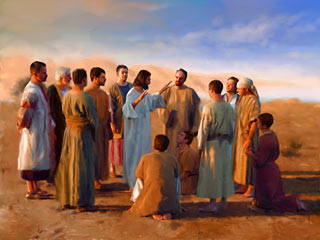
Scripture Passage: Matthew 9:35 – 10:13
35Then Jesus went about all the cities and villages, teaching in their synagogues, and proclaiming the good news of the kingdom, and curing every disease and every sickness. 36When he saw the crowds, he had compassion for them, because they were harassed and helpless, like sheep without a shepherd. 37Then he said to his disciples, “The harvest is plentiful, but the laborers are few; 38therefore ask the Lord of the harvest to send out laborers into his harvest.”
10Then Jesus summoned his twelve disciples and gave them authority over unclean spirits, to cast them out, and to cure every disease and every sickness. 2These are the names of the twelve apostles: first, Simon, also known as Peter, and his brother Andrew; James son of Zebedee, and his brother John; 3Philip and Bartholomew; Thomas and Matthew the tax collector; James son of Alphaeus, and Thaddaeus; 4Simon the Cananaean, and Judas Iscariot, the one who betrayed him.
5These twelve Jesus sent out with the following instructions: “Go nowhere among the Gentiles, and enter no town of the Samaritans, 6but go rather to the lost sheep of the house of Israel. 7As you go, proclaim the good news, ‘The kingdom of heaven has come near.’ 8Cure the sick, raise the dead, cleanse the lepers, cast out demons. You received without payment; give without payment. 9Take no gold, or silver, or copper in your belts, 10no bag for your journey, or two tunics, or sandals, or a staff; for laborers deserve their food. 11Whatever town or village you enter, find out who in it is worthy, and stay there until you leave. 12As you enter the house, greet it. 13If the house is worthy, let your peace come upon it; but if it is not worthy, let your peace return to you. 14If anyone will not welcome you or listen to your words, shake off the dust from your feet as you leave that house or town.
They had different backgrounds. What that tells me is that there was not some “ideal” person or “ideal” resume’ for the job. Many were fishermen, a couple were business owners, one was a tax collector, one was a zealot, whatever that meant. I think a zealot was what we would think of as an activist of some sort. But they all came together even with all their differences.
And then Jesus gives them the authority to heal, to cure, to raise the dead, to cleanse, all in Jesus’ name. And, if you read a little farther, he tells them not to take any money, not a bag, not even a change of clothes. This always struck me as weird. So, they go out into the world without really being prepared? I think maybe Jesus didn’t want them to be weighed down. He didn’t want them to rely solely on themselves because when we do that, it becomes about us. And this was not about the disciples; it was about the journey on which they were called to go.
Then (still reading farther) Jesus tells them that if someone doesn’t welcome them, if someone doesn’t listen, if someone doesn’t extend hospitality to them, if someone out and out rejects them, don’t worry about it. Just “shake off the dust from your feet”. That is hard. When you feel like you’re right, when you feel like you’re doing what you’re supposed to be doing, it is really hard to walk away from rejection. But it’s another reminder that it’s not about us. Sometimes stuff just doesn’t happen the way we plan. Maybe the person that comes to them next will get through. Jesus even warns them in this passage that they may be in danger. There may be people that want to come after them. But Jesus tells them how to endure, how to keep going.
You know what Jesus doesn’t tell them? Surprisingly, he doesn’t tell them what to say to people. He doesn’t give them a set Biblical interpretation or a prescribed theological premise. He tells them to proclaim the good news of the Kingdom of God. He sends them out to tell the story. He sends them out to invite others into that story—anybody, everybody, whoever they encounter who will listen. And he tells them how to adapt, how to be nimble. He reminds them that it’s not about them or what they think; it’s about the good news. And he leaves room for them to wrestle with their own understanding.
That’s what it’s about. I don’t think we’re supposed to memorize our beliefs. I don’t think we’re meant to be ready to spit them out at a moment’s notice. Do you remember a couple of years ago when the so-called evangelism gurus started telling you that you needed to come up with an “elevator speech”? It was a 20 second speech that would somehow tell someone what you believed and convert them. OK, I don’t mean to be disrespectful, but I always thought that was truly one of the dumbest things I’ve ever heard. Our faith is not about spouting pre-formed messages. I’m not real sure that passing out flyers or practiced speeches is the way to win people over. It is rather about relationships. It’s about listening—listening to where people are, what people need, and maybe even what has turned them off before. Jesus did that. He didn’t spout theology sound bites. He got to know people. He listened. He loved.
So, maybe our call is to be a little less defined, a little more open, to employ a little less “canned” theology and begin to listen, to learn, to love. So, maybe we breathe out the definition. Maybe we breathe out the canned speech. And maybe we breathe in just being who God calls us to be—open, loving, maybe just shaking the dust off enough to be who we’re meant to be.
Today we are bombarded with a theology of certitude. I don’t find much biblical support for the stance of “God told me and I’m telling you, and if you don’t believe as I do, you’re doomed.” A sort of “My god can whip your god” posture. From Abraham, going out by faith not knowing where he was being sent, to Jesus on the cross, beseeching the Father for a better way, there was always more inquiring faith than conceited certainty. (Will Campbell)
Grace and Peace,
Shelli
 Dancing to God