(part of the “Breathing Out” Lenten Series)
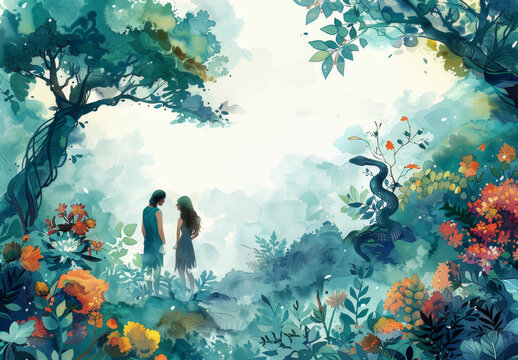
Genesis 2: 15-17; 3: 1-7 (Lent 1A)
15The Lord God took the man and put him in the garden of Eden to till it and keep it. 16And the Lord God commanded the man, “You may freely eat of every tree of the garden; 17but of the tree of the knowledge of good and evil you shall not eat, for in the day that you eat of it you shall die.”
3Now the serpent was more crafty than any other wild animal that the Lord God had made. He said to the woman, “Did God say, ‘You shall not eat from any tree in the garden’?” 2The woman said to the serpent, “We may eat of the fruit of the trees in the garden; 3but God said, ‘You shall not eat of the fruit of the tree that is in the middle of the garden, nor shall you touch it, or you shall die.’” 4But the serpent said to the woman, “You will not die; 5for God knows that when you eat of it your eyes will be opened, and you will be like God, knowing good and evil.”
6So when the woman saw that the tree was good for food, and that it was a delight to the eyes, and that the tree was to be desired to make one wise, she took of its fruit and ate; and she also gave some to her husband, who was with her, and he ate. 7Then the eyes of both were opened, and they knew that they were naked; and they sewed fig leaves together and made loincloths for themselves.
This is always such an odd little story. What do we do with it? Yes, it’s known as the “Second Creation Account”. It’s actually probably the first one. This one is out of the Yahwist tradition and the “first one” (the one organized into “days”) is probably more from the Priestly tradition, which would have come a little later. I guess the canon-compilers were going for drama. I don’t know. So, what do we do with it? Well, it’s obvious no one has ever known what to do with it because over the centuries, the tradition slowly morphed into “Eve-blaming”. Oh, yes, let’s blame the girl! Because the guy had nothing to do with it. Are you kidding me? Personally, I think the most obvious lesson is don’t listen to talking snakes. I mean, that seems pretty straightforward, right?
So, first of all, let’s all admit that it’s a story (a good one with lots of special effects but a story nevertheless). I don’t think there was an Adam and Eve. I don’t think there was some sort of secret utopian garden to which we’re trying to return. And, for me, the jury is still out on the talking snake. But the lessons? The lessons are real. The Truth is real. Adam (Adamah) means “man” or “human” (or man of the earth). So, this a wonderful parable or fable not about the birth of one man but rather an attempt to explain how we humans came to be. Adamah is formed from dust (resembling that dust that was smeared on your forehead yesterday). And Eve? The name Eve (Chavah) means “living one” or “source of life”, perhaps even “breath of life”. OK, that’s beginning to make sense. Those are things we’ve seen before.
And then there’s this garden. There they were in the garden, innocent, yes, but also unknowing, unthinking, not quite yet human. See, it was the beginning. It was not the place where we were meant to be. God created us to go beyond where we are, to go beyond that “safe” place, rather than to live in some sort of controlled environment where nothing can touch us. But the mistake that these “first humans” made was assuming there was a different way to do that. According to the story, they jumped the gun a bit. We all do it. We think we know best. We think we can figure it out on our own. We think the rules are not for us because, obviously, we know better. (Or maybe we’ve mistakenly listened to a talking snake!)
We are not called to be innocent. That’s just dumb. We’re human. We’re complicated. God made us that way, filled with dust and new life, darkness and light, regret and grace. Again, we’re not called to be innocent. We’re called to be redeemed, renewed, and recreated. That story of that garden was only the beginning. Several modern theologians and writings have referred to it as the “kindergarden of eden”. It was how we began to understand ourselves. And I think the point of it was not the creation of the human creature, the innocent and obedient one, but rather the realization by that creature that he or she was indeed human, that we are both flawed and glorious, that we are made of dust and the very breath of God. The key is that we have to let go, breathe out, if you will, of the need to be in control, the need to go our own way. Because, life is full of talking snakes.
I claim credit for nothing. Everything is determined, the beginning as well as the end, by forces over which we have no control…We all dance to a mysterious tune, intoned in the distance by an invisible piper. (Albert Einstein)
Grace and Peace,
Shelli
 Dancing to God
Went to Ash Wed breakfast yesterday
Especially came home with ‘read the scriptures and life as something to ‘Form’
us, not ‘inform’ us