Stilled

So before we dive in, (that was a pun) I want to invite you to a little imagery.  What in your life needs to be calmed?  What is the thing that you feel like you just can’t control, just can’t get a handle on which way to go?  What is the storm that scares you and turns you and sometimes feels like it has knocked you off your feet?  We all have it, that thing that we’d just like someone to “fix”.  And I want you to imagine that storm.

This Gospel passage is one of the most familiar and oft-quoted stories in the Gospels.  Many of us can recall listening to this story as it was read to us from one of those children’s storybook bibles or seeing it depicted in paintings and pictures.  We like this story.  It tends to sometimes gives us a sense of composure about our lives, knowing that Christ can calm the storms, purge our fears, and make our lives into the way that we like them once again.

Here, Jesus stands on the edge of the boat with his arms outstretched over the whitecaps of a raging lake (it’s a like, rather than a sea).  With that image in mind, the text may become for us a miracle story demonstrating the divine power of Jesus.  This Jesus in whom we believe, this Jesus in whom we put our faith, can do anything—can pick up the pieces of our lives and put them back together, can calm the raging waters that frustrate our otherwise calm repose, and can turn our lives into what we cannot, calming the storms of disapproval, rejection, failure, meaningless, illness, and even death and providing us a veritable sanctuary to see all those things through. 

But the problem is that if we stop there, if for us Jesus becomes the one who always “fixes” things, who calms the chaos and puts things back the way they were, then I think we have missed a large part of who Jesus is.  Sometimes I think it’s good to be reminded that Jesus is not a superhero.  The promise is NOT that he will put things back the way they were; the promise is that life is more, that there is more waiting for us beyond what we see, and that we will always, always, always have someone with us as we walk through these storms.

I remember when I was a young adult.  I had moved to Denver with Apache Corporation and was facing my first winter beyond the (relatively) mild winters of South Texas.  Now you have to understand that I was an only daughter as well as an only granddaughter.  I was used to having things “fixed” for me. As I sat in my apartment on that coldest night that I had encountered so far in my new surroundings, the weatherman on the news, in an effort to insert some other facts of interest into an otherwise perilous situation, told us that oil in a car will congeal at 22 degrees below zero (Fahrenheit).  He then followed this fun fact with the prediction that the temperature that night would fall to 27 degrees below zero.  I thought of my brand new car sitting outside of the apartment building and I panicked.  I did the only thing I knew to do.  As the independent and assured young woman that I was, I called my dad. When I told him the dilemma (after waking him at 11:30 his time), his response completely threw me: “Shelli, I know that you think I have the answers to all of life’s questions, but, think about it—I have lived in Katy, TX my entire life.  Why would I know the answer to this question?  I think it was at that moment that my dad moved from being my “fixer” to being my father.  I think it’s safe to assume that the disciples had fallen into the same boat, so to speak.  Jesus was always there, always pulled them out of the murky water, always saving them usually from themselves. 

So, think about the passage again.  It was evening.  It was beginning to be dark as the light of day began to tip beneath the horizon.  And it was now that Jesus had suggested that they make their way to the other side of the lake, away from the familiar crowds, toward the unknown, perhaps the unfriendly and unwelcoming, with their small little entourage of boats.  Why would they do this?  Think about it.  They did not have access to the “Severe Weather Center” on their local news broadcast or that neat little weather app on your phone.  They had no navigation equipment or GPS.  They had no idea what they were getting into.  The darkness was always a symbol for the wilderness, for danger.  And the other side of the lake?  Completely unknown.  So, Jesus suggests that they venture into the wilds of the unknown, to leave the safety of the harbor behind.

And as they get out into the middle of the lake, a great windstorm arises, so great that the waves crash against the boats carrying Jesus and the disciples.  Now you have to remember that this was not a huge boat.  First century fishing boats were probably about 20 feet long and had no cover over them.  You couldn’t go down under deck.  The hull would have been maybe only four feet deep.  So before long, water begins to fill up the small boat. Not even the experienced fishermen in the bunch could do anything about this.  So they turn to Jesus.  Jesus will save them.  Jesus will fix this.  “Jesus, save us!”

And there is Jesus, sound asleep on the boat cushion at the rear of the boat.  You can imagine what the disciples thought.  “Are you kidding me?  Here we are, dying, and you are asleep!  What are you thinking?  Get up and save us!  Get up now!”  Now, odd as this may be to us, you can’t really blame Jesus.  He had to be tired.  He had been teaching in the hot sun and the crowds just wouldn’t leave him alone.  So, he lay down and he rested.  Everything would be alright.  And then he is jolted awake by these overly-dramatic disciples who can’t seem to take care of themselves or each other.  “Good grief,” he thought, “have you learned nothing from me?” So he got up and with a few simple words, “Peace! Be still!”, the storm subsided.  And they floated for a few moments, not saying a word to each other, as the boat glided through the water as if on glass.  Then Jesus turned to them.  “Have you no faith?  Have you learned nothing from me?”

So, as I mentioned before, we’re all familiar with this story.  It’s reading has been sort of drilled into us from an early age.  What if we’re reading it wrong?  What if Jesus didn’t really calm the waves but rather calmed the disciples’ stress and anxiety about them?  What if Jesus, with calming wisdom, simply guided the boat into a calm place, into a still cove that was sheltered from the winds and waves?  What if Jesus with a peace-filled repose took the helm and steered the boat away from the waves and then in the quietness, looked at the disciples and said peacefully, “Shhh….calm…everything is going to be OK.” What if Jesus wisely gave the disciples room to breathe?

At the risk of destroying your perceptions about the story, the notion that Jesus somehow fixes our lives by taking the storms away doesn’t really jive with the rest of the scriptures.  God doesn’t fix things; The Bible is not the story of a magician. God re-creates them.  And sometimes it means just looking at something differently or perhaps from a different place.  But all of us are often trying to escape the storm.  So, we look for something that will get us out of it.  But even when God steers us into the quiet, into the stillness, that doesn’t mean that it will always be that way or that we should stay there.  That is not the final plan.

When I was little, we used to swim in rice wells (because, you know…Katy).  It was fun and a little scary.  You had to crawl up onto this huge pipe and walk out on it over the water.  As the water gushed out of the pipe, it created these swirling typhoon-like waves of water.  And you jumped off and were forced down into it by the waters barreling out.  And then you swam a little and got out and did it again.  But you know what?  We never went into the still waters around the edge of the pond.  You know why?  It was dangerous.  It was rancid.  That’s where the snakes were. The safest place was the constantly-swirling water.

13th century mystic Mechtild of Magdeburg said that “the day of my spiritual awakening was the day I saw—and knew I saw—all things in God and God in all things.”  You know, when we read this passage, we see God on the shore, amidst safety and predictability.  And we see God in the calming of the storm.  But we may miss the God in the darkness as our little boat sails away from the disappearing light.  We may miss God in the storms themselves that we encounter that make us realize that God has given us enough faith to get us through.  And we miss God in the unfamiliarity of the far shore, in the unknown lands toward which we sail.  We also miss the way God guides us into a place where we can sort of regroup and ready ourselves for the rest of the journey.  For us, fear is something we are supposed to overcome.   And yet, Jesus didn’t rebuke the disciples because they were afraid; his frustration was that they didn’t have faith to know that God was there with them, with them no matter what life brings.  That is why in the midst of all these storms and all this noise, in the midst of everything that goes on in our lives, we hear Jesus saying, “Peace! Be still…Come and follow me—not the noise, not the ones that tell you that life can be fixed. Untie your boats from the harbor and follow me.” And, in the meantime, God may steer you into a cove until you’re ready for the rest of the journey. God is not going to fix it; God is going to show you a new thing.  All you have to do is follow, no matter what the journey holds, because we’re on our way to Life.       

Grace and Peace,

Shelli

Seeds

It seems that Jesus was big on botanical images, doesn’t it?  But they work.  You plant seeds, you feed and care for them, and they grow into a plant, right?  But I think there’s something else.  Plants don’t grow because we make them grow.  Plants grow because that’s what plants do.  We can’t hurry them.  We can’t control them.  We can’t predict when they will bloom.  Oh, we can shape them and prune them and help them along but they’re pretty much going to do what they’re meant to do.  Regardless of how much we plan and how much we do, we cannot make our plant grow.  We are not called to plan when the harvest will happen or when it will end.  They sprout, they grow, they produce fruit, and they die.  They’re part of that cycle of life.  They’re part of us.  It doesn’t mean that we have nothing to do with it, though.  We are the scatterers and the gatherers.  We are the planters and the harvesters.

Next, Jesus once again uses that familiar little mustard seed.  We’ve read that many times before.  It’s tiny, really nothing more than a spec.  Now often when we read of this beloved mustard seed, so many of us imagine this tiny seed that grows into this big beautiful tree.  (I don’t know.  Was there a Sunday School picture that depicted that?) You’ve heard that image.  People like to use it to depict what even a tiny bit of faith can do.  But I’m not so sure that’s what it was meant to say.  Because, see, that tiny mustard seed does not, no matter how hard it tries, no matter what we do to help it, grow into a majestic redwood.  It grows into a bush (or if it’s REALLY persistent, a sort of bushy, squatty tree), a very ordinary bush with an ordinary harvest that will end up in our spice rack or as a spread on our sandwich.  There’s nothing really surprising about the outcome.  It’s what is supposed to happen.  It’s what God has promised.

So, interestingly enough, Jesus used something incredibly ordinary to illustrate his point.  But even run-of-the-mill ordinary things can be extraordinary.  A couple of months ago, I bought some egg rolls.  But when I got ready to eat them, I realized I had no Chinese mustard.  How can you eat egg rolls without Chinese mustard? (Well, I can’t) So, I thought, well how hard can that be to make?  All it takes is a little dry mustard, a little rice vinegar, and some ice water.  Easy, right?  Well, yes, if you want to create something that will clean out your sinuses for the next decade!  Just for the record, mustard, small though it might be, packs quite a dramatic punch!

So, what, really, is Jesus trying to teach us with this string of parables?  It sort of sounds like the disciples were getting the teacher’s notes and the rest of us were just on our own.  No, I think Jesus just wanted us to look at things differently.  I think Jesus wanted us to have faith in the faith that God had in us.  Faith is a gift.  God supplants the seeds of faith into our lives—ALL of our lives.  And they begin to grow. But, lest we think that faith can be charted into some perfectly-increasing line graph through our life, we need to remember that there is no prescribed pathway for our faith.  “Measuring faith” is not up to us.  God gives us whatever we need.

So, if someone tells you that “you don’t have enough faith” or that “you just need to have more faith”, have faith in the faith that God has in you.  Each of us has been given the faith that we need to be who God calls us to be.  Sometimes it will, indeed, feel like your faith could move mountains.  And sometimes it just doesn’t seem to fit into who you are.  Sometimes it seems empty and elusive.  Sometimes it seems like you’ve lost it.  (St. John of the Cross penned it as the “dark night of the soul” in his well-known 16th century poem) Perhaps those times in your life are times when your faith lays in winter fallow, regenerating, re-seeding, preparing for the new growth to come.  To be honest, if everyone was constantly moving mountains, the world’s topography would be totally confusing.  Sometimes, it takes faith to get out of bed. On those days, that’s enough.  Sometimes the silence of faith is more powerful than the loud, mountain-moving chorus.

The truth is, most of our life is lived between the times of planting and the times of harvest.  Most of our life is spent waiting on fruit, waiting on completion, waiting on something that we might never see in this life (I think Moses could tell us a thing or two about that.  Sometimes the promised land is not ours to enter).  But those fallow times are never wasted.  They, too, are part of the life cycle.  In fact, it is those times of fallow, those times of waiting when our faith is what gets us through.  Have faith in the faith that God has in you.  The harvest is coming.  Maybe you’ll see it; maybe you won’t.  But your faith is part of what brings it into being—no matter how small you think the seed might be.  So, whatever you do, however small it seems, just keep scattering seed and have faith in the faith that God has in you.

Grace and Peace,

Shelli

Creation…again

Genesis 1

1In the beginning when God created the heavens and the earth, 2the earth was a formless void and darkness covered the face of the deep, while a wind from God swept over the face of the waters.’ 3Then God said, “Let there be light”; and there was light. 4And God saw that the light was good; and God separated the light from the darkness.5God called the light Day, and the darkness he called Night. And there was evening and there was morning, the first day. 6And God said, “Let there be a dome in the midst of the waters, and let it separate the waters from the waters.” 7So God made the dome and separated the waters that were under the dome from the waters that were above the dome. And it was so. 8God called the dome Sky. And there was evening and there was morning, the second day. 9And God said, “Let the waters under the sky be gathered together into one place, and let the dry land appear.” And it was so. 10God called the dry land Earth, and the waters that were gathered together he called Seas. And God saw that it was good. 11Then God said, “Let the earth put forth vegetation: plants yielding seed, and fruit trees of every kind on earth that bear fruit with the seed in it.” And it was so. 12The earth brought forth vegetation: plants yielding seed of every kind, and trees of every kind bearing fruit with the seed in it. And God saw that it was good.13And there was evening and there was morning, the third day. 14And God said, “Let there be lights in the dome of the sky to separate the day from the night; and let them be for signs and for seasons and for days and years, 15and let them be lights in the dome of the sky to give light upon the earth.” And it was so. 16God made the two great lights—the greater light to rule the day and the lesser light to rule the night—and the stars. 17God set them in the dome of the sky to give light upon the earth, 18to rule over the day and over the night, and to separate the light from the darkness. And God saw that it was good. 19And there was evening and there was morning, the fourth day. 20And God said, “Let the waters bring forth swarms of living creatures, and let birds fly above the earth across the dome of the sky.” 21So God created the great sea monsters and every living creature that moves, of every kind, with which the waters swarm, and every winged bird of every kind. And God saw that it was good. 22God blessed them, saying, “Be fruitful and multiply and fill the waters in the seas, and let birds multiply on the earth.” 23And there was evening and there was morning, the fifth day. 24And God said, “Let the earth bring forth living creatures of every kind: cattle and creeping things and wild animals of the earth of every kind.” And it was so. 25God made the wild animals of the earth of every kind, and the cattle of every kind, and everything that creeps upon the ground of every kind. And God saw that it was good. 26Then God said, “Let us make humankind in our image, according to our likeness; and let them have dominion over the fish of the sea, and over the birds of the air, and over the cattle, and over all the wild animals of the earth, and over every creeping thing that creeps upon the earth.”27So God created humankind in his image, in the image of God he created them; male and female he created them. 28God blessed them, and God said to them, “Be fruitful and multiply, and fill the earth and subdue it; and have dominion over the fish of the sea and over the birds of the air and over every living thing that moves upon the earth.” 29God said, “See, I have given you every plant yielding seed that is upon the face of all the earth, and every tree with seed in its fruit; you shall have them for food. 30And to every beast of the earth, and to every bird of the air, and to everything that creeps on the earth, everything that has the breath of life, I have given every green plant for food.” And it was so. 31God saw everything that he had made, and indeed, it was very good. And there was evening and there was morning, the sixth day.

So, when I started writing weekly, I told you there might be more when I felt extra spirity. Ok, that happened. This morning, I had the opportunity (I use the term loosely) to leave home before sunrise and drive to a 7:00 breakfast as part of our Annual Conference meeting.

Driving east, I was suddenly struck by the beauty of the pre-dawn sky and felt an overriding sense of God’s Spirit wrapped around Creation, embracing all that is. I realized that listening to “Morning Joe” on Sirius radio did not fit with my accidental devotional so I asked my ever-constant companion Siri to play Carrie Newcomer. Now, as you may have figured out if you followed my Advent devotionals, Carrie Newcomer has LOTS of songs (like 80-ish). So a random selection from Apple’s artificial intelligence could produce any. Imagine my surprise when the AI choice was “Shelter in the Sky”. (Ok, this is really coming together)

As I listened I was reminded of the scripture that invites us into the ordering of Creation, not the Creation itself, but the way God takes the canvas and turns chaos into order, the order that we experience, the order beyond our understanding, the order that continues. And what I realized is that that ordering didn’t just happen once. There was not just seven days or seven billion years in which God ordered Creation but rather God does it everyday—over and over and over again. Creation…again.

At the beginning

When the earth moves to greet the new day and the light begins to come to be

The sky stretches itself across the canvas of creation with colors of pink and coral, yellow and salmon, and beneath it the grey-blue horizon takes the light unto itself.

And in that light, the earth begins to be revealed, the land, the waters, distinct from each other, distinct from the sky.

And in the shadows, in the first light of the morning, trees stand to greet the light, and blooms open to take the light forth.

Then as the earth turns toward the light, the ball of light appears, peeking from behind the horizon.

And all of God’s creatures rise to meet the day, the crawlers, the runners, and humankind.

And as the day begins, creation once again comes to be, filled with the breath and Word of God, recreated, respoken, renewed. And it is very very good, this Creation…again.

Grace and Peace,

Shelli

Home Repairs

Oh, who are we kidding?  Family reunions are hard.  Jesus has returned home.  And the family was not all that supportive of him.  Doesn’t your family reunion include some people that you sometimes wish would just be quiet, maybe not speak their mind so freely, maybe learn to filter what they say? See, Jesus was not echoing the church leaders.  What a troublemaker!  All of the stuff he was saying did not makes sense.  So, they accuse him of being possessed by a demon. (Yes, that’s always very impressive when your family does that!)

So, Jesus, in true Jesus fashion, began teaching in parables.  “Really, people?  I mean, if I were possessed, if I were Satan or a demon or something, then how in the world could I heal people?  How in the world could I speak of this God of grace and forgiveness?  If I WERE evil and I preached AGAINST evil, then it would all fall anyway.  Because any house that is divided will fall.  God is a God of forgiveness.  But we have to listen.  We have to listen to who the Spirit is calling us to be or we cannot be close to God.”

Jesus is not denying our place in the world; Jesus is calling us to realize that the world needs us to move beyond that place.  We are called to embrace our larger family, to open our eyes to their needs, to open our minds to the part of God that they can show us, and to open our lives that they might be a part of us.  That is what it means to have a servant’s heart, what it means to be part of the family of God—not only to give what we have to others, but to share our very lives with them.

So, why are we being warned that our house is going to fall down?  Oh, it’s not talking about our individual house.  It’s also not talking about our house of worship or our denomination.  (Although my own United Methodist Church has spent a little bit of time falling down lately!  We have not been the bastion of unity!)  And it’s also not talking about our country (although we could stand to learn some lessons from it!)  It’s talking about all of us.  It’s talking about the world.  It’s talking about a world that right now is divided.  No, correct that…it’s downright splitting at the seams.  We are all so distracted by our own individual needs.  We spend so much time preserving our own opinions and even wrapping ourselves in our own flag (uh, yeah, you’re not supposed to wrap yourself in the flag!) that we have forgotten who we are.  We have forgotten that we are here for each other.  We have forgotten that we are called to be the hands and feet and mind of Christ in the world.

So, go with me here…imagine us all standing in a circle.  But you know the way we are.  We stand an appropriate distance apart, not wanting to violate acceptable personal space standards and certainly not wanting anyone to violate ours.  And we miss noticing that our neighbor is hurting, that our neighbor is hungry, that our neighbor needs help to ward off an enemy that has attacked them and tried to take their country.  (Sorry, trying not to get political here!)  We want to help but we don’t want to get TOO involved.  And we certainly don’t want it to affect us.  But that’s not the way a house works.  Houses can’t exist with holes in them.  Houses can’t exist with its parts sprawled across “acceptable” space.  So, step in.  Make the circle smaller.  Step in enough that you’re forced to touch each other.  (Yes, it’s uncomfortable!)  You know what would make it more bearable? Embrace each other.  It creates more comfort, more space.  And yet it still holds the house together.  And we start to see each other differently. 

You know, if we could, if the laws of physics permitted, we could step in again.  We could truly become part of each other.  That’s what God intended.  God intended for us to become part of each other and, in that way, as the circle came closer and closer to the center, we would also come closer to God.  We were not created to exist alone, painfully holding the pieces of the house together.  The house is all of us.  And if we hold on, we can repair it.

It doesn’t mean that we will not have disagreements.  I don’t even know if it means that we all like each other.  God made us very different from one another.  Thanks be to God.  Because those differences are what wakes us up to the movement of God’s Spirit in our midst.  But we’re called to respect each other, allow each other the freedom to be who God calls each of us to be, and, more than anything, we’re called to love each other—in our own families, in our church, and as we move, filled with God’s breath and empowered by God’s Spirit, into the world where God already is.

There is a story of a father who was desperately trying to keep his children entertained.  It was a wet Saturday, the children were bored, and they were beginning to get on his nerves.  But then he came up with what he thought was a very inventive (and, hopefully, a time-consuming) activity for them.  He took a magazine and found a map of the world printed on one page.  He tore out the page and proceeded to cut it up with scissors into small pieces.  Then he jumbled up all the pieces and placed them in a pile on the floor, like the pieces of a jigsaw puzzle.  He then gave his two young sons the task of putting the map together again, thinking that it would surely keep them quiet for some time.  Imagine his amazement when, less than five minutes later, they returned with the completed map.  “How,” he asked, “did you manage to put it back together again so quickly?” “Oh, it was easy,” replied on of his sons.  “You told us it was a map of the world, and when we looked at the pieces, at first we didn’t know where to begin to sort it all out.  It seemed impossible.  But then we realized that there was a picture of a person on the other side, so we just put the person back together again.  When we turned it over, the world had come back together again as well.” (From One Hundred Wisdom Stories From Around the World, by Margaret Silf)

Grace and Peace,

Shelli

Rest

 23One sabbath he was going through the grainfields; and as they made their way his disciples began to pluck heads of grain. 24The Pharisees said to him, “Look, why are they doing what is not lawful on the sabbath?” 25And he said to them, “Have you never read what David did when he and his companions were hungry and in need of food? 26He entered the house of God, when Abiathar was high priest, and ate the bread of the Presence, which it is not lawful for any but the priests to eat, and he gave some to his companions.” 27Then he said to them, “The sabbath was made for humankind, and not humankind for the sabbath; 28so the Son of Man is lord even of the sabbath.”

3Again he entered the synagogue, and a man was there who had a withered hand. 2They watched him to see whether he would cure him on the sabbath, so that they might accuse him. 3And he said to the man who had the withered hand, “Come forward.” 4Then he said to them, “Is it lawful to do good or to do harm on the sabbath, to save life or to kill?” But they were silent. 5He looked around at them with anger; he was grieved at their hardness of heart and said to the man, “Stretch out your hand.” He stretched it out, and his hand was restored. 6The Pharisees went out and immediately conspired with the Herodians against him, how to destroy him.

“And on the seventh day God finished the work that he had done, and he rested on the seventh day from all the work that he had done.  So God blessed the seventh day and hallowed it, because on it God rested from all the work that he had done in creation.” 

We know these familiar verses.  But where was the part about the rules?  (Yeah, they’re not there.  I think, sadly, those may have been inserted later!)  Truthfully, the Sabbath was never meant to be governed by rules.  The Sabbath was meant for us.  But many of us read the beginning of the second chapter of Genesis as sort of a pretty poetic “wrap up” to the whole Creation account. We read it as “whew! That’s done!”  But the Sabbath is much, much more.  This divine resting is part of the created order.  This divine act of blessing the Sabbath is God’s act of giving power to the temporal order; it is the honoring of the cycle of work and rest that is part of the implicit rhythm of Creation.  God did not stop working at Creation to take a nap.  God rather created the Sabbath that we might embrace all that had been created.  Essentially, the Sabbath is the climax of all there is.  And so, we are given the commandment to “remember the Sabbath” or to “observe the Sabbath”, depending on where you’re reading, not because it’s a rule but because it’s part of who we are. 

But in the passage, there are those who forgot this.  In one of his poems, T.S. Eliot said that “we had the experience but missed the meaning.”  This describes it to a tee. They were so worried about Jesus breaking the “rules” of the Sabbath that they forgot compassion; they forgot justice; they forgot who they were; they forgot what the Sabbath was meant to be; they forgot that the Sabbath was there to sustain who they were. 

The Hebrew term for Sabbath, Shabbat, means“to cease and desist”. It is a call to stop—to stop work, to stop accomplishment, to stop worrying, to stop possessiveness, to stop controlling others, to stop trying to be God.  It is not a legalistic commandment, but a calling to wholeness, a calling to who we are called to be.  You see, this Sabbath, or Shabbat, that God created, the climax of all that is created, is the culmination of all things.  It is a glimpse of the holy and the sacred, a chance for us to experience the life that is to come. 

Nice as we all are, we do not gather on the Sabbath simply because we enjoy one another’s company.  We could go sit at Starbucks and do that.  We come because in the deepest part of our being is a hunger for the Kingdom of God.  Sometimes that’s hard to define.  Hans Kung defines the reign of God as “God’s creation healed.”  That means all that we see, all that we are, body-bent and soul-starved, will be able to stand and praise and join with God.  In 1951, Rabbi Abraham Heschel wrote what I think is the quintessential classic entitled The Sabbath.  In it, Heschel says that “unless one learns how to relish the taste of Sabbath while still in this world, unless one is initiated in the appreciation of eternal life, one will be unable to enjoy the taste of eternity in the world to come.  Sad,” he says, “is the lot of the one who arrives inexperienced and when led to heaven has no power to perceive the beauty of the Sabbath…”

But I must confess that I struggle with keeping Sabbath.  There is too much to do; there are too many places to be; there are too many things that only I can do.  (Oh, come on!)  The truth is, when I am feeling overwhelmed, I tend to buy books on “Sabbath” and “Simplicity”.  Needless to say, I have a lot of them.  I think I am trying to create the perfect setting for my own “Sabbath-keeping”.  And therein lies my problem.  The call to hallow or remember or keep the Sabbath is not a rule.  It is an invitation to freedom, to wholeness.  That’s exactly what our Creation account implies that God did, if only for a day in time.  God created Sabbath rest and then rested in the beauty and rhythm of the Creation that was already there.  God quit creating and intentionally rested in what was created.

And by remembering and observing the Sabbath, we too, can enter the rhythms and cycles of Creation just as they are intended to be.  Heschel contends that “The Sabbath is more than an armistice, more than an interlude, it is a profound conscious harmony of [humans] and the world, a sympathy for all things and a participation in the spirit that unites what is below and what is above.  All that is Divine in the world is brought into union with God.  This is Sabbath, and the true happiness of the universe.”

There is a story of an American traveler on safari in Kenya.  He was loaded down with maps, and timetables, and travel agendas.  Porters from a local tribe were carrying his cumbersome supplies, luggage, and “essential stuff.”  On the first morning, everyone awoke early and traveled fast and went far into the bush.  On the second morning, they all woke very early and traveled very fast and went very far into the bush.  On the third morning, they all woke very early and traveled very fast and went even farther into the bush.  The American seemed please.  But on the fourth morning, the porters refused to move.  They simply sat by a tree.  Their behavior incensed the American.  “This is a waste of valuable time.  Can someone tell me what is going on here?”  The translator answered, “They are waiting for their souls to catch up with their bodies.”

That is what God has given us in the Sabbath—the gift of reconnecting with our soul, the gift of reconnecting with God, the gift of once again realizing what the freedom of life means.  It is the chance to once again stand up straight and praise God for all that we are and all that we will become.  It is the freedom to be what God intended us to be, to cease being weighed down by things that are not part of that.  Maybe that’s something we ought to put on our “to do list”.

The traditional Jewish Sabbath begins at sundown, the Christian Sabbath with morning worship.  In both, Sabbath time begins with the lighting of candles and a stopping—to welcome the Sabbath in.  Marcia Falk writes that “three generations back my family had only to light a candle and the world parted.  Today, Friday afternoon, I disconnect clocks and phones.  When night fills my house with passages, I begin saving my life.”  This is the beginning of sacred time.  This is the beginning of eternity.  This is where we find life.

Barukh atah Adonai, Eloheinu, melekh ha’olam. Asher kidishanu b’mitz’votav v’tzivanu. L’had’lik neir shel Shabbat.  Amein

Blessed are you, Lord, our God, sovereign of the universe Who has sanctified us with [these] commandments and commanded us To light the lights of Shabbat.  Amen.           

Faith dies when religion declares its certainties beyond question. Faith is a journey, and there is always more to discover. If you want a solid “Biblical truth,” it is that we have more to see. The other is the freedom to rest. Not just take a day off from work, but rest, stop, open our mouths to sing and, from no hymnal ever fought over, discover the song we and God are composing. We cannot know what that song is until we stand still. We cannot know what work God is doing in our lives until we stop our own striving. We cannot know what truth God would show us until we set aside all that we think we know. We cannot accept the gift God would give us until we put down tools, weapons, certainties, and pious accoutrements, and simply hold out open hands to God. (Tom Ehrich)

Grace and Peace,

Shelli

Undefined

Nicodemus had lots of questions.  It didn’t say anything about his faith in Jesus or whether or not he believed.  He was just trying to get it all nailed down.  We are no different.  I mean, this Trinity thing that we celebrate this Sunday in what will be the last high holy day in a triumvirate of holy days where Jesus makes space for us, fills us with the Spirit, and gives us a model for what is the wholeness of God that we experience in our lives.  But what is the Trinity?  I mean, truthfully, it’s not even really in the Bible.  (Every year, the lectionary passages don’t QUITE explain it.  This year, it just capitalized on a bunch of questions.)  But, see, there wasn’t some “do this” proclamation that laid it all out for us.  No one was ever invited to the top of a cloudy mountain to receive the answer about the Trinity.  Is it three or is it one?  Is it separate or on top of each other?  And how do you tell what part of it is present in a moment?  It’s all so very confusing.

Well, think about these questions.  Where does the sky stop and the earth begin on the horizon?  Where does one mountain stop and another begin in a sprawling mountain range? Where is that place that the ocean definitively meets the beach?  Not the place where you walk toward it and thrust your feet into the water.  Where is that place where there is only water that becomes only land?  And where, as the earth spins on its axis, does light begin?  Where is the first light of the day?  The truth is, we can’t see any of those.  We can’t see them because our minds won’t discern them as separate and because, to be really honest, they’re not separate at all.  So, why are we so intent on trying to put things in categories—good and bad, light and dark, us and them?  None of those things really exist apart from the other.  I think the notion of a Trinitarian God, a God who is seen in different ways to different people and yet is the same God, is a lot like that.  Roman Catholic Bishop Christopher Mwoleka put it very well when he said that “Christians have made the basic mistake of approaching the Trinity as a puzzle to be solved rather than as an example to be imitated.”  The Trinity is not an entity; it is rather a tool, a way of understanding who God is and who we are called to be as fully human.  Like that ocean that we see as it rolls onto the beach, there is not a place where one aspect of God stops and another begins.  It’s as if Christ in all his comings and goings was trying to say just one thing: “Come, follow me…this way…in whatever place you see me.”

For several years, I co-lead an Interfaith Scripture Study when I was at St. Paul’s United Methodist with one of the rabbis from Temple Emanuel in Houston.  With participants from both Temple Emanuel and St. Paul’s, we would study various Scriptures and share in both our diverse and common understandings of them.  As time permitted, we would often end the study sessions with either an “Ask the Christians” question or an “Ask the Jews” question (with NOTHING off the table).  One day during the “Ask the Christians” episode, I got the always-dreaded question: “Explain the Trinity to us and tell us how it is not polytheistic, how it is not a depiction of three Gods.”  OK, I responded, you do realize that that is one of the most difficult things to explain and, I will tell you, that most of us Christians don’t really get it anyway.  But, here goes…So I took a really deep breath and just started talking.  And this is how I explained it…

In the beginning was God.  God created everything that was and everything that is and laid out a vision for what it would become.  But we didn’t really get it.  So, God tried and tried again to explain it.  God sent us Abraham and Moses and Sarah and Hagar and Ruth and Naomi.  God sent us Judges and Kings and Prophets.  But we still didn’t get it.  God wove a vision of what Creation was meant to be and what we were meant to be as God’s children through poetry and songs and beautiful writings of wisdom.  But we still didn’t get it. 

“So,” God thought, “there is only one thing left to do.  I’ll show you.  I’ll show you the way to who I am and who I desire you to be.  I will walk with you.”  So, God came, Emmanuel, God-with-us, and was born just like we were with controversy and labor pains and all those very human conceptions of what life is.  Jesus Christ, Emmanuel, was the Incarnation of a universal truth, a universal path, the embodiment of the Way to God and the vision that God holds for all of Creation.  But we still didn’t get it.  We fought and we argued and we held on to our own human-contrived understandings of who God is.  And it didn’t make sense to us.  This image of God did not fit into our carefully-constructed boxes that we had so painstakingly laid out.  This version of God was turning tables and breaking rules.  And so, as we humans have done so many times before and so many times since, we destroyed that which got in the way of our understanding and made our lives difficult to maintain.  We got rid of it.  There…it was finished…we could go back to the way it was before.

But God loves us too much to allow us to lose our way.  And so, God promised to be with us forever.  Because now you have seen me; now you know what it is I intended; now you know the Way.  And so, I will always be with you, always inside of you, always surrounding you, always ahead of you, and always behind you.  There will always be a part of me in you.  Come, follow me, this way.

Now we know the way.  Jesus did not walk this earth so that we could merely emulate what he did so that we could please God.  Jesus Christ, God Incarnate, Emmanuel, came to show us the way, to point out the journey that each of us is called to travel to become one with God.  And God’s Spirit, always present, always sustaining us, empowers us to become part of that Trinitarian unity and journey with God to God.  It is we—the we that we were always meant to be. 

The truth is, the Trinity IS a little undefined because God is undefined.  We don’t know everything about God.  God will never be fully known because God is God.  And, as you know, we always get in trouble when we are trying to define things, trying to put things in what we perceive as their allotted place.  We do this with thoughts and ideas.  We do this with our time.  We do this with other people.  And, yes, we humans do it with God.  There’s always more to God than what we can define.  We are not called to define God; we’re called to follow. 

“Come, follow me…this way…in whatever place you see me.”

Grace and Peace,

Shelli

Ruah

Scripture Text: Acts 2:1-21 (Pentecost)

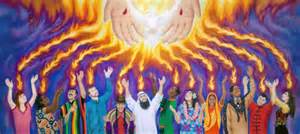
When the Day of Pentecost had come…I thought I’d write about it!  I know, I haven’t done this in a while.  And, of course, I really should have posted this earlier today but maybe that points to what Pentecost really is.  Pentecost is not just a day.  Pentecost really isn’t merely the Church’s birthday.  Pentecost is a season.  It is our season. After all the waiting and the birthing and the revealing and the journeying and the death and the Resurrection of Christ happens, Christ steps away and invites us into the place where he stood.  He steps away and leaves emptiness to fill and here, in this empty place, we are given everything we need.  And this season of Pentecost becomes our becoming.  It is the season when, empowered by the Holy Spirit, we become who God calls us to be, who God had always called us to be. 

The Hebrew word for God’s Spirit is ruah.  There’s not really a way to translate it into our language.  It is not limited to wind; it is not limited to breath (although that’s how we usually end up translating it); it is much, much more.  Indeed, it is the very essence, the very fullness of God.  Talking about Spirit is talking about God.  God in power like the force of the wind and God in intimacy like breath.  God’s spirit blows through and breathes into each and every person.  This is the fullness of God.  This is us in our fullness.  This is the place to which the story was leading us all along.

Several years ago, I had an experience that, for me, gave life to this Pentecost story.  I was traveling through Hungary as part of a church choir tour and one of our singing opportunities was the Sunday morning worship service of a small, extremely poor Protestant church on the Pest side of the Danube in the city of Budapest.  No one in the small congregation spoke any English.  We, of course, did not speak Hungarian either.  You have to understand that the Hungarian language is usually grouped closely with Finnish because of its syntax, but it has so many words and sounds that are borrowed from Turkish as well as centuries of various gypsy languages that it has no real commonality with any language.  So, our communication was limited to hand signals, nods, and smiles.  The entire worship service was in this language that was more unfamiliar than anything that I had ever heard.  We went through about an hour of unfamiliar songs (not just new hymns, but songs in a new language), foreign liturgy, and a 45-minute sermon that meant absolutely nothing to us.

At one point I looked around and realized that they had their heads down and were speaking what must have been a common prayer.  We put our heads down.  As I sat there, praying my own prayer along with them, I was suddenly aware that something had changed.  I still, of course, could not understand the words but somewhere in there I had heard something inherently familiar.  I looked at the person next to me and said, “That’s the Lord’s Prayer.”  I started with the second petition of the familiar prayer and slowly those around me began to join in.  When we came to the end, there was sort of a stunned silence around us.  We had all finished at the same time.

This was not a case of me somehow miraculously understanding a language that I did not know.  It was, instead, a hearing of an incredible rhythm that runs beneath every language and connects us all, a rhythm that is within us when we learn its cadence.  That rhythm is the Spirit of God.  THAT is ruah.  I realized at that moment that the point of the Biblical Pentecost story was not the speaking, but the hearing and the understanding.   Regardless of our differences, there is one common voice that connects us all, if we will only listen.       

Pentecost did not create a church.  Pentecost breathed God’s breath into the world and equipped all of us for work.  This is precisely the work that Jesus envisioned. Jesus did not come to create a new institution.  Jesus was never a Christian—that came probably as much as 20 or so years after the Resurrection.    Jesus came to give us holy breath.  His teachings and his behavior were all radically new—the beginning of a new Creation.  In order to empower people for such work, Jesus gave them the very breath that had stirred him.  “Live differently,” he told them, “Be a “new Creation”.”  The church is not about liturgies and hierarchies and doctrines and building walls.  Those are merely tools that we use to help us along, to help us define who we are as God’s people.  But we are about so much more.  For through us all runs the Spirit, the breath, the very essence of God.  And when we choose to establish institutions or doctrines or beliefs that are not open to God’s Spirit flowing in its midst, we have missed the point.  When we choose to have structures that leave out part of who we are, that leave out part of our diversity, that leave out some of our voices, that leave out some of the all of us who are called to God’s work, we are not tuned to that rhythm that is created by God’s breath breathing into the world.  So, in this Season of Pentecost, this Season of Our Becoming, listen…listen for that one voice.  It is part of who we are.  Author Richard Lederer told a graduating class in a 2007 commencement speech:  “Let there be no distance in who you are and what you do.”  Pentecost is our moment when we see who we are so that we’ll know what it is we’re called to do.  So, it’s time to go and be disciples—ALL of us, together. 

Grace and Peace,

Shelli