Rest

 23One sabbath he was going through the grainfields; and as they made their way his disciples began to pluck heads of grain. 24The Pharisees said to him, “Look, why are they doing what is not lawful on the sabbath?” 25And he said to them, “Have you never read what David did when he and his companions were hungry and in need of food? 26He entered the house of God, when Abiathar was high priest, and ate the bread of the Presence, which it is not lawful for any but the priests to eat, and he gave some to his companions.” 27Then he said to them, “The sabbath was made for humankind, and not humankind for the sabbath; 28so the Son of Man is lord even of the sabbath.”

3Again he entered the synagogue, and a man was there who had a withered hand. 2They watched him to see whether he would cure him on the sabbath, so that they might accuse him. 3And he said to the man who had the withered hand, “Come forward.” 4Then he said to them, “Is it lawful to do good or to do harm on the sabbath, to save life or to kill?” But they were silent. 5He looked around at them with anger; he was grieved at their hardness of heart and said to the man, “Stretch out your hand.” He stretched it out, and his hand was restored. 6The Pharisees went out and immediately conspired with the Herodians against him, how to destroy him.

“And on the seventh day God finished the work that he had done, and he rested on the seventh day from all the work that he had done.  So God blessed the seventh day and hallowed it, because on it God rested from all the work that he had done in creation.” 

We know these familiar verses.  But where was the part about the rules?  (Yeah, they’re not there.  I think, sadly, those may have been inserted later!)  Truthfully, the Sabbath was never meant to be governed by rules.  The Sabbath was meant for us.  But many of us read the beginning of the second chapter of Genesis as sort of a pretty poetic “wrap up” to the whole Creation account. We read it as “whew! That’s done!”  But the Sabbath is much, much more.  This divine resting is part of the created order.  This divine act of blessing the Sabbath is God’s act of giving power to the temporal order; it is the honoring of the cycle of work and rest that is part of the implicit rhythm of Creation.  God did not stop working at Creation to take a nap.  God rather created the Sabbath that we might embrace all that had been created.  Essentially, the Sabbath is the climax of all there is.  And so, we are given the commandment to “remember the Sabbath” or to “observe the Sabbath”, depending on where you’re reading, not because it’s a rule but because it’s part of who we are. 

But in the passage, there are those who forgot this.  In one of his poems, T.S. Eliot said that “we had the experience but missed the meaning.”  This describes it to a tee. They were so worried about Jesus breaking the “rules” of the Sabbath that they forgot compassion; they forgot justice; they forgot who they were; they forgot what the Sabbath was meant to be; they forgot that the Sabbath was there to sustain who they were. 

The Hebrew term for Sabbath, Shabbat, means“to cease and desist”. It is a call to stop—to stop work, to stop accomplishment, to stop worrying, to stop possessiveness, to stop controlling others, to stop trying to be God.  It is not a legalistic commandment, but a calling to wholeness, a calling to who we are called to be.  You see, this Sabbath, or Shabbat, that God created, the climax of all that is created, is the culmination of all things.  It is a glimpse of the holy and the sacred, a chance for us to experience the life that is to come. 

Nice as we all are, we do not gather on the Sabbath simply because we enjoy one another’s company.  We could go sit at Starbucks and do that.  We come because in the deepest part of our being is a hunger for the Kingdom of God.  Sometimes that’s hard to define.  Hans Kung defines the reign of God as “God’s creation healed.”  That means all that we see, all that we are, body-bent and soul-starved, will be able to stand and praise and join with God.  In 1951, Rabbi Abraham Heschel wrote what I think is the quintessential classic entitled The Sabbath.  In it, Heschel says that “unless one learns how to relish the taste of Sabbath while still in this world, unless one is initiated in the appreciation of eternal life, one will be unable to enjoy the taste of eternity in the world to come.  Sad,” he says, “is the lot of the one who arrives inexperienced and when led to heaven has no power to perceive the beauty of the Sabbath…”

But I must confess that I struggle with keeping Sabbath.  There is too much to do; there are too many places to be; there are too many things that only I can do.  (Oh, come on!)  The truth is, when I am feeling overwhelmed, I tend to buy books on “Sabbath” and “Simplicity”.  Needless to say, I have a lot of them.  I think I am trying to create the perfect setting for my own “Sabbath-keeping”.  And therein lies my problem.  The call to hallow or remember or keep the Sabbath is not a rule.  It is an invitation to freedom, to wholeness.  That’s exactly what our Creation account implies that God did, if only for a day in time.  God created Sabbath rest and then rested in the beauty and rhythm of the Creation that was already there.  God quit creating and intentionally rested in what was created.

And by remembering and observing the Sabbath, we too, can enter the rhythms and cycles of Creation just as they are intended to be.  Heschel contends that “The Sabbath is more than an armistice, more than an interlude, it is a profound conscious harmony of [humans] and the world, a sympathy for all things and a participation in the spirit that unites what is below and what is above.  All that is Divine in the world is brought into union with God.  This is Sabbath, and the true happiness of the universe.”

There is a story of an American traveler on safari in Kenya.  He was loaded down with maps, and timetables, and travel agendas.  Porters from a local tribe were carrying his cumbersome supplies, luggage, and “essential stuff.”  On the first morning, everyone awoke early and traveled fast and went far into the bush.  On the second morning, they all woke very early and traveled very fast and went very far into the bush.  On the third morning, they all woke very early and traveled very fast and went even farther into the bush.  The American seemed please.  But on the fourth morning, the porters refused to move.  They simply sat by a tree.  Their behavior incensed the American.  “This is a waste of valuable time.  Can someone tell me what is going on here?”  The translator answered, “They are waiting for their souls to catch up with their bodies.”

That is what God has given us in the Sabbath—the gift of reconnecting with our soul, the gift of reconnecting with God, the gift of once again realizing what the freedom of life means.  It is the chance to once again stand up straight and praise God for all that we are and all that we will become.  It is the freedom to be what God intended us to be, to cease being weighed down by things that are not part of that.  Maybe that’s something we ought to put on our “to do list”.

The traditional Jewish Sabbath begins at sundown, the Christian Sabbath with morning worship.  In both, Sabbath time begins with the lighting of candles and a stopping—to welcome the Sabbath in.  Marcia Falk writes that “three generations back my family had only to light a candle and the world parted.  Today, Friday afternoon, I disconnect clocks and phones.  When night fills my house with passages, I begin saving my life.”  This is the beginning of sacred time.  This is the beginning of eternity.  This is where we find life.

Barukh atah Adonai, Eloheinu, melekh ha’olam. Asher kidishanu b’mitz’votav v’tzivanu. L’had’lik neir shel Shabbat.  Amein

Blessed are you, Lord, our God, sovereign of the universe Who has sanctified us with [these] commandments and commanded us To light the lights of Shabbat.  Amen.           

Faith dies when religion declares its certainties beyond question. Faith is a journey, and there is always more to discover. If you want a solid “Biblical truth,” it is that we have more to see. The other is the freedom to rest. Not just take a day off from work, but rest, stop, open our mouths to sing and, from no hymnal ever fought over, discover the song we and God are composing. We cannot know what that song is until we stand still. We cannot know what work God is doing in our lives until we stop our own striving. We cannot know what truth God would show us until we set aside all that we think we know. We cannot accept the gift God would give us until we put down tools, weapons, certainties, and pious accoutrements, and simply hold out open hands to God. (Tom Ehrich)

Grace and Peace,

Shelli

Undefined

Nicodemus had lots of questions.  It didn’t say anything about his faith in Jesus or whether or not he believed.  He was just trying to get it all nailed down.  We are no different.  I mean, this Trinity thing that we celebrate this Sunday in what will be the last high holy day in a triumvirate of holy days where Jesus makes space for us, fills us with the Spirit, and gives us a model for what is the wholeness of God that we experience in our lives.  But what is the Trinity?  I mean, truthfully, it’s not even really in the Bible.  (Every year, the lectionary passages don’t QUITE explain it.  This year, it just capitalized on a bunch of questions.)  But, see, there wasn’t some “do this” proclamation that laid it all out for us.  No one was ever invited to the top of a cloudy mountain to receive the answer about the Trinity.  Is it three or is it one?  Is it separate or on top of each other?  And how do you tell what part of it is present in a moment?  It’s all so very confusing.

Well, think about these questions.  Where does the sky stop and the earth begin on the horizon?  Where does one mountain stop and another begin in a sprawling mountain range? Where is that place that the ocean definitively meets the beach?  Not the place where you walk toward it and thrust your feet into the water.  Where is that place where there is only water that becomes only land?  And where, as the earth spins on its axis, does light begin?  Where is the first light of the day?  The truth is, we can’t see any of those.  We can’t see them because our minds won’t discern them as separate and because, to be really honest, they’re not separate at all.  So, why are we so intent on trying to put things in categories—good and bad, light and dark, us and them?  None of those things really exist apart from the other.  I think the notion of a Trinitarian God, a God who is seen in different ways to different people and yet is the same God, is a lot like that.  Roman Catholic Bishop Christopher Mwoleka put it very well when he said that “Christians have made the basic mistake of approaching the Trinity as a puzzle to be solved rather than as an example to be imitated.”  The Trinity is not an entity; it is rather a tool, a way of understanding who God is and who we are called to be as fully human.  Like that ocean that we see as it rolls onto the beach, there is not a place where one aspect of God stops and another begins.  It’s as if Christ in all his comings and goings was trying to say just one thing: “Come, follow me…this way…in whatever place you see me.”

For several years, I co-lead an Interfaith Scripture Study when I was at St. Paul’s United Methodist with one of the rabbis from Temple Emanuel in Houston.  With participants from both Temple Emanuel and St. Paul’s, we would study various Scriptures and share in both our diverse and common understandings of them.  As time permitted, we would often end the study sessions with either an “Ask the Christians” question or an “Ask the Jews” question (with NOTHING off the table).  One day during the “Ask the Christians” episode, I got the always-dreaded question: “Explain the Trinity to us and tell us how it is not polytheistic, how it is not a depiction of three Gods.”  OK, I responded, you do realize that that is one of the most difficult things to explain and, I will tell you, that most of us Christians don’t really get it anyway.  But, here goes…So I took a really deep breath and just started talking.  And this is how I explained it…

In the beginning was God.  God created everything that was and everything that is and laid out a vision for what it would become.  But we didn’t really get it.  So, God tried and tried again to explain it.  God sent us Abraham and Moses and Sarah and Hagar and Ruth and Naomi.  God sent us Judges and Kings and Prophets.  But we still didn’t get it.  God wove a vision of what Creation was meant to be and what we were meant to be as God’s children through poetry and songs and beautiful writings of wisdom.  But we still didn’t get it. 

“So,” God thought, “there is only one thing left to do.  I’ll show you.  I’ll show you the way to who I am and who I desire you to be.  I will walk with you.”  So, God came, Emmanuel, God-with-us, and was born just like we were with controversy and labor pains and all those very human conceptions of what life is.  Jesus Christ, Emmanuel, was the Incarnation of a universal truth, a universal path, the embodiment of the Way to God and the vision that God holds for all of Creation.  But we still didn’t get it.  We fought and we argued and we held on to our own human-contrived understandings of who God is.  And it didn’t make sense to us.  This image of God did not fit into our carefully-constructed boxes that we had so painstakingly laid out.  This version of God was turning tables and breaking rules.  And so, as we humans have done so many times before and so many times since, we destroyed that which got in the way of our understanding and made our lives difficult to maintain.  We got rid of it.  There…it was finished…we could go back to the way it was before.

But God loves us too much to allow us to lose our way.  And so, God promised to be with us forever.  Because now you have seen me; now you know what it is I intended; now you know the Way.  And so, I will always be with you, always inside of you, always surrounding you, always ahead of you, and always behind you.  There will always be a part of me in you.  Come, follow me, this way.

Now we know the way.  Jesus did not walk this earth so that we could merely emulate what he did so that we could please God.  Jesus Christ, God Incarnate, Emmanuel, came to show us the way, to point out the journey that each of us is called to travel to become one with God.  And God’s Spirit, always present, always sustaining us, empowers us to become part of that Trinitarian unity and journey with God to God.  It is we—the we that we were always meant to be. 

The truth is, the Trinity IS a little undefined because God is undefined.  We don’t know everything about God.  God will never be fully known because God is God.  And, as you know, we always get in trouble when we are trying to define things, trying to put things in what we perceive as their allotted place.  We do this with thoughts and ideas.  We do this with our time.  We do this with other people.  And, yes, we humans do it with God.  There’s always more to God than what we can define.  We are not called to define God; we’re called to follow. 

“Come, follow me…this way…in whatever place you see me.”

Grace and Peace,

Shelli

Ruah

Scripture Text: Acts 2:1-21 (Pentecost)

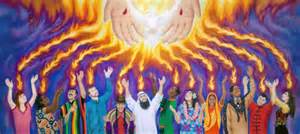
When the Day of Pentecost had come…I thought I’d write about it!  I know, I haven’t done this in a while.  And, of course, I really should have posted this earlier today but maybe that points to what Pentecost really is.  Pentecost is not just a day.  Pentecost really isn’t merely the Church’s birthday.  Pentecost is a season.  It is our season. After all the waiting and the birthing and the revealing and the journeying and the death and the Resurrection of Christ happens, Christ steps away and invites us into the place where he stood.  He steps away and leaves emptiness to fill and here, in this empty place, we are given everything we need.  And this season of Pentecost becomes our becoming.  It is the season when, empowered by the Holy Spirit, we become who God calls us to be, who God had always called us to be. 

The Hebrew word for God’s Spirit is ruah.  There’s not really a way to translate it into our language.  It is not limited to wind; it is not limited to breath (although that’s how we usually end up translating it); it is much, much more.  Indeed, it is the very essence, the very fullness of God.  Talking about Spirit is talking about God.  God in power like the force of the wind and God in intimacy like breath.  God’s spirit blows through and breathes into each and every person.  This is the fullness of God.  This is us in our fullness.  This is the place to which the story was leading us all along.

Several years ago, I had an experience that, for me, gave life to this Pentecost story.  I was traveling through Hungary as part of a church choir tour and one of our singing opportunities was the Sunday morning worship service of a small, extremely poor Protestant church on the Pest side of the Danube in the city of Budapest.  No one in the small congregation spoke any English.  We, of course, did not speak Hungarian either.  You have to understand that the Hungarian language is usually grouped closely with Finnish because of its syntax, but it has so many words and sounds that are borrowed from Turkish as well as centuries of various gypsy languages that it has no real commonality with any language.  So, our communication was limited to hand signals, nods, and smiles.  The entire worship service was in this language that was more unfamiliar than anything that I had ever heard.  We went through about an hour of unfamiliar songs (not just new hymns, but songs in a new language), foreign liturgy, and a 45-minute sermon that meant absolutely nothing to us.

At one point I looked around and realized that they had their heads down and were speaking what must have been a common prayer.  We put our heads down.  As I sat there, praying my own prayer along with them, I was suddenly aware that something had changed.  I still, of course, could not understand the words but somewhere in there I had heard something inherently familiar.  I looked at the person next to me and said, “That’s the Lord’s Prayer.”  I started with the second petition of the familiar prayer and slowly those around me began to join in.  When we came to the end, there was sort of a stunned silence around us.  We had all finished at the same time.

This was not a case of me somehow miraculously understanding a language that I did not know.  It was, instead, a hearing of an incredible rhythm that runs beneath every language and connects us all, a rhythm that is within us when we learn its cadence.  That rhythm is the Spirit of God.  THAT is ruah.  I realized at that moment that the point of the Biblical Pentecost story was not the speaking, but the hearing and the understanding.   Regardless of our differences, there is one common voice that connects us all, if we will only listen.       

Pentecost did not create a church.  Pentecost breathed God’s breath into the world and equipped all of us for work.  This is precisely the work that Jesus envisioned. Jesus did not come to create a new institution.  Jesus was never a Christian—that came probably as much as 20 or so years after the Resurrection.    Jesus came to give us holy breath.  His teachings and his behavior were all radically new—the beginning of a new Creation.  In order to empower people for such work, Jesus gave them the very breath that had stirred him.  “Live differently,” he told them, “Be a “new Creation”.”  The church is not about liturgies and hierarchies and doctrines and building walls.  Those are merely tools that we use to help us along, to help us define who we are as God’s people.  But we are about so much more.  For through us all runs the Spirit, the breath, the very essence of God.  And when we choose to establish institutions or doctrines or beliefs that are not open to God’s Spirit flowing in its midst, we have missed the point.  When we choose to have structures that leave out part of who we are, that leave out part of our diversity, that leave out some of our voices, that leave out some of the all of us who are called to God’s work, we are not tuned to that rhythm that is created by God’s breath breathing into the world.  So, in this Season of Pentecost, this Season of Our Becoming, listen…listen for that one voice.  It is part of who we are.  Author Richard Lederer told a graduating class in a 2007 commencement speech:  “Let there be no distance in who you are and what you do.”  Pentecost is our moment when we see who we are so that we’ll know what it is we’re called to do.  So, it’s time to go and be disciples—ALL of us, together. 

Grace and Peace,

Shelli