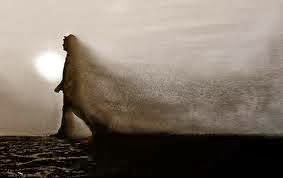
Even When the Sun Is Not Shining

Scripture Passage:  1 Peter 3: 18-22 (Lent 1B)

18For Christ also suffered for sins once for all, the righteous for the unrighteous, in order to bring you to God. He was put to death in the flesh, but made alive in the spirit, 19in which also he went and made a proclamation to the spirits in prison, 20who in former times did not obey, when God waited patiently in the days of Noah, during the building of the ark, in which a few, that is, eight persons, were saved through water. 21And baptism, which this prefigured, now saves you—not as a removal of dirt from the body, but as an appeal to God for a good conscience, through the resurrection of Jesus Christ, 22who has gone into heaven and is at the right hand of God, with angels, authorities, and powers made subject to him.

The faith communities to which this was written did not have it easy.  They were the outsiders–shunned, unaccepted, separated from the only society that they knew.  To put it bluntly, they were living in hell.  So this comes as a reminder that what they are experiencing now is not permanent.  It is not the final word.  New life is just over the horizon.  For the writer of this epistle, this is a sure promise, made real through our baptism.  Baptism here is depicted a re-creation, as resurrection.  The whole point is that believers do not need to fear the difficulties and sufferings that are present now.  God has indeed promised something new. 

In all honesty, I don’t think this writer necessarily saw baptism as merely a cleansing.  Rather, baptism is a claiming.  We are claimed by God.  We are empowered by the Spirit of Christ.  We are made new.  So no matter what hell we might find ourselves in, there is more up ahead.  God has claimed us.  Each of us is a beloved child of God.  Our baptism acknowledges that and, like the waters that flooded the earth, sweeps us into new life.

In fact, even the powers of hell cannot impede the recreation that is happening all around us.  Now most of our churches choose to recite the more sanitized version of the Apostles’ Creed but there is an older version that dates back to the 5th century that goes like this:  “I believe in God the Father almighty, maker of heaven and earth; and in Jesus Christ, his only Son our Lord, who was conceived by the Holy Ghost, born of the Virgin Mary, suffered under Pontius Pilate, was crucified, dead, and buried. He descended into hell.”  That last sentence is believed to have been loosely taken from this passage.  We read that Jesus proclaimed even to the “spirits in prison”.  In other words, Jesus descended into hell, into the bowels and depths of life, into the deepest of despair.  And, there, he blew the gates open and the eternally forsaken escaped, crossing the threshold to new life.  In the Middles Ages, it was referred to as the “Harrowing of Hell”.  Now, admittedly, there is little basis for this theology but if death hath no sting, why would hell win?  (And to be honest, there’s really little basis for the notion of “hell” as we 21st century folks think of it anyway.  I think Dante did us no favors.) If God’s promise extends to all of Creation, then perhaps hell really hath no fury.    

Now this is in no way a lessening of the impact or importance of sin.  We all know that.  We sin.  We try not to.  But we sin.  In fact, most of us are pretty good at creating our own hell.  We plunge ourselves into darkness, into separation from God, through fear, or guilt, or shame, and we struggle to claw our way out.  But even the powers of sin are no match for the promise before us.  That is the whole point of our faith.  So, if we believe that, why is it such a stretch to believe that the God of all, the God who loves us, and who has claimed us, could vanquish all the powers that afflict us, that God has vanquished all the powers of hell?

Perhaps this Lenten season of penitence is not so much a call to grovel at the feet of a forgiving God but rather to faithfully follow this God who beckons us home to begin again.  Maybe it truly is the harrowing of whatever hell we find ourselves in.  But in order to do that, we have to name our sin and release its power.  It’s part of our story.  It’s part of what we must tell.  And with that, the waters subside and the green earth rises again. 

Now, I don’t profess to know the whole truth about this hell thing.  It’s not an issue for me.  But I struggle to reconcile the notion of a place called hell with this God who offers eternal mercy and grace and forgiveness, with this God that wants the Creation to return so badly to where they belong, to enter into a relationship with the Godself–so badly, in fact, that this God would come and walk this earth just to show us the way home.  Oh, don’t get me wrong.  Hell definitely exists.  But perhaps it is our creation, rather than God’s.  Perhaps our faith will show us that the gates of hell have already been removed and that all we have to do is walk the way toward life.  What if we were to let our Lenten journey be our journey toward life?

See, I think that if we somehow brand Lent as the “penitential season”, a dark and foreboding journey through darkness to get to the Easter lilies, we’ve missed the point.  Yes, it sort of plunges us into darkness, makes us think about our dark nights and our dark parts of our lives.  But the reason is not just for us to feel guilt and shame but to see, finally, that in the darkness, you can see the Light up ahead. 

You’re probably familiar with this, but writing this made me remember the words found on the wall of a cellar in the Cologne concentration camp after World War II:

I believe in the sun
even when it is not shining
And I believe in love,
even when there’s no one there.
And I believe in God,
even when he is silent.

I believe through any trial,
there is always a way
But sometimes in this suffering
and hopeless despair
My heart cries for shelter,
to know someone’s there
But a voice rises within me, saying hold on
my child, I’ll give you strength,
I’ll give you hope. Just stay a little while.

I believe in the sun
even when it is not shining
And I believe in love
even when there’s no one there
But I believe in God
even when he is silent
I believe through any trial
there is always a way.

May there someday be sunshine
May there someday be happiness
May there someday be love
May there someday be peace….

– Unknown

On prisoners of darkness, the sun begins to rise, the dawning of forgiveness upon the sinner’s eyes. He guides the feet of pilgrims along the paths of peace. O bless our God and Savior, with songs that never cease. (Michael Perry, from the hymn “Blessed Be the God of Israel”)

Grace and Peace,

Shelli

With No Time to Prepare

Scripture Passage:  Mark 1: 9-15 (Lent 1B)

9In those days Jesus came from Nazareth of Galilee and was baptized by John in the Jordan. 10And just as he was coming up out of the water, he saw the heavens torn apart and the Spirit descending like a dove on him. 11And a voice came from heaven, “You are my Son, the Beloved; with you I am well pleased.” 12And the Spirit immediately drove him out into the wilderness. 13He was in the wilderness forty days, tempted by Satan; and he was with the wild beasts; and the angels waited on him. 14Now after John was arrested, Jesus came to Galilee, proclaiming the good news of God, 15and saying, “The time is fulfilled, and the kingdom of God has come near; repent, and believe in the good news.”

Jesus was driven out into the wilderness.  The Markan passage says that it happened immediately.  (Actually, the Gospel writer we call Mark liked things to happen “immediately”.  Read the whole thing in one sitting and you’ll see what I mean.)  So, Jesus had no time to pack, no time to prepare.  There was no family lunch after the baptism.  First he gets baptized and the Spirit descends upon him.  He is claimed by the Spirit.  And then the same Spirit that claims him somehow compels him to go out into the wilderness alone–no supplies, no map, no compass, no cell phone with that neat little GPS app–immediately.  Driven out into the wilderness…You know, I used to think that I understood this wilderness thing.  I used to picture Jesus going out into the wilderness, into the trees, into nature, to pray and commune with God.  Perhaps my idea of a wilderness was somewhat skewed by visions of thick East Texas pine trees or perhaps the clammy sensation of the Costa Rican rainforest.  After all, nature is always a great place to become closer to God.

And then I saw the Judean wilderness, the same wilderness into which Jesus was driven by the Spirit.  I stood there on that mountain with a view of winds and sands and nothingness, the true depiction of forsakenness and despair.  And, standing there, I thought about this image of Jesus going out into the wilderness.  On purpose?  He went on purpose?  This is not a wilderness for the faint of heart and certainly not for one with such a faulty sense of direction as I seem to have.  This wilderness has no trees, no real markings of any kind.  The faint pathways change as the winds blow the sands wherever they want.  Even if one began this wilderness journey with some faint sense of where he or she was headed, the pathway would move in an instant and the traveler would be stranded, vulnerable, with no real sense of direction at all.

So into this vulnerable state, Jesus was driven.  If you read the passage, the Spirit claimed him at his baptism and then drove him into a journey that had no obvious pathway at all.  The mere thought of it terrifies us.  After all, don’t we do everything we can do to avoid the wilderness, to avoid a loss of control, a loss of our sense of direction, a loss of the knowledge of where we are and where we are going. But last I checked, the same Spirit supposedly descended on me as descended on Jesus.  So am I to assume that that Spirit is now driving me into the wilderness?  As one who was also baptized, who also had this same Spirit, am I being compelled to go beyond what I know?  But, I will tell you, I did not plan for the wilderness.  I do not have everything I need.  I need to pack.  I need to prepare.  (I probably need new shoes!)  And so I wait.  But that baptism thing keeps tugging at us.  You know, it’s not really meant to be a membership ritual.  It is meant, rather, to be the driving force in our lives.  It is the thing that drives us into the wilderness–if only we will go.

Contrary to the way most of us live our lives, faith is not certainty or knowledge.  It is not, I’m afraid, a sure and unquestioning sense of where one is going, even, for us seemingly progressive theologians (because we are ALL theologians!), in a “big picture” way.  It is not about being saved from something.  Faith is not about learning or being shown the way.  We are not given a map.  It’s just not that clear.  In fact, it’s downright murky, almost like sand in the air.  No, I think that faith is about entering The Way, being driven into the wilderness, where one is vulnerable, unprepared, and usually scared to death.  And in that death, in that yielding, in that realization that we’re not really sure where it is we’re supposed to go, we encounter God.  And then in the next instant, the winds will blow the path away and, once again, we are in darkness until we realize that God is still there, not pointing to show us, but walking with us.

Every Lenten season we read of the wilderness into which Jesus was driven.  It is the affirmation that Jesus was not a superhero or a star of Survivor.  Rather, Jesus was driven into the deepest depths of human frailty and vulnerability and, unsure of where to go, found God.  Wandering the wilderness is not about finding your way but rather being open and vulnerable enough that The Way will find you.  So in what way do you need to let yourself be vulnerable?  In what way do you need to wander in the wilderness?

The promised land lies on the other side of a wilderness.  (Havelock Ellis)

Grace and Peace,

Shelli

The Spaces Through Which God Speaks

Scripture Passage:  Genesis 9: 8-17 (Lent 1B)

8Then God said to Noah and to his sons with him, 9“As for me, I am establishing my covenant with you and your descendants after you, 10and with every living creature that is with you, the birds, the domestic animals, and every animal of the earth with you, as many as came out of the ark. 11I establish my covenant with you, that never again shall all flesh be cut off by the waters of a flood, and never again shall there be a flood to destroy the earth.” 12God said, “This is the sign of the covenant that I make between me and you and every living creature that is with you, for all future generations: 13I have set my bow in the clouds, and it shall be a sign of the covenant between me and the earth. 14When I bring clouds over the earth and the bow is seen in the clouds, 15I will remember my covenant that is between me and you and every living creature of all flesh; and the waters shall never again become a flood to destroy all flesh. 16When the bow is in the clouds, I will see it and remember the everlasting covenant between God and every living creature of all flesh that is on the earth.” 17God said to Noah, “This is the sign of the covenant that I have established between me and all flesh that is on the earth.”

This is actually the tale-end of the story of Noah and the famous ark filled to the brim with the remnants of Creation.  And here…after all this time of pounding rains, all this time cooped up with animals of all kinds, all this time rocking and swaying with the boat…here, God speaks.  So, does that mean that when we are mired in Covid restrictions and fears and, for us in Texas, sitting here with failing electricity, questionable water, and bursted pipe, we are waiting to hear God speak?  Well, take note.  The familiar bow of color is set in the clouds as a sign of the promise that God has made.  We usually take it as a sign that God will take care of us, that God will right the wrongs of the world and order them yet again, that God will somehow assuage our pain and grief and put things back the way they were.  Really?  THAT’S not what that says.

Now we can either look at this story as a sort of children’s story, complete with rainbows and pairs of elephants and zebras and orangutans or we can look at this story as one depicting a deity who was so angered by the rebellion of the Creation that God wiped it off the face of the earth. Truthfully, neither one works. Indeed, this is a story about rebellion and human sinfulness. (And to be honest, what good story is NOT?) But the whole point is that no matter how far the human creation wandered from the Creator, there was a calling back, a return, an offering of love and forgiveness and a chance to begin again. Now, that’s hard for us to fathom too, possibly because we are not good at offering each other “do-overs”. We are not good at understanding a God who would dispense with all means of justified destruction and just offer Presence and Grace and a future filled with hope. It is hard for us to imagine that no matter what we do, no matter what we screw up or blow up or make up, God is offering a chance to return, a chance to be re-created into something that only God can imagine.

The Celtic tradition would look upon the rainbow not as a promise that God would “fix” the world or “fix” us, but as a threshold, a point between what is and what will be.  So, the promise is not that God will fix everything, but that, always, there is a chance to begin again.  We, always and forever, no matter what we’ve done or thought or how many times we’ve flaked out in life, have the chance to return to the beginning. God does not wipe what has happened.  God does not forget what we have done.  Rather God, knowing and remembering full well what the creatures have done in Creation, STILL God offers a threshold through which we can return to Grace–if we will only step through.  In the empty space of our lives, God speaks.

In this Lenten season, we will often find ourselves surrounded by the darkness of the wilderness.  We may find ourselves mired in despair.  We might somehow turn up on a road that we never intended to travel.  In fact, sometimes we find ourselves in hell.  Maybe those of us in Texas haven’t had power or water or sanity for several days.  (I, for one, am living as a nomad because my house has no water and the ceiling of the closet is now on the floor and on top of my clothes because of a burst pipe.  That’s really a nice touch!)  But these are never the final word.  Even when tales of a place called Golgotha begin to swirl around us, there is always something more.  When we come to the end, God will be there to beckon us into the arms of grace that we might begin again.  God has promised re-creation.  Maybe that’s signified by a rainbow.  Maybe it’s just another way forward.  But, you see, we have to let go of the chaos because it’s not the final say.  God WILL speak again.  And maybe THAT’S the point of this Lenten journey.

The grace of God means something like:  Here is your life.  You might never have been, but you are because the party wouldn’t have been complete without you.  Here is the world.  Beautiful and terrible things will happen.  Don’t be afraid.  I am with you.  Nothing can ever separate us…There’s only one catch.  Like any other gift, the gift of grace can be yours only if you’ll reach out and take it.  Maybe being able to reach out and take it is a gift too.  (Frederick Buechner)

Grace and Peace,

Shelli

What Is Left Behind

Scripture Passage:  Psalm 51: 1-3, 7-13 (Ash Wednesday Psalter)

1Have mercy on me, O God, according to your steadfast love; according to your abundant mercy blot out my transgressions. 2Wash me thoroughly from my iniquity, and cleanse me from my sin. 3For I know my transgressions, and my sin is ever before me .Purge me with hyssop, and I shall be clean; wash me, and I shall be whiter than snow. 8Let me hear joy and gladness; let the bones that you have crushed rejoice. 9Hide your face from my sins, and blot out all my iniquities. 10Create in me a clean heart, O God, and put a new and right spirit within me. 11Do not cast me away from your presence, and do not take your holy spirit from me. 12Restore to me the joy of your salvation, and sustain in me a willing spirit. 13Then I will teach transgressors your ways, and sinners will return to you.

So, how quickly did you wash them off?  Or were you saved from getting ashes by a Zoom Ash Wednesday Service.  It doesn’t matter.  We know.  We know that yesterday was our day of repentance.  Yesterday was our day of acknowledging that yes, indeed, we are sinful beings.  Goodness, Lent has barely begun and we’re already talking about sin?   We have begun the journey again. It is a journey of giving up and giving in, of wandering in the wilderness, of stopping or at least slowing down enough to let God’s Spirit begin once again to seep into our being. So why do we have to talk about sin?

But sin? Who wants to talk about sin? I mean, I’m Methodist. We are “grace” people, after all! We are forgiven people. Isn’t that what we’re told? God’s mercy is infinite. Jesus took care of all that, right? Really? So, you have no part in this? You just want to go on your merry way? The truth is, what relationship with God would we have if we truly thought we were either sinless or our sins were just hosed off of us without us even knowing what had happened? I mean, what in the world is forgiveness if there’s nothing to forgive? But the fact that God loves me not just in spite of me but BECAUSE of me is a much deeper understanding of God. This is a God who is not waiting for me to clean my act up so I can get on the yellow brick road toward a grace-filled life. This is a God who walks with me down this rocky, sometimes steep and treacherous trail through a wilderness I do not understand and showers me with grace even when I am muddied and worn by sin. This is a God who doesn’t just wait for me to return but takes me by the hand and leads me home no matter what I’ve done or who I’ve been. 

There I said it—sin, Sin, SIN! Hmmm! Steeple didn’t fall off, stained glass windows still there, me, still standing. I think even the Zoom connection is still working.  In this season of wilderness wanderings, it is our time to acknowledge that yes, we mess up; that yes, we make the wrong choices (I’m hoping God doesn’t yet regret that whole free will decision way back when!); that, yes, we sin. But the point is that we also choose—we CHOOSE to follow God on this journey. Now, at the risk of speaking for the Great I AM, I would much rather have a relationship with one who CHOSE to follow rather than one who knew nothing else. Choosing God and being innocent are not the same. In fact, it is from our sin, from the dust of our lives, that we choose God.

Do you remember the so-called “Second Creation account”?  It says that God created humans from the dust of the ground, from the dirty, yucky dust that blew uncontrollably across the land.  The dust moved freely from one place to another carrying the beginnings of life whether or not we knew it.  And then God breathed life into it and it became something new, a New Creation made in the very image of God.  Dust…dirty, yucky, dust…the leftovers, that which remains, that which stays behind clinging to that on which it lands.  We try to wash it away or wipe it down or Febreze it to give it a fresh, clean scent or just sweep it under the rug (you know, with the other dust).  But, no matter what, it ALWAYS returns.  And yet, this season begins by calling us to return to it.  And then we pray to God that we might somehow get a clean heart, a fresh start, a new beginning. 

 So, once again, we acknowledge that we are both in need of God and that God loves us more than we will ever fathom. Now, you would think those two scenarios would fit together rather well. But somewhere along the way, we have somehow replaced our need for God with our need to be perfect. Albert Outler called it “overreaching”, getting in God’s business. See, God doesn’t need us to be perfect, or sinless, or innocent. God desires us to choose to follow. God desires us to be who God calls us to be.

And so, the pathway looms ahead. It’s not always familiar territory. And, in fact, we usually have to leave part of what we carry and hold so tightly behind. We usually tend to travel too weighted down to notice where we need to go. So, give up what you need to give up or take on what you need to take on. And remember when you felt the ashes on your skin to remind you who you are and also whose you are. Let them be a blessing and a beginning. And know that God calls you away from the self that you have imagined. And begin to walk. It is a journey that is hard and difficult and takes you through darkness. But it is a journey that leads to life, that leads to beginning again.

And so this day, we return.  We return to our beginnings.  Rather than expecting God to “wipe us clean”, this day calls us to expect God to create us yet again.  We return to dust so that God can take us, breathe life into us once again, creating in us a clean heart and a new and right Spirit.  Today we become dust once again, moving freely and then clinging to God yet again.  

Meanwhile, sin is our only hope, because the recognition that something is wrong is the first step toward setting it right again. (Barbara Brown Taylor, in “Speaking of Sin”)

Grace and Peace,

Shelli

Both And

Ash Wednesday Lectionary Passage:  Matthew 6: 1-6, 16-21

Beware of practicing your piety before others in order to be seen by them; for then you have no reward from your Father in heaven.“So whenever you give alms, do not sound a trumpet before you, as the hypocrites do in the synagogues and in the streets, so that they may be praised by others. Truly I tell you, they have received their reward. But when you give alms, do not let your left hand know what your right hand is doing, so that your alms may be done in secret; and your Father who sees in secret will reward you.  “And whenever you pray, do not be like the hypocrites; for they love to stand and pray in the synagogues and at the street corners, so that they may be seen by others. Truly I tell you, they have received their reward. But whenever you pray, go into your room and shut the door and pray to your Father who is in secret; and your Father who sees in secret will reward you… 16“And whenever you fast, do not look dismal, like the hypocrites, for they disfigure their faces so as to show others that they are fasting. Truly I tell you, they have received their reward. 17But when you fast, put oil on your head and wash your face, 18so that your fasting may be seen not by others but by your Father who is in secret; and your Father who sees in secret will reward you. 19“Do not store up for yourselves treasures on earth, where moth and rust consume and where thieves break in and steal; 20but store up for yourselves treasures in heaven, where neither moth nor rust consumes and where thieves do not break in and steal. 21For where your treasure is, there your heart will be also.

So, several years ago, I heard some pieces of an interview with a political figure questioning another well-known political figure’s religion.  The claim was that it was difficult to discern whether or not this person practiced “legitimate Christianity”.  Really?  And what in the world, pray tell, is “legitimate Christianity”?  And how do you know?  I mean, especially since we’re apparently suppose to be in our rooms with the door shut praying in secret!  But then, aren’t we supposed to be out in the world showing the love of Christ?  Whew!  Well, regardless of the fact that it must have been a slow news day, sometimes it’s just a whole lot of mixed messages, isn’t it?

Today we begin this season of mixed messages, the season of “both-and”.  First of all, Lent itself, literally “springtime”, means that we begin clearing all of the winter debris that has grown and gathered in the flowerbeds and leaving room for new life.  This season is about both pruning and fertilizing, cutting and nurturing.  It’s about cleaning out and freshening up.  Theologically, this season brings images of walking through darkness toward the light, through the wilderness toward home, of giving up and taking on, of death and new life.  We are told to let go and to take up, to lay down and to rise up.  We are told to breathe in and to breathe out.  And now, to pray in secret and go out and serve the world. 

So, is your head spinning?  Maybe that’s why this season is so difficult.  There’s no baby; there’s no star; there’s not even, when you think about, anybody around to tell us not to be afraid.  No one comes to tell us what is going to happen.  There is no appropriately convenient Lenten Annunciation.  We just have to start walking that pathway toward Jerusalem with both assurance and humility.  But this time, in many ways we walk alone.  This God who has walked with us every step of the way has seemed to have gone on at least a few steps ahead of us.  Where Advent kept pushing us back, telling us to wait, in many ways, this season of Lent is pulling us kicking and screaming into something we do not understand, something that, given the choice, we might choose not to do, choose to go back into our room and shut the door.  And yet, we’re told to follow.

I’ve shared this story before, but it is one of my favorites:  A rabbi once told his disciples, “Everyone must have two pockets, with a note in each pocket, so that he or she can reach into the one or the other, depending on their needs.  When feeling high and mighty one should reach into the left pocket, and find the words: “Ani eifer v’afar; I am dust and ashes.  But when feeling lowly and depressed, discouraged or without hope, one should reach into the right pocket, and, there, find the words: “Bishvili nivra ha’olam…For my sake was the world created.”

Talk about mixed messages!  We are dust and ashes, resembling that cast-off debris.  And we are loved more than we can even fathom.  We are so very human, struggling with greed and hubris, with some inflated sense of our own worth that makes us think we are better than others or deserve more than others, makes us think that there is some sort of “legitimate Christianity” in which we are called to participate to prove our very worth.  And, yet, somewhere in the midst of our humanity, in the midst of all those things that we do not do or those things we do not do well, there is a piece of the Divine.  Bishvili nivra ha’olam.  Do you even know how much you are loved?  Do you even know how to imagine a God that has given you the world?

Perhaps the mixed messages are because we cannot let go, cannot see what God is offering, cannot fathom how much we are loved.  Today is the day when we proclaim we are dust, when we confess our sins and lay prostrate before the ruins of our lives.  Today is the day when we take burned palm branches and allow them to be smeared across our forehead in the faint shape of a cross.  Today is the day that we remember we are dust, remember that we are particles of waste that are left from what was.  Today is the day when we go in our room and shut the door.  But the only reason we do this is so that we will stop what we are doing, look at our lives, and know how very much we are loved.  Bishvili nivra ha’olam.  For your sake, the world was created. 

Faith is about mixed messages–letting go and taking on, human and Divine, death and life, sending and return.  Perhaps this Season of Lent is about realizing that there is a Holy and Sacred “And” connecting it all.   Lent is not about giving things up; it is about emptying your life that you may be filled.  Lent is not about going without; it is about making room for what God has to offer.  And today is not about clothing yourself in the morbidness of your humanity; it is about embracing who you are before God.

There was once a question posed to a group of children:  “If all the good people in the world were red, and all the bad people in the world were green, what color would you be?”  A little girl thought for a moment.  Then her face brightened, and she replied:  “I’d be streaky!”  We would all be streaky.  To be human is to be a mixture of the unmixable, to be streaky.  It is to live incomplete, yet yearn for completion; to be imperfect, yet long for perfection; to be broken, yet crave wholeness.  It is to live with mixed messages.  And as we begin what is essentially our own journey to the cross, we note that it is one that not only recognizes but embraces the fact that there are many conflicting and disjointed ideals that God, in God’s infinite mystery and wisdom, allows to exist together—arrogance and humility, good and bad, faith and doubt, human and divine, cross and resurrection, death and life—none can exist without its counterpart.  

Faith is about living a life of breathing out and breathing in.  Neither can exist alone.  So…remember…you are dust and ashes…breathe out…..For you the world was created…breathe in….

My ego is like a fortress.  I have built its walls stone by stone to hold out the invasion of the love of God.  But I have stayed here long enough.  There is light over the barriers.  O my God…I let go of the past.  I withdraw my grasping hand from the future.  And in the great silence of this moment, I alertly rest my soul. (Howard Thurman)

Grace and Peace,

Shelli

A Thin Place

This Sunday’s Lectionary Passage:  Mark 9: 2-9 (Transfiguration B)

2Six days later, Jesus took with him Peter and James and John, and led them up a high mountain apart, by themselves. And he was transfigured before them, 3and his clothes became dazzling white, such as no one on earth could bleach them. 4And there appeared to them Elijah with Moses, who were talking with Jesus. 5Then Peter said to Jesus, “Rabbi, it is good for us to be here; let us make three dwellings, one for you, one for Moses, and one for Elijah.” 6He did not know what to say, for they were terrified. 7Then a cloud overshadowed them, and from the cloud there came a voice, “This is my Son, the Beloved; listen to him!” 8Suddenly when they looked around, they saw no one with them any more, but only Jesus. 9As they were coming down the mountain, he ordered them to tell no one about what they had seen, until after the Son of Man had risen from the dead. 

In the big scheme of things, we’ve gotten to this point pretty fast.  Here it is—a child born into anonymous poverty and raised by no-name peasants turns out to be the Son of God.  He grows up, becomes a teacher, a healer, and capable of hosting large groups of people with just a small amount of leftovers.  He asks a handful of random people to become his followers, to help him in his mission.  They leave everything they have, give up their possessions and their way of making a living, they sacrifice any shred of life security that they might have had, and begin to follow this great person around, probably often wondering what in the world they were doing or where they were really going on this incredible journey on which he was taking them.  And then one day, Jesus leads them up to a mountain, away from the interruptions of the world. 

And there on that mountain, the clothes that Jesus was wearing change, taking on a hue of dazzling, blinding, white, whiter than anything that they had ever seen before.  And on the mountain appeared Elijah and Moses, representing the Law and the prophets, the forerunners of our faith, standing there with Jesus.  It’s as if all that is and all that was came together in this one climactic moment. No longer is there any separation between what came before and what happens in this moment; no longer can the Old Testament and New Testament be looked upon without each other to tell the story.

Peter wanted to build three dwellings to house them.  I used to think that he had somehow missed the point, that he was in some way trying to manipulate or control or make sense of this wild and uncontrollable mystery that is God.  I probably thought that because that’s what I may tend to do.  But, again, Peter was speaking out of his Jewish understanding.  He was offering lodging—a booth, a tent, a tabernacle, a sanctuary—for the holy.  For him, it was a way not of controlling the sacred but rather of honoring the awe and wonder that he sensed.  And from the cloud that veils them comes a voice, “This is my Son, the Beloved, listen to him!”  “Listen to him!”  OK, be honest.  What would have been your reaction?  I’m thinking our first response would not have been overly profound: “Wow!”  Our second response?  “This is it; we are surely going to die.”  

And then, just as suddenly as they appeared, Moses and Elijah drop out of sight and Jesus was standing there alone, completely unveiled.  In Old Testament Hebrew understanding, the tabernacle shrouded in the cloud was the place where God was.  Here, this changes.  Jesus stays with them and the cloud dissipates.  Jesus IS the tabernacle, the reality of God’s presence in the world.  And all that was and all that is has become part of that, swept into this Holy Presence of God.  And, more importantly, we are invited into it.  No longer are we shielded from God’s Presence.  We become part of it, a mirror for all to experience and encounter the living God.

And so the disciples start down the mountain.  Jesus remains with them but they kept silent.  The truth was that Jesus knew that this account would only make sense in light of what was to come.  The disciples would know when to tell the story.  They saw more than Jesus on the mountain.  They also saw who and what he was.  And long after Jesus is gone from this earth, they will continue to tell this strange story of what they saw.  For now, he would just walk with them.  God’s presence remains.          

The Celtic tradition would call them “thin places”, places where that so-called “veil” that separates the earth and heaven, the ordinary and the sacred, the human and the Divine, becomes so thin, so translucent, that one gets a glimpse of the glory of God.  It is those times and places in our lives where God’s Presence becomes almost palpable and where we cannot help but be transfigured into what God calls us to be.  Perhaps it is those times when we don’t just think about God but rather create space enough for the sacred and the Divine to penetrate our lives and our flesh in the deepest part of our being.  And, therein, lies our transfiguration.  In essence, we were right.  We die.  We die to the way we are and we become someone different. 

The Greek term for “transfiguration” is “metamorphosis”, deriving from the root meaning “transformation”.  We know that word as it relates to science and nature.  Most of us probably think of the lowly caterpillar who, given enough time, becomes a beautiful butterfly.  Metamorphosis is, literally, to change into something else.  There is no going back.  The butterfly will never again reenter the cocoon. 

Those thin places in our lives, those places where the holy spills into our being, where we finally know that we are not called to understand but to see, to see what God has put before us—those are the places and times that provide those mountain-top experiences.  But we’re not just limited to one.  They are there all the time.  God’s Presence is always with us.  We just have to learn to see in a new way.  We have to learn to see that blinding, awe-inspiring, mysterious glory of God.    

The Hebrews understood that no one could see God and live.  You know, I think they were right.  No one can see God and remain the same.  We die to ourselves and emerge in the cloud.   The truth is, when we are really honest with ourselves, we probably are a little like the disciples.  We’d rather not really have “all” of God.  We’d rather control the way God enters and affects our lives.  We’d rather be a little more in control of any metamorphosis that happens in our lives, perhaps even hold on to that cocoon a little longer than we should.  We’d rather be able to pick and choose the way that our lives change.  We’d rather God’s Presence come blowing in at just the right moment as a cool, gentle, springtime breeze.  In fact, we’re downright uncomfortable with this devouring fire, bright lights, almost tornado-like God that really is God.  God is not something that we are supposed to understand, or figure out, or control.  God is awe and wonder and mystery.  God is God.  And encountering God is the point of our story.  It’s the pinnacle, the thin place, the climax.

This account of the Transfiguration of Jesus seems to me that it should be the climax of Jesus’ story—the quintessential mountain-top experience.  After all, how can you top it—Old Testament heroes appearing, God speaking from the cloud, and Jesus all lit up so brightly that it is hard for us to look at him.  But there’s a reason that we read this on the last Sunday before we begin our Lenten journey.  In some ways, it IS perhaps the climax of Jesus’ earthly journey.  Jesus tells the disciples to keep what happened to themselves, if only for now.  And then the lights dim.  Moses and Elijah are gone, and, if only for awhile, God stops talking.    

Jesus walked with the disciples in the silence.  The air became thicker and heavier as they approached the bottom.  As they descended the mountain, they knew they were walking toward Jerusalem.  As they walked down the mountain, the holy city lay before them and Galilee was forever behind them. 

Next Wednesday, Lent begins.  The Transfiguration, the climax, is only understood in light of what comes next.  We are nearing the end of our Epiphany journey.  We are nearing the end of that season of warm illumination.  The light is now almost blinding to the ways of this world.  We have been to the mountaintop and we have seen the glory of God.  And we have been changed.  There is no going back.  The only way is through Jerusalem.  We have to walk through what will come. Jesus has started the journey to the cross.  We must do the same. If we stay here, we miss out.  God has gone on to Jerusalem.  It is a journey through a wilderness, a journey through something we do not understand.  So we have to follow with new eyes.     

The real voyage of discovery consists not in seeking new landscapes, but in having new eyes. (Marcel Proust)

SOME HOUSEKEEPING: OK, believe it or not, Lent is upon us. The wilderness awaits. So, I’m going to try to commit to writing every day for Lent, beginning Ash Wednesday. Here’s your part. Read them every day. Let’s make it a journey that we take together. And pray for me. (Lent is A LOT of writing!) And, if you find one meaningful, “like” it or comment. (That moves it up the magic Google search engine!) So, I’ll meet you in the wilderness! S…

Grace and Peace,

Shelli

Breathe…

This Sunday’s Lectionary Passage:  Mark 1: 29-39

29As soon as they left the synagogue, they entered the house of Simon and Andrew, with James and John. 30Now Simon’s mother-in-law was in bed with a fever, and they told him about her at once. 31He came and took her by the hand and lifted her up. Then the fever left her, and she began to serve them. 32That evening, at sundown, they brought to him all who were sick or possessed with demons. 33And the whole city was gathered around the door. 34And he cured many who were sick with various diseases, and cast out many demons; and he would not permit the demons to speak, because they knew him. 35In the morning, while it was still very dark, he got up and went out to a deserted place, and there he prayed. 36And Simon and his companions hunted for him. 37When they found him, they said to him, “Everyone is searching for you.” 38He answered, “Let us go on to the neighboring towns, so that I may proclaim the message there also; for that is what I came out to do.” 39And he went throughout Galilee, proclaiming the message in their synagogues and casting out demons.

So, this Scripture has LOTS of stuff going on, doesn’t it?  In one passage, Jesus leaves the synagogue, goes to someone’s house, heals a woman, eats dinner, cures all these people that showed up at the door, and then finally (finally!) in the dark of the early morning gets to go off by himself to pray. Jesus is depicted as a never-tiring, all-encompassing, always-present healer and teacher that was always open to offering his heart to others in love.  If this is the life that we are supposed to live, I don’t know about you, but as much as I want to live a life based on the life of Jesus, it sort of seems a little exhausting.  Is this what it means to follow in Jesus’ footsteps?

This story seems very chaotic, almost a frenzy of chaotic clamoring as people try to get to Jesus.  And the disciples were no help.  I mean, Jesus had already cured everyone who had been brought to him and they apparently ran out and gathered more.  In fact, the passage says that the “whole city was gathered at the door”.  The whole city?  (“We need you.  Come now.  Houston is at your door!)  But this time, it says that he cured “many”—not all–many.  So maybe Jesus’ purpose was not to do everything for everyone but rather to show us a way to live that aligned with the life that God envisioned for us.

And, so, in the morning, before dawn, while it was still dark, Jesus got up and went to a deserted place, a place without the crowds, a place where he could pray and be alone with God.  I think this is the high point of the passage.  Because here we see a very human, very vulnerable, and (I would think) very tired Jesus who seeks direction and deeply desires to spend time with God.  We see a Jesus that needs to stop and spend time alone in prayer and thought—just like we do.  And there he prayed…

But, alas, even Jesus did not have the luxury of unlimited time for himself and his prayer life.  We are told that Simon and the others literally hunted him down. (Hunted him down?!?)  You can imagine it: “Come on, Jesus, everyone is looking for you, everyone needs you…what are you doing out here by yourself when there’s so much work to be done.”  (OK, I think this is rather humorous!)  Jesus’ answer?  (Wait for it!)  “So, they’re all looking for me in town?  OK, then let’s go somewhere else.”  (GREAT answer!)  Because after all, his mission was to spread the Gospel, not to get “bogged down” in answering every need of the town.  I mean, that’s why he had called all these disciples.  What were they doing? What a great lesson this could provide for us!  Jesus did not feel the need or the compulsion to be “all things to all people”.  His mission was to be who God called him to be. 

So what does this mean for us?  We understand that we are called to serve others, that we are called to healing and teaching and loving our neighbors, that we are called to be part of changing the world. Jesus showed us that.  But Jesus also showed us that we are also called to a deserted place, to prayer and solitude, to a close and personal relationship with God.  And, for most of us, that deserted place is much harder to find amidst the crowds that are lined up, clamoring and chaotic, outside our own door.

But then the words of the commandment return to us.  “Remember the Sabbath, to keep it holy.”  Sabbath rest is not vacation.  It is not a nap or even just a break from the day to day.  And it is not even limited to a specific day of the week.  It is rather setting aside a time with God so that we will experience re-creation, just as Jesus did away from everyone else.

The Hebrew term for “Sabbath” is Shabbat, which essentially means “to cease or desist”.  It means to stop: to stop work, to stop worrying, to stop possessing, to stop running, to stop trying to be God and working so hard to ensure our future as we would like it to be.  It means to stop creating, which is exactly what God did in the first chapter of Genesis.  It means to stop and look around and see all that there is to see.

The term Shabbat also means “to rest”, to enter into the rhythm of life in which God created and invited us to live.  Our fast-paced, driven society often tries to convince us that this is a sign of weakness, of laziness, a characteristic of someone who will never succeed or get ahead.  But we often forget that life is about rhythms and cycles that support and renew each other.  Jesus knew that and, in this passage,, tries to show the disciples and ultimately us just that.

In her book “Keeping the Sabbath Wholly”, Marva Dawn tells the story of a wagon train on its way from St. Louis to Oregon.  Its members were devout Christians, so the whole group observed the habit of stopping for the Sabbath day.  Winter was approaching quickly, however, and some among the group began to panic in fear that they wouldn’t reach their destination before the heavy snows.  Consequently, several members proposed to the rest of the group that they should quit their practice of stopping for the Sabbath and continue driving onward seven days a week.  Well, this proposal triggered a lot of contention in the community, so finally it was suggested that the wagon train should split into two groups—those who wanted to observe the Sabbath and those who preferred to travel on that day.  The proposal was accepted, and both groups set out and traveled together until the next Sabbath day, when one group continued while the other remained at rest.  Guess which group got to Oregon first.  You’re right.  The ones who kept the Sabbath reached their destination first.  Both the people and the horses were so rested by their Sabbath observance that they could travel much more vigorously and effectively the other six days of the week.

We are not meant to just go and go non-stop.  God didn’t create us for that.  In fact, God didn’t create ANY of creation for that.  All of creation is full of seasons, full of that rhythm of doing and resting, growing and fallow, birth and death.  Jesus knew that.  And so even though there was still more work to do, he went to a deserted place.  And there he stopped, and rested, and prayed…

A legend relates that “at the time when God was giving the Torah to Israel, [God] said to them:  My children!  If you accept the Torah and observe my commandments, I will give you for all eternity a thing most precious that I have in my possession.  And what, asked Israel, is that precious thing which Thou will give us if we obey Thy Torah?  The world to come.  Show us in this world an example of the world to come.  The Sabbath is an example of the world to come.”  Abraham Heschel says that “unless one learns how to relish the taste of Sabbath [rest] while still in this world, unless one is initiated in the appreciation of eternal life, one will be unable to enjoy the taste of eternity in the world to come.  Sad is the lot of [the one] who arrives inexperienced and when led to heaven has no power to perceive the beauty of the Sabbath.”

That is why Jesus went to the deserted place—not to just run away from the crowds, but to bask in the beauty of Sabbath rest, to glimpse the mystery of the world to come and have a clearer vision of how to live.  And that is why we are all called to our own deserted place—to our own times of ceasing and rest and basking in Sabbath holiness.  Because the only way to prepare our bodies for healing, our minds for teaching, and our hearts for loving is to set aside a time when our souls can become one with God and just for a moment glimpse the beauty of the world to come.

Aristotle once said “we are what we repeatedly do.”  So do we want to be this wild, chaotic, almost frantic way we often live our life?  Or do we want to breathe in the presence of God, who fills us and leads us to life?   So go to your deserted place and be blessed with Sabbath joy, renewed in Sabbath holiness, and enfolded with the eternity of Sabbath peace.  Remember the Sabbath and keep it holy.  It is the world to come.  It is that home to which we journey. It is who you are. Breathe…

Sometimes the most important thing in a whole day is the rest we take between two deep breaths. (Etty Hillesum)

Grace and Peace,

Shelli