At the Edge of the Rainbow

The Clifs of Moher, County Clare, Ireland

Scripture Passage:  Luke 3:21-22a

Now when all the people were baptized, and when Jesus also had been baptized and was praying, the heaven was opened, and the Holy Spirit descended upon him in bodily form like a dove.

What does it mean for the heavens to open, to somehow, whether literally or figuratively, come pouring into the earth?  When you read that, it’s a little hard to go back to the notion of the separation of the secular and the sacred.  No longer is God or whatever you think of heaven “out there”.  In some incredible, wonderful way, the Holy and the Sacred has poured into where we are.  All is sacred.

On this day when all who are Irish and all who become Irish for this day celebrate the feast day of St. Patrick, I thought we’d go back and visit his roots a little bit.  As his story goes, he was born Maewyn Succat in Roman Britain in the late 4th century.  Captured by Irish raiders when he was sixteen, he lived as a slave in Ireland for six years before escaping.  He would later return to Ireland as a missionary until his death in 460 or 461 and by the 8th century would become the land’s patron saint.  St. Patrick is, of course, associated with what we describe as Celtic Christianity.  This is a branch of Christianity that was unique to these Irish people during the Early Middle Ages.  The Celtic Christians unapologetically embraced their Celtic and Druid roots and articulated them through their new Christian lenses, even making some of their Druid gods and goddesses Christian saints.  We’re not completely sure how these Christians even got to Ireland but they were firmly established there by the 2nd century.  One view is that the Galatian Christians to whom Paul wrote (the Galts) were part of those who then migrated to what is now Wales, Ireland, and Scotland after the Roman invasion and occupation.

Celtic Christianity always has had a sense of pilgrimage, of journeying.  They were always, as Deborah Cronin describes it, “a bit on the edge”.  I think that would describe their physical location as well as their religious belief system.  But I also think it is where they are spiritually.  You see, the Celtic understanding is that all things are sacred.  Just as the Scripture implies, they had this strong sense that the spiritual world does indeed spill into the material world.  They embrace the image as a “thin place”, a place and time where time matters not and the spirit world is very close, a place where one can almost feel it, almost reach out and touch what is holy and sacred.  Rock bridgeThese thin places, thresholds between what is and what will be, are crossing places between the world and the Divine.  They are embraced as places of growth, as places through which we journey from one place to another, one way of seeing to another, one way of being to another.  So what we think of as ordinary places become sacred and holy as the sacred spills through them onto us.  Bridges, gateways, and causeways reconnect what is divided and make them accessible to each other.   Burial grounds mark the crossing place from life to death, from “this world” to an “other world”, from time and space to eternity and infinity.  And the rainbow?  If you remember, the ninth chapter of Genesis says that God set a bow in the clouds, a sign of the connection, the covenant, between God and the earth. 
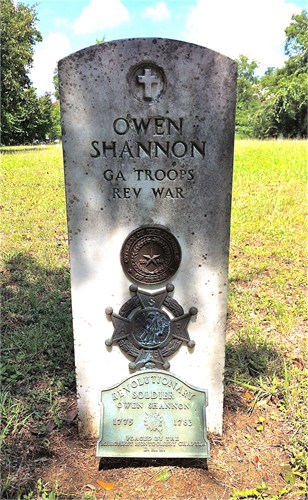
Burial site of Owen Shannon (1762-1839), Old Methodist Cemetery, Montgomery, TX (my great-great-great-great grandfather)

It is a symbol of the promise that the Sacred and the Holy is not inaccessible or removed from us but has spilled into the earth.  Never again can we become separated or isolated; never again can we close ourselves off and not move forward.

And for us?  We are always standing at the edge of the rainbow, the edge of the Sacred and the Holy.  God is in our midst and everything is Sacred.  The mundane and the ordinary is marked by God’s fingerprints and have become extraordinary.  This Lenten season is a journey of transformation.  We are moving from one way of being to another, from that mountaintop to Jerusalem, from life to death and life beyond.  And along the way are thresholds that we traverse.  We are always at the edge of the rainbow.  We just have to open ourselves to the sacredness that everything holds.  God is in our midst. Heaven has opened and has spilled into the earth.  Everywhere we walk is holy ground.

God rejoiced to see [God’s] Dream reborn.  [God] desired to mark this moment eternally, as a sign to all creation that hope is more real and permanent than despair.  [God] shone [this] perfect , invisible light–the light of joy–through all the tears that would ever flow out of human grief and suffering.  That invisible light was broken down, through our tears, into all the colours of the rainbow.  And God stretched the rainbow across the heavens, so that we might never forget the promise that holds all creation in being.  This is the promise that life and joy are the permanent reality, like the blue of the sky, and that all the roadblocks we encounter are like the clouds–black and threatening perhaps, but never the final word.  Because the final word is always “Yes”!  (Margaret Silf, in Sacred Spaces:  Stations on a Celtic Way)

On this Lenten journey, look around. What holiness do you see?  Where do you see God in your midst?

Rath De ‘ort (Gaelic, pronounced Rah Day urt, “The Grace of God on you.”)

Shelli


Psalm 121: A Season for Blessing

BlessingPsalter for Today:  Psalm 121

I lift up my eyes to the hills— from where will my help come?  My help comes from the Lord, who made heaven and earth.  He will not let your foot be moved; he who keeps you will not slumber.  He who keeps Israel will neither slumber nor sleep.  The Lord is your keeper; the Lord is your shade at your right hand.  The sun shall not strike you by day, nor the moon by night.  The Lord will keep you from all evil; he will keep your life.  The Lord will keep your going out and your coming in from this time on and forevermore.

Several months ago, I was about to leave a wedding rehearsal that I had just finished when the bride’s parents came up to me and asked if I could give them a blessing.  I have to admit that I was surprised.  We give blessings at baptisms and blessings at weddings.  We bless meals and houses and ships and new buildings.  We even bless our animal companions once a year or so.  But for some reason, blessings just for the sake of blessing, just for the sake of being, has become almost non-existent. Perhaps we’ve become almost distrustful of it, as if it’s some sort of implied expectation that God will shower good things upon us.  Our language has taken that concept of being “blessed” as some sort of reward, as if God has somehow built a bubble of good things and protection around us.  Well, truthfully, that’s just bad theology.  No where are we promised that God will shield us from bad things or continually shower us with good.  Faithful living does not guarantee that one will become healthy, wealthy, and wise.  The promise is that God will journey WITH us through all that life holds, even through the valley of the shadow of death.

This Psalm is known by some as one of the psalms of ascent, a traveler’s psalm.  It was often used as one began a journey and was a reminder to look to that place where God was, to know that God was there, a traveler with the traveler.  It is also a Psalm of blessing, a blessing for one who is about to begin a journey.  In our translation, the scripture begins with a question.  But since there’s no real punctuation in the original Hebrew in which it was written, this may or may not be intended this way.  Maybe, rather than a sojourner looking for help, it is one who acknowledges that he or she is not alone.  “I lift up mine eyes to the hills from where my help will come.”  This is the Lord who, no matter what happens, will keep your life–through all that life holds, darkness and life.  The Lord is always and forever present, never drifting away or slumbering. The chorus from Elijah (Mendelssohn) uses this theme.  “He, watching over Israel, slumbers not nor sleeps.”  God is always there.  This is the promise of faith.

The Hebrew call to be a blessing (Parshas Lech Lecha) is used eighty-eight times in the Book of Genesis.  A blessing is a gift.  It involves every sphere of our existence.  It is not, as our language and our culture seems to depict, payment for a life well-lived; it is not taking the bad things of life as God’s way of strengthening us or something; it is not somehow straining to proclaim the bad as good; and it is certainly not living some unreal existence where darkness does not seep in at all.  Being blessed means to be recreated.  It takes time.  To be a blessing is to enter the story.  God calls, God promises, and, as the Psalmist depicts, God walks with us, ever-present and ever-faithful.  That is how God is revealed.  When we enter the story, we are truly blessed.  We begin again.  We are blessed to be a blessing, one who journeys with God.

A Blessing is a beginning, a new beginning, an acknowledgment that, even now, recreation is happening.  Life is a blessing.  Even darkness and wilderness and desert spaces in our lives are blessings as they look ahead for the Light to come.  On Ash Wednesday, we were blessed with ashes as this Lenten journey began, as we were reminded who and whose we are.  We began again.  God walks with us on this journey.  We know that.  Intellectually, we know that.  But knowing it deep within our being is what being blessed is all about.

Blessing is one of the ways that God makes the presence of God known here and now. (Joan Chittister, in Listen with the Heart:  Sacred Moments in Everyday Life, p. 8)

On this second Sunday of our Lenten journey, know yourself blessed, know yourself recreated, know yourself as you begin again.

Grace and Peace,

Shelli

Unsaid

The Sound of SilenceScripture Passage: Psalm 62: 1a

For God alone my soul waits in silence.

We are not generally a silent people.  Even in the quietness of our homes, there is noise–lots and lots and lots of noise.  (Because there is a somewhat demanding Black Lab barking at me right now!) Silence seems to elude us.  On some level, it takes a lot of time and that is a hard thing to come by. And, to be honest, in my world, I’m not even sure it exists.  There is always something making noise.  So how does my soul wait in silence?  How does my soul find that rhythm that it so desperately needs, the natural rhythm of noise and silence.  Maybe we could employ some of that white noise that is supposed to drown out other noises.  Would that work?  But isn’t that just more noise?  We work hard at honing our communication skills.  And yet, communication is not just about talking; it’s about that rhythm of expression and listening, of noise and silence.  We need silence sometimes.  It is part of the rhythm of life.  Mother Teresa of Calcutta once said that “we need to find God, and [God] cannot be found in noise and restlessness.  God is the friend of silence.  See how nature–trees, flowers, grass–grows in silence; see the stars, the moon, and the sun, how they move in silence…we need silence to be able to touch souls.”

So, why is silence so hard to find?  Are we unsure of ourselves, a little reticent about what we might hear, perhaps a little fearful of what we might be asked to do? So, we try to fill the emptiness with noise.  Now, to be honest, I’m not sure that “pure” silence really exists.  There’s always something making noise.  Perhaps “keeping silence” is more about returning to a natural level of noise than it is stopping all noise itself.  In her book, When God is Silent, Barbara Brown Taylor talks about an experience by composer John Cage’s time in an anechoic chamber (a room without echoes).  With his perfect hearing, he picked up two distinct sounds–one high and one low.  When he described them to the engineer in charge, he was told that the high sound was his nervous sytem in operation, and the low one was his blood in circulation.  Noise is part of life.  Keeping silence is not about existing in pure silence; it is about living in pure life, in Creation.  And yet, most of us live most of our lives in noise–artificial noise, the noise of the world, rather than the noise of Creation.

If you go back and read the story of Creation, it began in silence.  I think it probably began in “pure” silence, in a void (implying that perhaps “pure” silence is not meant to exist at all).  And then God spoke us (along with everything else) into being.  In her book, Taylor says, “in his poetic eulogy “The World of Silence”, the French philosopher Max Picard says that silence is the central place of faith, where we give the Word back to the God from whom we first received it.  Surrendering the Word, we surrender the medium of our creation.  We unsay ourselves, voluntarily returning to the source of our being, where we must trust God to say us once again.”

In this Lenten journey, we talk about journeying, about surrendering. We talk about re-aligning our lives with what God envisions for us, and we talk about change.  But maybe the part we’re missing is where we don’t talk–I mean, INTENTIONALLY, enter into silence.  Shhhhh!  Let God say you into being again. (And now I’m going to quit talking!)

There is nothing so much like God in all the universe as silence. (Meister Eckhart)

At this point in your Lenten journey, just be silent.  Just listen.  Just wait to be unsaid.

Grace and Peace,

Shelli

The Path of the Wind

WindScripture Passage: John 3: 1-17 (Lent 2A)

Now there was a Pharisee named Nicodemus, a leader of the Jews. He came to Jesus by night and said to him, “Rabbi, we know that you are a teacher who has come from God; for no one can do these signs that you do apart from the presence of God.” Jesus answered him, “Very truly, I tell you, no one can see the kingdom of God without being born from above.” Nicodemus said to him, “How can anyone be born after having grown old? Can one enter a second time into the mother’s womb and be born?” Jesus answered, “Very truly, I tell you, no one can enter the kingdom of God without being born of water and Spirit. What is born of the flesh is flesh, and what is born of the Spirit is spirit. Do not be astonished that I said to you, ‘You must be born from above.’ The wind blows where it chooses, and you hear the sound of it, but you do not know where it comes from or where it goes. So it is with everyone who is born of the Spirit.” Nicodemus said to him, “How can these things be?” Jesus answered him, “Are you a teacher of Israel, and yet you do not understand these things? “Very truly, I tell you, we speak of what we know and testify to what we have seen; yet you do not receive our testimony. If I have told you about earthly things and you do not believe, how can you believe if I tell you about heavenly things? No one has ascended into heaven except the one who descended from heaven, the Son of Man. And just as Moses lifted up the serpent in the wilderness, so must the Son of Man be lifted up, that whoever believes in him may have eternal life. “For God so loved the world that he gave his only Son, so that everyone who believes in him may not perish but may have eternal life. “Indeed, God did not send the Son into the world to condemn the world, but in order that the world might be saved through him.

This is a hard one.  More of us are probably a lot more like Nicodemus than we care to admit.  I don’t think that there’s any question that he was smart, well-learned even.  He was a rabbi, a teacher of all things Scriptural and all things of faith.  He knew what questions to ask and we shouold give him the benefit that he was continuing to probe and explore.  Perhaps he wasn’t as sure anymore of his own certainty when it came to his beliefs.  But he wasn’t ready to admit it even to himself.  He wasn’t really ready to go there yet.  So he goes to Jesus in the dark of night, cloaked in mystery and secrets.  And Jesus begins to explain in the way that Jesus always does–not literally, not factually, but open-ended, inviting one not to believe what he is saying but to enter who he was.

You know, when you have a seminary degree, people often assume that you somehow spent several years of your life studying so that you will have all the answers.  Well, sadly, that would not be the case.  You see, not so sadly, seminary does not teach you the answers; it teaches you how to ask the questions.  That’s what sort of makes up faith, don’t you think–questions that leave us desiring more, questions that will not allow us to rest on the laurels of who we have figured out God is, what we have figured out God meant (Really?)  and what we have figured out God wants us to do.  Faith is what reminds us that there is always something more, always something up ahead, always a faint road that God calls us to walk not so that we will know the answers but so that we will become The Way to God.

And, interestingly enough, this calling often comes when we are at our most vulnerable, cloaked in the dark of night, so to speak.  The anonymous 14th century mystic described it as “the cloud of unknowing”, proposing that the only way to know God is to let go of what we know, to risk surrendering ego and mind and what we have “figured out”, and enter the cloud of the unknown, where we would truly know God.  (The 4th century bishop Gregory of Nyssa contended that as we journeyed deeper into faith, we entered darker and darker places and in the darkness we could finally see what needed to be seen.) That’s where Nicodemus was–still struggling, still wandering somewhat aimlessly in the darkness, still asking “how can this be?”, but beginning to know. (Not “understand”, mind you, just know.)

Jesus tells the questing rabbi that he must be born from above (or “again”, or “anew”–the Greek anothen remains ambiguous at best.)  But whatever it is, you have to let the wind blow where it chooses and just be in it.  When I read that, I thought of “riding out” Hurricane Ike in my pier and beam bungalow with my mom (who didn’t want me to do that by myself) and my rather confused Black Lab.  What we realized was that, as opposed to a house with a slab that remains staid and unyielding. my house is built so that the hurricane-force winds swirls around it and UNDER it.  It just moves with the wind.  It doesn’t have to bend or push.  There were no straining or creeking walls.  It just moves.  It gives itself to the wind.

In this Season of Lent, the winds of change are swirling all about.  We hear the sounds but we do not know its path.  We, too, must give ourself to the wind, must enter the darkness, the cloud of unknowing, and walk, trusting that we will find ourselves in the place where we belong.  We are not always called to understand, but only to know.

Where does the wind come from, Nicodemus?  Rabbi, I do not know.  Nor can you tell where it will go. 

Put yourself into the path of the wind, Nicodemus.  You will be borne along by something greater than yourself.  You are proud of your position, content in your security, but you will perish in such stagnant air. 

Put yourself into the path of the wind, Nicodemus.  Bring leaves will dance before you.  You will find yourself in places you never dreamed of going; you will be forced into situation you have dreaded and find them like a coming home. 

You will have power you never had before, Nicodemus.  You will be a new man. 

Put yourself into the path of the wind. 

      (Myra Scovel, “The Wind of the Spirit”, 1970, in Hearing God’s Call, by Ben Campbell Johnson)

In this Season of Changing Winds, what things that you have “figured out” do you need to release?  What will it take for you to let go of needing to understand?  What will it mean for you to know?

Grace and Peace,

Shelli

The Pilgrim’s Way

the_journeyScripture Passage:  Genesis 12: 1

Now the Lord said to Abram, “Go from your country and your kindred and your father’s house to the land that I will show you.

Have you ever noticed that no one spends much time standing still in the Bible?  The story begins with God breathing life into Creation and, in essence, making us a home, a place.  But it doesn’t take but a few chapters before we are on the move–aliens, immigrants, sojourners.  It’s pretty clear that God calls us to be pilgrims on this Way, traveling light and gathering all of Creation together as we move. And along the way, we hear lots of words like “sent forth” and “go” and “follow”.  We are called to be a people on the move (at least figuratively and probably even a little literally), essentially migrating from one place to the next, from one way of being to another.  And most of the time, those that came before us moved freely through their journey without a map, without real plans or even real provisions.  Most of the time they were just journeying to a place they did not know but that they knew that God would show them. 

So what has happened to us?  How did we become so planted? How did our lives become so safe?  It was never that way in the beginning.  The journey of faith was a wildly unpredictable one into places unknown. The journey of faith called its travelers to be pilgrims in the wilderness, sojourners through foreign lands.  Oh, we like to think of ourselves as journeyers, particularly we Methodists who readily espouse Wesley’s notion of faith as movement, as, to coin his words, “going on to perfection”.  (Gee, there’s that “go” thing again!)  And yet, we will do everything possible to avoid getting driven to the wilderness or left without everything that we need (or at least the latest technological gadget).  We tend to separate ourselves from discomfort or inconvenience or chaos.  We stick to our plans.  But wildness and chaos often creates a certain energy.  It wakes us up; it makes us pay attention.  Maybe that’s why Lent begins in the wilderness.

Have you ever noticed that when you travel you see a lot more than when you’re just driving to and from work?  Is it because there’s more to see?  Or is it that when one is unfamiliar territory, one is more aware of the surroundings, more open to seeing things as they are?  Seeing oneself as a pilgrim, a wanderer, is the same thing.  It keeps our eyes open and our minds alert.  We notice God’s Presence; we notice God’s People; we do not see ourselves as “owners” or even squatters.  We see ourselves as part of Creation.  We begin to see that we are called not to arrive but to journey.  Our faith IS the journey.  So Lent begins in the wilderness and asks us to travel deep within ourselves, beyond our preconceptions, beyond our assumptions, beyond our plans.  We go, open to what God has to show us along the way. 

It may be that when we no longer know what to do, we have come to our real work. And when we no longer know which way to go, we have begun our real journey. (Wendell Berry)

So as we make this Lenten journey, what do you see?  What are you missing?  Where are you being called to go? (And does that have to involve your cell phone?)

Grace and Peace,

Shelli

Re-Patterned

RoundaboutScripture Passage:  Romans 4: 1-5, 13-17 (Lent 2A)

What then are we to say was gained by Abraham, our ancestor according to the flesh? For if Abraham was justified by works, he has something to boast about, but not before God. For what does the scripture say? “Abraham believed God, and it was reckoned to him as righteousness.” Now to one who works, wages are not reckoned as a gift but as something due. But to one who without works trusts him who justifies the ungodly, such faith is reckoned as righteousness…For the promise that he would inherit the world did not come to Abraham or to his descendants through the law but through the righteousness of faith. If it is the adherents of the law who are to be the heirs, faith is null and the promise is void. For the law brings wrath; but where there is no law, neither is there violation. For this reason it depends on faith, in order that the promise may rest on grace and be guaranteed to all his descendants, not only to the adherents of the law but also to those who share the faith of Abraham (for he is the father of all of us, as it is written, “I have made you the father of many nations”) —in the presence of the God in whom he believed, who gives life to the dead and calls into existence the things that do not exist.

We are creatures of habit.  We cling to our patterns of life sometimes for our very identity.  And it is no different with our faith.  Our ways of believing, our ways of worship, our ways of practicing our faith are, for most of us, virtually untouchable.  (If any of you have ever tried to make any changes in a worship service, you know EXACTLY what I’m talking about!)  We are open to change as long as WE don’t have to change.  We are open to doing things differently as long as it doesn’t affect us.  Does that sound a little bit uncomfortably familiar?

The audience to whom Paul was probably writing were really no different.  They had grown up with norms of what was “right” and “righteous”, what made them acceptable before God and as people of faith.  For them, their revered patriarch Abraham was blessed because he followed God and did the right things (which also happened to of course be the things that they were doing).  And now here is Paul daring to write that that’s not what it meant at all, that it had nothing to do with what Abraham did or whether he lived and practiced his faith in the right way but that he had faith in a God that freely offered relationship, in a God that freely and maybe even a little haphazardly offered this relationship to everyone.  Faith is not something that you define or check of your list of “to do’s”; faith is something that you live.

In this Season of Lent, we talk a lot about giving up old ways and taking on new patterns in life.  Lent is a season of re-patterning who we are and how we live.  Maybe it’s a time to let go of the things that we assume, those habits that are so ingrained in us that we don’t even realize that they are there, things that have somehow become so much a part of our lives that they have by their nature changed who we are.  Think of Lent as the season that asks us to drive on the other side of the road.  I remember the first time I did that.  It was in New Zealand.  Now if you’ve been to New Zealand, you understand that the miles and miles of rolling hills patterned only by sheep farms is a good place to learn to drive on the other side.  There is lots of room for “correction”, shall we say.  That wasn’t the problem.  The problem was the more heavily populated areas where we had to deal with other people’s habits and ways of being.  (As in when you had to worry about other people on the road!)  And in the middle of every town was what they call a “round-about”.  It was sort of fun to get on but getting off was a completely different story.  My brain did not work that way.  I couldn’t make myself turn the right way (or the wrong way) while I was driving on what was to me the “wrong” side of the road.  (So, needless to say, we would just drive around that circle several times!)  It was one of the scariest things I’ve ever done.

Paul was trying to get people to look at things differently, to think differently, perhaps even to drive on the other side of the road.  “Leave the old patterns and the old rules and the old ways of thinking behind,” he was saying, and get on.  It’s a little scary and you might have to drive around it a few times.  But just do it.  Open your eyes and look at things differently.  Open your lives to faith.  Oh, don’t get me wrong, our rules and our patterns can help us at times.  They give us foundations, sort of a tangible guide to support us on this journey.  They are necessary.  They are a means of grace.  But the passage reminds us that these rules and foundation are just that.  They are not an end unto themself.  It takes faith to breathe life into them, to make them come alive.  It takes faith to give us the ability to back away from ourselves sometimes and figure out in what ways our life needs to be re-patterned.  (Otherwise, we just keep driving around in circles!)  Lent calls us to look at all of our life with a critical eye, to discern what is purely habit and what is truly a way of living out our faith.  Lent calls us to look at things differently, to really see rather than just assume.  Lent calls us to have enough faith to drive on the other side of the road.

In faith there is enough light for those who want to believe and enough shadows to blind those who don’t. (Blaise Pascal)

As we continue on this Lenten journey, take a look at your habits, at those things that you just take for granted.  Which ones are life-giving?  Which ones hinder faith and openness?

Grace and Peace,

Shelli

The Dwelling Place

Open HouseScripture Passage: Psalm 27:4

One thing have I desired of the Lord, that will I seek after; that I may dwell in the house of the Lord all the days of my life, to behold the beauty of the Lord, and to enquire in his temple. (KJV)

The Psalmist gives us great comfort, this idea of dwelling with God forever.  It is our hope; it is our promise; it is what our faith is all about.  So what does it mean to “dwell”?  One definition is to “stay” or to “reside in permanent residence.”  That is usually the way we think of this notion–to live with God, to stay with God forever.  For us, a “dwelling” is something permanent, a structure that protects us and gives us shelter.  It is the place where we can go when life gets to be too much and when we need rest and sustenance.  It is the place where we can hide ourselves away and heal.  It is the place that feels like home. 

But dwellings also wall us off from the rest of the world, setting up boundaries of what is “mine” and what is “yours”.   They allow us to ignore the needs and the lives of those who are not within our walls.  I live in an older neighborhood in Houston.  Once filled with a few older Victorian homes and lots of small 1920’s bungalows (I have one of those), it is now becoming a victim of the so-called “McMansion” syndrome as bungalow after bungalow is torn down so that a sprawling three-story (or even four-story) Victorian wannabe can take over the entire lot.  So, beyond mere protection and shelter, the dwelling has creeped beyond its own boundaries and taken on an identity all its own.

Is this how we read these words now, as if we have somehow taken up residence with God and God’s sprawling house?  Is that what it means to dwell with God, to stay, to hide, take move into a permanent structure (perhaps with other like-minded children of God)?  But there is another meaning of the word “dwell”.  It is also defined as “to linger over” or “ponder”.  So what, then, would it mean to spend all the days of one’s life pondering God, lingering with God?  I don’t think God calls us to stay with God but rather to be with God.  The walls of dwellings sound to me far too limiting of a limitless God. (Which is the reason that the image of Christ becomes the new Temple, the new Dwelling.)  But this dwelling that we have somehow conjured up in our minds is not where God lives but rather where we want God to be, the place where we envision pulling God into our notion of who God is.  But to be, to be with God, means to go where God is, to open one’s mind and heart and soul to being the very image of God, to being the dwelling of God.

Once again, it requires us to make room, to clear our lives of the “stuff” that we have accumulated and to perhaps open the doors and windows and let the fresh air and light in.  God IS our sustenance, our shelter, even, at times, our protector.  But God does not wall us off from the rest of the world.  We are called to go forth, to be God’s image in the world.  We are called to ponder, to linger over, to become.  Doesn’t that sound a little familiar?  Mary treasured all these words and pondered them in her heart. (Luke 2: 19, NRSV)  And then, if you remember, she became the very dwelling of the Godself, the God-bearer, the one that birthed God into the world.  We are not called to stay with God; we are called to be with God, to be a dwelling place for God with God in God.  We are called to be the God-bearers.  It is home, the place where we can truly rest our souls.

My ego is like a fortress.  I have built its walls stone by stone to hold out the invasion of the love of God.  But I have stayed here long enough.  There is light over the barriers.  O my God…I let go of the past, I withdraw my grasping hand from the future, and in the great silence of this moment, I alertly rest my soul.  (Howard Thurman)

On this Lenten journey, what does it mean for you to dwell in God, to ponder?  What does it mean to become a dwelling place for God?

Grace and Peace,

Shelli