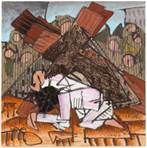
Station VIII: Lament

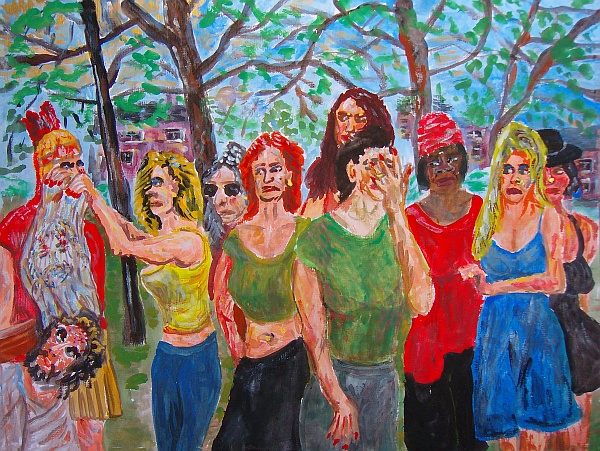
"The Women:  Veronical Wipes Jesus' Face and Jesus Meets the Women of Jerusalem, St. Mary's Church, Barton-on-Humber, April 4, 2007
“The Women: Veronical Wipes Jesus’ Face and Jesus Meets the Women of Jerusalem, St. Mary’s Church, Barton-on-Humber, April 4, 2007

Scripture Passage: Luke 23: 27-31

27A great number of the people followed him, and among them were women who were beating their breasts and wailing for him.28But Jesus turned to them and said, “Daughters of Jerusalem, do not weep for me, but weep for yourselves and for your children.29For the days are surely coming when they will say, ‘Blessed are the barren, and the wombs that never bore, and the breasts that never nursed.’30Then they will begin to say to the mountains, ‘Fall on us’; and to the hills, ‘Cover us.’31For if they do this when the wood is green, what will happen when it is dry?”

The eighth station on this holy walk is marked by a stone with a Latin cross on the wall of a Greek Orthodox church.  Near the cross, an inscription reads, “Christ the Victor.”  Tradition has designated this as the place where Jesus encounters the women of Jerusalem.  The women were convinced of his holiness.  I don’t think they understood it completely.  After all, who did?  (After all, who does?)  But they knew that he was something special.  After all, he had paid attention to them, these women, these ones who were given no place in society other than to birth babies.  He saw them as something more.  And they were grateful.  And today they grieved.

As Jesus and the crowd moved closer to the end, the wailing got louder and louder.  Jesus, covered in dirt and sweat and near death, lifted his head and looked into their eyes.  “Do not weep for me,” he said, “but weep for the world.”  Weep for the world; cry for the world; grieve for the world. In other words, those that suffer in the world, those parts of the world that are not life-giving, those part of people’s lives that are not the vision that God holds–those things should bother you.  Those are the things for which you should weep.

Weeping is hard for us.  Our culture is pretty well emotionally controlled, for the most part.  In fact, there are those that grow up thinking that tears and grief and crying are a sign of weakness.  We do not know how to lament.  And, yet, think of all those psalms of lament.  They are prayers.  Laments are prayers.  Weeping is prayer.  These are prayers for what could be and is not, prayers for what should have been that fell short, and prayers for the hurting in our world.  Jesus is telling these women to pray, to wake up, and to work to change the world.  He is acknowledging that they understand this vision and that, now, they have work to do.  It is a way of putting others before self.  It is a way of engaging yourself and your faith in bringing the Kingdom of God in its fullest into being.  It is a way of continuing the life of Jesus Christ.

I saw a feature news story by NBC’s Brian Williams last night on Camden, New Jersey.  A bustling boomtown in the first half of the 20th century, Camden is now America’s poorest city and the one with the highest crime rate.  Surrounded by relatively affluent suburbs, it is the place that we drive by, wondering why no one does anything.  Its residents that fill the inner city row houses seldom venture outside for fear of the safety of themselves and their children.  It is the way we hide poverty and despair in plain sight.

http://www.nbcnews.com/video/rock-center/51110367

So on this Lenten journey, learn what it means to weep for the world.  Pray for the world and for others who hurt and grieve and bleed, those who fear and cry and need.  Learn to lament, an active lament that will make you part of bringing the world into that vision that God holds.  Open your eyes to see the pain that exists in plain sight.  Our Lenten journey calls us to do something to change the world.

Grace and Peace,

Shelli

Becoming Prodigal

"The Return of the Prodigal Son", Rembrandt, c.
“The Return of the Prodigal Son”, Rembrandt, c. 1667

This Week’s Lectionary Passage: Luke 15: 1-3, 11b-32

Now all the tax collectors and sinners were coming near to listen to him. 2And the Pharisees and the scribes were grumbling and saying, “This fellow welcomes sinners and eats with them.” 3So he told them this parable:…“There was a man who had two sons. 12The younger of them said to his father, ‘Father, give me the share of the property that will belong to me.’ So he divided his property between them. 13A few days later the younger son gathered all he had and traveled to a distant country, and there he squandered his property in dissolute living. 14When he had spent everything, a severe famine took place throughout that country, and he began to be in need. 15So he went and hired himself out to one of the citizens of that country, who sent him to his fields to feed the pigs. 16He would gladly have filled himself with the pods that the pigs were eating; and no one gave him anything. 17But when he came to himself he said, ‘How many of my father’s hired hands have bread enough and to spare, but here I am dying of hunger! 18I will get up and go to my father, and I will say to him, “Father, I have sinned against heaven and before you; 19I am no longer worthy to be called your son; treat me like one of your hired hands.”’ 20So he set off and went to his father. But while he was still far off, his father saw him and was filled with compassion; he ran and put his arms around him and kissed him. 21Then the son said to him, ‘Father, I have sinned against heaven and before you; I am no longer worthy to be called your son.’ 22But the father said to his slaves, ‘Quickly, bring out a robe—the best one—and put it on him; put a ring on his finger and sandals on his feet. 23And get the fatted calf and kill it, and let us eat and celebrate; 24for this son of mine was dead and is alive again; he was lost and is found!’ And they began to celebrate. 25“Now his elder son was in the field; and when he came and approached the house, he heard music and dancing. 26He called one of the slaves and asked what was going on. 27He replied, ‘Your brother has come, and your father has killed the fatted calf, because he has got him back safe and sound.’ 28Then he became angry and refused to go in. His father came out and began to plead with him. 29But he answered his father, ‘Listen! For all these years I have been working like a slave for you, and I have never disobeyed your command; yet you have never given me even a young goat so that I might celebrate with my friends. 30But when this son of yours came back, who has devoured your property with prostitutes, you killed the fatted calf for him!’ 31Then the father said to him, ‘Son, you are always with me, and all that is mine is yours. 32But we had to celebrate and rejoice, because this brother of yours was dead and has come to life; he was lost and has been found.’”

This is truly one of the world’s best-known and best-loved parables.  In fact, it shows up even in the Mahayana Buddhist tradition as well as others, so I would surmise that everyone has a hard time figuring this out.  The truth is, we humans like the image of one being welcomed home.  And even though those of us who try to do everything right, try to be who we’re supposed to be, are a little bothered by our identification with the older son, we like that image of the safety net that no matter how badly we mess our lives up, we can always begin again.

But when you delve a little deeper, there’s always more to the story.  (Oh, come now, you didn’t think that there would just be one level to a parable told by Jesus, did you?)  So, think about the fact that in this time and in this culture, there were expectations.  Land and resources were viewed as a gift to be handled responsibly.  They were ancestral lands and were meant to stay together, to stay within the family, rather than being split apart and divided.  So, this was a shocking parable, far from anything that its hearers could have imagined.  This father who gave away resources to a younger son that then leaves the family was going against all that the culture prescribed.  And a father that welcomed him back was just being duped.  And then to essentially take him back into the family and heap more abundance upon him was just unthinkable.  Good grief, when will this father ever learn?

We have come to equate the word “prodigal” with one who returns.  But if you look up the word, it means one who is recklessly spendthrift.  It also means yielding abundantly.  So how can those two definitions refer to the same word?  Because the notion of abundance, the notion of offering all that you have and all that you are, the notion of being this prodigal father is deemed irresponsible in our world’s view.  And yet, this image of one who offers all as abundance is the image of God that we get over and over again.  God does not dole out riches or rewards based on who we are and what we do; rather God offers everything, pouring as much of the Godself into our lives as we can possibly hold (and then more that we might spill it out into the world around us).  This is a God of abundance.  We don’t understand it.  We can’t control it.  We can’t even really accept it half the time.  We look for a catch.  After all, the world tells us that we cannot get something for nothing.

But “something for nothing” is exactly what God is offered.  God’s only desire is that we open ourselves to this prodigal abundance that God offers.  You’ve probably often heard a description of this parable ending with something like “head home to the open arms of God, the feast is waiting.”  What if the ending was something more like “just open yourselves to the abundance that is right there.  You don’t have to go anywhere.  You don’t have to do anything.  You just have to desire in the deepest part of your being the incredible blessings and abundance that God is already heaping into your life.”

Here is the God I want to believe in:  a Father who, from the beginning of Creation, has stretched out his arms in merciful blessing, never forcing himself on anyone, but always waiting; never letting his arms drop down in despair, but always hoping that his children will return so that he can speak words of love to them and let his tired arms rest on their shoulders.  His only desire is to bless. (Henri J.M. Nouwen, The Return of the Prodigal Son, 95-96)

So in this Lenten season, open yourself to this Prodigal God, this God of Abundance.  Think what it would mean to become a prodigal, spending lavishly the abundance that God offers and, then, becoming that very abundance yourself.

Grace and Peace,

Shelli

Station VII: Betrayed

Station 07-EScripture Passage:  Matthew 26: 20-23

20When it was evening, he took his place with the twelve; 21and while they were eating, he said, “Truly I tell you, one of you will betray me.” 22And they became greatly distressed and began to say to him one after another, “Surely not I, Lord?” 23He answered, “The one who has dipped his hand into the bowl with me will betray me.

The seventh station on the Via Dolorosa is Jesus’ second fall.  Marked by a Roman column housed in a Catholic Chapel, it is the traditional place where the Gate of Judgment stood.  This is the place where judgments were passed on those that had committed crimes.  And here, passing out of the city, Jesus falls again.  Though surrounded by a host of onlookers and curious tourists, he is alone, deserted and betrayed by those whom he had loved.  You can surmise that they were fearful for themselves, perhaps even fearful that there would be no one to carry the message into the future.  But let’s be honest.  They just weren’t there.  The night before, Jesus had dipped his hand into a bowl that others at the table would also touch and dip.  Jesus knew that the one who had dipped his hand into the bowl with him would betray him.

I know.  The story picks up with Judas right after the verses of Scripture that I used.  We like thinking of Judas as the poster boy of betrayal.  That’s an easy way out, to blame it on the most obvious perpetrator, the one who makes us all look like saints.  And yet, Jesus’ words as the writer of this Gospel portrayed them, says “the one who has dipped his hand…”  Think about it.  It was a community bowl.  ALL of those at the table dipped their hands in the bowl.  The truth is, Jesus probably knew that he would be alone on this day, that all would in their own way betray him–one by a kiss, one by a denial, and others by stepping back into their fears that they, too, might be found out.

Polish-born writer Isaac Singe said that “when you betray someone else you also betray yourself.”  The reason, I think, is because betrayal cuts so deep that you lose a part of yourself.  If someone asked you what the opposite of faith is, you’d probably immediately say doubt.  But, think about it, doubt compels one to search, compels one to question, compels one to grow.  Doubt and faith are inextricably intertwined.  The opposite of faith, the antithesis of faith, of journeying toward who you are called to be is more than likely betrayal.  It is completely contrary to “love your neighbor” as well as to “love God with [all you are]”.  Betrayal is a loss of who one is called to be.

And so Jesus falls, alone, defeated, betrayed.  He was feeling the ultimate of rejection.  All he had left was hope.  And so he breathed deeply and continued on.  And his betrayers cowered behind closed doors feeling a loss that they could not describe.  Surely not I…surely not I…surely not I.

In this Season of Lent, think of ways that you betray who you are called to be, ways that you cut yourself off from life, from others, from God.  Then, rise up, for you faith has made you whole.

Grace and Peace,

Shelli 

The Sacred “And”

The Creation of Adam [Humanity], Michelangelo, segment of The Sistine Chapel, c. 1512
This Week’s Lectionary Passage:  2 Corinthians 5: 16-21

16From now on, therefore, we regard no one from a human point of view; even though we once knew Christ from a human point of view, we know him no longer in that way. 17So if anyone is in Christ, there is a new creation: everything old has passed away; see, everything has become new! 18All this is from God, who reconciled us to himself through Christ, and has given us the ministry of reconciliation; 19that is, in Christ God was reconciling the world to himself, not counting their trespasses against them, and entrusting the message of reconciliation to us. 20So we are ambassadors for Christ, since God is making his appeal through us; we entreat you on behalf of Christ, be reconciled to God. 21For our sake he made him to be sin who knew no sin, so that in him we might become the righteousness of God.

Paul starts right off acknowledging Jesus as both divine and human.  That in and of itself is hard for us.  I mean, we like the idea of Jesus coming and walking around in our midst, giving us a much clearer way of understanding what it is we’re supposed to be about.  We like the idea of what sometimes seems to us to be a sort of “semi-human” leading us around and in some satisfactory way “proving” to us that God really does exist.  We like the idea of having someone to emulate.  But, see, Jesus is not a textbook or proof of God’s existence or even a super-hero that we can aspire to be like.  Jesus is fully human, that fully-developed image of the Godself in which we were all created.  Jesus came not to start a religion or even a belief system; Jesus came into our midst, Emmanuel, God With Us, that we might, finally, become human.

But in order to be fully human, in order to become this New Creation about which Paul writes, we have to let go, have to open ourselves to the Divine pouring into us, filling us.  The New Creation is not a denial of humanity.  The coming of God’s Kingdom into our being does not mean that we will become Divine; it means, rather that God’s Spirit, the essence of the Divine will pour into our lives and make us fully human.  St. Athanasius of Alexandria (4th century) supposedly claimed that “Christ became human that we might become divine.”  Now that used to bug me a bit.  It even bugs me when someone refers to another person (or themself!) as “godly”.  I don’t think of myself or anyone else as “like God”.  I actually believe that God pretty much has a monopoly on that way of being.  And yet, if Jesus had NOT come as human, as one of us, then God’s Spirit, the essence of the Divine, would have remained pretty removed and unapproachable for our limited capabilities.  Perhaps Jesus came as human to show us how to open ourselves to the Divine, how to leave room for this pouring in of the sacred and the holy into our lives, how to relate to a God that was never really removed and unapproachable at all. 

The statement says that Jesus came as fully human and fully divine.  The two cannot be separated; otherwise, humanity is removed from God and the Divine remains aloof and inaccessible.  But together, intertwined, eternally connected with a sacred “and”, we become fully human.  We become the one that God created us to be.  We become a new creation, reconciled to God.  We become righteousness, become sacredness, become the essence of God’s Spirit.

So in this Lenten season, be fully human.  Open yourselves to the Spirit of the Divine pouring into your life.  Embrace the sacred “and” of you and God together, Emmanuel, God With Us. 

Grace and Peace,

Shelli

Station VI: No Longer Hidden

Station 06-HScripture Passage: Luke 8: 43-48:

43Now there was a woman who had been suffering from hemorrhages for twelve years; and though she had spent all she had on physicians, no one could cure her. 44She came up behind him and touched the fringe of his clothes, and immediately her hemorrhage stopped. 45Then Jesus asked, “Who touched me?” When all denied it, Peter said, “Master, the crowds surround you and press in on you.” 46But Jesus said, “Someone touched me; for I noticed that power had gone out from me.” 47When the woman saw that she could not remain hidden, she came trembling; and falling down before him, she declared in the presence of all the people why she had touched him, and how she had been immediately healed. 48He said to her, “Daughter, your faith has made you well; go in peace.”

The sixth station of the Stations of the Cross, named Veronica Wipes the Face of Jesus, does not come directly from Scripture but rather from the hearts and the traditions of the early European Christians. Tradition holds that Jesus healed a young woman named Veronica in his early ministry and as a sign of her deep and abiding gratitude for him, she accompanied him to the place of his execution. When she wiped his sweating face along this walk, the imprint of his face supposedly remained on the cloth. Eusebius, in his Historia Ecclesiastica, tells how at Caesarea Philippi lived the woman who Jesus healed of the blood disorder. In the West, she was identified as Martha of Bethany; in the East, she was called Berenike, or Beronike, the name appearing in the Acts of Pilate. The derivation of the name Veronica comes from the words “Vera Icon”, or “true image”.

This man had shown her great compassion when she thought there was none. The bleeding had started and had never stopped. And so, always, she was deemed unclean and, therefore, unacceptable, untouchable, shunned. This was a last effort to claim her life, to become a person of value and worth again in a society that so carefully laid out who was acceptable and who was not. She had, carefully, made her way through the crowds that day avoiding the stares and recoils that others held for her. And then she touched him. It was only a touch but she could feel something. She cowered back into the crowd trying to hide. But he saw her, compelling her forward and her life was never the same again.

And so on this day, she could not just hide out in the crowd. He needed someone–companionship, mercy, compassion. She didn’t care what she was risking. After all, this is the one who had given her her life. She could do this one thing. And when she wiped his face, she felt that same burst of power that she had felt before, a life-giving, life-awakening power. And she was left with the image of Christ.

Whether we take this literally or not, whether we believe that she was healed or that Christ’s imprint adhered to a cloth, is not the point. You see, each of us was made in the image of God. We are not destined to BE God but to be an image, a reflection of the Godself into the world and into the lives of each and every one that we meet. And when we show compassion, when we show mercy, when we step forward and show love to those who need it the most, the imprint of that image DOES stay with us. We become a reflection of the Christ, an image of the God who gave us life and calls us to show it to the world. And as Jesus walked toward death, the image of the Christ remained, no longer hidden, on the one who reached out to one in need. Reaching out to others does not mean that we are Christ; it means that we are human, fully human, the way Christ showed us to be.

So in this season of darkness and shadows, remain no longer hidden but step forward into this Walk of Christ and help someone in need. And the imprint of Christ, the image of the very Godself, will stay with you always.

Grace and Peace,

Shelli

Manna Lessons

Bernardino Luini, c. 1520
The Gathering of Manna, Bernardino Luini, c. 1520

This Week’s Lectionary Passage:  Joshua 5: 9-129The Lord said to Joshua, “Today I have rolled away from you the disgrace of Egypt.” And so that place is called Gilgal to this day.  10While the Israelites were camped in Gilgal they kept the passover in the evening on the fourteenth day of the month in the plains of Jericho.11On the day after the passover, on that very day, they ate the produce of the land, unleavened cakes and parched grain.12The manna ceased on the day they ate the produce of the land, and the Israelites no longer had manna; they ate the crops of the land of Canaan that year.

That experience in Egypt was still hanging around, a past that you just can’t shake, that haunts your dreams and gets in the way of moving forward.  If was hard, hard to live within someone else’s culture, to live with what is important to someone else, to give up who you were and, more than that, to give up who you were becoming.  Hope had all but died.  And then God opens a door and you can literally taste freedom just over the horizon.  But the horizon was far away.  And on the way was danger, and hunger, and thirst.  And then manna appears.

It was a mysterious little plant, appearing each day so that they could eat their fill and then disappearing just as quickly.  You couldn’t hold on to it, couldn’t save it, couldn’t pack it away for safekeeping.  It was downright elusive.  But maybe that’s what hope is all about.  Maybe hope is like that, appearing when we need it and then disappearing when we try to hold onto it.  Maybe hope dies when we hold it too long and try to make it something that it is not.  Maybe hope requires that we keep moving.

But now, God has rolled Egypt away.  We have to let the pain go.  We need to remember, yes, because it is part of us and we need to make sure that it doesn’t happen again–to anyone.  But we have to forgive and let go of the disgrace.  God has rolled that away.  And here at Gilgal, meaning “rolling away”, that all comes true.  On this day, we have eaten of the land.  This beautiful land with disgrace rolled away has provided for us.  And the manna is only a memory.  Maybe it was there to teach us to only take what we need, to teach us to let go, to teach us to hope, to teach us to keep moving.  It is good lesson to carry into this land.  I am no longer looking for manna.  God has now invited me to participate in what God provides.  This land can feed us all.

So, as you continue on your Lenten journey, think about those things that you still hold, those things that you need to let go.  Learn to take what God offers; learn to let go; learn to hope, learn to keep moving. Learn to not miss what God has provided because you’re looking for manna.

Grace and Peace,

Shelli

The Season of Unpreparation

Scripture Passage: Mark 6: 7-12
7He called the twelve and began to send them out two by two, and gave them authority over the unclean spirits.8He ordered them to take nothing for their journey except a staff; no bread, no bag, no money in their belts;9but to wear sandals and not to put on two tunics.10He said to them, “Wherever you enter a house, stay there until you leave the place.11If any place will not welcome you and they refuse to hear you, as you leave, shake off the dust that is on your feet as a testimony against them.”12So they went out and proclaimed that all should repent.

What do you mean we’re not supposed to take anything with us?  This journey is hard.  There might be danger along the way.  We have to be prepared.  Admit it.  That’s what we all think.  After all, this journey to the cross is hard.  We’re not even halfway there–just sixteen days or so–and we’ve already encountered more than we really thought we could handle.  And now we’re told to go out there virtually unprepared for what will come next.

Maybe that’s our problem.  Maybe we mistake this Lenten journey as a time of preparing us for the Cross when, actually, we’re being called to unprepare ourselves, to put it all aside and encounter the raw roughness of the road itself.  This season is not a season of preparation but, rather, a season to shake the dust off, to clear our minds of any baggage that we have brought to this place, and to leave empty-handed, open, ready to receive.

It’s not something that we do well, this letting go, this allowing ourself to appear vulnerable, out of control, and unprepared.  I mean, we know that we have to walk this walk.  We know what’s coming.  We know what we have to go through.  And so we don some sort of cross-cut suit of armor to protect us, to make it just a little bit easier.  But think what Jesus did at the beginning of this journey.  He went into the desert, unprepared, taking nothing.  He did encounter danger–the danger of his own needs, his own desires, his own vision of what his life could hold.  What he encountered was himself.  And then he shook off the dust and left, returning to the road itself.  St. Catherine of Sienna once said that “all the way to God is God.”

This road to the Cross IS the road to which we are called.  It is the Way of God.  The challenge for us in this season is not to prepare ourselves for what is to come, but to clear the way. 

Grace and Peace,

Shelli