EASTER 2A: But…

This Week’s Lectionary Text:  Acts 2:14a, 22-32
But Peter, standing with the eleven, raised his voice and addressed them, “Men of Judea and all who live in Jerusalem, let this be known to you, and listen to what I say. “You that are Israelites, listen to what I have to say: Jesus of Nazareth, a man attested to you by God with deeds of power, wonders, and signs that God did through him among you, as you yourselves know— this man, handed over to you according to the definite plan and foreknowledge of God, you crucified and killed by the hands of those outside the law. But God raised him up, having freed him from death, because it was impossible for him to be held in its power. For David says concerning him, ‘I saw the Lord always before me, for he is at my right hand so that I will not be shaken; therefore my heart was glad, and my tongue rejoiced; moreover my flesh will live in hope. For you will not abandon my soul to Hades, or let your Holy One experience corruption. You have made known to me the ways of life; you will make me full of gladness with your presence.’ “Fellow Israelites, I may say to you confidently of our ancestor David that he both died and was buried, and his tomb is with us to this day. Since he was a prophet, he knew that God had sworn with an oath to him that he would put one of his descendants on his throne. Foreseeing this, David spoke of the resurrection of the Messiah, saying, ‘He was not abandoned to Hades, nor did his flesh experience corruption.’ This Jesus God raised up, and of that all of us are witnesses.

According to the writings of Acts, it seems that those who had been with Jesus did get on task pretty quickly and suddenly turned into witnesses rather than limiting themselves to being followers.  This passage is part of Peter’s “Pentecost Proclamation”.  You can hear the excitement in the voice of the writer.  There really is a desire to get everyone on board, to let everyone see what the witnesses have seen, what the witnesses now know.  The problem is that with most of us humans, there’s always a “but”, an excuse, a really, really, really good reason why we can’t fully commit to what God is calling us to do.

At first reading, it seems that there exists a strong belief here in the notion of Jesus’ death being “pre-ordained” by God.   I’m not so sure about that though.  If God did “pre-ordain” Jesus’ crucifixion, does that also mean that God “pre-ordained”  the Crusades, the Holocaust, and the terrorist act of September 11, 2001?  I mean, where does it stop?  Whatever happened to free will?  Are we just pawns in some great divine chess game waiting for God to move us to the next place?  I have to tell you, that’s not my image of God. 

As the Scripture says, I think God actually DID intend to hand this God Incarnate over to us, to give up a piece of Divine control, to invite us to respond to this incredible act of God literally walking in our midst.  Think about it…you know how you take that favorite jacket to the dry cleaners?  Life is not designed such that you can stand there and watch them check it in, go through the dry cleaning process, and hang it back in its environmentally-unfriendly plastic bag (yes, that was a little bit of a dig!), all the while making sure that it is properly tagged and identified and gets to where it needs to go.  No, the truth is, you hand it over to the cleaner.  Now, at the risk of comparing the Son of God to a really cute jacket, God handed over the human part of God to us.  God relinquished control.  It was up to us.  But…but we messed up.  No excuses this time!  We royally messed up.  We didn’t like change; we didn’t like being told that the way that we had figured out how to live was not the right way; and we didn’t like the idea that we could no longer control our own destiny.  So, we killed God.  We lost the Divine in our midst, if only for a moment.

BUT…”God raised him up”.  BUT God stepped in and found what was lost, redeemed what was gone, and made alive what was once dead.  THAT is what we are called to witness–not that something awful that God had supposedly “pre-ordained” happened, but that God had “pre-ordained” handing the very Godself over to us.  And when we didn’t respond the way we should have, God stepped in yet again–not to punish, not to “undo”, but to take the worst of humanity and recreate it into the best of God.  Now, my friends, THAT is a good story.  THAT is something to which we can witness!

This is the season when God shows us how to be more than followers, how to be witnesses and doers, how to BE Christ in the world…no “buts”…we really are supposed to do it!

Christ is Risen!  The Lord is Risen indeed!

Grace and Peace,

Shelli

Next

The Region of Galilee
Taken February, 2010

Scripture Text:  Matthew 28: 16-20
Now the eleven disciples went to Galilee, to the mountain to which Jesus had directed them. When they saw him, they worshiped him; but some doubted. And Jesus came and said to them, “All authority in heaven and on earth has been given to me. Go therefore and make disciples of all nations, baptizing them in the name of the Father and of the Son and of the Holy Spirit, and teaching them to obey everything that I have commanded you. And remember, I am with you always, to the end of the age.”

Now what?  What do we do next? What do we do now that the holy and the sacred, the very Divine, has spilled into our world?  What do we do now that death has been vanquished and life has been recreated into something we couldn’t have even imagined before?  It seemed easier before, when we were being called to follow, being called to look to Jesus for our teachings, for our way of becoming what we should be.  But now, we are not being told to follow.  We are being told to “Go”.  Go?  Go where?  If Lent is our formative season, Eastertide is our becoming. It is the season when we become what we’re meant to be–disciples–all of us.  The disciplines we’ve learned and the teachings we’ve heard are now ours to embody.  It is our turn, our turn to become the Word incarnate, to become the Spirit of Christ here on this earth.  (And you thought Lent was hard!)

Soar we now where Christ has led, Alleluia!
Following our exalted head, Alleluia!
Made like him, like him we rise, Alleluia!
Ours the cross, the grave, the skies, Alleluia!
                             (from “Christ the Lord is Risen Today”, hymn by Charles Wesley, 1739)

So, go forth into the world, into your life. Go forth and become the Living Christ, the embodiment of the One who has Risen. But, remember, you are never alone. The very Divine has spilled into our world.
 
Christ the Lord is Risen!  The Lord has risen indeed!
 
Grace and Peace,
 
Shelli 

So, really, what IS next?  Well, I’m going to try my best to keep this blog going, maybe “semi”-daily.  This has been a wonderful discipline for me and it really has given me life.  So, maybe they’ll be a little shorter, maybe a little more sporadic.  And maybe in a few weeks, I’ll try a book study through it or something.  We’ll just see where it goes.  In the meantime, for those of you who are having this emailed to you, if you want to continue getting them, just do nothing and they will show up just like always.  If you’d rather not get them, just let me know by dropping me an email.  And if you know someone else that wants emails, they can do the same thing.  If you just click on this link, you should be able to email me through St. Paul’s website:  http://stpaulshouston.org/form/online_form.aspx?formid=37

Thanks for journeying with me!  Shelli

Maybe It IS About Us

Scripture Text:  Matthew 28: 1-10
After the sabbath, as the first day of the week was dawning, Mary Magdalene and the other Mary went to see the tomb. And suddenly there was a great earthquake; for an angel of the Lord, descending from heaven, came and rolled back the stone and sat on it. His appearance was like lightning, and his clothing white as snow. For fear of him the guards shook and became like dead men. But the angel said to the women, “Do not be afraid; I know that you are looking for Jesus who was crucified. He is not here; for he has been raised, as he said. Come, see the place where he lay. Then go quickly and tell his disciples, ‘He has been raised from the dead, and indeed he is going ahead of you to Galilee; there you will see him.’ This is my message for you.” So they left the tomb quickly with fear and great joy, and ran to tell his disciples. Suddenly Jesus met them and said, “Greetings!” And they came to him, took hold of his feet, and worshiped him. Then Jesus said to them, “Do not be afraid; go and tell my brothers to go to Galilee; there they will see me.”

At last!  The day for which we’ve waited, for which we’ve prepared, for which we’ve hoped is here!  Alleluia!  Christ is Risen!…Christ is Risen indeed!

Last evening, we had an Easter Vigil at St. Paul’s.  I have grown to love that service.  I love entering the darkened, bare sanctuary and then being part of lighting it and filling it.  It is joyful to see it come alive!  As we were setting up, I got to do something that I had never done before.  Michael and I unwrapped the brand new Christ candle.  We opened the box and then worked together to unwrap it.  It was wonderful.  Both of us were grinning.  It was like bringing new life into the world.  You see, the Christ candle is the center of every worship service in that big Gothic sanctuary.  We light this brand new, tall Christ candle for the first time on Easter and then it burns down through the year until it is sadly snuffed out for the last time on Maundy Thursday.  This one had never been lit, never been a part of the service, never been viewed by any of us.  And there is lay on the sacristy table with both of us staring at it.  It was as if that acid-free tissue paper that we had peeled away was the rock itself that we rolled away.  Christ is risen!  Let the light of Christ illumine all!

And so this day, we light the brand new Christ candle and we joyously celebrate Christ’s Resurrection.  We finally get to sing “Alleluia” again after so many weeks of quiet and darkness. But what is it we’re celebrating?  Are we glad that Christ’s death was not permanent?  Well, of course we are.  But if Easter is only about Christ’s Resurrection, then the whole thing would have been for naught.  You know, it’s weird.  We struggle all through Lent to let go of ourselves, to surrender.  The reason we do that is because God has something else in store for us.  It’s called resurrection–no just Christ’s, but our own!  The whole purpose of Christ’s Resurrection was to unveil our eternity, to show us what was coming for us, to lay the groundwork for not Christ’s raising, but our own.  So, do you believe that?  You say you believe that Christ was raised.  Why would the Resurrection even happen if God was not trying to show us our own.  This is the Easter lesson.  Jesus came and walked this earth as God-With-Us, Emmanuel, to lead us into communion with God, to show us eternity.  Hmmm!  Maybe it IS about us!  But if it is, what do you plan to do with it?  What does it mean to celebrate not only Jesus’ Resurrection but our own?  What does it mean for God to love you so much that God would recreate your life?  So if your life is worth that much to God, what are you planning to do with it?  Go now, roll the stone away…and reveal what God has planned for you!  Alleluia!

And on the third day of this time
The tomb opened to the light
And there my Lord, who died before
Is risen in my sight.
Christ my Lord is Risen Today!
And gone is need to mourn,
For Creation lost has lived again
And life itself reborn.
I tell this story so that you’ll know
That death is not the end.
The journey turns and light returns
As each of us to life transcend.


So, on this day when we celebrate the Risen Christ, celebrate also the story of your own resurrection!

Christ is Risen!  Alleluia!  You are risen!  Alleluia!

Grace and Peace,

Shelli

NOTE:  The “whole” Holy Week poem is on a page on my blog under “Other Stuff”.


Vigil

Scripture Text: Habakkuk 2:20 
But the Lord is in his holy temple; let all the earth keep silence before him!

Silence…What do we do with silence? The world in which we live doesn’t handle that well.  We think we need to fill it, be the first to speak, be the first to resolve its discomfort, the first to solve its discontent.  Why is that?  Why do we need to fill every space, every moment, with “stuff”?  This is the day of silence.  It is our tomb-watch.  We cannot DO anything…we must sit…just sit. And wait.

Yesterday, we lost the ultimate of control–control of ourselves, of our humanity, of our humaneness.  Yesterday, all that was good and decent and life-giving in our life died, hung on a cross and buried in a tomb.  This wasn’t the way we MEANT for it to happen.  Like Judas, we have our regrets, perhaps even struggle to live with what we’ve done.

But this day is not about what we’ve done.  We need to get out of ourselves.  We need to get over it, because, let me tell you, it is not about me, it is not about any of us.  We need to stop wallowing in the self-serving aura of guilt.  What’s done is done.  Humanity, I think, committed the ultimate sin.  Humanity’s greed, humanity’s self-preservation, and humanity’s ego tried to rid itself of God, of something beyond oneself, beyond one’s control.  But God is God and we are not.  Thanks be to God!  And in God’s unfailing and unswerving love for what God has created, God forgives.  Not only does God forgive, God recreates what we have uncreated and makes it better than before.  The cross is God’s greatest act of Creation yet.  That is tomorrow’s promise.  That is tomorrow’s hope.  That is tomorrow.

And so this day, we wait.  We cannot do what will be done.  This is the day of silence, the day that God, behind the scenes, sets the stage, gathering all that God knows, all that God has created in the past, all heaven and hell alike, and begins to put everything into place, staging it for what it will someday be.  This day is not ours.  This day is God’s.  Tomorrow is another day, a new chapter to the story of which we are a part.  Tomorrow will come.  That is the promise.  But, for now, we just have to wait, hold vigil, sit by the tomb where we have buried what we were.  Because God has other things in mind. The Light of Life is about to dawn.

This is the day of silence. It is our tomb-watch. We cannot DO anything…we must sit…just sit. And wait.

The Saturday shadows fight the sun
Surely it’s all a dream.
We grieve our loss and quietly nurse our pain
While the world goes on in steam
Who then really is to blame?
Who’s fault do we imply?
Does it really matter now?
When innocence has died?
The world has lost all innocence
And yet no one need be judged to death
For hell this day has lost its place
Vanquished by God’s forgiving breath
This day is not for us to know
What happens in God’s stead
This day we wait in silent vigil
While God moves on ahead.

On this day, this silent Saturday, just wait…there is nothing for you to do, there is nothing you HAVE to do…just wait…

Grace and Peace,

Shelli

The Cenacle

The Cenacle As it Exists Today
Jerusalem, Israel

Lectionary Text:  John 13: 1-17, 31b-35
Now before the festival of the Passover, Jesus knew that his hour had come to depart from this world and go to the Father. Having loved his own who were in the world, he loved them to the end. The devil had already put it into the heart of Judas son of Simon Iscariot to betray him. And during supper Jesus, knowing that the Father had given all things into his hands, and that he had come from God and was going to God, got up from the table, took off his outer robe, and tied a towel around himself. Then he poured water into a basin and began to wash the disciples’ feet and to wipe them with the towel that was tied around him. He came to Simon Peter, who said to him, “Lord, are you going to wash my feet?” Jesus answered, “You do not know now what I am doing, but later you will understand.” Peter said to him, “You will never wash my feet.” Jesus answered, “Unless I wash you, you have no share with me.” Simon Peter said to him, “Lord, not my feet only but also my hands and my head!” Jesus said to him, “One who has bathed does not need to wash, except for the feet, but is entirely clean. And you are clean, though not all of you.” For he knew who was to betray him; for this reason he said, “Not all of you are clean.” After he had washed their feet, had put on his robe, and had returned to the table, he said to them, “Do you know what I have done to you? You call me Teacher and Lord—and you are right, for that is what I am. So if I, your Lord and Teacher, have washed your feet, you also ought to wash one another’s feet. For I have set you an example, that you also should do as I have done to you. Very truly, I tell you, servants are not greater than their master, nor are messengers greater than the one who sent them. If you know these things, you are blessed if you do them…”Now the Son of Man has been glorified, and God has been glorified in him. If God has been glorified in him, God will also glorify him in himself and will glorify him at once. Little children, I am with you only a little longer. You will look for me; and as I said to the Jews so now I say to you, ‘Where I am going, you cannot come.’ I give you a new commandment, that you love one another. Just as I have loved you, you also should love one another. By this everyone will know that you are my disciples, if you have love for one another.”

The Cenacle, from the Latin cenaculum, or “Upper Room”, is the place where this final gathering takes place.  We usually think of this night as the night of “The Last Supper”, when the Eucharist that we so dearly love came to be.  And yet, the writer of the version of the Gospel narrative that we call John barely mentions the dinner at all.  There seems to be much more focus on Jesus himself, on what he was feeling at this moment, and how he understood what was about to happen to him.  So, if only for a moment, let us forget about the meal…

I visited the site known as the “Upper Room” when I was in Israel last year.  Now understand that it’s more than likely not the REAL Upper Room.  No one really knows for sure where that was.  The traditional site may have been built by the Crusaders possibily into a building that was already there and had survived the destruction of Jerusalem in 70 A.D. under Titus.  But there was still something about going to this Upper Room.  When I entered, my first thought was, “no, this can’t be right!  It’s too big.”  I suppose all of the artistic renditions to which I’ve been exposed over the years had gotten the best of me.  I had somehow imagined this stuffy little room in someone’ attic.  This couldn’t be right.  Then I went back and read the Scripture text.  No where does it say that the disciples were alone with Jesus.  This was the Passover feast, which would have started with the traditional Seder meal including friends and extended family.  And THEN Jesus got up from the table and went to the disciples.

But rather than looking at it solely as an historical event, think about what it really meant.  Jesus knew that this was his final night.  Everything was coming down to this place and this time–his birth, his life, his ministry–and he knew that things were about to change forever.  And all he could think about in that moment was how much he loved those who had been with him.  Yes, they were a little bumbling sometimes, maybe a little too focused on what was in it for them.  And he knew that they really didn’t understand the whole thing.  But they had stuck with him.  How he loved them!  And so he gets up and kneels and washes their feet, taking each foot in both hands and caressing it like a parent caresses his or her child.  It did not matter what they thought. It did not matter that they did not understand.  And it certainly did not matter what anyone around them thought.  This was the moment.  This was the moment when he would teach them to love, would teach them to be vulnerable, would teach them to sit, to just sit there in the presence of their Lord. 

It is hard for us to understand because it is hard for us to just sit and be in the moment, to shut out the world if only for awhile.  But this moment is its own.  For in this moment, Jesus does not think about what is to come.  For just a moment, Jesus does not worry whether or not the disciples can do what needs to be done when he is gone.  And for just a moment, this moment, here in this Cenacle, nothing else in the world matters–not the betrayal, not the denial, not the time when he will die alone and despised by most of the world.  Having loved his own who were in the world, he loved them to the end.  And so in this moment, Jesus loves.

It would be his final teaching.  I think it probably is THE teaching.  Everything is swept into to this moment–this Announced, God-With-Us, Spirit-empowered, disciple-calling, teaching, healing, raising, anointing moment.  It all ends with Love.

The Garden of Gethsemane
Jerusalem, Israel
February, 2010

After this, the Matthean version of the Gospel depicts Jesus going into the Garden of Gethsemane with his disciples and then going off to pray.  It was his final surrender.  As the night goes on, the events move faster, speeding through an almost surreal order–the betrayal, the handing over, the mock trial–until Jesus is supposedly imprisoned in a dark dungeon in the House of Caiaphas, the high priest.  There he would wait the dawn of Friday morning.

We enter now that Upper Room
And take the wine and bread
And sit as our Lord washes our feet
When we feel we should be washing instead
A late night walk down a winding path,
Into the garden we go
And in the cold of night, Jesus says
Something that we already know.
For on this night it all will end
With naught but a single kiss
Our friend, our teacher, and our Lord
Surely it can’t be ending like this.
Our Lord Jesus now is whisked away
In a flurry of chaotic swarm
And we are left with a helpless silence
As the clouds gather for the storm.
The sun has set in blackest night
And my Lord lies in chains
What has brought us to this place?
Which of us is full of blame?
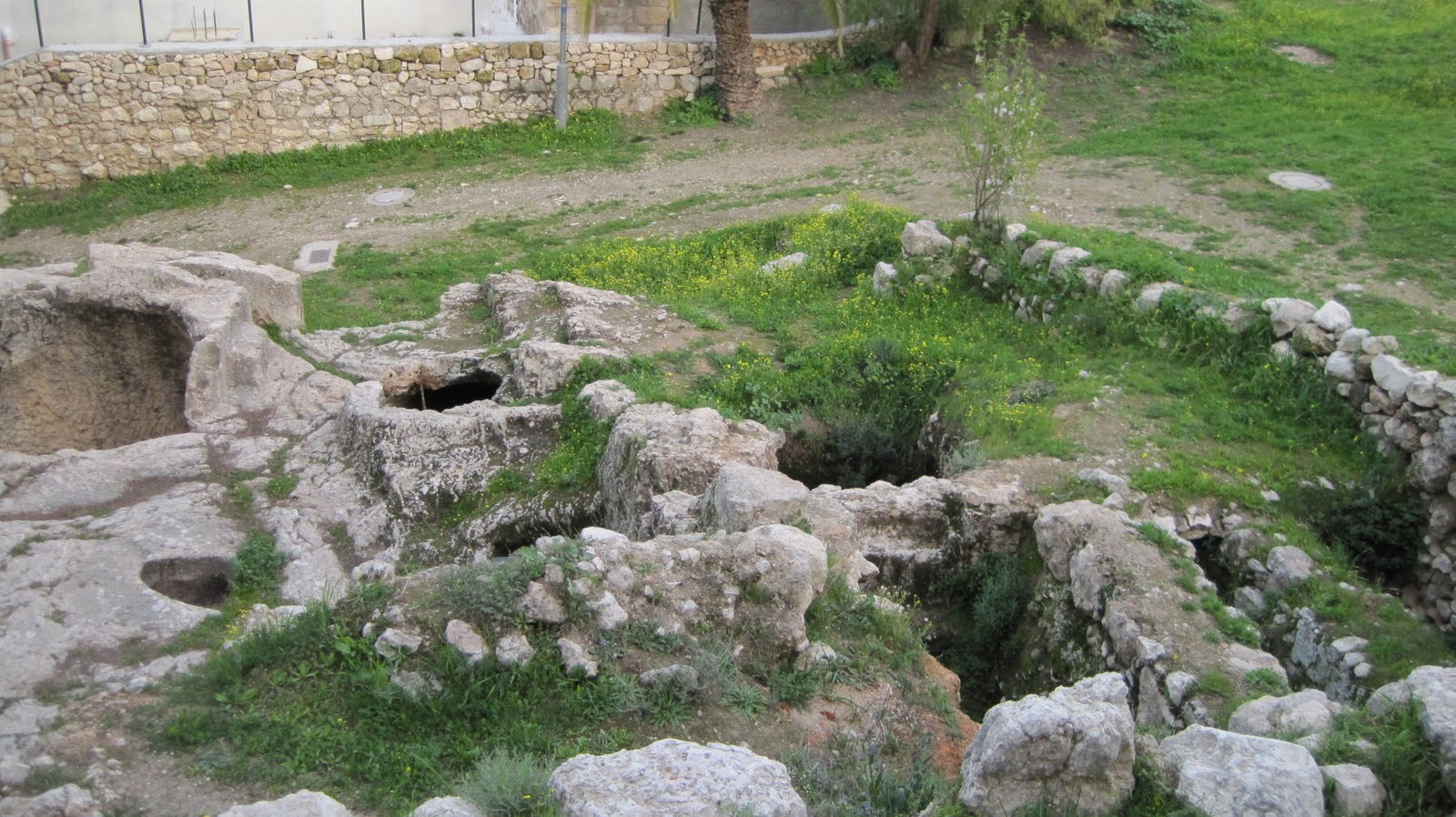
The Ruins of the House of Caiaphas
Jerusalem, Israel, February, 2010

As we come so near to the Cross, let us not grieve yet.  Let us, just for a moment, love as Jesus loves.

Grace and Peace in this holiest of weeks,

Shelli        

Et Tu, Judas

The Judas Tree

Lectionary Text:  John 13: 21-32
After saying this Jesus was troubled in spirit, and declared, “Very truly, I tell you, one of you will betray me.” The disciples looked at one another, uncertain of whom he was speaking. One of his disciples—the one whom Jesus loved—was reclining next to him; Simon Peter therefore motioned to him to ask Jesus of whom he was speaking. So while reclining next to Jesus, he asked him, “Lord, who is it?” Jesus answered, “It is the one to whom I give this piece of bread when I have dipped it in the dish.” So when he had dipped the piece of bread, he gave it to Judas son of Simon Iscariot. After he received the piece of bread, Satan entered into him. Jesus said to him, “Do quickly what you are going to do.” Now no one at the table knew why he said this to him. Some thought that, because Judas had the common purse, Jesus was telling him, “Buy what we need for the festival”; or, that he should give something to the poor. So, after receiving the piece of bread, he immediately went out. And it was night. When he had gone out, Jesus said, “Now the Son of Man has been glorified, and God has been glorified in him. If God has been glorified in him, God will also glorify him in himself and will glorify him at once.

Jesus knew who would betray him.  It was his friend, the one that had accompanied him as he traveled around the lake teaching, the one who had met his family, the one who on those long nights after those just-as-long frustrating days had listened to him.  In fact, it would be the one he trusted.  The one who held the purse that bought them small but nourishing meals and paid their way, the one that had figured out how to budget the money so that they could get to Jerusalem.  It was the one that had it together.  It was the last one that he would have thought would do this.  But Jesus knew who would betray him.  It hurt, hurt more deeply than anyone would ever know.  Et Tu, Judas?  Even you, Judas?

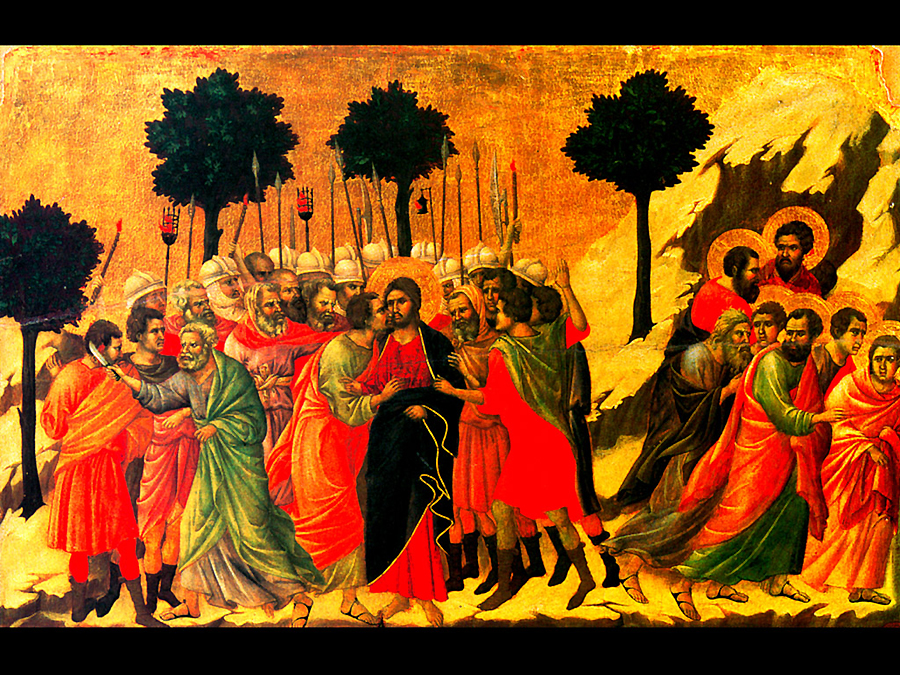
“Kiss of Judas”
Duccio di Buoninsegna (1308)

The others will never figure it out.  They are too busy trying to figure out who it is (and trying to make sure that it’s not them!)  Isn’t that what we do?  In an odd sort of way, this Scripture holds some degree of comfort for us.  After all, Judas is bad, SO bad that whatever it is we mess up can’t possibly be as bad.  And so the world blames Judas for all of our wrongs.  Because, if we make Judas look bad, then maybe we won’t look as bad as we know we might be.  Dante would place him in the fourth level of the ninth rung of hell.  Now let me tell you, that is NOT good.  According to Dante’s Inferno, Judas shares this rung with Brutus and Cassius, who played a part in the murder of Julius Caesar.  (Et Tu, Brute?)  We are no better.  As long as there is a Judas, we
                                                                                        are not the worst.

But, really, do you think God desires our innocence?  If that was the case, we might as well all hang it up right now!  The truth is, none of us is innocent.  Innocence died a really long time ago.  And, interestingly enough, God didn’t have any need to resurrect that.  God does not desire our innocence; God desires us.  God desires repentance, reconciliation, and redemption.  God calls us to turn toward God, be with God, and accept that gift of forgiveness that God offers us.  That’s all it takes.  If God wanted perfect people, I’m thinking God would have made them.  God would have populated the world with a bunch of stepford pod-people and things probably would have gone a lot smoother.  I don’t know…maybe God wanted better dinner conversation.  Maybe God desired a good story.  Or maybe, just maybe, God wanted us to choose God rather than being compelled by something other than ourself.  And so God offers forgiveness for whatever we’ve pulled in the past.  Barbara Brown Taylor, in Speaking of Sin, contends that it is sin that is our only hope.  Because it is when we know that we have failed, when we know that we have moved farther away from God, when we name what it is that stands in our way, that the doors will swing open with a force we never knew and all of a sudden, we find ourselves sitting at the table in a place that we did not think we deserved.  Isn’t God incredible?  So, why do we need to blame Judas?  We are all looking for God.  Sometimes we just make bad choices.  But God always offers us another chance.  Forgiveness is the starting point for change, the beginning of the rest of our eternity.

Madeleine L’Engle tells an old legend that after his death Judas found himself at the bottom of a deep and slimy pit.  For thousands of years he wept his repentance, and when the tears were finally spent he looked up and saw, way, way up, a tiny glimmer of light.  After he had contemplated it for another thousand years or so, he began to try to climb up towards it.  The walls of the pit were dank and slimy, and he kept slipping back down.  Finally, after great effort, he neared the top, and then he slipped and fell all the way back down.  It took him many years to recover, all the time weeping bitter tears of grief and repentance, and then he started to climb again.  After many more falls and efforts and failures he reached the top and dragged himself into an upper room with twelve people seated around a table.  “We’ve been waiting for you, Judas.  We couldn’t begin till you came.”[i]

Et tu, Judas!  Even you, Judas!  Even you!

The path now seems to fly beneath us
And our doubts get carried away
We begin to question if we are more apt
To follow or betray
We hear the story of Judas’ deed
And quickly jump to blame,
But more than that we have to ask
If we might have done the same.

So, in this holiest of weeks, look first at yourself and find those places that separate you from God, and then look to God.  The table is waiting.  We can’t begin till you come!
Grace and Peace in this holiest of weeks,
Shelli

[i] From “Waiting for Judas”, by Madeleine L’Engle, in Bread and Wine:  Readings for Lent and Easter (Maryknoll, NY:  Orbis Books, 2003), 312.


Unless A Grain of Wheat Dies

Lectionary Text:  John 12: 20-36
Now among those who went up to worship at the festival were some Greeks. They came to Philip, who was from Bethsaida in Galilee, and said to him, “Sir, we wish to see Jesus.” Philip went and told Andrew; then Andrew and Philip went and told Jesus. Jesus answered them, “The hour has come for the Son of Man to be glorified. Very truly, I tell you, unless a grain of wheat falls into the earth and dies, it remains just a single grain; but if it dies, it bears much fruit. Those who love their life lose it, and those who hate their life in this world will keep it for eternal life. Whoever serves me must follow me, and where I am, there will my servant be also. Whoever serves me, the Father will honor.  “Now my soul is troubled. And what should I say—‘Father, save me from this hour’? No, it is for this reason that I have come to this hour. Father, glorify your name.” Then a voice came from heaven, “I have glorified it, and I will glorify it again.” The crowd standing there heard it and said that it was thunder. Others said, “An angel has spoken to him.” Jesus answered, “This voice has come for your sake, not for mine. Now is the judgment of this world; now the ruler of this world will be driven out. And I, when I am lifted up from the earth, will draw all people to myself.” He said this to indicate the kind of death he was to die. The crowd answered him, “We have heard from the law that the Messiah remains forever. How can you say that the Son of Man must be lifted up? Who is this Son of Man?” Jesus said to them, “The light is with you for a little longer. Walk while you have the light, so that the darkness may not overtake you. If you walk in the darkness, you do not know where you are going. While you have the light, believe in the light, so that you may become children of light.” After Jesus had said this, he departed and hid from them.

The tide has begun to turn.   The palm branches and spilled perfume have turned to talk about death and we wonder how long we can take it.  We live in a world that tries it best to avoid death, either literally or figuratively.  We instead work to be in total control of our lives and of what happens to us.  And so we push death away.  But here Jesus is saying that it is death the brings life, that relinquinshing control and letting go allows the fruit to grow and prosper.  That is totally backwards from what we have figured out our lives should be.  So what, then, does this all mean?

This passage never really made sense to me until I discovered that wheat is a caryopsis.  This means that the single seed of this plant remains joined with the ovary wall.  Together, they form the grain.  In other words, the seed does not remain a seed but rather dies to self and becomes the grain, a true metamorphosis into new life.  In essence, death and life are interconnected, indeed dependent one upon the other.  So, Jesus was using this as a metaphor for what would happen to him and, ultimately, what would happen to us.  Our death and our life are interconnected.  In this life, we find death.  And then in death, we find new life.  Abraham Heschel said that “eternal life does not grow away from us; it is planted within us growing beyond us.” (Sabbath, p. 74)  So, our life, our eternal life has already begun.  It is already part of us.

So, why is this still difficult for us?   I think that it is because when we start talking about death and crosses and dying to self, we have to face our own self in order to do that.  No longer can we be satisfied with a Sunday-only sort of faith.  No longer can we just talk about it.  Dying to self calls for real change, real reflection.  And perhaps change is more painful than death itself.  The cross is the place where our humanity meets the Divine head-on.  There is no holding back.  There is no hiding away.  There is no waiting for a better time.

But we still want some sort of proof.  We still want to see Jesus.  I’m pretty sure that the reason that we don’t see it has more to do with us than with Jesus.  I have many times been on a bus racing across some country with a group of people trying to see as much as I could see–the Highlands of Scotland, the Alps of Austria, the rolling lands north of Moscow, Russia, or the wilderness desert around the Dead Sea.  Well, you get the idea.  You have your own images.  Oftentimes, rather than just sitting and enjoying the whole panoramic view, I have attempted to take pictures of it.  Well you know that it is a near-fact that if you try to snap a picture from a bus of a panoramic view, you will instead get a tree, or a highway sign, or, my favorite, the side of another bus.  It is not because the picture is not there; it is because you are moving too fast to see the whole thing.  When you move too fast, you don’t have enough space through which to encounter God, through which to see Jesus.


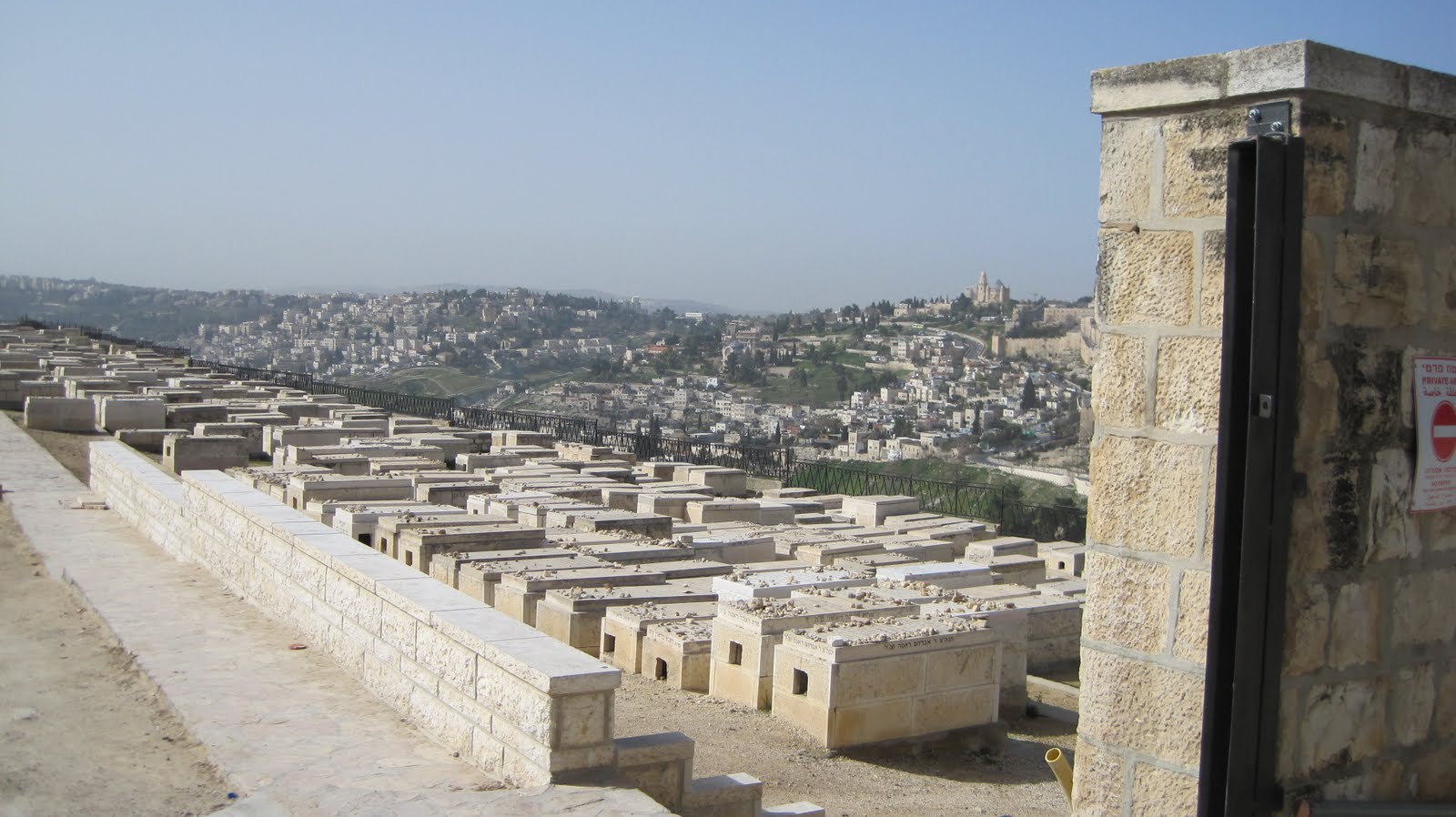
Jewish Cemetery near the
Old City of Jerusalem

 Holy Week provides space, space enough to see the Cross, space enough to see the life that comes from death, space enough to let go, space enough to breathe in what God has given us.  But this will not happen unless we slow down enough to let go of that to which we hold so tightly, let go of those things that you think you cannot live without, let go of those things that you are convinced are necessary for life.  Because you know what?  They’re really not.  Life cannot be unless a grain of what dies. 

Our path has taken us through the city and we are getting nearer and nearer to the Cross.  God never promised that we would not experience loss or pain or grief.  They are part of our human existence.  But at the Cross, there is enough space for the human to encounter the Divine.  At the Cross, a very human death becomes new life as the Divine spills onto the seed of our humanity and becomes life.  At the Cross, we will see Jesus.

And then the tide begins to turn
And talk of death ensues
But not just death for death’s dark sake
But death so life won’t lose.
We hear tales of wheat that when it dies
Leaves no seed behind
For the seed itself has died away
To itself bear fruit sublime

So, in this holiest of weeks, let go of that to which you hold, to that thing that you do not think you can live without.

Grace and Peace,

Shelli