SECOND SUNDAY IN ADVENT: A Child of the Light

On this second Sunday in Advent, we sing the late 20th century hymn by Kathleen Thomerson entitled “I Want to Walk as a Child of the Light”. Most of us like this song.  We like the thought of a warm and illuminating light pervading our very lives.  We want to follow Christ.  We want to be a child of the Light.  But think about it.  Do we really know what we’re signing up to be?

The image of light is prevalent throughout the Scriptures and throughout our understanding of God.  It starts in the beginning with the Creator God pushing back the darkness with the light, filling what was essentially an empty formless void with Illuminating Light.  The Light is in essence the very Presence of God.  This is not to be taken as merely day filling night.  In fact, part of the Creation story is the setting into place that eternal cycle of day and night, work and rest.  They are both essential; they are both of God; they are both part of the Created order.  They are one.

No, this Light of God is different.  It is God’s Presence.  It is Illumination replacing emptiness, void, nothingness, absence.  To say that we want to walk in that Light, to be a part of that Light, is to say that we want to be with God, that we want to be part of God’s continuing Creation that illuminates all there is.  We are saying that we want to live within that Kingdom of God. But do not think that this means that we all of a sudden start basking in this warm, yellow-gold light.  (That’s the sun, not God.)  The Light of God is more pervasive than we can even fathom.  It is white-hot, burning with a tender fire, as it brings everyone and everything into its flame.  The writer of the book we know as Malachi compares it to a refiner’s fire that is so hot that it can change the form of anything it touches.  There is no shelter from this light because the shelter IS the light.  No longer can we cower in the shadows of political or social correctness while pain and injustices continue to exist around us.  No longer can we move freely from one social class to the next like we move from streetlight to streetlight on a dark winter night and nonchalantly leave others behind.  No longer can we exist in a world where only a portion of us stand bathed in artificial light and are accepted or promoted or fed or insured.  We are children of the light.  We are children of a different Way.  We are the ones that are called to expose the shadows of this world and bring the radiance and fullness of God’s Kingdom into being.  In this Season of Advent we are the ones that are called to birth God, the Hope and Joy and Light of all Creation, into the world. 

I want to walk as a child of the Light
I want to follow Jesus
God set the stars to give light to the world
The Star of my life is Jesus.

Refrain:In Him there is no darkness at all
The night and the day are both alike
The lamb is the Light of the city of God
Shine in my heart Lord Jesus.

I want to see the Brightness of God
I want to look at Jesus
Clear Son of righteousness shine on my path
And show me the way to the Father. (Refrain)

I’m looking for the coming of Christ
I want to be with Jesus
When we have run, with patience, the race
We shall know the joy of Jesus. (Refrain)


In this season of Advent, give yourself the gift of walking as a child of the light!  You will never be able to be the same again.

Grace and Peace,

Shelli


ADVENT 2B: The Beginning of the Story

ADVENT 2B Lectionary:  Mark 1: 1-8:

The beginning of the good news of Jesus Christ, the Son of God.  As it is written in the prophet Isaiah, “See, I am sending my messenger ahead of you, who will prepare your way; the voice of one crying out in the wilderness:  ‘Prepare the way of the Lord, make his paths straight,’” John the baptizer appeared in the wilderness, proclaiming a baptism of repentance for the forgiveness of sins. And people from the whole Judean countryside and all the people of Jerusalem were going out to him, and were baptized by him in the river Jordan, confessing their sins. Now John was clothed with camel’s hair, with a leather belt around his waist, and he ate locusts and wild honey. He proclaimed, “The one who is more powerful than I is coming after me; I am not worthy to stoop down and untie the thong of his sandals.I have baptized you with water; but he will baptize you with the Holy Spirit.”

Admit it…John the Baptist scares us a little bit–a wilderness man, a wild evangelist, wearing a suit of camel’s hair and making a meal of locusts and honey.  Really?  Why couldn’t the messenger have been someone a little more traditional, someone a little more easier to be around?  But, then again, have you ever known God to stay within the boundaries that we’ve drawn?  Maybe that’s the whole point.  I mean, here is a messenger, paving the path, preparing the way for the coming of the Lord.  No Mary and Joseph, no baby, no stable, no shepherds, no magi, no angels…just…boom…the One is coming that will baptize you with the Spirit of God…the One is coming who will change your life and change your ways and change the world from what we know it to be…the One is coming who will bring us all into the Reign of God.  Hold on…get ready!

The writer of Mark’s Gospel leaves us suspended in time, waiting, rather than living through the whole story together.  Many spiritual writers call that a state of liminality, a point of being betwixt and between, the moment between what is and what will be, a place in which the old world is left behind but we’re not sure what the new one looks like just yet.  It is a point between two times that intersect and become one.  So, are you ready? Well, if you’re not, you need to get that way.  Because in this Gospel, the good news has already begun, whether we’re prepared or not.

Throughout this version of the Gospel, there is a sense of urgency, a sort of abruptness, that somehow compels us to get on board with it, to not tarry with things that do not matter and do not prepare us for the coming. The writer of Mark cuts to the chase:  humanity has waited and prepared itself for this for centuries.  We are reminded of that as the passage pulls in the words of Isaiah, the foretelling of that time when God would come and be among us, when God would come and save us.  Now is the time.  The Christmas celebration for all its splendor and all its beauty and all its twinkling lights is first and foremost the fulfillment of God’s promise of salvation.  This IS the beginning of the good news of Jesus Christ, the Son of God.  This IS the beginning of our story.

But there is another implication here.  In this Advent season, as we wait with expectant hope, we are also reminded that our expectations are limited by our own lives.  God has so much more in store that what we could ever fathom.  Maybe that’s why the writer of Mark quickly takes us to the wilderness and wilds of our lives (and to the bizarre wilderness man!).  You see, God will not be plunked down in the middle of the bustling city of Jerusalem.  God will not come in the way that we plan or imagine how God will come.  Rather, God will emerge in the wilderness of our lives and we will realize that God has been there all along.  We do not have to go to Jerusalem or prepare a grand entry to encounter God.  God comes to us.  We just have to be open to whatever God’s coming is.  And we have to be willing to enter a new beginning.  What we are living is not the prelude; it’s the beginning of the story.

In this season of Advent, give yourself the gift of the wilderness–those wild and untamed places in your lives where you might just experience the coming of God anew.  In other words, all this planning and preparation…forget about it!  Just open yourself to the coming of Christ!

Grace and Peace,

Shelli

How Can This Be?

We are told over and over in the Scriptures “do not be afraid” or “be not afraid” or “do not fear”.  Well, in my humble experience of the Bible, it strike me that when God or an angel or some other instrument uses these words, one should be extremely concerned!  After all, God is preparing you for something really big.  The world as you know it will start shaking and quaking and the foundation that you’ve so carefully built for yourself will become mere quicksand.  Nothing will ever be the same again.

But of all the “be not afraids” in the Bible, surely the one to a young Galilean girl at the beginning of what we now call the “first century” takes the cake!  “Excuse Me, Mary, I have something for you to do.  I’d like you to give birth to a son even though you haven’t married Joseph yet and even though none of your family or your friends or your community will understand it and even though the world will struggle with this birth so much that it will initially not end well, and, oh yeah, there’s one other small little detail…you will be essentially birthing the salvation of the world!  But, do not be afraid!  So, let me know what you think!”  I think Mary’s initial response (as its translated in our Scriptures) is one of the most profound phrases ever:  “How can this be?” It is the question of faith.  Because, you see, it CAN’T be–not without God and, interestingly enough, not EVEN without Mary.

But in Mary’s defense, she had other preconceptions working against her. (Oh…so we’re not the only ones with that problem!)   There is a folktale that is told in the Book of Tobit (you’ll find it in the Apocrypha) that tells of a jealous angel who would appear on a bride’s wedding night each time she married and killed her bridegroom.  This story, of course, was probably part of the culture in which Mary lived.  So, don’t be afraid?  Good grief…she was terrified!  But she listens to the reassurance that she is given and take it “under advisement”.

And then God waits…(boy, God’s good at waiting–maybe THAT’S part of the lesson!)…God waits patiently for Mary to respond.  The world hangs suspended if only for a time, its very salvation teetering on the brink of its demise.  Oh, sure, if Mary said no, God could have gone to someone else.  God could have found SOMEONE to birth the salvation of the world.  But it wouldn’t have been the same.  After all, the Divine did not just plunk a far-removed piece of the Godself into a womb.  Our understanding is that, yes, the Christ was fully Divine; but Jesus was “born of a woman”, fully human and, as a human, Jesus carried Mary’s unique and specific DNA with him.  Mary was not just a container through which God came into this little world.  Mary’s DNA, Mary’s response, Mary’s “how can this be?”, Mary’s “yes” is all through the salvation of the world.

So, how can this be?  I do believe in the omnipotence of God.  But I also believe that God, in God’s infinite wisdom, chose to give up part of that power.  It’s called free will.  God gave a piece of the Godself to each of us that we might choose to respond in faith.  How can this be?  Certainly not without God and not even without us.  Our faith journey is a partnership with God, a dance between the human and the Divine.  And so God waits…How can this be?…Only if you respond.  Remember, Mary said “yes” and the Divine began to spill in to the womb of the world.  Salvation began. 

In this season of Advent, give yourself the gift of responding to the God that calls you to birth part of the earth’s salvation.  How can this be?  I don’t know…it’s your calling!  What is your response?

Grace and Peace,

Shelli

ADVENT 2B: As If


The Burning Bush, Nicholas Froment, ca. 1476

ADVENT 2B:  Lectionary:  2 Peter 3: (8-10) 11-15a
Since all these things are to be dissolved in this way, what sort of persons ought you to be in leading lives of holiness and godliness,waiting for and hastening the coming of the day of God, because of which the heavens will be set ablaze and dissolved, and the elements will melt with fire? But, in accordance with his promise, we wait for new heavens and a new earth, where righteousness is at home.Therefore, beloved, while you are waiting for these things, strive to be found by him at peace, without spot or blemish;and regard the patience of our Lord as salvation.

God will come when God will come.  We’ve heard that over and over. But, granted, this life of faith is difficult.  How do you keep holding on to a hope when you often see no progress at all?  How can we continue to be forced to wait for whatever it is for which we’re waiting?  Because, as the passage says, we are promised a new heaven and a new earth.  We are promised that all of Creation will be recreated.  We are promised that, once and for all, righteousness will have a home.  Righteousness, then, will be the norm.  Righteousness will be an everyday thing.

And in this Season of Advent, we learn to wait.  Good things cannot be rushed.  The plan for God’s Kingdom was not made hastily and it cannot be just thrown together because we are getting a bit impatient with the whole ordeal.  So, what do we do in the meantime?  We live as if it’s here.  We live righteousness.  We give it a home.  The Holy and the Sacred is not unattainable.  In fact, if we just open our eyes, it is spilling into our lives even as we speak.  God does not sit back and watch us squirm and strain until all is said and done.  Rather, God gives us glimpse after glimpse and incarnation after incarnation and waits with infinite patience for us to respond. Look around…there are more burning bushes and parted seas than we can ever possibly imagine.  As the writer of the Epistle passage that we read this week maintains, it is that Holy Patience, that Waiting God in which we find our salvation.  And so if we live as if the Holy and the Sacred has completely filled our lives, righteousness will indeed have a home and we will no longer be waiting for salvation.

In this season of Advent, give yourself the gift of living as if righteousness and peace and the fullness of God is all you know.

Grace and Peace,

Shelli


Announcing the Beginning

The Anunciation
Icon at St. Catherine’s Monastery

Christmas is coming!  We live this Season of Advent as if its purpose is to point to the beginning (or the “re-beginning”).   We prepare for the coming of God!  But think about it.  Something happened nine months before.  This human Jesus, like all of us, had to be grown and nurtured in the womb before the miracles started.  March 25th—The Feast of the Annunciation—is for some traditions the turning point of human history.  It is in this moment that God steps through the fog into humanity and, just like every human that came before, must wait to be fully birthed into this world.

We Protestants sort of skip over the Anunciation.  And then we start with Christmas and count back nine months.  After all, it’s just a bunch of waiting, right?  OK, that works.  Nine months before Christmas…But March 25th is traditionally regarded as the first day of Creation. (Now, really, I don’t even BEGIN to say that THAT is a real date!  But, it’s as good as any, right?)  So, let’s go with it.  March 25th is the beginning.  The Anunciation…the announcement of the coming of Christ, the coming of God, into our little world…IS the first day of Creation. (You know, “In the beginning was the Word and the Word was…”)  So, begin at the beginning and count forward…to the birth of God into the world. Like Creation, the coming of Christ was the Light pushing the darkness away.

But the world, like any expectant parent, had to wait.  Advent teaches us to wait.  Advent teaches us that birth does not appear in a flash.  Rather, birth, like all things that matter, is a process.  And, it is definitely worth the wait. 

God will come when God will come.  But we don’t want to miss the process of the birth.

In this season of Advent, give yourself the gift of being a part of the process of birthing the world into being.  But part of it means that you have to wait until it’s ready to be.

Grace and Peace,

Shelli

ADVENT 2B: Something Incredible is About to Happen

ADVENT 2B: Lectionary: Isaiah 40: 1-5 (6-11)
Comfort, O comfort my people, says your God. Speak tenderly to Jerusalem, and cry to her that she has served her term, that her penalty is paid, that she has received from the Lord’s hand double for all her sins.  A voice cries out: “In the wilderness prepare the way of the Lord, make straight in the desert a highway for our God. Every valley shall be lifted up, and every mountain and hill be made low; the uneven ground shall become level, and the rough places a plain. Then the glory of the Lord shall be revealed, and all people shall see it together, for the mouth of the Lord has spoken.”

First of all, with all due respect to Mr. Handel’s presentation, this passage was probably not originally written with us or our tradition in mind!  This really is talking about the people of Israel.  It really is talking about bringing comfort to a people who have wandered in the Judean wilderness.  Probably written toward the end of the Babylonian exile, this writing offers a vision where a highway (a REAL highway) through the wilderness will be made level and straight.  If, as most assume, this part of the book that we know as Isaiah was written after the exile, it would have been soon after 539 BCE when Cyrus of Persia conquered the Babylonians and, not really caring whether or not the Israelites stayed, allowed them to return to Jerusalem.  So imagine a highway that, typical of the ancient world, would have originally been built to accommodate royal processions.  And so God is depicting a highway made for a grand procession led by the Almighty.

The just-released exiles are returning.  But to what?  Their city and their way of life lay in ruins.  They can’t just go back and pick up where they left off.  They have to feel that God has deserted them.  They are looking for comfort.  They are looking for solace.  They are looking for God to put things back the way they were before.  But God has something different in mind.  Rather than repair, God promises recreation; rather than vindication, God promises redemption; and rather than solace, God promises transformation.  God is making something new–lifting valleys, lowering mountains, and ultimately, when all is said and done, revealing a glory that we’ve never seen before.

In this Advent season, we are given the same vision.  We are not promised solace.  We are not promised that Emmanuel, God With Us, is coming to put our lives back together.  In fact, can you feel it?  The world has begun to shake.  The valleys are rising; the mountains are leveling.  Something incredible is about to happen.  The light is just beginning to dawn.  Life as we know it will never be the same again.   Soon the fog will lift and we will see that the road does not lead back.  It instead leads us home.  But we’re going to have to be willing to leave what we know.

In this season of Advent, give yourself the gift of not going back so that God can show you the Glory that is about to be revealed.

Grace and Peace,

Shelli

Following Mystery

16th century English poet and priest, John Donne said that “to love God is to follow the mystery, to be led by its showing and withdrawing.”  So, what does that mean…to follow the mystery?  We live in a world where truth is defined as a collection of knowledge, as the accumulation of things known, of things proven.  We do not do well with mystery.  We attempt to conquer it, rather than follow it.  We pray that God will somehow swoop in and finally clear all of this chaos up for us once and for all.  We pray that God will give us understanding and easy roads.  We pray for enlightenment.  We pursue certainty.  We try to figure it all out.  And then Advent comes…

Behold!  Hear this!  Keep awake!  Be not afraid!  You see, things are about to change.  The world as you know it is about to be shaken to its core or, at least, to its senses.  All of those things that you have placed around you in at attempt to control your life will mean nothing.  All of those expectations that you have wrapped around yourself in an effort to prepare for the future are probably keeping your hands from doing what they are meant to do.  And as hard as it is for this “Type A” personality to admit, it is not our job to conquer the chaos of the world by organizing it into something that makes sense to us; rather, we are called to follow the Divine Mystery as it illuminates everything around us.  We are called to open our eyes to see what God is showing us.

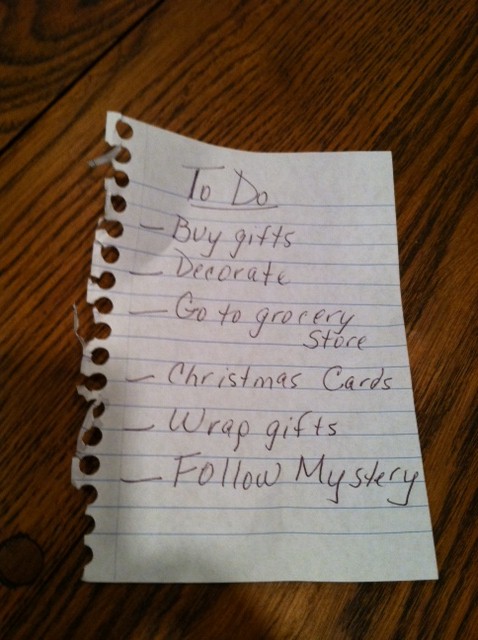
Don’t get me wrong.  I love preparing for Christmas.  I love buying and wrapping gifts.  I love Christmas trees and lights.  I love baking and giving what I’ve baked away.  And all of those things are on my “to do” list.  But Advent is about mystery.  It is about being open to the revealing of the One whom we cannot define or control.  It is about being open to the possibility that God will enter this seemingly God-forsaken world not with loud, thrashing pronouncements so that we are certain that’s who it is, but more like a whisper in the quiet of the night in a small town and an unkempt grotto in the midst of the chaotic reality of this world.  Advent is about letting go of certainty and following the mystery.

In this season of Advent, give yourself the gift of not needing to be certain, of not needing to have everything planned.  Give yourself the gift of being open to the mystery that enters your life.

Grace and Peace,

Shelli