The Days are Surely Coming

“The days are surely coming…No longer shall they teach one another , or say to each other, ‘Know the Lord,’ for they shall all know me, from the least of them to the greatest, says the Lord; for I will forgive their iniquity, and remember their sin no more.” (Jeremiah 31: 27..34)

The Old Testament scripture from today’s Lectionary’s text paints a vision for which we all look. It is the vision of that time when the covenant “written on the people’s hearts” will finally be fulfilled. As Christians, it is hard for us to not read this Scripture through our own lens. But remember the setting in which this was probably written: It is the time following the exile. The cities have been breached; the temple has been totally destroyed; there is nothing left of the lives that were before. The people who first heard this had become subjects of the Persian king and life as they knew it has been ripped away at its very foundations. But through the prophet Jeremiah, God unveils a vision of reconstruction and renewal. But this time, things will be different…

This time things will be different…How many times have you heard that in your own life? THIS time I won’t eat so much; THIS time I won’t get so upset; THIS time I won’t let myself get into this mess; THIS time I’ll do it right. This time things will be different…But THIS time God is not giving us a set of rules. God is not telling us what to do or when to do it. God instead promises a renewed covenant, a transformation from what was to what will be. And this time things WILL be different…

By writing it in our hearts, God has written Godself into us, renewing that image of the Godself buried deep within our beings. God is making who God is part of our very essence. It is permanent. God has written the capacity for immense love and unending faithfulness into us. And someday…someday…we’ll realize what that means. And this time things WILL be different…

We have spent the last few weeks wandering in our own wildernesses. And today, the road changes. The wilderness seems to be not so evident, as if a sort of organized earthly sprawl is creeping into it. There are more houses than we remember seeing before, more signs of people going about their lives, better pavement on the roads. We must be nearing the city. Jerusalem is just over the horizon. We are not yet there, but we sense that change is in the air. There is a sort of excitement. People are beginning to gather. And somewhere over the hill, there’s a faint cadence of drums and some sort of hammering in the distance. It is hard to understand what it all means. But we, with the Godself written into our being and the promise of a new life deep within our hearts, will walk on…toward Jerusalem. And God walks with us…

So go forth toward the city. There is no way around!

Grace and Peace,

Shelli

Wilderness Wanderings

This week’s lectionary Gospel passage is the Markan account of Jesus’ Baptism, followed by his 40-day time in the wilderness as he prepared for his ministry. Now for most of us, conjuring up images of a wilderness takes some thought as we sit in the midst of skyscrapers, paved roads, and fenced lawns. So we try to imagine thick, wooded landscapes with hanging vines obstructing our way and our view. But, think about it, the wilderness that Jesus knew was probably desert–unobstructed, yes, but with nothing to mark your way, nothing to “hang on to” when you felt like you were getting lost. And what about the pathway? Rather than being merely difficult to tread, it was changing all the time, as the winds and sands continually blew over it, marring its very existence. And then…the temptations…so much more evident in the wilderness–the temptation to take control, the temptation to take the easy way out, the temptation to turn back. So, why in the world would Jesus spend time in this seemingly God-forsaken wilderness?

Jesus, rather than depriving himself, was emptying himself. Without paved pathways and landscapes marking our way, we are vulnerable. And it is when we are the most vulnerable that we realize that we need God. When the temptations are staring us in the face, we need God more than ever. And that is also when we realize that the wilderness is far from being God-forsaken. God is always there but, finally, the fact that we are empty makes us acutely aware of God’s Presence in a way that we’ve never known. In fact, the wilderness is God-bearing and by emptying ourselves, by entering the wilderness, we finally make room to become God-bearing too.

Several years ago, I had the opportunity to visit Hampton Court, near London, which probably has some of the most beautiful gardens in the world. As we walked through the gardens, we were struck by row upon row of colorful blooms—a horticulturist’s dream. There were roses and camellias and daffodils of all sizes and colors and just the fact that they were all so perfect was utterly amazing. The beauty of Creation was at its most picturesque. As we walked through the gardens, there was one area that looked extremely odd among the perfectly manicured plats. It looked forgotten and overgrown, full of weeds and not a flower in sight. It reminded me of those “open for adoption” litter signs where you know that the next mile or so will be littered with trash as a symptom of the “forgotten child”. I thought it was very odd in this plethora of perfection to see something so forgotten, so fallow, and so hopeless. There was even a chain across the entrance barring any more investigation. Someone, I thought, ought to take control here and do something! But as I was about to leave, I noticed a sign. According to the sign, in order for these gardens to bloom throughout the season with continual colors, there is a system of “rolling fallow”—a crop rotation of sorts. This wilderness-looking area was just that—a fallow, resting wilderness—an intentional wilderness in order that it might be nurtured and fed. It was not dead—it was allowing God to work on it.

Maybe that’s what we’re called to do in this season of Lent–to create an intentional wilderness, a place stripped of those things on which we rely, a place where we become the most vulnerable, a place where we have no control, a place where we can meet God, a place where, finally, we can become a God-bearer. Maybe Lent is the time when we finally let go and allow God to work on us that we might burst forth on Easter morning in radiant bloom.

So go forth this season into the wilderness that you might finally be prepared to know God!

Grace and Peace,

Shelli

Threshold

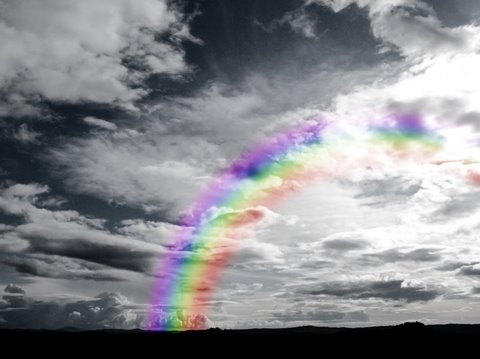
In this Sunday’s Lectionary readings, the passage from the Hebrew Scriptures is the end of the account of Noah and The Great Flood. Noah and his family have listened to God, built the ark, and have now been cooped up for months as the torrential waters pounded against the wood of their somewhat tenuous residence, drowning the very earth and all the foundations that they knew. Noah sends a bird out to “test the waters”. The bird returns. After several attempts, the bird finally does not return. The land is ready; the waters have receded and the earth has reappeared. And there–there in the sky is a splash of color, a bow in the clouds, the sign of God’s promise that Creation will never again be separated from its Creator.

The Celts understood the rainbow as a bridge, a threshold between what is and what will be. It is, in Celtic terms, a “thin place”, as the thin gaseous vapors form a sort of bridge in the clouds between one way of being and the next. This is the bridge to promise and discovery; this is the bridge to life. Hey….maybe there really is a pot of gold at the end!

This is a perfect passage for Lent. We are indeed in a threshold season, a season between one world and the next, between death and eternity, between who we are and what we will be. Lent is not a season where we withdraw, pulling ourselves away from our lives and the world. For some of us, we think we need to do that, giving up things that are part of our lives to remind us of our connection to God. Don’t get me wrong. Lent is a contemplative and retrospective season, a season when we take a good hard look at our lives, at their failings and misgivings, at the ways that we have been complicit in the continued crucifixion of goodness and grace and love. But the retrospection is not to fill us with remorse or regret; it is to propel us forward through the threshold. It is to open to our eyes to the thin places, where the colors come alive and the way is clear.

The rainbow, the promise of hope, is, in physical terms, a reflection. It is a mirror of what surrounds it. And in that mirror, in that threshold, we see ourselves–our life, our death, and, our glorious resurrection. Because, after all, that IS the pot of gold at the end of the rainbow!

So go forth this season and seek the threshold–do not be afraid–it is filled with hope and promise like nothing you’ve ever known!

Grace and Peace,

Shelli

Ash Wednesday

Lent, which, literally, means “springtime” is a time of nurturing and preparation. And, like springtime, it is also a time of growth and renewal, a re-greening and bringing back to life of our winter-worn souls. Our forty days of Lent are reminiscent of the forty trying days that Jesus spent in the dry and secluded wilderness as he readied himself for his ministry. In the same way, this is a preparation time for us as we begin that walk toward the cross and into a deeper walk with God.

Joan Chittister says that “Lent is not an event. It is not something that happens to us. It is at most a microcosm of what turns out to be a lifelong journey to the center of the self. The purpose of Lent is to confront us with ourselves in a way that’s conscious and purposeful, that enables us to deal with the rest of life well.” She calls it a “growing season”, rather than a “penitential season”. We are not called to wallow in guilt during this time; we are not necessarily called to deprive ourselves of things we need; we are called to begin to look at things differently.

So on this Ash Wednesday, as we begin this journey, we are called to repentance, to a turning around, to change. People often look upon this day with fear and trembling. It is not meant to be that way. But it is a day that forces us to look at ourselves and our own lives and, perhaps for some of us, that can be a little uncomfortable. Think of it, though, as a threshold that begins a journey into new life, a window to a new way of seeing, and a doorway to a new way of being. It is a time for clearing, a time for preparing the ground for planting; it is a time for breathing out, letting out all the things that stand in the way of your relationship with God, thereby making way to breathe in what God offers. It is the day when we say “here I am, God, just as I am. But I am ready. I am ready to change! I am ready to be renewed and made whole.” And it is the day when we finally admit that we cannot do it alone and that somewhere in the fallow of our lives, God comes in and we are made whole.

So Ash Wednesday is not just a day of morose belittling of ourselves. A rabbi once told his disciples, “Everyone must have two pockets, with a note in each pocket, so that he or she can reach into the one or the other, depending on their needs. When feeling high and mighty one should reach into the left pocket, and find the words: “Ani eifer v’afar; I am dust and ashes. But when feeling lowly and depressed, discouraged or without hope, one should reach into the right pocket, and, there, find the words: “Bishvili nivra ha’olam…For my sake the world was created.”
Lent is not about giving things up; it is about emptying your life that you may be filled. Lent is not about going without; it is about making room for what God has to offer. And this beginning of Lent is not about clothing yourself in the morbidness of your humanity; it is about embracing who you are before God.

So go toward the Cross and embrace the you that God is breathing in!

Grace and Peace,

Shelli

Transfigured

Today is Transfiguration Sunday, the Sunday when we read of Elijah being taken up to heaven in a whirlwind and the Gospel passage that depicts the Transfiguration of Jesus on the mountain top. Both of these sometimes seem to be sort of fantastical, hard-to-believe images. I mean, after all, the whirlwind, the chariot, bright lights, descending clouds, and, of course, Old Testament heroes and prophets reappearing. But, you know, anything can happen on that mountain. After all, it is on the mountain that we can see beyond ourselves; it is on the mountain that everything is illumined in all directions; and it is on the mountain that God appears to us.
We don’t really know if there was a real “mountain” or not. (In all truth, the literal topography just doesn’t seem to work!) For me, a metaphorical one works just as nicely. It is that place where God appears to me. Some people claim to have had one stand-out, quintessential experience that turned their whole life toward God. For me, I have had a series of mountain-top and near-mountain-top experiences throughout my life. None stand out as “the one”, but each one in its own way has redirected me toward God, toward the cross, and has indeed changed my life.
I think that is the reason that we read of this Transfiguration right before Lent. It is our redirecting, our refocusing, if you will, from our ordinary everyday lives toward the Lenten journey–the journey to the cross. In many ways, the Transfiguration is the climax of the human experience of Jesus–the mountain-top experience. And then Jesus tells the disciples to keep what happened to themselves, if only for now. And then the lights dim. There are no chariots, Moses and Elijah are gone, and, if only for awhile, God seems to be silent. And it is in that silence that Jesus walks down the mountain toward Jerusalem. And he asks us to follow. And we can–because now we see the way to go. Because we have truly been changed!
So go forth from the mountain and begin your journey to the cross!
Grace and Peace,
Shelli

Change

We have heards lots of talk about change lately. We have heard lots of calls to change. And we have been presented with reasons why we have no choice other than to change. But, as we all know, change does not come easy. It is fraught with the unknown, a perilous journey through the wilderness. It is filled with choices and decisions. And, probably the most uncomfortable thing of all, it means that there is no return. There is no going back once the wheels of change have begun.

Isn’t that what we’re all about, though? Isn’t that what our faith journey means? God does not call us to stand still, feet planted, ignoring the winds that are blowing around us. If that were the case, don’t you think the world would be a bit more stable? But, really, who of us live a life that has not changed over the past year, perhaps even over the last three months? For that matter, who of us lives the same life that we did yesterday? No, God calls us to walk this walk through change and, for that matter, to be a part of the change itself. If that were not the case, the Gospels would not be full of things like fishermen being asked to give up their careers and their lifestyles, magi taking a different road than what they had planned, and the very heavens being torn apart.

We are called to change. Not only that, we are called to be part of making that change happen. God did not create the world and then put out a call for its preservation. Instead, God is continually turning darkness into light and death into life. And throughout it all, waters are divided, the heavens are torn apart and curtains separating worlds are ripped apart if for no other reason that that we can get a glimpse of the way things are supposed to be. So, we are a people of change–called to change ourselves, our lives, and the whole of Creation in which we live.

It is not easy. It is not comfortable. But, after all, that is not what we were promised! We were not promised that our lives would be preserved; we were promised that they would be transformed. But transformation must happen from the inside out. When we become the change, the change will happen.

Only those who live beyond themselves ever become fully themselves. (Joan Chittister)

So go forth and be the change!

Grace and Peace,
Shelli

Do You Have God in Your DNA?

There’s a church that I pass most mornings in my neighborhood (unless I go a different way so I can buy coffee!) that has one of those ever-changing metallic letter boards with messages or sermon titles or just passing whimsies–I’m not sure which. This week the message is this: Do You Have God in Your DNA? Now often the messages on this board strike me as a little trite or unrefined, but I think this week’s poses an interesting question. After all, as humans, we associate DNA with the very basis of our individuality, our makeup, the thing that makes us who we are. Now I don’t really think that God has “DNA”, per se, but what would it mean for God to impart divine individuality or eternal order and makeup into who we are. Well, of course, God has. After all, we are “made in God’s image”. God has made us who we are and who we will be and breathed a part of the Godself into us.

So what does it mean to make one in your image? I think it means to imagine what they will be, to impart a piece of your own self into them (much like an artist or a composer putting all that they know and all that they have and all that they are into a masterwork). I think that’s what God has done in creating each of us–imparted a piece of the Godself, a piece of the Divine into us, a DNA, if you will, that is not of this existence, but of one to come. God did not create us and then leave us to our own devices. We are not inventions engineered to certain specifications. We are, rather, artistic and musical renderings that are affected by time and space and the definitive input of those who cross our path, those who play us or repaint us or just enjoy the fact that we’re here. But somewhere deep within our being is a part of God, an image that is not our Creation, an order that is not our doing, and an individuality that we share only with the One who breathed us into being.

So go forth and be the image buried deep within your DNA…

Grace and Peace,
Shelli